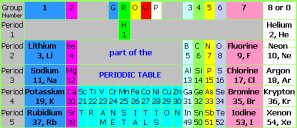
 Which is a Noble Gas? [gp0-1]
- helium
- chlorine
- nitrogen
- oxygen
- Which is a Noble Gas [gp0-2]
- fluorine
- neon
- ammonia
- ozone
- Which is a Noble Gas [gp0-3]
- nitrogen
- chlorine
- argon
- oxygen
 Which is an electron arrangement of a Noble Gas? [gp0-4]
- 2.8.1
- 2.8.7
- 2.8.8.2
- 2
- Which is an electron arrangement of a Noble Gas? [gp0-5]
- 2.8
- 2.8.7
- 2.8.8.2
- 2.8.18.2
- Which is an electron arrangement of a Noble Gas? [gp0-6]
- 2.8.2
- 2.8.8
- 2.8.18.7
- 2.1


Which statement is TRUE about the Noble Gases? [gp0-7]- they readily react with chlorine
- down the group the colour of the gas gets darker
- they are poor conductors of heat
- they are good conductors of electricity
-
Which statement is TRUE about the Noble Gases? [gp0-8]- they readily react with chlorine
- down the group the colour of the gas gets darker
- they are good conductors of heat
- they are poor conductors of electricity
-
Which statement is TRUE about the Noble Gases? [gp0-9]- they are very unreactive gases
- down the group the colour of the gas gets darker
- they are good conductors of heat
- they are good conductors of electricity
-
Which statement is TRUE about the Noble Gases? [gp0-10]- they readily burn in oxygen
- they are all colourless gases
- they are good conductors of heat
- they are good conductors of electricity
- Which Noble Gas is used in filament bulbs to stop the filament burning out too quickly? [gp0-11]
- neon
- helium
- argon
- krypton
- Which Noble Gas is used in balloons? [gp0-12]
- argon
- krypton
- neon
- helium
- Which gas is used in electrical discharge lights? [gp0-13]
- neon
- helium
- nitrogen
- oxygen
 Which gas is used in laser beams? [gp0-14]
- nitrogen
- krypton
- helium
- oxygen
 Which gas has been replaced by safer helium in airships? [gp0-15]
- carbon dioxide
- nitrogen
- hydrogen
- oxygen
 Which gas is used to provide a non-oxidising atmosphere in welding operations? [gp0-16]
- neon
- helium
- carbon dioxide
- argon
- Which statement explains the lack of chemical reactivity by Noble Gases? [gp0-17]
- they have a stable full outer shell of electrons
- it is impossible to ionize the gases because too much energy is required
- they form very stable molecules of two combined atoms
- the lower energy, inner full shells of electrons cannot be used in chemical bonding
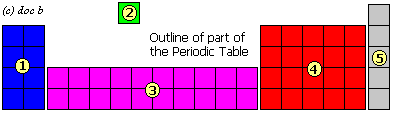 In which section of the Periodic Table will you find the Noble Gases? [gp0-18]
- section (1)
- section (5)
- section (3)
- section (4)
- section (2)
- The Noble Gases consist of? [gp0-19]
- diatomic molecules
- triatomic molecules
- single free atoms
- atoms linked by weak bonds
- Which reason best accounts for the use of helium in modern airships? [gp0-20]
- lighter than air and cheap to produce
- expensive, but easy to store in cylinders
- expensive, but a very unreactive gas
- less dense than air and not flammable
- Which statement is TRUE about the trend, with increasing atomic number, down the Group of Noble Gases? [gp0-21]
- the boiling points increase
- the melting points decrease
- the density decreases
- the reactivity decreases
- Which statement is TRUE about the trend, with increasing atomic number, down the Group of Noble Gases? [gp0-22]
- the boiling points decrease
- the melting points increase
- the density decreases
- the reactivity decreases
- Which statement is TRUE about the Group of Noble Gases? [gp0-23]
- they are all dense gases
- they are lightly coloured gases
- they have low melting points and boiling points
- they will all burn in pure oxygen
- In 1962 a Canadian chemist, Bartlet, managed to combine xenon with the highly reactive Halogen gas fluorine to make xenon tetrafluoride. Which equation is correct in making xenon tetrafluoride? [gp0-24]
- Xe2 + 2F2 ==> XeF4
- 2Xe + 4F ==> 2XeF4
- Xe2 + 8F2 ==> 2XeF4
- Xe + 2F2 ==> XeF4
-
Which is TRUE about the 'Noble Gases'? [gp0-25]- they are very unreactive
- they have a great tendency to share or gain electrons to form a chemical bond
- argon is used in welding to keep the surrounding metal cool
- argon is used in lamps to make the metal filament a better conductor
-
Which is TRUE about the 'Noble Gases'? [gp0-26]- they are very reactive
- they have little tendency to share or gain electrons to form a chemical bond
- argon is used in welding to keep the surrounding metal cool
- argon is used in lamps to make the metal filament a better conductor
-
Which is TRUE about the 'Noble Gases'? [gp0-27]- they are very reactive
- they have a great tendency to share or gain electrons to form a chemical bond
- argon is used in welding to stop oxidation of the metal
- argon is used in lamps to make the metal filament a better conductor
-
Which is TRUE about the 'Noble Gases'? [gp0-28]- they are very reactive
- they have a great tendency to share or gain electrons to form a chemical bond
- argon is used in welding to keep the surrounding metal cool
- argon is used in lamps to stop the metal filament from being oxidised
- Which is an electron arrangement of a Noble Gas? [gp0-29]
- 2.8.18.8
- 2.8.4
- 2.8.8.2
- 2.8.18.2