
Which statement is TRUE about the modern PERIODIC TABLE? [pt-14]- the elements are laid out in order of atomic number
- elements in the same group have an increasing number of electrons in the outer shell with increase in atomic number down the group
- from left to right, elements in the same period, use an increasing number of electron shells (energy levels)
- most elements are non-metals
Which statement is TRUE about the modern PERIODIC TABLE? [pt-15]- the elements are laid out in order of relative atomic mass
- elements in the same group have the same number of electrons in the outer shell or energy level
- from left to right, elements in the same period, use an increasing number of electron shells (energy levels)
- most elements are non-metals
Which statement is TRUE about the modern PERIODIC TABLE? [pt-16]- the elements are laid out in order of relative atomic mass
- elements in the same group have an increasing number of electrons in the outer shell with increase in atomic number down the group
- elements in the same period use the same number of shells (energy levels)
- most elements are non-metals
Which statement is TRUE about the modern PERIODIC TABLE? [pt-17]- the elements are laid out in order of relative atomic mass
- elements in the same group have an increasing number of electrons in the outer shell with increase in atomic number down the group
- from left to right, elements in the same period, use an increasing number of electron shells (energy levels)
- most elements are metals
Which statement is TRUE about the modern PERIODIC TABLE? [pt-18]- the elements are laid out in order of number of neutrons
- elements in the same group have an increasing number of electrons in the outer shell with increase in atomic number down the group
- from left to right, elements in the same period, use an increasing number of electron shells (energy levels)
- the elements were originally laid out in order of atomic mass

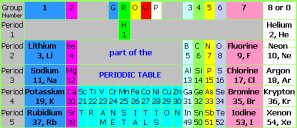
Which of the elements shown has 1 outer electron? [pt-19]- element Q
- element R
- element Z
- element G
Which of the elements shown is a Halogen? [pt-20]- element Q
- element R
- element Z
- element G
Which of the elements shown is an Alkali Metal? [pt-21]- element Q
- element R
- element Z
- element G
Which of the elements shown would be chemically the most similar? [pt-22]- elements Q and R
- elements R and A
- elements M and X
- elements G and M
Which of the elements shown are in the same period? [pt-23]- elements Q and R
- elements R and A
- elements M and X
- elements G and M
Which of the elements shown are both likely to be metals? [pt-24]- elements Z and Y
- elements Q and R
- elements G and E
- elements T and W
Which of the elements shown are both Halogen non-metals with 7 outer electrons? [pt-25]- elements Z and Y
- elements Q and R
- elements G and E
- elements T and W
Which of the elements shown are both in Group 3? [pt-26]- elements Z and Y
- elements Q and E
- elements G and E
- elements D and Y
Which of the elements shown are both Noble Gases? [pt-27]- elements Z and T
- elements Q and R
- elements G and E
- elements T and W
Where in the Periodic Table are you MOST LIKELY to find an element that is a shiny solid and reacts fast with cold water? [pt-28]- Group 1
- Group 7
- Group 0 (8)
- Transition Series
 The Atomic Number of an element is? [pt-29]
- the number of neutrons in the nucleus
- the sum of the protons and neutrons in the nucleus
- the number of protons in the nucleus
- the number of electrons in the outer shell
- The Mass Number of an element is? [pt-30]
- the number of neutrons in the nucleus
- the sum of the protons and neutrons in the nucleus
- the number of protons in the nucleus
- the number of electrons in the outer shell
Where in the Periodic Table are you MOST LIKELY to find an element that forms an alkaline hydroxide in water? [pt-31]- Group 1
- Group 7
- Group 0 (8)
- Transition Series
Where in the Periodic Table are you MOST LIKELY to find an element that is a soft silvery solid? [pt-32]- Group 1
- Group 7
- Group 0 (8)
- Transition Series
Where in the Periodic Table are you MOST LIKELY to find an element that readily forms an M+ ion? [pt-33]- Group 1
- Group 7
- Group 0 (8)
- Transition Series
Where in the Periodic Table are you MOST LIKELY to find an element that is rapidly oxidised (corroded) in air? [pt-34]- Group 1
- Group 7
- Group 0 (8)
- Transition Series
Where in the Periodic Table are you MOST LIKELY to find an element that is a low melting solid and a good conductor of heat? [pt-35]- Group 1
- Group 7
- Group 0 (8)
- Transition Series
- Four electron arrangements are given below.
Which is of an element in Group 5 of the Periodic Table? [pt-37]- 2.5
- 2.7
- 2.8.8
- 2.8.8.1
- Four electron arrangements are given below.
Which is a Halogen? [pt-38]- 2.5
- 2.7
- 2.8.8
- 2.8.8.1
- Four electron arrangements are given below.
Which is a Noble Gas? [pt-39]- 2.5
- 2.7
- 2.8.8
- 2.8.8.1
- Four electron arrangements are given below.
Which is an Alkali Metal? [pt-40]- 2.5
- 2.7
- 2.8.8
- 2.8.8.1
- Four electron arrangements are given below.
Which is of a Noble Gas? [pt-41]- 2
- 2.3
- 2.8.5
- 2.8.8.2
- Four electron arrangements are given below.
Which is of a Period 1 element? [pt-42]- 2
- 2.3
- 2.8.7
- 2.8.8.1
- Four electron arrangements are given below.
Which is of a Period 2 element? [pt-43]- 2
- 2.3
- 2.8.6
- 2.8.8.2
- Four electron arrangements are given below.
Which is of a Group 3 element? [pt-44]- 2
- 2.3
- 2.8.5
- 2.8.8.2
- Four electron arrangements are given below.
Which is of a Group 5 element? [pt-45]- 2
- 2.3
- 2.8.5
- 2.8.8.2
- Four electron arrangements are given below.
Which is of a Period 3 element? [pt-46]- 2.1
- 2.3
- 2.8.5
- 2.8.8.2
- Four electron arrangements are given below.
Which is of a Group 2 element? [pt-47]- 2
- 2.3
- 2.8.6
- 2.8.8.2
- Four electron arrangements are given below.
Which is of a Period 4 element? [pt-48]- 2
- 2.4
- 2.2
- 2.8.8.2
Where in the Periodic Table are you MOST LIKELY to find a solid element that is a poor conductor of heat and electricity? [pt-51]- Group 1
- Group 7
- Group 0 (8)
- Transition Series
Where in the Periodic Table are you MOST LIKELY to find an element that is a very reactive non-metal? [pt-52]- Group 1
- Group 7
- Group 0 (8)
- Transition Series
Where in the Periodic Table are you MOST LIKELY to find an element that shows little reaction with other elements? [pt-54]- Group 1
- Group 7
- Group 0 (8)
- Transition Series
Where in the Periodic Table are you MOST LIKELY to find an element that is a colourless gas? [pt-55]- Group 1
- Group 7
- Group 0 (8)
- Transition Series
Where in the Periodic Table are you MOST LIKELY to find an element that has a full outer electron shell? [pt-56]- Group 1
- Group 7
- Group 0 (8)
- Transition Series
Where in the Periodic Table are you MOST LIKELY to find an element that is used to provide an 'inert' atmosphere in welding? [pt-58]- Group 1
- Group 7
- Group 0 (8)
- Transition Series
Where in the Periodic Table are you MOST LIKELY to find an element that is a hard tough metal? [pt-60]- Group 1
- Group 7
- Group 0 (8)
- Transition Series
Where in the Periodic Table are you MOST LIKELY to find an element that is a high melting solid? [pt-61]- Group 1
- Group 7
- Group 0 (8)
- Transition Series
Where in the Periodic Table are you MOST LIKELY to find an element that forms a variety of coloured compounds? [pt-62]- Group 1
- Group 7
- Group 0 (8)
- Transition Series
Where in the Periodic Table are you MOST LIKELY to find an element that shows catalytic properties? [pt-63]- Group 1
- Group 7
- Group 0 (8)
- Transition Series
Where in the Periodic Table are you MOST LIKELY to find an element that is a strong dense solid? [pt-64]- Group 1
- Group 7
- Group 0 (8)
- Transition Series
Where in the Periodic Table are you MOST LIKELY to find an element that forms a coloured oxide used to stain glass windows? [pt-65]- Group 1
- Group 7
- Group 0 (8)
- Transition Series
Which of the following elements is a liquid non-metal at room temperature and pressure? [pt-66]- bromine
- carbon
- copper
- mercury
Which of the following elements is a solid non-metal at room temperature and pressure? [pt-67]- bromine
- carbon
- copper
- mercury
Which of the following elements is a solid metal at room temperature and pressure? [pt-68]- bromine
- carbon
- copper
- mercury
Which of the following elements is a liquid metal at room temperature and pressure? [pt-69]- bromine
- carbon
- copper
- mercury
Which of the following elements is a gas at room temperature and pressure? [pt-70]- nitrogen
- sulfur
- chromium
- tin
Which of the following elements is a yellow solid non-metal at room temperature and pressure? [pt-71]- carbon
- sulfur
- chromium
- tin
Which of the following elements is a shiny solid at room temperature and pressure? [pt-72]- carbon
- sulfur
- nickel
- phosphorus
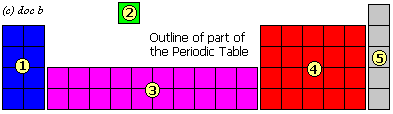
The diagram shows an outline of parts of the Periodic Table.
In which section will you find the most reactive metals? [pt-73]- section 1
- section 3
- section 4
- section 5
The diagram shows an outline of parts of the Periodic Table.
In which section will you find the Transition Metals? [pt-74]- section 1
- section 3
- section 4
- section 5
The diagram shows an outline of parts of the Periodic Table.
In which section will you find most of the non-metals? [pt-75]- section 1
- section 3
- section 4
- section 5
- The diagram shows an outline of parts of the Periodic Table.
In which section will you find the Noble Gases? [pt-76]- section 1
- section 3
- section 4
- section 5
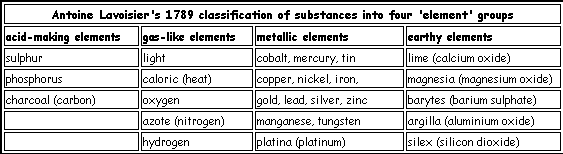
Which statement about Lavoisier's 1789 classification of elements is TRUE? [pt-77]- 'light' and 'caloric' are neither elements or compounds
- sulfur, phosphorus and charcoal are 'acid making elements' because they react with water to form acids
- not all the 'metallic elements' listed are true elements
- some of the 'earthy elements' really are elements
Which statement about Lavoisier's 1789 classification of elements is TRUE? [pt-78]- 'light' and 'caloric' are an element and a compound respectively
- sulfur, phosphorus and charcoal are 'acid making elements' because they form oxides which dissolve in water to form acids
- not all the 'metallic elements' listed are true elements
- some of the 'earthy elements' really are elements
Which statement about Lavoisier's 1789 classification of elements is TRUE? [pt-79]- 'light' and 'caloric' are an element and a compound respectively
- sulfur, phosphorus and charcoal are acid making elements because they react with water to form acids
- all the 'metallic elements' listed are true elements
- some of the 'earthy elements' really are elements
Which statement about Lavoisier's 1789 classification of elements is TRUE? [pt-80]- 'light' and 'caloric' are an element and a compound respectively
- sulfur, phosphorus and charcoal are acid making elements because they react with water to form acids
- not all the 'metallic elements' listed are true elements
- none of the 'earthy elements' really are elements

Which statement about Mendeleev's 1869 Periodic Table of elements is TRUE? [pt-83]- If X represents the element missing between silicon (Si) and tin (Sn) the formula of its chloride would be XCl3
- the group known as the Alkali Metals are missing
- they were set out in order of atomic mass (atomic weight)
- If X represents the element missing between silicon (Si) and tin (Sn) the formula of its oxide would be X2O3
Which statement concerning Mendeleev's 1869 Periodic Table of elements is TRUE? [pt-87]- the group known as the Alkali Metals are missing
- If X represents the element missing between silicon (Si) and tin (Sn) the formula of its chloride would be XCl
- in the modern Periodic Table they are set out in order of atomic number
- If X represents the element missing between silicon (Si) and tin (Sn) the formula of its oxide would be XO3

Which statement is TRUE about the modern Periodic Table? [pt-92]- a group is a complete horizontal row of similar elements
- a period is a vertical column of elements of different chemical character
- elements behave in the same way when the same number of electron shells are used
- about a 1/4 of the elements are non-metals
Which statement is TRUE about the modern Periodic Table? [pt-93]- a group is a vertical column of elements of similar chemical character
- a period is a vertical column of elements of different chemical character
- elements behave in the same way when the same number of electron shells are used
- about a 3/4 of the elements are non-metals
Which statement is TRUE about the modern Periodic Table? [pt-94]- a group is a vertical column of very different elements
- a period is a complete horizontal row of elements of different chemical character
- elements behave in the same way when the same number of electron shells are used
- about a 1/4 of the elements are metals
Which statement is TRUE about the modern Periodic Table? [pt-95]- a group is a vertical column of very different elements
- a period is a complete horizontal row of elements of similar chemical character
- elements behave in the same way when the outer shell contains the same number of electrons
- about a 1/4 of the elements are metals
Which statement about Lavoisier's 1789 classification of elements is TRUE? [pt-96]- he thought the 'earthy elements' were elements because many reacted with acids to form salts
- sulfur, phosphorus and charcoal are acid making elements because they react with water to form acids
- not all the 'metallic elements' listed are true elements
- all of the 'earthy elements' are compounds
Which of the following is likely to be a Group 7 element? [pt-97]- a very toxic and reactive green gas
- grey tough metal forming coloured compounds
- readily corroded silvery solid that fizzes with water
- an unreactive colourless gas
Which of the following is likely to be a Transition Metal? [pt-98]- a very toxic and reactive green gas
- grey tough metal forming coloured compounds
- readily corroded silvery solid that fizzes with water
- an unreactive colourless gas
Which of the following is likely to be an Alkali Metal? [pt-99]- a very toxic and reactive green gas
- grey tough metal forming coloured compounds
- readily corroded silvery solid that fizzes with water
- an unreactive colourless gas
Which of the following is likely to be a Noble Gas? [pt-100]- a very toxic and reactive green gas
- low boiling liquid forming an unreactive gas
- pale yellow reactive gas
- an unreactive colourless gas
Which of the following is likely to be a Transition Metal? [pt-101]- orange high melting solid and good electrical conductor
- soft low melting solid which is a good conductor of heat
- very reactive red liquid
- a gas used to fill the bulb of a lamp to stop the filament burning out
Which of the following is likely to be an Alkali Metal? [pt-102]- orange high melting solid and good electrical conductor
- soft low melting solid which is a good conductor of heat
- very reactive red liquid
- a gas used to fill the bulb of a lamp to stop the filament burning out
Which of the following is likely to be a Halogen? [pt-103]- orange high melting solid and good electrical conductor
- soft low melting solid which is a good conductor of heat
- very reactive red liquid
- a gas used to fill the bulb of a lamp to stop the filament burning out
Which of the following is likely to be in Group 0 (8)? [pt-104]- orange high melting solid and good electrical conductor
- soft low melting solid which is a good conductor of heat
- very reactive red liquid
- a gas used to fill the bulb of a lamp to stop the filament burning out
The 'Alkali Metals' are all in the same Group of the Periodic Table because they are all? [pt-105]- have one electron in the outer shell
- react fast with water to form an alkaline hydroxide
- soft silvery solids
- form an ionic chloride
The 'Halogen' non-metals are all in the same Group of the Periodic Table because they all? [pt-106]- form coloured vapours
- have seven electrons in the outer shell
- form ionic compounds with metals
- react rapidly with hydrogen by sharing one electron
The 'Noble Gas' non-metals are all in the same Group of the Periodic Table because they all? [pt-107]- very unreactive elements
- colourless gases
- have a full outer shell of electrons
- have a full inner shell of electrons
The 'Transition Metals' are all chemically similar because they? [pt-108]- are all strong metals due to strong chemical bonding
- all have several free electrons per atom in the crystal structure
- are not very reactive metals
- have similar electron structures
 In 1866 the English chemist John Newlands proposed a 'Periodic Table' based on the 'Law of octaves'. This meant that every 8th element was very similar and placed in the same 'group'. Which statement is TRUE concerning his 'element classification'? [pt-109]
- the Noble Gas 'group' are missing
- not all the halogens are correctly placed together in the same 'group'
- not all the Alkali Metals are correctly placed together in the same 'group'
- transition metals are at least separated from non-metallic elements
- In 1866 the English chemist John Newlands proposed a 'Periodic Table' based on the 'Law of octaves'. This meant that every 8th element was very similar and placed in the same 'group'. Which statement is TRUE concerning his 'element classification'? [pt-111]
- some of the Noble Gas 'group' are included
- not all the halogens are correctly placed together in the same 'group'
- all the known Alkali Metals are correctly placed together in the same 'group'
- transition metals are at least separated from non-metallic elements
 Which 'trend' is TRUE down the Alkali Metal Group with increase in atomic number? [gp1-1]
 - they become more reactive
- the atoms get smaller
- the melting point gets higher
- the boiling point gets higher
- Which 'trend' is TRUE down the Alkali Metal Group with increase in atomic number? [gp1-2]
- they become less reactive
- the atoms get larger
- the melting point gets higher
- the boiling point gets higher
- Which 'trend' is TRUE down the Alkali Metal Group with increase in atomic number? [gp1-3]
- they become less reactive
- the atoms get smaller
- the melting point gets lower
- the boiling point gets higher
- Which 'trend' is TRUE down the Alkali Metal Group with increase in atomic number? [gp1-4]
- they become less reactive
- the atoms get smaller
- the melting point gets higher
- the boiling point gets lower
 Hydrochloric acid is a strong acid that forms chloride salts with alkali metal hydroxides. The acid's pH is likely to be? [gp1-5]
- pH 1
- pH 7
- pH 10
- pH 13
- The salt sodium chloride is soluble in water and the pH of its aqueous solution is likely to be? [gp1-6]
- pH 1
- pH 7
- pH 10
- pH 13
- Sodium carbonate solution is a weak alkali, the pH of its aqueous solution is likely to be? [gp1-7]
- pH 1
- pH 7
- pH 10
- pH 13
- Sodium hydroxide is a strong alkali, the pH of its aqueous solution is likely to be? [gp1-8]
- pH 1
- pH 7
- pH 10
- pH 13
- Which is TRUE about the Group 1 Alkali Metals? [gp1-17]
- they have unusually low densities
- they have unusually high melting points
- they are typical hard metals
- they are poor conductors of heat
- Which is TRUE about the Group 1 Alkali Metals? [gp1-18]
- they have unusually high densities
- they have unusually low melting points
- they are typical hard metals
- they are poor conductors of electricity
- Which is TRUE about the Group 1 Alkali Metals? [gp1-19]
- they have unusually high densities
- they have unusually high melting points
- they are unusually soft metals
- they are poor conductors of heat
- Which is TRUE about the Group 1 Alkali Metals? [gp1-20]
- they have unusually high densities
- they have unusually high melting points
- they are typical hard metals
- they are good conductors of heat
- Which is TRUE about the Group 1 Alkali Metals? [gp1-21]
- they have unusually high densities
- they have unusually high melting points
- they are typical hard metals
- they are good conductors of heat
- Which is TRUE about the Group 1 Alkali Metals? [gp1-22]
- they have unusually high densities
- they have typically high boiling points
- they are typical hard metals
- they are poor conductors of heat
- Which is TRUE about the Group 1 Alkali Metals? [gp1-23]
- when pure they are silver solids
- they have untypically low boiling points
- they are untypical hard metals
- they are poor conductors of electricity because they only have one free outer electron in the metal lattice
- Which is TRUE about the Group 1 Alkali Metals? [gp1-24]
- when pure they are colourless solids
- they have untypically low boiling points
- they are kept under oil because of their reactivity to oxygen
- they are poor conductors of electricity because they only have one free outer electron in the metal lattice
- When an alkali metal reacts with the non-metal chlorine, which statement is TRUE about the compound formed? [gp1-25]
- it will have a high melting point
- it will be a green solid
- it will not dissolve in water
- it will be a covalent compound
- When an alkali metal reacts with the non-metal chlorine, which statement is TRUE about the compound formed? [gp1-26]
- it will have a low melting point
- it will be a white solid or colourless crystals
- it will not dissolve in water
- it will be a covalent compound
- When an alkali metal reacts with the non-metal chlorine, which statement is TRUE about the compound formed? [gp1-27]
- it will have a low melting point
- it will be a pale green solid
- it will dissolve in water to give a neutral solution of pH 7
- it will be a covalent compound
- When an alkali metal reacts with the non-metal oxygen, which statement is TRUE about the compound formed? [gp1-28]
- it will have a low melting point
- it will be a pale green solid
- it will dissolve in water to give an alkaline solution of pH 14
- it will be a covalent compound
- When an alkali metal reacts with the non-metal oxygen, which statement is TRUE about the compound formed? [gp1-29]
- it will have a low melting point
- it will be a pale green solid
- it will dissolve in water to give a neutral solution of pH 7
- it will be an ionic compound
- Which is TRUE about the reaction of lithium and water containing universal indicator? [gp1-30]
- the products are lithium hydroxide and hydrogen
- the reaction is fast and endothermic
- the indicator turns from neutral green (pH 7) to strongly acid red (pH 1)
- the gas formed causes a glowing splint to re-ignite
- Which is TRUE about the reaction of lithium and water containing universal indicator? [gp1-31]
- the products are lithium oxide and hydrogen
- the reaction is fast and exothermic
- the indicator turns from acid red (pH 3) to neutral green (pH 7)
- the metal sinks but carries on reacting
- Which is TRUE about the reaction of potassium and water containing universal indicator? [gp1-32]
- the products are potassium oxide and hydrogen
- the reaction is fast and endothermic
- the indicator turns from neutral green (pH 7) to strongly alkaline purple (pH 14)
- the metal sinks but carries on reacting
- Which is TRUE about the reaction of lithium and water containing universal indicator? [gp1-33]
- the products are lithium oxide and hydrogen
- the reaction is fast and endothermic
- the indicator turns from neutral green (pH 7) to weakly alkaline dark green (pH 8)
- the gas formed gives a pop with a lit splint
- Which is TRUE about the reaction of potassium and water containing universal indicator? [gp1-34]
- the reaction is so exothermic the gas formed burns with a lilac flame
- the products are potassium hydroxide and oxygen
- the indicator turns from neutral green (pH 7) to weakly alkaline dark green (pH 8)
- the gas formed re-ignites a glowing splint

Which of the elements listed is an Alkali Metal? [gp1-35]- element X
- element D
- element E
- element W
Which of the elements listed is an Alkali Metal? [gp1-36]- element A
- element J
- element Z
- element G
- Given the equation ...
2Li(X) + 2H2O(?) ==> 2LiOH(?) + H2(?)
Which state symbol should be where (X) is? [gp1-37]- (s)
- (l)
- (aq)
- (g)
- Given the equation ...
2Na(?) + 2H2O(X) ==> 2NaOH(?) + H2(?)
Which state symbol should be where (X) is? [gp1-38]- (s)
- (l)
- (aq)
- (g)
- Given the equation ...
2K(?) + 2H2O(?) ==> 2KOH(X) + H2(?)
Which state symbol should be where (X) is? [gp1-39]- (s)
- (l)
- (aq)
- (g)
- Given the equation ...
2Rb(?) + 2H2O(?) ==> 2RbOH(?) + H2(X)
Which state symbol should be where (X) is? [gp1-40]- (s)
- (l)
- (aq)
- (g)
 In the Periodic Table a vertical column of similar elements is called a? [gp1-45]
- Group
- Period
- Series
- Block
- In the Periodic Table a complete horizontal row elements of varying physical and chemical character is called a? [gp1-46]
- Group
- Period
- Series
- Block
- In the Periodic Table part of a horizontal row elements of similar physical and chemical character is called a? [gp1-47]
- Group
- Period
- Series
- Block
- In the Periodic Table, the elements were originally laid out in order of? [gp1-48]
- atomic number
- reactivity
- atomic radius
- atomic mass
- In the modern Periodic Table, the elements are now laid out in order of? [gp1-49]
- atomic number
- reactivity
- atomic radius
- atomic mass
- Which element is very similar physically and chemically to potassium? [gp1-50]
- chlorine
- sodium
- helium
- sulfur
 Which is a metal that floats on, and reacts with, water and the product turns universal indicator purple? [gp1-51]
- iron
- bromine
- lithium
- helium
- The element sodium is stored under oil because it? [gp1-52]
- floats on water
- is less dense than oil
- cannot react with air
- reacts rapidly with water
- When sodium reacts with water, the products are? [gp1-53]
- sodium hydroxide and hydrogen
- sodium hydroxide and oxygen
- sodium hydride and oxygen
- sodium oxide and hydrogen
- Which element is a liquid non-metal at room temperature and pressure? [gp1-61]
- bromine
- carbon
- copper
- mercury
- Which element is a solid non-metal at room temperature and pressure? [gp1-62]
- bromine
- carbon
- copper
- mercury
- Which element is a solid metal at room temperature and pressure? [gp1-63]
- bromine
- carbon
- copper
- mercury
- Which element is a liquid metal at room temperature and pressure? [gp1-64]
- bromine
- carbon
- copper
- mercury
- Which element is a gas at room temperature and pressure? [gp1-65]
- nitrogen
- sulfur
- chromium
- tin
- Which element is a yellow solid non-metal at room temperature and pressure? [gp1-66]
- carbon
- sulfur
- chromium
- tin
- Which element is a shiny solid at room temperature and pressure? [gp1-67]
- carbon
- sulfur
- nickel
- phosphorus
- The diagram shows an outline of part of the Periodic Table in five sections. In which section will you find the most reactive metals? [gp1-68]
- section 1
- section 3
- section 4
- section 5
- The diagram shows an outline of part of the Periodic Table in five sections. In which section will you find the Transition Metals? [gp1-69]
- section 1
- section 3
- section 4
- section 5
- The diagram shows an outline of part of the Periodic Table in five sections. In which section will you find most of the non-metals? [gp1-70]
- section 1
- section 3
- section 4
- section 5
- The diagram shows an outline of part of the Periodic Table in five sections. In which section will you find the Noble Gases? [gp1-71]
- section 1
- section 3
- section 4
- section 5
- The diagram shows an outline of part of the Periodic Table in five sections. In which section will you find hydrogen? [gp1-72]
- section 5
- section 3
- section 4
- section 2
- Complete the equation: [gp1-73]
sodium + water ==> ? + ?- sodium hydroxide + hydrogen
- sodium oxide + hydrogen
- sodium hydride + oxygen
- sodium hydroxide + oxygen
- Complete the equation: [gp1-74]
potassium + water ==> ? + ?- potassium oxide + hydrogen
- potassium hydroxide + hydrogen
- potassium hydride + oxygen
- potassium hydroxide + oxygen
- Which is TRUE about Alkali Metals? [gp1-75]
- they are very hard
- lumps of them are not easily shaped
- when freshly cut they are shiny
- they have low boiling points
- Which is TRUE about Alkali Metals? [gp1-76]
- they are very hard
- they have high melting points
- when freshly cut they are dull looking
- lumps of them are easily shaped
- Which is TRUE about the compound formed on combining an Alkali Metal with the Halogen element chlorine to form the metal chloride? [gp1-77]
- is an ionic compound
- soluble to form a pale green solution in water
- the solid conducts electricity
- the solution in water does not conduct electricity
- Which is TRUE about the compound formed on combining an Alkali Metal with the Halogen element chlorine to form the metal chloride? [gp1-78]
- is a covalent compound
- soluble to form a colourless solution in water
- the solid conducts electricity
- the solution in water does not conduct electricity
- Which is TRUE about the compound formed on combining an Alkali Metal with the Halogen element chlorine to form the metal chloride? [gp1-79]
- is a covalent compound
- forms a pale green solution in water
- the solid does not conduct electricity, but the molten salt does
- it has a low melting point
- Which is TRUE about the compound formed on combining an Alkali Metal with the Halogen element chlorine to form the metal chloride? [gp1-80]
- is a covalent compound
- insoluble in water
- the solid conducts electricity
- the solution of it in water conducts electricity
- Which is TRUE about the compound formed on combining an Alkali Metal with the element oxygen to form the metal oxide? [gp1-81]
- soluble to form a colourless solution in water
- has a low melting point
- the solid conducts electricity
- the solution in water does not conduct electricity
- Which is TRUE about the compound formed on combining an Alkali Metal with the element oxygen to form the metal oxide? [gp1-82]
- it is insoluble in water
- it has a high melting point
- the solid conducts electricity
- the solution in water does not conduct electricity
- Which is TRUE about the compound formed on combining an Alkali Metal with the element oxygen to form the metal oxide? [gp1-83]
- it is insoluble in water
- it has a low boiling point
- it is a white solid
- the solid conducts electricity
- Which is TRUE about the compound formed on combining an Alkali Metal with the element oxygen to form the metal oxide? [gp1-84]
- it is insoluble in water and floats on the surface
- the solid is a good conductor of electricity
- it is a pale yellow solid with a low melting point
- when molten or dissolved in water, it will conduct electricity
- Which is solid metal? [gp1-93]
- aluminium
- hydrogen
- sulfur
- bromine
- Which is gaseous non-metal? [gp1-94]
- aluminium
- hydrogen
- sulfur
- bromine
- Chlorine reacts with
potassium to form potassium chloride. Which is TRUE about it? [gp1-95]
- green insoluble solid
- white insoluble solid
- white soluble solid
- green insoluble solid
- Potassium hydroxide dissolves in water to form? [gp1-96]
- potassium oxide
- hydrogen gas
- a salt solution
- an alkaline solution
- Most metallic elements are found in the central block and in? [gp1-97]
- Groups 1 and 2
- Groups 3 and 4
- Groups 5 and 6
- Groups 7 and 0 (or 8)
- The elements in Group 1 of the Periodic Table are called the? [gp1-98]
- Alkaline Earth Metals
- Alkali Metals
- Transition Metals
- Reactive Metals

Which halogen at room temperature and pressure is a green gas? [gp7-1]- fluorine
- chlorine
- bromine
- iodine

Which halogen at room temperature and pressure is a dark red liquid? [gp7-2]- fluorine
- chlorine
- bromine
- iodine

Which halogen at room temperature and pressure is a dark solid? [gp7-3]- fluorine
- chlorine
- bromine
- iodine
Which halogen on heating gives an orange-brown vapour? [gp7-4]- fluorine
- chlorine
- bromine
- iodine
Which halogen on heating gives a purple vapour? [gp7-5]- fluorine
- chlorine
- bromine
- iodine
 Which following is TRUE about the trend DOWN the Group 7 Halogens with increase in atomic number? [gp7-23]
- the melting points increase
- the boiling points decrease
- the reactivity increases
- the atoms get smaller
- Which following is TRUE about the trend DOWN the Group 7 Halogens with increase in atomic number? [gp7-24]
- the melting points decrease
- the boiling points increase
- the reactivity increases
- the atoms get smaller
- Which following is TRUE about the trend DOWN the Group 7 Halogens with increase in atomic number? [gp7-25]
- the colour of the element gets lighter
- the boiling points decrease
- the reactivity decreases
- the atoms get smaller
- Which following is TRUE about the trend DOWN the Group 7 Halogens with increase in atomic number? [gp7-26]
- the colour of the element gets lighter
- the boiling points decrease
- the reactivity increases
- the atoms get larger
- Which following is TRUE about the trend DOWN the Group 7 Halogens with increase in atomic number? [gp7-27]
- the colour of the element gets darker
- the melting points decrease
- the reactivity increases
- the atoms get smaller
 Which four numbers a, b, c and d are required to balance the equation? [gp7-28]
a Cl2(aq) + b KI(aq) ==> c KCl(aq) + d I2(aq)- 1 2 2 1
- 2 1 1 2
- 1 2 1 2
- 2 1 2 1
- Which statement is TRUE about the Group 7 Halogens? [gp7-29]
- they have low melting points
- they are good conductors of heat
- the first three are gases at room temperature and pressure
- they are strong materials when solid
- Which statement is TRUE about the Group 7 Halogens? [gp7-30]
- they have high melting points
- they are poor conductors of heat
- the first three are gases at room temperature and pressure
- they are strong materials when solid
- Which statement is TRUE about the Group 7 Halogens? [gp7-31]
- they have high boiling points
- they are good conductors of electricity
- the first two are gases at room temperature and pressure
- they are strong materials when solid
- Which statement is TRUE about the Group 7 Halogens? [gp7-32]
- they have high boiling points
- they are good conductors of electricity
- only the first one is a gas at room temperature and pressure
- they are brittle and crumbly materials when solid
- Which statement is TRUE about the Group 7 Halogens? [gp7-33]
- they have low boiling points
- they are good conductors of electricity
- only the first one is a gas at room temperature and pressure
- they exist as single atoms at room temperature
- Which statement is TRUE about the Group 7 Halogens? [gp7-34]
- they have high boiling points
- they are poor conductors of electricity
- only the first one is a gas at room temperature and pressure
- they exist as single atoms at room temperature
- Which statement is TRUE about the Group 7 Halogens? [gp7-35]
- they have high boiling points
- they are good conductors of electricity
- all their vapours are coloured
- they exist as single atoms at room temperature
- Which statement is TRUE about the Group 7 Halogens? [gp7-36]
- they have high boiling points
- they are good conductors of electricity
- all their vapours are colourless
- they exist as diatomic molecules X2 at room temperature
 Which is TRUE about the Group 7 Halogens? [gp7-37]
- form negative ions of charge -1
- form ionic compounds with other non-metallic elements
- form covalent compounds with metallic elements
- a less reactive halogen can displace a more reactive one from its ionic salt
- Which is TRUE about the Group 7 Halogens? [gp7-38]
- form negative ions of charge -2
- form covalent compounds with other non-metallic elements
- form ionic compounds with hydrogen
- a less reactive halogen can displace a more reactive one from its ionic salt
- Which is TRUE about the Group 7 Halogens? [gp7-39]
- form negative ions of charge -2
- form ionic compounds with other non-metallic elements
- form ionic compounds with metallic elements
- a less reactive halogen can displace a more reactive one from its ionic salt
- Which is TRUE about the Group 7 Halogens? [gp7-40]
- form positive ions of charge +1
- form ionic compounds with other non-metallic elements
- form covalent compounds with metallic elements
- a more reactive halogen can displace a less reactive one from its ionic salt
 Which is formed at the positive electrode (+ anode) during the electrolysis of brine (aqueous sodium chloride solution)? [gp7-41]
- chlorine
- hydrogen
- sodium hydroxide
- sodium chlorate(I)
- Which is formed at the negative electrode (- cathode) during the electrolysis of brine (aqueous sodium chloride solution)? [gp7-42]
- chlorine
- hydrogen
- sodium hydroxide
- sodium chlorate(I)
- Which is left after the electrolysis of brine (aqueous sodium chloride solution)? [gp7-43]
- chlorine
- hydrogen
- sodium hydroxide
- sodium chlorate(I)
- Which is made by combining two of the products from the electrolysis of brine (aqueous sodium chloride solution)? [gp7-44]
- chlorine
- hydrogen
- sodium hydroxide
- sodium chlorate(I)
- Which is a suitable test for the product formed at the positive electrode (+ anode) during the electrolysis of brine (aqueous sodium chloride solution)? [gp7-45]
- bleaches damp blue litmus
- squeaky pop with lit splint
- turns universal indicator from green to purple
- turns universal indicator from green to red
- Which is a suitable test for the product formed at the negative electrode (- cathode) during the electrolysis of brine (aqueous sodium chloride solution)? [gp7-46]
- bleaches damp blue litmus
- squeaky pop with lit splint
- turns universal indicator from green to purple
- turns universal indicator from green to red
- Which is a suitable test for the product left after the electrolysis of brine (aqueous sodium chloride solution)? [gp7-47]
- bleaches damp blue litmus
- squeaky pop with lit splint
- turns universal indicator from green to purple
- turns universal indicator from green to red
- Which is a suitable test for the product formed by combining sodium hydroxide and chlorine from the electrolysis of brine (aqueous sodium chloride solution)? [gp7-48]
- bleaches damp blue litmus
- squeaky pop with lit splint
- turns universal indicator from green to purple
- turns red litmus paper blue and bleaches it white
 Which is used in the manufacture of ceramics? [gp7-49]
- sodium hydroxide
- silver chloride
- chlorine
- hydrogen
 Which is used in the manufacture of photographic film? [gp7-50]
- sodium hydroxide
- silver chloride
- chlorine
- hydrogen
 Which is used in the manufacture of disinfectants? [gp7-51]
- hydrochloric acid
- silver chloride
- chlorine
- hydrogen
 Which is used in the manufacture of margarine? [gp7-52]
- sodium hydroxide
- silver chloride
- chlorine
- hydrogen
 Which is used in the manufacture of PVC plastic? [gp7-53]
- chlorine
- hydrogen
- sodium chlorate(I)
- hydrochloric acid

 Which is used in the manufacture of ammonia? [gp7-54]
- chlorine
- hydrogen
- sodium hydroxide
- hydrochloric acid
- Which is used in the manufacture of detergent soaps? [gp7-55]
- chlorine
- hydrogen
- sodium hydroxide
- hydrogen chloride
 Which is used with water to make a well known acid? [gp7-56]
- sodium chlorate(I)
- hydrogen
- sodium hydroxide
- hydrogen chloride
- Which is used in the manufacture of hydrochloric acid? [gp7-57]
- hydrogen
- sodium hydroxide
- sodium chlorate
- silver chloride
- Which is used in the manufacture of paper? [gp7-58]
- hydrogen
- sodium hydroxide
- chlorine
- silver bromide
 Which is used to kill bacteria in water? [gp7-58]
- hydrochloric acid
- sodium hydroxide
- chlorine
- silver bromide
- Which is used in the manufacture of photographic film? [gp7-60]
- hydrogen
- sodium hydroxide
- sodium chlorate
- silver bromide
- Which is used to manufacture of bleaches? [gp7-61]
- chlorine
- hydrogen
- silver iodide
- hydrochloric acid
- Which is used in the manufacture of the soluble salt of the acidic medication Aspirin? [gp7-62]
- chlorine
- sodium hydroxide
- silver iodide
- sodium chlorate(I)
- Which is used in the manufacture of photographic film? [gp7-63]
- chlorine
- hydrogen
- silver iodide
- sodium hydroxide
- Which is used in the manufacture of bleaches? [gp7-64]
- hydrochloric acid
- hydrogen
- silver iodide
- sodium hydroxide
 Which correctly describes a property of the compound formed when a halogen X (eg Cl, Br, I) combines with an Alkali Metal M (eg Li, Na, K etc.)? [gp7-89]
- the solid is a poor conductor
- low melting point
- silvery solid
- will not conduct when liquid or when dissolved in water
- Which correctly describes a property of the compound formed when a halogen X (eg Cl, Br, I) combines with an Alkali Metal M (eg Li, Na, K etc.)? [gp7-90]
- the solid is a good conductor
- high melting point
- silvery solid
- will not conduct when liquid or when dissolved in water
- Which correctly describes a property of the compound formed when a halogen X (eg Cl, Br, I) combines with an Alkali Metal M (eg Li, Na, K etc.)? [gp7-91]
- the solid is a good conductor
- has a low boiling point
- white or colourless solid
- will not conduct when liquid or when dissolved in water
- Which correctly describes a property of the compound formed when a halogen X (eg Cl, Br, I) combines with an Alkali Metal M (eg Li, Na, K etc.)? [gp7-92]
- the solid is a good conductor
- has a low boiling point
- silvery solid
- will conduct when liquid or when dissolved in water
- Which does NOT represent a possible reaction? [gp7-93]
- iodine + potassium bromide ==> potassium iodide + bromine
- chlorine + sodium iodide ==> potassium chloride + iodine
- bromine + potassium iodide ==> potassium bromide + iodine
- fluorine + sodium chloride ==> potassium fluoride + chlorine
- Which does NOT represent a possible reaction? [gp7-94]
- chlorine + potassium bromide ==> potassium chloride + bromine
- chlorine + sodium fluoride ==> potassium chloride + fluorine
- bromine + potassium iodide ==> potassium bromide + iodine
- fluorine + sodium chloride ==> potassium fluoride + chlorine
- Which does NOT represent a possible reaction? [gp7-95]
- chlorine + potassium bromide ==> potassium chloride + bromine
- chlorine + sodium iodide ==> potassium chloride + iodine
- bromine + potassium chloride ==> potassium bromide + chlorine
- fluorine + sodium chloride ==> potassium fluoride + chlorine
- Which does NOT represent a possible reaction? [gp7-96]
- chlorine + potassium bromide ==> potassium chloride + bromine
- chlorine + sodium iodide ==> potassium chloride + iodine
- bromine + potassium iodide ==> potassium bromide + iodine
- bromine + sodium chloride ==> potassium bromide + chlorine
- Which is the most reactive halogen listed? [gp7-97]
- chlorine
- bromine
- iodine
- astatine
- Which is the least reactive halogen listed? [gp7-98]
- chlorine
- iodine
- bromine
- fluorine
- Which quartet of hazard warning symbols should ALL be on a cylinder of chlorine? [gp7-99]
-
 Which pair of hazard warning symbols should BOTH be on a bottle of hydrochloric acid? [gp7-100]
-
- Which is a Noble Gas? [gp0-1]
- helium
- chlorine
- nitrogen
- oxygen
- Which is a Noble Gas [gp0-2]
- fluorine
- neon
- ammonia
- ozone
- Which is a Noble Gas [gp0-3]
- nitrogen
- chlorine
- argon
- oxygen
- Which is an electron arrangement of a Noble Gas? [gp0-4]
- 2.8.1
- 2.8.7
- 2.8.8.2
- 2
- Which is an electron arrangement of a Noble Gas? [gp0-5]
- 2.8
- 2.8.7
- 2.8.8.2
- 2.8.18.2
- Which is an electron arrangement of a Noble Gas? [gp0-6]
- 2.8.2
- 2.8.8
- 2.8.18.7
- 2.1


Which statement is TRUE about the Noble Gases? [gp0-7]- they readily react with chlorine
- down the group the colour of the gas gets darker
- they are poor conductors of heat
- they are good conductors of electricity
-
Which statement is TRUE about the Noble Gases? [gp0-8]- they readily react with chlorine
- down the group the colour of the gas gets darker
- they are good conductors of heat
- they are poor conductors of electricity
-
Which statement is TRUE about the Noble Gases? [gp0-9]- they are very unreactive gases
- down the group the colour of the gas gets darker
- they are good conductors of heat
- they are good conductors of electricity
-
Which statement is TRUE about the Noble Gases? [gp0-10]- they readily burn in oxygen
- they are all colourless gases
- they are good conductors of heat
- they are good conductors of electricity
- Which Noble Gas is used in filament bulbs to stop the filament burning out too quickly? [gp0-11]
- neon
- helium
- argon
- krypton
- Which Noble Gas is used in balloons? [gp0-12]
- argon
- krypton
- neon
- helium
- Which gas is used in electrical discharge lights? [gp0-13]
- neon
- helium
- nitrogen
- oxygen
 Which gas is used in laser beams? [gp0-14]
- nitrogen
- krypton
- helium
- oxygen
 Which gas has been replaced by safer helium in airships? [gp0-15]
- carbon dioxide
- nitrogen
- hydrogen
- oxygen
 Which gas is used to provide a non-oxidising
atmosphere in welding operations? [gp0-16]
Which gas is used to provide a non-oxidising
atmosphere in welding operations? [gp0-16]- neon
- helium
- carbon dioxide
- argon
- Which statement explains the lack of chemical reactivity by Noble Gases? [gp0-17]
- they have a stable full outer shell of electrons
- it is impossible to ionize the gases because too much energy is required
- they form very stable molecules of two combined atoms
- the lower energy, inner full shells of electrons cannot be used in chemical bonding
- In which section of the Periodic Table will you find the Noble Gases? [gp0-18]
- section (1)
- section (5)
- section (3)
- section (4)
- section (2)
- The Noble Gases consist of? [gp0-19]
- diatomic molecules
- triatomic molecules
- single free atoms
- atoms linked by weak bonds
- Which reason best accounts for the use of helium in modern airships? [gp0-20]
- lighter than air and cheap to produce
- expensive, but easy to store in cylinders
- expensive, but a very unreactive gas
- less dense than air and not flammable
- Which statement is TRUE about the trend, with increasing atomic number, down the Group of Noble Gases? [gp0-21]
- the boiling points increase
- the melting points decrease
- the density decreases
- the reactivity decreases
- Which statement is TRUE about the trend, with increasing atomic number, down the Group of Noble Gases? [gp0-22]
- the boiling points decrease
- the melting points increase
- the density decreases
- the reactivity decreases
- Which statement is TRUE about the Group of Noble Gases? [gp0-23]
- they are all dense gases
- they are lightly coloured gases
- they have low melting points and boiling points
- they will all burn in pure oxygen
- In 1962 a Canadian chemist, Bartlet, managed to combine xenon with the highly reactive Halogen gas fluorine to make xenon tetrafluoride. Which equation is correct in making xenon tetrafluoride? [gp0-24]
- Xe2 + 2F2 ==> XeF4
- 2Xe + 4F ==> 2XeF4
- Xe2 + 8F2 ==> 2XeF4
- Xe + 2F2 ==> XeF4
-
Which is TRUE about the 'Noble Gases'? [gp0-25]- they are very unreactive
- they have a great tendency to share or gain electrons to form a chemical bond
- argon is used in welding to keep the surrounding metal cool
- argon is used in lamps to make the metal filament a better conductor
-
Which is TRUE about the 'Noble Gases'? [gp0-26]- they are very reactive
- they have little tendency to share or gain electrons to form a chemical bond
- argon is used in welding to keep the surrounding metal cool
- argon is used in lamps to make the metal filament a better conductor
-
Which is TRUE about the 'Noble Gases'? [gp0-27]- they are very reactive
- they have a great tendency to share or gain electrons to form a chemical bond
- argon is used in welding to stop oxidation of the metal
- argon is used in lamps to make the metal filament a better conductor
-
Which is TRUE about the 'Noble Gases'? [gp0-28]- they are very reactive
- they have a great tendency to share or gain electrons to form a chemical bond
- argon is used in welding to keep the surrounding metal cool
- argon is used in lamps to stop the metal filament from being oxidised
- Which is an electron arrangement of a Noble Gas? [gp0-29]
- 2.8.18.8
- 2.8.4
- 2.8.8.2
- 2.8.18.2


