|

 Steam
Locomotive 3440/3717 CITY OF TRURO Steam
Locomotive 3440/3717 CITY OF TRURO
Ex GWR 4-4-0 3700 City Class
Heritage & Preserved Steam Locomotive
Engines
My
Archive Steam Photos from the 1960s


*
 *
*

Steam locomotive
GWR
3717 CITY OF TRURO BR 3440
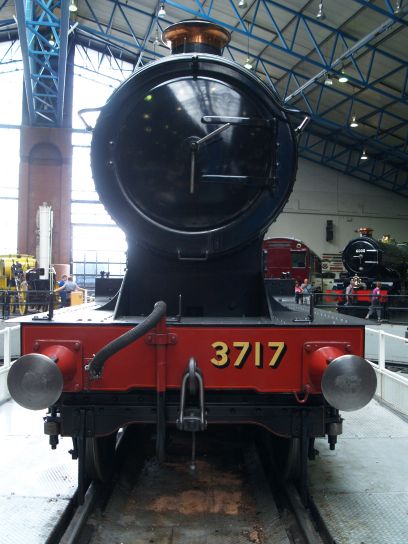
Front profile of the smoke box,
front bogie wheels and brass rimmed chimney of 3440 3717 CITY OF
TRURO in NRM, York.

3440 3717 CITY OF TRURO portraits in York NRM


Profile views of
3440/3717 CITY OF TRURO on the turntable of York NRM


3700 CLASS 'CITY'
4-4-0 locomotive GWR 3717 CITY OF TRURO (BR locomotive 3440) was built
in 1903 to a design by Churchward for express passenger trains, and is reputed to be the first loco to
reach 100 m.p.h. when it hauled an 'Ocean mails' special from Plymouth
to Paddington in 1904. It was granted extensive restoration work at
Swindon in 2000.
Technical details of
locomotive 3440/3717: Boiler pressure of 3440/3717: 200 lbf/sq.in., Weight of
3440/3717: loco 55.3 tons, tender 36.75 tons, Wheel diameter of 3440/3717: 3'
2'', 6' 8½", Valve gear of 3440/3717: Stephenson piston valves, Cylinders of
3440/3717 (diameter x stroke): 18" x 26" (I), Tractive effort of 3440/3717:
17800 lbf., Power classification of 3440/3717: Class ?

3717 CITY OF TRURO is
a fine looking engine hauling tourists at York NRM.

A magnificent survivor
of the Great Western Railway.

3717 CITY OF TRURO and the replica ROCKET (1979
version), in the workshops of York NRM in February 2012
Source Wikipedia
GWR 3700 Class 3440 City of Truro 3717
Type and origin
Power type Steam
Builder GWR Swindon Works
Serial number 2000
Build date April 1903
Specifications
Configuration:
• Whyte 4-4-0
Gauge 4 ft 8 1⁄2 in (1,435 mm)
Career
Operators Great Western Railway
Class 3700, "City" class
Numbers 3440, renumbered 3717 in 1912
Official name City of Truro
Retired 1931
Restored 1957, 1984 & 2004
Current owner National Railway Museum
The GWR 3700 Class steam locomotive No. 3440 City of Truro was built in
1903 for the Great Western Railway (GWR) at Swindon Works to a design by
George Jackson Churchward. It was partially rebuilt in 1911 and 1915,
and renumbered 3717 in 1912. Although it is a point of contention, some
believe the locomotive to be the first to attain a speed of 100 miles
per hour (160.9 km/h) during a run from Plymouth to London Paddington in
1904.
Construction and modifications
The locomotive was the eighth of a batch of ten locomotives forming part
of the GWR 3700 (or 'City') Class, and was delivered from Swindon Works
in May 1903. All ten were named after cities on the GWR system; this
batch was originally numbered 3433–42, City of Truro being 3440; like
most GWR 4-4-0s, they were renumbered in December 1912, this batch
becoming 3710–19 of which City of Truro became 3717. The locomotives
were fitted with superheaters in 1910–12, City of Truro being so treated
in September 1911. This changed its appearance quite noticeably, as it
gained a longer smokebox. Most were later given piston valves instead of
their original slide valves, City of Truro in November 1915. 3440 GWR
3717 1 City of Truro steam locomotive
Speed record
City of Truro was timed at 8.8 seconds between two quarter-mile posts
whilst hauling the "Ocean Mails" special from Plymouth to London
Paddington on 9 May 1904. This timing was recorded from the train by
Charles Rous-Marten, who wrote for The Railway Magazine and other
journals. If exact, this time would correspond to a speed of 102.3 mph
(164.6 km/h); but Rous-Marten's stopwatch read in multiples of 1⁄5
second, so the next possible longer time it could register was 9
seconds, corresponding to exactly 100 mph 3440 GWR 3717 dubious –
discuss City of Truro steam locomotive .
Initially, mindful of the need to preserve their reputation for safety,
the railway company allowed only the overall timings for the run to be
put into print; neither The Times report of the following day 3440 GWR
3717 2 City of Truro steam locomotive nor Rous-Marten's article in The
Railway Magazine of June 1904 mentioned the maximum speed. However, the
morning after the run two local Plymouth newspapers did report that the
train had reached a speed between 99 and 100 miles an hour whilst
descending Wellington Bank, Somerset. This claim was based on the
stopwatch timings of a postal worker, William Kennedy, who was also on
the train. 3440 GWR 3717 3 City of Truro steam locomotive
Rous-Marten first published the maximum speed in 1905, though he did not
name the locomotive or railway company:
On one occasion when special experimental tests were being made with an
engine having 6 ft. 8 in. coupled wheels hauling a load of approximately
150 tons behind the tender down a gradient of 1 in 90, I personally
recorded a rate of no less than 102.3 miles an hour for a single
quarter-mile, which was covered in 8.8 seconds, exactly 100 miles an
hour for half a mile which occupied 18 seconds, 96.7 miles an hour for a
whole mile run in 37.2 seconds; five successive quarter-miles were run
respectively in 10 seconds, 9.8 seconds, 9.4 seconds, 9.2 seconds and
8.8 seconds. This I have reason to believe to be the highest railway
speed ever authentically recorded. I need hardly add that the
observations were made with the utmost possible care, and with the
advantage of previous knowledge that the experiment was to be made,
consequently without the disadvantage of unpreparedness that usually
attaches itself to speed observations made in a merely casual way in an
ordinary passenger train. The performance was certainly an epoch-making
one. In a previous trial with another engine of the same class, a
maximum of 95.6 miles an hour was reached.
— C Rous-Marten: p2118, Bulletin of the International Railway Congress –
October 1905 3440 GWR 3717 4 City of Truro steam locomotive
Before his death in 1908, Rous-Marten did name the locomotive as City of
Truro. Official confirmation from the Great Western Railway came in
1922, when they published a letter written in June 1905 by Rous-Marten
to James Inglis, the general manager, giving further details of the
record. 3440 GWR 3717 5 City of Truro steam locomotive
...What happened was this: when we topped the Whiteball Summit, we were
still doing 63 miles an hour; when we emerged from the Whiteball Tunnel
we had reached 80; thenceforward our velocity rapidly and steadily
increased, the quarter-mile times diminishing from 11 sec. at the tunnel
entrance to 10.6 sec., 10.2 sec., 10 sec., 9.8 sec., 9.4 sec., 9.2 sec.,
and finally to 8.8 sec., this last being equivalent to a rate of 102.3
miles an hour. The two quickest quarters thus occupied exactly 18 sec.
for the half-mile, equal to 100 miles an hour. At this time the
travelling was so curiously smooth that, but for the sound, it was
difficult to believe we were moving at all...
This sequence of eight quarter-mile timings is thought to start at
milepost 173, the first after the tunnel, with the maximum speed at
milepost 171.
From 1922 onwards, City of Truro featured prominently in the Great
Western Railway's publicity material.
Doubts over the record centre on the power of the locomotive and some
contradictions in Rous-Marten's passing times. However, his milepost
timings are consistent with a speed of 100 mph or just over. The latest
research examines the evidence and uses computer simulation of the
locomotive performance to show that a speed of 100 mph was possible and
that the timings do indeed support such a speed. 3440 GWR 3717 6 City of
Truro steam locomotive
A comparison of a computer simulation of City of Truro's acceleration to
100mph with Charles Rous Marten's quarter-mile stopwatch timings.
This record was set before any car or aeroplane had attained such a
speed. However, in May 1904, City of Truro was not the fastest vehicle
in the world, as 130 mph (210 km/h) had been reached the previous year
on an experimental electric railway near Berlin. An earlier, unconfirmed
run of over 100 mph is recorded from 1893 in the US, by New York Central
and Hudson River Railroad 4-4-0 locomotive No. 999. This claim has
little supporting evidence; for example, unlike City of Truro, there are
no timings showing the acceleration up to 100 mph. Even some
contemporary American technical journals doubted that such a high speed
had been attained: "Many are disposed to receive with doubt the
statement that on 9 May the locomotive No. 999 of the New York Central
railroad ran at the speed of 100 miles an hour, or that on a subsequent
date she ran a single mile in 32 seconds." 3440 GWR 3717 7 City of Truro
steam locomotive J P Pearson travelled on the Empire State Express on 10
May 1893 and recorded a speed no higher than 81 mph, still a very
respectable speed for the time. 3440 GWR 3717 8 City of Truro steam
locomotive
Preservation
This section needs additional citations for verification. Please help
improve this article by adding citations to reliable sources. Unsourced
material may be challenged and removed. (May 2012) (Learn how and when
to remove this template message)
After the 1904 speed record, 3440 continued in everyday service until it
was rendered obsolete in 1931, being withdrawn from service in March
that year. 3440 GWR 3717 9 City of Truro steam locomotive The historical
significance of City of Truro led to the locomotive's survival after
withdrawal from service, with the GWR's Chief Mechanical Engineer
Charles Collett asking that the engine be preserved at the London and
North Eastern Railway's Railway Museum at York when it was withdrawn in
1931, after the directors of the GWR had refused to preserve the engine
at the company's expense. 3440 GWR 3717 citation needed City of Truro
steam locomotive It was donated to the LNER, being sent from Swindon on
20 March 1931, 3440 GWR 3717 10 City of Truro steam locomotive and was
subsequently displayed at the new museum in York. During World War 2
York was considered to be a likely bombing target so the locomotive was
evacuated to the small engine shed at Sprouston station (near Kelso) on
the Tweedmouth to St Boswells line in the Scottish Borders.
City of Truro's nameplate and worksplate, recording that it was the
2000th loco to be built at Swindon Works in April 1903
City of Truro on a special train for Bristol at Plymouth on 3 December
2004
City of Truro at Didcot Railway Centre
In 1957, City of Truro was returned to service by British Railways
Western Region. The locomotive was based at Didcot, and was used both
for hauling special excursion trains and for normal revenue services,
usually on the Didcot, Newbury and Southampton line, and was renumbered
back to 3440, and repainted into the ornate livery it carried at the
time of its speed record in 1904. It was withdrawn for a second time in
1961. In 1962, it was taken to Swindon's GWR Museum where, renumbered
back to 3717 and in plain green livery with black frames, it stayed
until 1984, when it was restored for the GWR's 150th anniversary
celebrations the following year. After that, it was returned to the
National Railway Museum, from where it was occasionally used on main
line outings. In 1989, 3440 City of Truro went over to the Netherlands
for 6 weeks to represent Great Britain and the National Railway Museum
in the 150th anniversary celebrations of the Netherlands railways. 3440
GWR 3717 citation needed City of Truro steam locomotive It was only by
chance that City of Truro made an appearance on the continent as the
original choice was LNER A4 Mallard which failed a boiler test. 3440 GWR
3717 citation needed City of Truro steam locomotive A year later 3440
made a guest appearance in an exhibition called "National Railway Museum
on Tour" which visited Swindon in 1990.
The latest restoration to full working order was undertaken in 2004, at
a cost of £130,000, to mark the 100th anniversary of the record-breaking
run, and the locomotive has subsequently hauled several trains on UK
main lines, although due to the lack of certain safety features it no
longer operates on the main line. 3440 GWR 3717 citation needed City of
Truro steam locomotive
City of Truro is now based semi-permanently at the Gloucestershire
Warwickshire Railway, often hauling trains between Toddington and
Cheltenham Racecourse. However, it frequently left its Toddington base
to visit other UK heritage railways.
In 2010, as part of the celebrations to mark the 175th anniversary of
the founding of the GWR, City of Truro was repainted and took up its
3717 guise once again. This was the first time it had carried an
authentic livery for its current state whilst operating in preservation.
3440 GWR 3717 citation needed City of Truro steam locomotive
City of Truro was withdrawn from traffic at the Bodmin & Wenford Railway
in early September 2011 with serious tube leaks, 3440 GWR 3717 11 City
of Truro steam locomotive and was moved to Shildon Locomotion Museum and
placed on static display. It was back in service in 2012, but in early
2013 the NRM declared the locomotive was to be withdrawn ahead of its
boiler ticket expiry due to a hole being discovered in one of its tubes.
The NRM did state that they would repair the leaking tubes after they
had restored 4472 Flying Scotsman, but after examination it was found
that the locomotive required more work than first thought and was
unlikely to be operational in the foreseeable future.
In late 2015, City of Truro, along with 'King' No. 6000 King George V,
returned to STEAM – Museum of the Great Western Railway (located at the
site of the old railway works in Swindon), and both were put on display
in preparation for Swindon 175 in 2016, celebrating 175 years since the
inception of Swindon as a railway town. 3440 GWR 3717 12 City of Truro
steam locomotive 3440 GWR 3717 13 City of Truro steam locomotive Both
locomotives are expected to remain at Swindon for five years. 3440 GWR
3717 12 City of Truro steam locomotive
During its restoration in 1984, the locomotive was the subject of a
'spoof' by Steam Railway magazine. The engine was being restored on the
Severn Valley Railway and workshops foreman Alun Rees suggested to
editor David Wilcock to repaint the driver's side of the locomotive in
BR lined black as 3717. This took place, and several pictures of the
engine as 3717 were taken on shed at Bridgnorth and in the Bridgnorth
yard. It was almost discovered by John Coiley when he visited the
railway that year, but Rees had the engine parked with its driver's side
along the workshop's wall so it couldn't be seen. The images were
released in 1985 with the note that 'proposals for a double chimney and
high sided tender were narrowly defeated...' This subsequently upset
many GWR enthusiasts; however, the engine never ran in this livery,
either in service or in preservation. 3440 GWR 3717 citation needed City
of Truro steam locomotive
In literature
City of Truro featured as a character in the book Duck and the Diesel
Engine, part of The Railway Series by the Rev. W. Awdry. The loco has
also appeared in the television spin-off Thomas the Tank Engine and
Friends, and was released as a diecast model in the Ertl range.
City of Truro starred in the 1957-8 serial "Will o'the Whistle" in the
D.C.Thomson comic The Wizard, in which it was used by resistance
fighters after the Kushanti invasion of Britain.
Models
The erstwhile Kitmaster company produced an unpowered polystyrene
injection moulded model kit for 00 gauge. In late 1962, the Kitmaster
brand was sold by its parent company (Rosebud Dolls) to Airfix, who
transferred the moulding tools to their own factory; they re-introduced
some of the former Kitmaster range, including City of Truro. In time,
the moulding tools passed on to Dapol who have also produced the model
kit. 3440 GWR 3717 14 City of Truro steam locomotive

My
Archive Steam Photos from the 1960s
Rail holidays in
Continental Europe Luxury train travel bookings Railway tours in France Germany
Austria Switzerland America USA Canada Trans-continental journeys by luxury
train great steam trains of Europe railway steam tours in Europe railway tours
of Spain Sweden Finland Norway Treyn Railway Holidays to France, Italy
and Spain from GWR steam locomotive 3440 3717 City of Truro express trains Booking tickets for Great Railway Journey luxury Rail Trip
holidays Train travel in Europe Rail holidays from GWR steam locomotive 3440
3717 City of Truro express trains to the USA & Canada luxury train through the Rocky Mountain Canadian rail
railway holidays through the Rockies US Cities by train from GWR steam
locomotive 3440 3717 City of Truro express trains Continental rail
holidays to France Germany Italy Austria Switzerland Glacier Express Treyn
Holidays from GWR steam locomotive 3440 3717 City of Truro express trains from Eurostar to Paris Brussels Avignon Turin Turino Rome Roma Florence
Firenze TGV fast trains Railway travel holidays
special steam excursions from GWR steam locomotive 3440 3717 City of Truro
express trains great steam heritage line and offers luxury Pullman
coach dining trains GWR steam locomotive 3440 3717 City of Truro express trains Travelling by train always seems a pleasure, especially if
through wonderful scenery to GWR steam locomotive 3440 3717 City of Truro
express trains in England, Scotland, Wales or on holiday in
the rest of Europe! The railway trip from GWR steam locomotive 3440 3717 City of
Truro express trains involves seeing or travelling behind a
'real' steam locomotive in action and there is nothing like the sight and sounds
of a steam train to invoke feelings of nostalgia in some of us to GWR steam
locomotive 3440 3717 City of Truro express trains even more luxury
by having a special trip out on a steam dining train! England Scotland Wales Northern
Ireland top class hotels in GWR steam locomotive 3440 3717 City of Truro express
trains dining out travel
tours top tourist destinations tourist information on GWR steam locomotive 3440
3717 City of Truro express trains weekend breaks mini-breaks
family holidays restaurants touring coach trips from GWR steam locomotive 3440
3717 City of Truro express trains continental tours cruise ships
pleasure cruises summer breaks spring breaks continental winter breaks European
winter holidays spring holidays summer holidays European Rail
tours Railway travel holidays special steam excursions from GWR steam
locomotive 3440 3717 City of Truro express trains A great steam
heritage line and offers luxury Pullman coach dining trains European
Rail tours US and Canadian Railway travel holidays special steam
excursions to GWR steam locomotive 3440 3717 City of Truro express
trains A great steam heritage line and offers luxury Pullman coach
dining trains Travelling by train from GWR steam locomotive 3440 3717
City of Truro express trains always seems a pleasure, especially if
through wonderful scenery either in England, Scotland, Wales or on
holiday in the rest of the railways of Europe! The railway trip involves
seeing or travelling behind a 'real' steam locomotive or heritage diesel
in action on a special trip from GWR steam locomotive 3440 3717 City of
Truro express trains Booking Eurostar
Continental Rail Travel Tour Tickets Stuttgart Brussels Eurostar
Brussels from GWR steam locomotive 3440 3717 City of Truro express trains by TGV to Ebbsfleet International, Ashford International Stratford International,
St Pancras International Paris Gare du Nord Paris Gare de Lyon Paris Gare de L'est Paris Gare Montparnasse
by
Eurostar from GWR steam locomotive 3440 3717 City of Truro express
trains London to Paris, Eurostar London - Brussels Eurostar London to
Lille deals bargain city breaks Great Railway Journey holidays in Italy,
Spain and France by TGV booking from GWR steam locomotive 3440 3717 City
of Truro express trains
Good
trainspotting 'TRAINSPOTS' Good
trainspotting and photographic locations
Barnetby Station, North Lincolnshire
*
Carlisle Station *
Clapham Junction Station,
London *
Colton Junction, south of York
*
Coventry *
Crewe Station *
Doncaster Station, South Yorkshire
*
Grantham *
Hellifield
station - Carlisle to Settle line *
Lancaster station
*
Leicester station *
Newcastle Station *
Northallerton Station *
Nuneaton
Station *
Peterborough *
Sheffield Station *
Stratford Station, East London
*
Tamworth *
Warrington Bank Quay
station *
Wigan North
Western - WCML *
York Station
See other TOPS classes of diesels and
electrics *
Class 01
*
Class
02 *
Class
03 *
Class
04 *
Class 08
*
Class 09
*
Class
10 *
Class 11
*
Class 14 *
Class 20
*
Class 24
*
Class
25 *
Class
26 *
Class 27
*
Class 31
*
Class 33
*
Class 35 *
Class 37
*
Class 40
*
Class 43
*
Class 44
*
Class 45
*
Class 47
*
Class
50 *
Class 52
*
Class
55 *
Class 56
*
Class 57 *
Class 58 *
Class 60
*
Class 66
*
Class
67 *
Class 68
*
Class 70
*
Class
71 *
Class 73
*
Class
76 *
Class
77 *
Class 84 *
Class 86
*
Class 87
*
Class 88 *
Class
90 *
Class 91
*
Class 92
*
Derby Lightweight
*
Class 101
*
Class 108
*
Class 114
*
Class 117
*
Class 120 *
Class 121
*
Class 122 *
Class 127
*
Class 141
*
Class
142 *
Class
144 *
Class 150
*
Class 153
*
Class 155
*
Class
156 *
Class
158
*
Class
159 *
Class 165
*
Class
166 *
Class
170
*
Class 172 *
Class 175
*
Class
180 *
Class
185 *
Class 195 *
Class 196 *
Class 197 *
Class
220 *
Class 221
*
Class
222 *
Class 252
*
Class
313 *
Class
315 *
Class 317 *
Class
319 *
Class 320
*
Class 321
*
Class 322
*
Class 323
*
Class
325 *
Class 331 *
Class
332 *
Class 333
*
Class 334 *
Class 350
*
Class
357 *
Class
360 *
Class
365
*
Class 373
*
Class
375 *
Class 376
*
Class
377 *
Class
378 *
Class
379 *
Class 380 *
Class 387 *
Class 390
*
Class
395 *
Class
414 *
Class
423 *
Class
442 *
Class
444 *
Class
450 *
Class
455 *
Class
458 *
Class
460 *
Class
465 *
Class 466 *
Class 489 *
Class 507/508 *
Class 700 *
Class 730 *
Class 755 *
Class 800 *
Class 801 *
Class 802 *
Class 803
*
Class 805 *
Class 3000
*
INDEX of My IMAGES OF PRESERVED STEAM LOCOMOTIVES
|





 Enter specific words e.g. locomotive, train, station, place, etc.