This page contains some online practice
exam questions only.
Jot down your answers and check against the worked out
answers at end of
the page
0.4A Introduction to
work done calculations, power and wasted energy
If an object begins to move or changes
how it moves (change in speed or direction) then a force must be involved.
If a force acts on an object, then work
is being done on the object increasing its energy store - this must involve
an energy transfer.
If an object exerts a force or
transfers energy in some way, work is done by this object and energy is
transferred from its energy store.
If there is no friction and a
force is applied to an object, the work done on the object will
equal the energy transferred to the object's kinetic energy store.
However, if an object is already
moving and experiences a resistive force of friction slowing it
down, the energy transferred from its kinetic energy store is equal
to the work done against the object's motion.
The energy can be transferred usefully
i.e. doing useful work, but some energy might (often) be wasted - often
dissipated to the surroundings as heat due to friction.
The energy transferred,
usefully or wastefully, is often referred to, and equal to, work done.
When dealing with the action of a
resultant force acting through a linear distance in the direction of the
force, you can calculate the work done with a very simple formula.
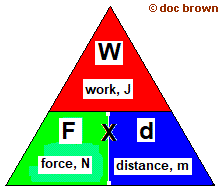 When ever you or a machine moves
something work is done
When ever you or a machine moves
something work is done
Work done (J) = energy
transferred = force (N) x distance (m)
W (J) = F (N) x d (m)
The distance equals the length of
the line of action through which the force acts.
(work done might be denoted
by E or W for the energy of work done, but remember the unit
for power is the watt, W, so take care!)
If you apply a force of one
newton through a linear distance of one metre, you do one joule of
work.
one joule of work done = a force of one newton x
one metre distance,
1 J = 1 Nm
Imagine a force of 1 newton
acting through a distance of 1 metre, 1 joule of work is done =
1 joule of energy transferred.
(note that newton metres (Nm) =
joules (J) = work done = energy transferred)
The distance must be along the
line of action of the force.
You need an energy source to keep
applying any force for any length of time.
Whenever work is done e.g.
mechanically or electrically, energy is transferred from one energy
store to another.
See
work calculation questions
 Power is the rate at which energy
is transferred or 'used up' - work done!
Power is the rate at which energy
is transferred or 'used up' - work done!
In other words power is the
rate of doing work.
The unit of power is the watt,
W.
power (W) = energy
transferred (J) / time taken (s)
power (W) = work done (J) / time taken (s)
P (W) = E (J) / t (s)
{and don't forget: work done
(J) = force (N) x distance (m), which you need to solve some
power problems}
A power rating of one watt means
one joule of energy is transferred per second,
or, 1 joule of work is done in 1
second.
The joule is the unit of energy
and the watt is the unit of power (W).
one watt = one joule of energy is
transferred per second,
1 W = 1 J/s
A 1 kW electric heater converts
1000 J of electrical energy ==> heat energy every second
(1 kW = 1000 W =
1000 J/s)
The power of a machine or any
other device is the rate at which it transfers energy.
A powerful machine doesn't
necessary mean a bigger force is generated, it just means a lot
of energy is transferred in a short time (or a lot of work done
in a short time).
The more work done/energy
transferred in a given time, the greater the power.
The shorter the time taken to
transfer energy/do work, the greater the power generated.
Conversely, by using gears
and a low powered electric motor, you can generate a relatively
big force. So, don't confuse power and force - use the terms
appropriately.
See
Turning
forces and moments including gears
However, no mechanical device or
electrical appliance is 'perfect' and energy is lost e.g. by thermal
energy by friction or sound from unwanted vibrations, heat loss from
circuit wires etc., but it is still part of the total work done - it
just isn't all useful!
Therefore you should know and understand that when energy is transferred
only part of it may be usefully transferred as useful energy or
useful work, the rest is ‘wasted’ to the surroundings
You should know and understand that wasted energy is eventually
transferred to the surroundings, which will become warmer AND ...
... the wasted energy
becomes increasingly spread out and so becomes less useful.
For more on wasted energy see:
Conservation of energy,
energy transfers-conversions, efficiency, calculations,
Sankey diagrams
0.4B More examples of energy
stores, energy transfers and mechanical work
calculations
Doing work in a mechanical sense is just
another set of examples of energy transfer e.g. from one energy store to
another.
This usually involves doing useful work,
but the final energy store destination might have no further use.
For example when you burn fuel in a
car engine the energy changes are as follows.
fuel + oxygen (chemical energy store)
==> hot gases (thermal energy store) ==> car moves (kinetic energy
store)
In the process some of the original
chemical energy store of the system is lost through friction and sound.
BUT, all the energy from the
chemical energy store ends up as thermal energy to warm up the surroundings. Therefore the
thermal energy store of the environment is increased but its now of no
use whatsoever!
The waste of energy increases (but
necessarily!) when you apply the brakes. Mechanical work is being done in the
process - work is being done against the force of friction. The friction effect of the brake pad on the brake disc converts
kinetic energy into thermal energy. The kinetic energy store of the car decreases
(fortunately!) and the thermal energy store of the brake pad + disc
increases. Eventually as the braking system cools down the heat energy
is transferred to increase the thermal energy store of the surroundings
- wasted or degraded energy!
If a vehicles crashes into a
stationary object, the contact force causes energy to be
mechanically transferred from the vehicle's kinetic energy store to
elastic potential energy store of the crushed vehicle parts,
the thermal energy stores of the vehicle, object crashed into
and the surrounding air (including some sound energy too - which
also ends up as thermal energy!).
See also
Reaction times, stopping distances, safety
aspects. calculations including F=ma
gcse physics notes
When you lift an object up you are
doing work against the effects of gravity.
The chemical energy stored in your
muscles is decreased as some of it used to lift the object-weight which
on gaining height increases its gravitational potential energy store.
In fact the work you do (J) equals
the weight of the object (N) x vertical distance lifted (m)
When you kick a ball up in the air,
three energy stores should be fairly obvious to you.
chemical energy store of muscles ==>
kinetic energy store of ball ==> gravitational potential energy store of
ball
AND, when the ball falls (ignoring a
bit of lost sound energy)
gravitational potential energy store
of ball ==>`kinetic energy store of ball ==> thermal energy store of the
ground
For more on wasted energy see:
Conservation of energy,
energy transfers-conversions, efficiency, calculations,
Sankey diagrams
0.4C Examples of simple
mechanical work done calculation questions
and Examples
of simple power calculation questions
How to solve 'work done' problems.
The formula for work done is quite
simple:
work done in joules = force in newtons x
distance in metres along the line through which the force acts
work done (J) = force (N) x distance
through which force acts (m)
E = F x d
In real situations of energy
transfers involving mechanical work, I'm afraid friction effects
accompany the useful work done.
Moving parts rubbing against each other
causes friction and rise in temperature - kinetic energy store ==>
thermal energy store of machine and surroundings.
Note that the force can be the weight
of an object acting in a vertical direction ... see the page on ...
 Mass and the effect of gravity force on it - weight, (mention of work done,
GPE and circular motion)
Mass and the effect of gravity force on it - weight, (mention of work done,
GPE and circular motion)
How to solve power problems - just a few
simple 'mechanical' examples here..
Power is the rate at which energy is
transferred, that is the rate at which work is done.
power in watts = (work done = energy
transferred) ÷ time taken
P (W) = E (J) / t (s)
Power P in Watts, Energy
E
in Joules, time t in seconds
The power rating of 1 watt is equal to a work rate of 1 joule
of energy transferred per second
See also
FORCES 3. Calculating resultant forces using vector
diagrams and work done
Examples of problem solving using
the 'work done' and 'work rate = power' formulae
In every case watch the units e.g.
W/kW, J/kJ/MJ, min/secs etc. so take care!
Q1
If you drag a heavy box with a force of 200 N across a floor for 3 m,
(a) what
work is done?
(b) If you do the job in 5 seconds,
what was your power rating in doing this task?
ANSWERS
Q2 (a) If a machine part
does 500 J of work moving linearly 2.5 m, what force was applied by the
machine?
(b) If an electric motor transfers
12.0 kJ of useful energy in 3.0 minutes.
Calculate the power output of the
motor.
(c) An appliance has a power rating
of 1.2 kW.
How many kJ of energy is
transferred in 8.0 minutes?
ANSWERS
Q3 A machine applies a
force of 200 N through a distance of 2.5 m in 2.0 seconds.
What is the power of the machine?
ANSWERS
Q4 A 500 kg express
skyscraper lift moves non-stop up a total height of 100 m.
(a) If the force of gravity = 9.8
N/kg, calculate the weight of the lift.
(b) Calculate the work done by the
lift motor.
(c) If the lift ascent time is 20
seconds, what is the power of the lift motor?
(d) What assumptions has been made
for calculations (b) and (c)?
ANSWERS
Q5 Part of a machine
requires a continuous force of 500 N from a motor to move it in a
linear direction.
(a) How much work is done in moving
it a distance of 50 m?
(b) If the power of the machine
is 5.0 kW, how long will it take to move the machine part the 50 m
distance?
ANSWERS
Q6 A machine has to move a conveyor
belt at a rate of 30 m/min.
The system is designed to use 6
kJ/min of electrical energy to move the conveyor belt along.
What is the minimum force the motor
must produce to move the conveyor belt along?
Difficult question, involving 3 steps.
ANSWERS
Q7 A toy model car has
a clockwork motor, whose spring can store 8.75 J of elastic potential
energy.
On release the clockwork motor can
deliver a continuous force of 2.5 N.
ANSWERS
Q8 A sliding object
moving across a very rough surface has 5.0 J in its kinetic energy store.
If the object experiences a constant
resistive force of friction of 25 N, calculate in cm how far the object
travels before coming to a halt.
ANSWERS
Q9 A small electric
motor uses 120 J of electrical energy in 3.0 minutes.
Calculate the power of the electric
motor.
ANSWERS
Q10 A 45.5 kg mass is
hoisted up vertically 15.5 m.
If the gravitational field force is
9.8 N/kg, calculate the work done to the nearest joule.
ANSWERS
Q11 A small electric
motor operating a water pump for a garden ornament does 6.5 kJ of work in
3.0 minutes.
Calculate the power of the pump.
ANSWERS
Q12 An electrical appliance transfers
8000 J of energy in 1 minute and 40 seconds.
Calculate the power of the appliance.
ANSWERS
Q13 A person weighing 600
N strides up 20 steps, each one 20 cm high, in 10 seconds.
(a) Calculate the work done.
(b) calculate the average power the
person generates in the process of ascending the 20 steps.
(c) If the person stands still on the
20th step, what is the person's power?
(d) When standing still, is your body
still doing work? Explain your answer!
ANSWERS
Q14 (you might not
have dealt with all aspects of Q14 yet)
Imagine a car of 1000 kg travelling
at 20 m/s doing an emergency stop in a distance of 25 m - the braking
distance.
Calculate the average braking force
produced by the driver when pressing on the brake pedal.
To solve this question you to use
several formulae.
(a) Calculate the kinetic energy of
the car.
(b) What work must be done to bring
the car to a halt? Explain your answer.
(c) Calculate the average braking
force required.
ANSWERS
Q15 A large car is
travelling at 120 km/hour and the engine provides a constant driving force
of 1500 N.
(a) How far does the car travel in 1
second?
(b) From your answer to (a) calculate
the power of the engine.
Difficult question, you have to do a little 'think'
connecting two equations.
ANSWERS
INDEX ENERGY: Types, stores, transfers, energy
calculations
Key points for Physics -
energy store
conversions - energy transfers
Information
sources for Doc Brown's key points: IGCSE-GCSE physics are based on textbooks
& syllabus-specifications for students taking the UK AQA,
Edexcel, OCR 21st Century Science, OCR Gateway science suite, WJEC, CCEA &
CIE GCSE
physics 9-1 level science examinations.
A focused and exam-board-aligned
set of revision notes on Mechanical Work
Calculations, specifically covering Work Done and
Power, suitable for GCSE/IGCSE Physics
students across WJEC, CCEA, CIE, AQA, Edexcel, and OCR:
Mechanical Work & Power – GCSE/IGCSE
Physics Revision
Core Definitions
| Term |
Definition |
| Work Done |
Energy transferred when a force
moves an object through a distance |
| Power |
The rate at which work is done or
energy is transferred |
Key Equations
| Quantity |
Formula |
Units |
| Work Done |
W = F x d |
Joules (J), Newtons (N), metres
(m) |
| Power |
P = W / t |
Watts (W), Joules (J), seconds (s) |
- ( W ): Work done
- ( F ): Force applied
- ( d ): Distance moved in the direction
of the force
- ( P ): Power
- ( t ): Time taken
Worked Examples
Example 1 – Work Done
A person pushes a crate with a force of 200 N over a distance of 3 m.
W = F x d = 200 x 3 = 600 J
Example 2 – Power
If 600 J of work is done in 4 seconds:
P = 600 / 4 = 150 W
Important Notes
- Work is only done
when the object moves in the direction of the force.
- No displacement = no work,
even if a force is applied.
- Power
is about how fast energy is transferred—not how much.
- 1 Watt
= 1 Joule per second.
Exam Tips
Always include units
in your final answer.
- Use formula triangles
to rearrange equations quickly.
- Underline or box
your final answer in calculations.
- Label known values
before substituting into equations.
- Check direction:
if the force and movement aren’t aligned, use W = F x d x cos θ
(especially in IGCSE/CIE).
- Practice unit conversions
(e.g. minutes to seconds, kJ to J).
EXTRA Note: Calculating
work done
in physics can look slightly different depending on the situation, but the
foundation stays the same:
Work done = Force × Distance
(in the direction of the force)
( W = F \times d )
Let’s walk through a few common scenarios
you might see in your GCSE or IGCSE Physics exams:
1.
Horizontal Force (e.g. pushing a box on a flat
surface)
If the force is applied in the same
direction as the movement:
work done = W = F x d
Example:
You push a trolley with a force of 100 N for 5 meters.
W = 100 x 5 = 500 J
2.
Vertical Lifting (e.g. lifting a weight
upward)
Here, you're working against gravity,
so use the weight of the object:
work done against gravity = W = m g h
Where:
- ( m ) = mass in kg
- ( g ) = gravitational field strength
(≈ 9.8 or 10 N/kg depending on your board)
- ( h ) = height in meters
Example:
Lifting a 2 kg weight 1.5 m upward
W = ~2 x 10 x 1.5 = ~30J
3.
Inclined Plane (e.g. pulling a sled up a
slope)
Use the component of the force parallel to the slope. If the angle θ (theta) is given:
W = F x d x cos θ
This adjusts for the fact the full force
may not act directly in the direction of motion.
4.
No Movement (e.g. pushing against a wall)
Even if you're applying a force, if the
object doesn't move:
W = 0
Work is only done when displacement
occurs.
You could have a situation where opposing
balance each other out, so no net force.
5.
Work Done by Friction or Resistance
If you're overcoming friction or air
resistance, the force is often the resistive force:
Example:
Pulling a sled with 50 N to overcome friction for 10 m:
work done = W = 50 x 10 = 500 J
If you do this in 20 seconds your power
generated is
power = P = 500 / 20 = 25 W
Exam Tip: Always Ask Yourself
- Has the object moved?
- Was there a force applied?
- Was it in the same direction
as the movement?
GCSE/IGCSE Physics Practice Quiz:
Calculating Work
Question 1:
A student pushes a box with a force of 120
N for a distance of 5 meters.
How much work is done?
- 24 J
- 600 J
- 625 J
- 580 J
Question 2:
Which of the following situations involves
zero work done?
- Pushing a trolley along a corridor
- Lifting a chair onto a table
- Pulling a sledge across ice
- Holding a heavy bag stationary
Question 3:
You lift a 15 kg suitcase to a height of 2
m. Take (g = 10 N/kg)
Calculate the work done.
- 30 J
- 150 J
- 300 J
- 75 J
Question 4:
A motor does 1000 J of work in 20 seconds.
What is the power output?
- 50 W
- 20 W
- 2000 W
- 500 W
Answers below!
Keywords, phrases and learning objectives
on energy
Be able to do mechanical work done calculations
involving power and force in the context of e energy stores and energy transfers.
Answers to Q1-4 above:
B, D, C and A
SITEMAP
Website content © Dr
Phil Brown 2000+. All copyrights reserved on Doc Brown's physics revision notes, images,
quizzes, worksheets etc. Copying of website material is NOT
permitted. Exam revision summaries and references to GCSE science course specifications
are unofficial.
