1.5
More examples of force interactions between objects
involving gravity
A 'force' interaction is a pair of equal and
opposite forces acting on two different objects e.g.
If you push down on the floor, the floor
pushes back up on you.
The forces of you and the floor are equal
and both objects experience a force.
This is an example of
Newton's 3rd Law of motion which
can be stated in various ways:
e.g. to every action there is an equal and
opposite reaction,
whenever a force acts on one body, an
equal and opposite force acts on some other body,
when two objects interact, the forces
they exert on each other are equal in magnitude, but act in opposite in direction.
The two forces are called an
interaction pair of forces and they must be of the same type and the
same size but acting in opposite directions on the different objects.
On diagrams both forces will be shown
by arrows indicating both the direction and magnitude of the vector
quantities.
The solar system -
non-contacting forces of gravity - objects in a gravitational field
When the moon is pulled towards the Earth by
the Earth's gravitational field force, there is an equal and opposite force
operating as the moon's gravitational field pulls the Earth towards!
If the
forces were not equal, either the moon would drift away into space or collide
with the Earth! Fortunately, its a good example of a gravitational non-contact force
operating!
The same argument applies to explain the
Earth orbiting the Sun, both bodies experience the same numerically equal
force, but acting in opposite directions. The diagram below illustrates
these two gravitational force situations.
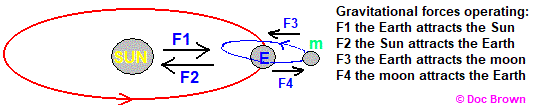
Diagram
to illustrate the gravitational field effects between several objects in
our solar system
Two pairs of forces interacting on the
same objects!
All objects standing motionless on the ground
are examples of opposite contact forces operating.
The weight of the object
acting as a downward force due to gravity is balanced by an upward push from the
ground as the atoms are minutely compressed.
If the forces were not balanced, either the
ground would sink or the object would be raised up!
BUT, take care with such descriptions,
analysis of the above situation reveals some complications!
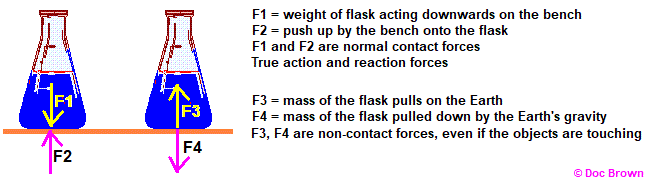
A bit more
messy to analyse than you think!
Consider the flask of liquid standing
motionless on a laboratory bench.
There are two sets of forces operating shown
by the arrows of opposing direction, but the same length - same magnitude of
force for each pair.
Both sets of forces are examples of Newton's 3rd Law, but don't mix the
two up!
The normal contact force due to the
weight of the object acting (pushing) down on the surface of the bench (F1) is
balanced by the bench under minute compression pushing back up to an equal and
opposite extent onto the flask (F2).
At the same time both the flask and the Earth
(including the bench) are mutually attracting each other (F3 and F4) to an equal
and opposite extent due to the non-contact force of gravity (this may
seem confusing, but it makes no
difference whether the objects are in contact or not, here gravity acts
throughout everything!).
In the cases described so far there is
no
resultant force, everything is balanced.
If the forces were not balanced and
there was some net resultant force, the object would move or be reshaped
- something would change!
For stationary objects, if the resultant
force acting on the object is zero the object is said to be in equilibrium (effectively means a state of balance).
See also
3. Calculating resultant forces using vector
diagrams and work done calculations
INDEX of my physics notes on FORCES
Section 1. An introduction
Key points
about
FORCES - interactions involving gravity - both contact and non-contact force
situations
Information
sources for Doc Brown's key points: IGCSE-GCSE physics are based on
textbooks & syllabus-specifications for students taking the UK AQA, Edexcel,
OCR 21st Century Science, OCR Gateway science suite, WJEC, CCEA and CIE GCSE
physics 9-1 level science examinations
A structured set of summary
revision notes on contact and non-contact forces involving
gravity, tailored to the major UK GCSE/IGCSE physics exam boards
(WJEC, CCEA, CIE, AQA, Edexcel, OCR), with examples and exam tips to help
students master this topic.
What Is Gravity?
- Gravity
is a non-contact force that attracts objects with mass
toward each other.
- On Earth, gravity gives objects
weight.
- Weight (N)
= mass (kg) ×
gravitational field strength (N/kg)
Tip:
Always refer to gravity as a gravitational force or weight in exams - not just “gravity”.
Non-Contact Force: Gravity in Action
| Scenario |
Force Type |
Explanation |
| Apple falling from a tree |
Non-contact |
Gravity pulls the apple downward
without physical contact |
| Moon orbiting Earth |
Non-contact |
Gravitational attraction keeps the
Moon in orbit |
| Skydiver accelerating downward |
Non-contact |
Gravity acts on the skydiver before
parachute opens |
Tip:
Use downward arrows in diagrams to show gravitational force acting on objects.
Contact Forces That Interact with Gravity
| Scenario |
Contact Force |
Interaction with
Gravity |
| Book resting on a table |
Normal contact force |
Table pushes upward to balance
downward gravitational force (weight) |
| Person standing on the ground |
Reaction force |
Ground pushes up with equal force to
person’s weight |
| Parachute slowing descent |
Air resistance |
Opposes gravitational pull, reducing
acceleration |
Tip:
Newton’s Third Law applies - every force has an equal and opposite reaction.
Typical Exam Board Requirements
|
Key Focus Areas |
| Distinguish contact/non-contact
forces, apply gravity in motion scenarios |
| Use force diagrams, calculate weight,
explain interactions |
| Describe gravitational force, apply
Newton’s laws, use vector diagrams |
| Identify forces acting on objects,
explain balance of forces |
| Define gravity as non-contact, use
examples, calculate weight |
| Describe gravitational force, apply to
falling objects and orbital motion |
Student Tips for Exam Success
- Learn the definition of gravity
as a non-contact force.
- Practice drawing force diagrams
showing both gravity and contact forces.
- Use real-world examples
(e.g. book on table, skydiver, orbiting satellite).
- Understand how balanced forces
result in no change in motion.
- Avoid vague terms like “gravity pushing
down” - use weight or gravitational force.
Keywords, phrases and learning objectives for force of gravity situations
Be able to describe and explain examples of force interactions between objects
involving gravity e.g. the solar system (non-contact gravity force)
or a solid object standing on a solid surface (normal contact
force).
WHAT NEXT?
TOP of page
INDEX for physics notes on FORCES
section 1
INDEX of all my physics notes on FORCES
INDEX of all my physics notes on FORCES
and MOTION
INDEX of all my PHYSICS NOTES
email doc
brown - comments - query?
BIG website and using the [SEARCH
BOX] below, maybe quicker than navigating the
many sub-indexes
HOME PAGE of Doc Brown's Science
Basic Science Quizzes for
UK KS3 science students aged ~12-14, ~US grades 6-8
Biology * Chemistry
* Physics for UK
GCSE level students aged ~14-16, ~US grades 9-10
Advanced Level Chemistry
for pre-university age ~16-18 ~US grades 11-12, K12 Honors
Find your GCSE/IGCSE
science course for more help links to all science revision notes
Revision notes on examples of force
interactions between objects involving gravity & contact &
non-contact forces based on the syllabus-specifications
for students taking IGCSE/GCSE level physics examinations, summary
revision notes and key points on examples of force interactions between
objects involving gravity & contact & non-contact forces for students taking the AQA
igcse/gcse physics notes on examples of force interactions between objects
involving gravity & contact & non-contact forces, Edexcel gcse
physics notes on examples of force interactions between objects
involving gravity & contact & non-contact forces, OCR 21st century GCSE
physics notes on examples of force interactions between objects
involving gravity & contact & non-contact forces, OCR gateway
GCSE physics notes on examples of force interactions between objects
involving gravity & contact & non-contact forces, WJEC gcse physics notes on
examples of force interactions between objects involving gravity &
contact & non-contact forces, CCEA
gcse physics notes on examples of force interactions between objects
involving gravity & contact & non-contact forces for students taking CIE Cambridge igcse
physics, exam revision notes on
examples of force interactions between objects involving gravity &
contact & non-contact forces, useful for US grade 9-10 physics courses
SITEMAP
Website content © Dr
Phil Brown 2000+. All copyrights reserved on Doc Brown's physics revision notes, images,
quizzes, worksheets etc. Copying of website material is NOT
permitted. Exam revision summaries and references to GCSE science course specifications
are unofficial.
INDEX of my physics notes on FORCES
Section 1. An introduction
