|
GCSE level physics exam revision notes on
Forces 5
Turning forces: 5.1
An
introduction
to explaining moments and mechanical forces of rotation - definition of a moment
[Author
©
Dr Phil Brown PhD:
Doc Brown's physics exam revision notes suitable for students of UK
IGCSE and GCSE level physics courses, ~ US grades 9-10 physics
[forces-5- page updated Mar 14th 2026 *]
email doc
brown: problems?, comments? query?
*
[privacy policy and disclaimer]
[ KEY
POINTS and learning objectives for this page, after initial notes]
Index of physics notes: 5.
Turning forces, calculating moments, problem solving
5.1
An
introduction
to moments and mechanical forces of rotation - defining a moment
This page will help you answer questions
such as: What is a moment? What is a mechanical advantage? How do you
calculate the turning effect of a force? Why are the turning effects of a
force so important? Where do we apply the advantages of the turning effect
of a force?
Forces can cause an object to rotate and the
turning effect of the force is called a
moment.
If a resultant force acts on an object
about a fixed turning point (the pivot) it will cause the object to
rotate e.g. turning a nut with a spanner, applying a screwdriver, opening a door
fixed on hinges. The pivot might also be called the
fulcrum.
The rotational or
turning force effect, the moment,
has a magnitude easily
calculated from the simple formula:
M = F x d, where M
= the moment of a force (Nm), F = force applied (N)
and d (m) is the
perpendicular distance from the pivot point to the line of action of the
force.
You
get the maximum moment by pushing/pulling the spanner at a right angle
(at 90o)
to the line (d) between the pivot point and the line of action where the
force is applied.

Screwing or unscrewing a nut on a bolt
This is illustrated by the simple diagram
of a spanner above.
The turning
force or moment is F x d.
See Part 5.2
Some simple moment calculations
with worked out answers
The pivot point is the central axis of
the bolt on which the nut is being turned by the spanner.
To tighten or loosen the nut you apply a
force, to the best mechanical advantage, at 90o to the spanner
arm itself.
Applying the force at any other angle
less than 90o reduces d and so reduces the effective moment of
the force.
You determine the force F by how hard you
push/pull the end of the spanner, but d is a fixed distance for a given
spanner.
This is one of many situations where you
are applying a force to increase the effect of your hand muscles.
The size of the moment increases with
increase in distance d or applied force F.
The longer the spanner, the greater is d,
hence the greater the
turning force generated - the greater the mechanical advantage of the
lever system.
All sorts of machines use turning forces to increase a
force (or pressure) effect to gain a mechanical advantage from a
printer's press to a bicycle.
More on the physics of unscrewing a tight
nut!

Spanner
'situations' A to D
Relative comments on the three 'moment' situations A to C
Situation A
With the longer spanner, and applying
the force perpendicular (at 90o) to the line from the point
of applying the force (end of 'handle') to the pivot point (centre of the nut or bolt),
you generate the maximum moment (F x d).
The perpendicular distance d, is the shortest distance between the pivot
and the line of action of the force
Situation
B
If you apply the force at any other
angle than at 90o to the perpendicular distance line (d), d
will always be shorter and hence a smaller moment is generated by
applying the same force as in situation A.
Note that when the line of action of
the force is down the 'spine' of the spanner, d is zero and the moment
is zero.
This is shown by the blue force
arrow at situation D.
Situation
C
With the shorter spanner, despite
applying the force at 90o (perpendicular), d is smaller and
you cannot generate as large a moment as in situation A.
So, for the same applied force,
the moment is smaller for the smaller length spanner.
Situations A and B and riding
a bicycle

You get
situation B (from above) pedalling a
bicycle when your foot and pedal are near the top or bottom of the
crank's cycle - the pivot point is the crank axle. If you press
downwards, you are creating the minimum moment - the minimum driving force forward.
At the top of the 'pedal cycle', if the direction of force is
downwards through the crank, the turning force, the moment, is very small.
BUT, at the top of the 'pedal
cycle', you soon learn to push
forwards to utilise the maximum moment and generate the maximum
force so that you mimic situation A where you are generating a force
at 90o to the pivoting axle and the line of action of the
force -
maximum moment = F x d on the above diagram.
You get the maximum force
transferred when the crank and pedal are parallel to the ground and
you exerting your maximum downward force at 90o to the
pivot point (axle) and the line of action of the force.
The centre of mass
and the stability of a free standing object
The centre of mass is a single point
in the object through which the whole weight of an object is considered to
act.
Its quite easy to envisage where it
is for a regular shape e.g. a rectangular block - shown in profile in
the diagram below. It is coincident with what is termed the 'centre
of gravity' of an object.
A standing object becomes unstable
when the vertical line through its centre of mass falls outside its
base, which effectively acts as a base - this happens if it is
tilted over on one edge, thereby creating a moment - a turning force.
Under these conditions, the weight of the object causes a
turning effect about the pivotal base.
The idea is illustrated by the
diagram below of a regular shaped block, shown in profile, and tilted at various angles (but it could be a
bus going round a corner!).
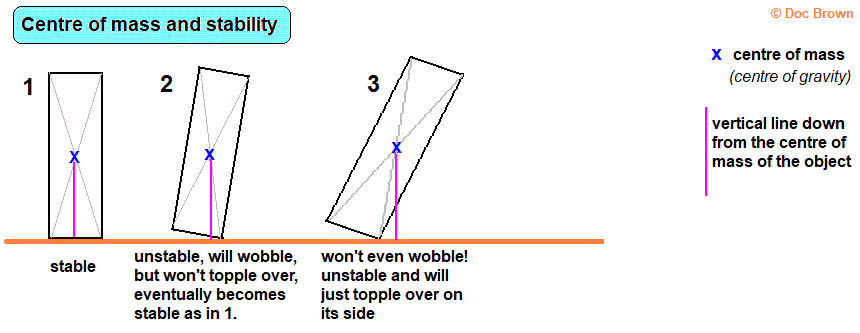
1. The vertical line from the centre
of mass passes right through the centre of the block's base.
The object
is completely stable - no moment (turning force) is generated.
2. The vertical line from the centre
of mass still passes through the base, but not its centre, and the block is unstable, so it
will wobble a bit from side to side, and eventually settle down in an
stable upright position as in 1.
The edge of the block touching the
surface acts as a pivot point.
The weight of the block creates an
anticlockwise moment (turning force) that makes the block fall back in
an anticlockwise direction, but not sufficient to topple the block over
on its longer side.
There is a point between 2. and 3. where theoretically, the
two moments are equal and the block will be balanced on one edge (an
equilibrium situation).
BUT, this is
not a very stable situation, any slight movement e.g. of the air, would
cause it to topple over!
When two moments equal
each other, we call it an equilibrium situation, which may or may not be
stable.
See Part 5.3
Moment calculations and a balancing situation (equilibrium)
3. The vertical line from the centre
of mass passes outside of the block's base. The block won't even
wobble, it is highly unstable and will just topple over on its longer side (to
become stable!).
Again, the edge of the block
touching the surface acts as a pivot point.
Again, the weight of the block
creates a clockwise moment (turning force) that makes the block fall
over in a clockwise direction, and sufficient to topple the block
over on to its longer side.
Tests on stability in terms of the
centre of mass are important e.g. road vehicles like buses are safety
tested to see the maximum angle allowed when tilted over without
toppling over in an accident.
Index of Forces 5.
Turning forces, calculating moments, problem solving
Key points
about
turning forces - what is a moment? what is an equilibrium in the context of
moments?
Information
sources for Doc Brown's key points: IGCSE-GCSE physics are based on
textbooks & syllabus-specifications for students taking the UK AQA, Edexcel,
OCR 21st Century Science, OCR Gateway science suite, WJEC, CCEA and CIE GCSE
physics 9-1 level science examinations
A structured set of summary revision notes
tailored to GCSE/IGCSE Physics students across major UK exam boards (WJEC,
CCEA, CIE, AQA, Edexcel, OCR), focusing on moments and equilibrium:
What Is a Moment?
- A moment is the turning effect of a force around a
pivot.
- Formula:
Moment} = Force (N) x Perpendicular distance from pivot (m)
- Units: Newton metres (Nm)
- Examples: Opening a door, using a spanner, seesaws.
Principle of Moments & Equilibrium
- Principle of Moments:
For an object in equilibrium:
Sum of clockwise moments = Sum of anticlockwise moments
- Equilibrium means:
- No net turning effect.
- Object is either stationary or rotating at constant speed.
- Common setups:
- Balanced beams.
- Seesaws.
- Levers and cranes.
Typical Exam Board Syllabus Contents
|
Key Focus Areas |
| Forces causing rotation, balance beams, calculating moments |
| Principle of moments, levers, real-world applications like crowbars
and scissors |
| Definitions, calculations, and applications in mechanical systems |
| Moment calculations, equilibrium conditions, practical examples |
| Use of formula, interpreting diagrams, applying principle of moments |
| Forces and turning effects, balance conditions, worked examples |
Student Exam Tips on moment questions
- Always use perpendicular distance from the pivot in
calculations.
- Label clockwise and anticlockwise forces clearly in
diagrams.
- Check units
- force in newtons, distance in metres.
- Use worked examples like seesaws or doors to visualise
concepts.
- Practice balancing problems using the principle of
moments.
- Revise real-world applications
- they often appear in
exam questions.
Everyday Examples of Moments
- Opening a door: The force you apply at the handle
creates a moment around the hinges (pivot). The further from the hinge, the
greater the moment.
- Using a spanner: Turning a bolt involves applying force
at a distance from the bolt’s axis - classic moment in action.
- Seesaw: Children of different weights balance by
adjusting their distance from the pivot to equalise moments.
- Pedalling a bicycle: Your foot applies force on the
pedal, which rotates the crank around its axis.
- Turning a steering wheel: The rim is far from the axis,
so a small force creates a large moment - making steering easier.
- Using scissors: Each blade rotates around the pivot
when force is applied at the handles.
- Wheelbarrow: Lifting the handles applies a moment
around the wheel axle, helping you raise the load.
- Opening a bottle with a bottle opener: The opener acts
as a lever, applying force at a distance from the cap’s pivot point.
- Swinging on a swing: Your body weight and motion create
moments around the swing’s suspension point.
- Using a crowbar: A classic lever
- force applied far from
the fulcrum generates a large moment to lift heavy objects.
Keywords, phrases and learning objectives for turning forces
Be able to explain and define what a moment is and
the idea of increasing a mechanical
force of rotation to gain a useful mechanical advantage.
WHAT NEXT?
TOP of page
INDEX for physics notes on forces 5
TURNING FORCES
INDEX of all my physics notes on FORCES
INDEX of all my physics notes on FORCES
and MOTION
INDEX of all my PHYSICS NOTES
email doc
brown - comments - query?
BIG website, using the [SEARCH
BOX] below, maybe quicker than navigating the
many sub-indexes
Basic Science Quizzes for
UK KS3 science students aged ~12-14, ~US grades 6-8
Biology * Chemistry
* Physics for UK
GCSE level students aged ~14-16, ~US grades 9-10
Advanced Level Chemistry
for pre-university age ~16-18 ~US grades 11-12, K12 Honors
Find your GCSE/IGCSE
science course for more help links to all science revision notes
Revision notes on rotation turning
forces & moments based on the syllabus-specifications
for students taking IGCSE/GCSE level physics examinations, summary
revision notes and key points on rotation turning forces & moments for students taking the AQA
igcse/gcse physics notes on rotation turning forces & moments, Edexcel gcse
physics notes on rotation turning forces & moments, OCR 21st century GCSE
physics notes on rotation turning forces & moments, OCR gateway
GCSE physics notes on rotation turning forces & moments, WJEC gcse physics notes on
rotation turning forces & moments, CCEA
gcse physics notes on rotation turning forces & moments for students taking CIE Cambridge igcse
physics, exam revision notes on
rotation turning forces & moments, useful for US grade 9-10 physics courses,
importance of centre of mass &
stability explained
in GCSE level physics, What you need to know about centre of mass &
stability explained for
GCSE level
physics,
Explaining the use of centre of mass & stability explained knowledge in GCSE level physics, Examples of
centre of mass & stability explained when studying GCSE level physics, What is
significant about centre of mass & stability explained, describing the theory of
centre of mass & stability explained when studying
GCSE level physics, revision notes for centre of mass & stability
explained in exams, online exam help
for centre of mass & stability explained, revision notes about centre of
mass & stability explained, what do I need to learn about centre of
mass & stability explained for
by GCSE physics exam?
help to understand the centre of mass & stability explained topic in preparation for GCSE physics exam
question, how to
prepare for questions involving centre of mass & stability explained in a GCSE physics examination?
SITEMAP
Website content © Dr
Phil Brown 2000+. All copyrights reserved on Doc Brown's physics revision notes, images,
quizzes, worksheets etc. Copying of website material is NOT
permitted. Exam revision summaries and references to GCSE science course specifications
are unofficial.
Index of Forces 5.
Turning forces, calculating moments, problem solving
|
