|
GCSE level physics exam revision notes on
Forces 5
Turning forces: 5.6
Gears and cog wheels - a means of transmitting a rotational force effect
[Author
©
Dr Phil Brown PhD:
Doc Brown's physics exam revision notes suitable for students of UK
IGCSE and GCSE level physics courses, ~ US grades 9-10 physics
[forces-5- page updated Mar 14th 2026 *]
email doc
brown: problems?, comments? query?
*
[privacy policy and disclaimer]
[ KEY
POINTS and learning objectives for this page, after initial notes]
Index of physics notes: 5.
Turning forces, calculating moments, problem solving
This page contains online questions only.
Jot down
your answers and check them against the worked out answers at the end of
the page.
5.6 Gears and cog
wheels - a means of transmitting a rotational force effect
Some simple calculations are included at the
end of section (f)
Cog wheels
are circular discs with teeth and components of many machines in transport and
industry.
They are a means of transmitting the rotational effect of
a force from one part to another part of a mechanical device e.g. industrial
machine, motor vehicle or a bicycle.
When several of them are
combined together (linked in contact via the teeth) a rotational force can be transmitted when fitted in contact
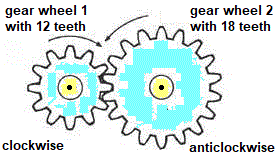
with each other. The cog/gear wheels when in direct contact will rotate in
opposite directions.
Through the interlocking, one cog wheel can turn another in the
opposite direction i.e. if one gear wheel goes clockwise, the gear
wheel in contact with it will go anticlockwise, no matter how many gear
wheels are connected together.
By using different size cog wheels differing in the number
of teeth, you can increase or decrease the force generated by the turning effect
of the gear wheels.
From the gear ratio you can work the
revolutions of one gear wheel with respect to the neighbour wheel e.g.
in the diagram gear wheel 1 has 12
teeth and gear wheel 2 has 18 teeth.
If the smaller wheel 1
turns once, wheel 2 turns 2/3 third of a revolution, teeth ratio
12/18 = 2/3 (0.66).
It the larger wheel 2 turns once,
wheel 1 turns 1.5 revolutions, teeth ratio 18/12 = 3/2 = 1.5.
The teeth ratio gives you the
gear ratio.
A force applied to a smaller gear wheel
creates a small moment
- shorter distance from the teeth to the axle pivot
point.
A force applied to a larger gear wheel
creates a larger moment
- longer distance from the teeth to the axle pivot
point.
As moment = force x distance,
the
ratio of the two moments of the ears is equal to the ratio of the gear radii
which equals the ratio of the teeth.
If you transfer the force from a larger cog wheel (gear wheel
of more teeth) to a smaller cog wheel (gear wheel of less teeth) you decrease
the moment of the 2nd as you have decreased the distance from the
applied force to axle pivot point.
No mechanical advantage is gained
- you haven't increased the output force of the smaller cogwheel.
The smaller cog wheel will be made to
turn faster than the larger cog wheel.
This is a way to increase rotational
speeds in machines.
If the first cog wheel has 20 teeth and
the second cog wheel 5 teeth, one rotation of the first wheel causes the
smaller wheel to rotate 20/5 times = 4 x more - a gear ratio of 1 : 4.
If it was the other way round and you
rotated the 2nd smaller cog wheel first, one turn of it would only
rotate the larger cog wheel by 1/4 (5/20) of a turn - a gear ratio of 4
: 1, decreasing the speed of rotation.
If you transfer the force from a smaller cog wheel (gear
wheel of less teeth) to a larger cog wheel (gear wheel of more teeth) you increase the moment as you have increased the distance from the applied
force to the axle pivot point.
A mechanical advantage is gained
-
you have increased the output force of the larger cogwheel.
By using a set of interlocking gears that
get bigger and bigger you can multiply the moment of the first small gear.
The larger cog wheel will turn more
slowly than the smaller one.
This is the way a relatively low powered
machine can be made to lift heavy weights.
If the first cog wheel has 8 teeth and
the second wheel 56 teeth, you need to turn the first wheel 56/8 = 7 times
to completely rotate the second wheel.
Examples of gear wheel (cogwheel)
applications
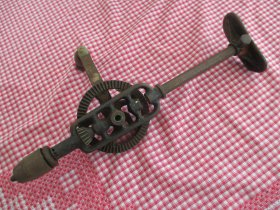
An old fashioned manual drill
The large cog wheel turns a smaller cog wheel at much greater
speed with good old fashioned muscle power!
The force is transmitted from one cog wheel to another.
Since a larger cog wheel of more teeth drives a smaller cog
wheel of less teeth, the output is a high turning speed of the drill.
Gearing in mill wheel systems


Complex machines such as you find in older flour mills and
textile mills, use
gears to utilise the power of the e.g. water wheel, to transmit a force to drive the
machinery with the required speed and power.
A slow rotating water wheel driving a cog wheel system ( a
gear system)
can produce high speeds of rotation to drive a spinning machine - an important
mechanical feature in the Industrial Revolution from the 18th to the 19th
century.
Clocks
Clocks use gear wheels to transmit
the potential energy of the spring and move the arms around at the
correct speed to indicate the correct time.
Different sized gear wheels
are need to operate the minute and hour hands.
The minute hand must go
round 60 x faster than the hour hand, so the gear ratios will take this
into account.
Gears on bicycles
Gears (cogwheels) are used in
bicycles to transfer the force from pedalling the front gears to the
gears on the rear wheels.
The gears are not in contact with
each other, but the cogs are connected by a continuous chain mechanism.
The force of your foot applied to the
pedal rotates the first gear (front cog) and, via the chain, the rear
gear (rear cog) is rotated in the same clockwise direction.
If the cogs are the same size (same
number of teeth), they both rotate at the same speed.


Bicycles often have complex sets of gears
for efficiently transferring the force generated by pedal action to driving
the rear wheel.


The following
two 'simplified' diagrams and notes explain the 'physics' principles behind
gear changes on a bicycle.
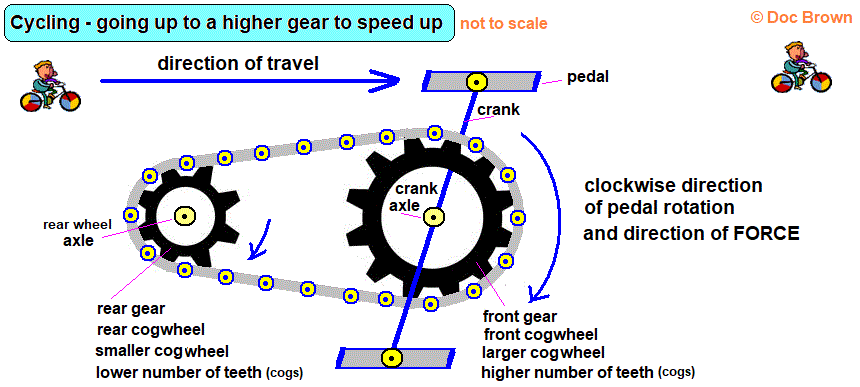
'Speeding up' - especially
downhill !!!
Apart from greater physical
exertion, in order to speed up when cycling, you change to a higher
gear.
You do this by switching to a
smaller rear gear wheel on the back wheel, the smaller gear wheel
rotates faster, but with a smaller force e.g.
The front gear has 12 teeth (or
cogs) and the rear cogwheel 8 in the diagram above.
The ratio is 12/8 = 1.5, so every
time you pedal the front cog round once, the rear cog and wheel are
turned 1.5 times - this assumes the gear teeth of both
cogwheels are the same size so the radius ratio of the cogwheels is
3 : 2.
The gear ratio change can be as high as a
53 to 11 ratio to go fast, so one pedal cycle rotates the rear wheel nearly
five times, but this gear ratio can be hard work!
With a triple chainring on the
front gear and 10 gear set on the rear wheel, you have a choice of
30 gear ratios for fastest speeds on the flat or downhill or
climbing the steepest hills.
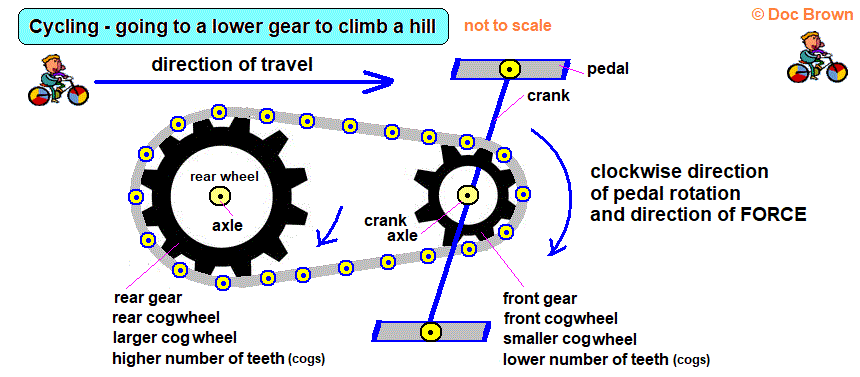
'Tackling a steep hill'
Apart from greater physical
exertion, in order to climb up a steep hill when cycling, you change
to a lower gear.
You do this by switching to a
larger rear gear wheel on the back wheel, the larger gear wheel
rotates more slowly, but with a larger force e.g.
The front gear has 8 teeth (or
cogs) and the rear cogwheel 12 (ratio 2/3) in the diagram above, so
one turn of the front gear by the pedals only produces 2/3rds of
turn of the rear cog and rear wheel.
If the ratio the front cog : rear
cog was 1 : 3, the mechanical advantage is 3 - this assumes the gear
teeth of both cogwheels are the same size so the radius ratio of the
cogwheels is 1 : 3.
This means the input force
produces an output force 3 x greater, but you do a lot of
pedalling to generate a continuous output of a force sufficient
to get up a steep hill.
Gear wheel questions
Q1 A 25 toothed gear wheel is in
contact with a 2nd gear wheel with 5 teeth.
When the first wheel is turned
twice clockwise, in what direction does the 2nd wheel turn and by
how many times?
Worked out ANSWERS
Index of Forces 5.
Turning forces, calculating moments, problem solving
Key points
about
turning forces - cog wheels and gears
Information
sources for Doc Brown's key points: IGCSE-GCSE physics are based on
textbooks & syllabus-specifications for students taking the UK AQA, Edexcel,
OCR 21st Century Science, OCR Gateway science suite, WJEC, CCEA and CIE GCSE
physics 9-1 level science examinations
Keywords, phrases and learning objectives for
these particular turning forces
Be able to explain how cog wheel
gear systems transmit a rotational
turning force.
Be able to do calculations based on cog wheel
teeth ratios
e.g. for bicycle gears, mill wheels or clocks.
importance of
how cog wheel ratios transmit a rotating turning force
in GCSE level physics, What you need to know about how cog wheel ratios
transmit a rotating turning force for
GCSE level
physics,
Explaining the use of how cog wheel ratios transmit a rotating turning
force knowledge in GCSE level physics, Examples of how cog wheel ratios
transmit a rotating turning force explained
when studying GCSE level physics, What is
significant about how cog wheel ratios transmit a rotating turning force, describing the theory of
how cog wheel ratios transmit a rotating turning force when studying
GCSE level physics, revision notes for how cog wheel ratios transmit a
rotating turning force in exams, online exam help
for how cog wheel ratios transmit a rotating turning force, revision notes about
how cog wheel ratios transmit a rotating turning force, what do I need to learn about
how cog wheel ratios transmit a rotating turning force for
by GCSE physics exam?
help to understand the how cog wheel ratios transmit a rotating turning
force topic in preparation for GCSE physics exam
question, how to
prepare for questions involving how cog wheel ratios transmit a rotating
turning force in a GCSE physics examination?
Revision notes on how cog wheel ratios transmit a rotating turning force based on the syllabus-specifications
for students taking IGCSE/GCSE level physics examinations, summary
revision notes and key points on how cog wheel ratios transmit a
rotating turning force for students taking the AQA
igcse/gcse physics notes on how cog wheel ratios transmit a rotating turning
force, Edexcel gcse
physics notes on how cog wheel ratios transmit a rotating turning
force, OCR 21st century GCSE
physics notes on how cog wheel ratios transmit a rotating turning
force, OCR gateway
GCSE physics notes on how cog wheel ratios transmit a rotating
turning force, WJEC gcse physics notes on how cog wheel ratios transmit
a rotating turning force, CCEA
gcse physics notes on how cog wheel ratios transmit a rotating turning
force for students taking CIE Cambridge igcse
physics, exam revision notes on
how cog wheel ratios transmit a rotating turning force, useful for US grade 9-10 physics courses
SITEMAP
Website content © Dr
Phil Brown 2000+. All copyrights reserved on Doc Brown's physics revision notes, images,
quizzes, worksheets etc. Copying of website material is NOT
permitted. Exam revision summaries and references to GCSE science course specifications
are unofficial.
Index of Forces 5.
Turning forces, calculating moments, problem solving
|
|
Worked out
ANSWERS to the moment calculations
Gear wheel questions
Q1 A 25 toothed gear wheel is in
contact with a 2nd gear wheel with 5 teeth.
When the first wheel is turned
twice clockwise, in what direction does the 2nd wheel turn and by
how many times?
The 2nd gear wheel must turn
anticlockwise - it must turn in the opposite
direction.
The 2nd gear wheel will turn 25/5
x 2 = 10
revolutions
Argument: The 25 teeth of the
first gear wheel will move 25 teeth of the smaller gear wheel. Since
the 2nd smaller wheel only has 5 teeth, the 25 teeth of the larger
gear wheel will move it 5 times per revolution and this is doubled
for two revolutions of the 1st larger wheel. The gear ratio is 5 :
1.
Index Forces 5.
Turning forces, calculating moments, problem solving
Website content © Dr Phil Brown
2000+. All copyrights reserved on Doc Brown's physics revision notes,
images, quizzes, worksheets etc. Copying of website material is NOT
permitted. Exam revision summaries and references to science course
specifications are unofficial. Explaining the importance of cog wheels,
gears, rotational force transmission
in GCSE physics, What you need to know about cog wheels, gears,
rotational force transmission for IGCSE physics,
Explaining the use of cog wheels, gears, rotational force transmission knowledge in GCSE
physics, Examples of cog wheels, gears, rotational force transmission explained
for GCSE physics exams, What is
the significance of cog wheels, gears, rotational force transmission in studying for
physics exams, What is the use of cog wheels, gears, rotational force
transmission ? Describing and
explaining the theory of cog wheels, gears, rotational force
transmission, revision preparation for AQA GCSE physics,
Edexcel GCSE physics, OCR GCSE physics. Website content © Dr
Phil Brown 2000+. All copyrights reserved on Doc Brown's physics revision notes, images,
quizzes, worksheets etc. Copying of website material is NOT
permitted. Exam revision summaries and references to science course specifications
are unofficial. These revision notes on cog wheels, gears,
rotational force transmission are suitable for AQA gcse physics,
cog wheels, gears, rotational force transmission revision notes for Edexcel gcse
physics, cog wheels, gears, rotational force transmission revision notes for OCR gcse Gateway science
physics,
cog wheels, gears, rotational force transmission revision notes for OCR 21st Century
science physics, cog wheels, gears, rotational force transmission revision notes WJEC GCSE
physics, cog wheels, gears, rotational force transmission revision
notes for CCEA gcse physics, cog wheels, gears, rotational force
transmission revision notes for CIE Cambridge IGCSE physics exams.
cog wheels, gears, rotational force transmission explained with
examples, help in revising cog wheels, gears, rotational force
transmission for gcse physics exams, knowing the importance of cog
wheels, gears, rotational force transmission for gcse physics exams, key
points to know about cog wheels, gears, rotational force transmission,
exam revision notes for cog wheels, gears, rotational force
transmission, what you need to know about cog wheels, gears, rotational
force transmission, revision help in learning about cog wheels, gears,
rotational force transmission
|