|
GCSE level Physics exam revision notes on
Forces & Motion
Part 3.5 Explaining the complex behaviour of a
falling parachutist, the drag forces and terminal velocities involved
[Author
©
Dr Phil Brown PhD:
Doc Brown's physics exam revision notes suitable for students of UK
IGCSE & GCSE level physics courses, ~ US grades 9-10 physics
[updated Mar 22nd 2026 *]
[ KEY
POINTS and learning objectives for this page, after initial notes]
email doc
brown: comments? query?
*
[privacy & cookies policies & disclaimer]
INDEX for physics notes on
acceleration of falling objects, experiments, friction, drag effects,
gravity, terminal velocity
3.5
The complex behaviour of a
falling parachutist
How and why does a parachute work? What
does it do?
This is an interesting case because it
involves an acceleration, a deceleration and two terminal velocities!
The influence of any side-wind is ignored in this analysis.
1.
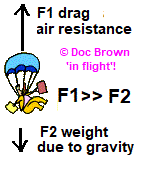 2.
2. 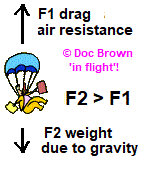 3.
3. 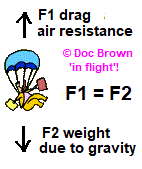
Free body diagrams for a
parachutist after the parachute is opened
and ignoring any side-winds.
These diagrams show the relative
magnitude of the two forces acting on a descending parachutist.
Note the relative size and direction of
the arrows. The weight force F2 is constant.
1. When the parachutist opens the
parachute, there is an immediate large drag force due to big
increase in air resistance (air friction).
2. As the parachutist slows down (decelerates) the
air resistance (F1) reduces and continues to do so until F1 = F2.
3. When drag force F1 equals the weight
force F2, the parachutist is descending at a steady speed - a terminal
velocity.
Remember the drag force on an object
due to friction (air resistance), increases with speed i.e. as more air
brushes over the surface of the object in the same time.
We
now look at the whole sequence of events after the parachutist has jumped
out of the aircraft

speed/velocity-time graph for a parachute descent
 weight due to gravity W↓
and the drag effect due to air resistance
D↑
weight due to gravity W↓
and the drag effect due to air resistance
D↑
(I'm ignoring the minor
effect of upthrust U↑ that applies to any fluid - gas or liquid)
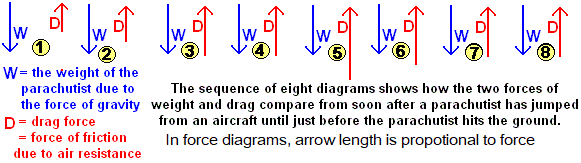
The force vectors operating in the jump
(1)
The parachutist jumps out of the aircraft and immediately accelerates due to
gravity (weight force W↓), but the parachute is not opened yet, so the
parachutist is in free fall!
Between (1)
to (3) acceleration is
taking place, but although W↓ is constant, the drag force D↑ due to air friction
(air resistance) is increasing, so the acceleration is decreasing (gradient
decreasing).
At (3)
the terminal velocity is first reached when the drag force D↑ = weight W
of the parachutist.
Its apparently great to do a spot
of sky diving first at ~120 mph (~54 m/s) with arms and legs stretched out
(increased surface area) and ~200 mph (~89 m/s) if body compact (minimum
surface area).
In the graph I've assumed its one or the other!
Under the influence of the Earth's
gravitational field this first terminal velocity depends on the
shape of your body, but its pretty fast!!!.
Between (3)
to (5) the
descent continues at the (1st) constant terminal velocity because the resultant
force is zero.
At (5)
the parachutist opens the parachute to increase air resistance. The wide
area brushing through the air produces a massive increase in air resistance (friction),
so the drag effect D↑ massively increases, and is far greater than W, so rapid
deceleration immediately takes place.
Between (5)
to (7) the deceleration
continues and as the parachutist decreases in speed, so the drag forces
decreases too.
At (7)
the drag force once again equals the weight force and the parachutist attains a
2nd, somewhat slower, terminal velocity.
Between (7)
and (8) the parachutist
descends far more slowly with constant speed to land safely at ~15 mph, again
the resultant force is zero.
Simple terminal velocity
parachute experiments
You do simple experiments with toy parachutes
attached to a weight to determine their terminal velocities.
You can vary the mass attached to a
parachute of constant surface area - will it fall faster the greater the
mass?
For the same weight of an attached mass,
does it fall more slowly with a larger sized area parachute?
There is scope for investigating
factors affecting the drag effect of air resistance.
Physics notes index on
acceleration of falling objects, experiments, friction, drag effects,
gravity, terminal velocity
Key points force and motion:
The
complexity of a parachutists - the physics of the descent
Information
sources for Doc Brown's key points: IGCSE-GCSE physics are based on
textbooks & syllabus-specifications for students taking the UK AQA, Edexcel,
OCR 21st Century Science, OCR Gateway science suite, WJEC, CCEA and CIE GCSE
physics 9-1 level science examinations
A structured set
of summary revision notes on the complex behaviour of a falling
parachutist, focusing on drag forces and
terminal velocity, tailored to the major UK GCSE/IGCSE
physics exam boards: WJEC, CCEA, CIE, AQA, Edexcel, and OCR.
Stages of a Parachutist’s Fall
1.
Initial Jump
- Only force acting: weight
(gravity) downward.
- Air resistance (drag)
is negligible.
- Resultant force = weight →
acceleration downward.
2.
Increasing Speed
- As speed increases, air
resistance increases.
- Resultant force decreases →
acceleration slows.
- Eventually, air resistance
= weight → terminal velocity reached.
3.
Parachute Opens
- Sudden increase in surface
area → massive increase in drag force.
- Drag > weight →
deceleration.
- Speed decreases until new
lower terminal velocity is reached.
4.
Final Descent
- Forces balance again: drag
= weight.
- Parachutist descends at
constant, safe speed.
Core Concepts Across Exam Boards
| Concept |
Description |
| Terminal Velocity |
Constant speed when drag force
balances weight |
| Drag Force |
Resistive force from air;
increases with speed and surface area |
| Newton’s Laws |
Explains changes in motion due
to unbalanced and balanced forces |
| Velocity-Time Graph |
Shows acceleration, terminal
velocity, deceleration, and final steady speed |
| Energy Transfer |
Work done against drag
converts kinetic energy into thermal energy |
Velocity-Time Graph Features
- Steep slope:
Initial acceleration.
- Flat section:
Terminal velocity.
- Dip after parachute opens:
Deceleration.
- Second flat section:
Lower terminal velocity.
Typical Exam
Board syllabus contents
- Focus on forces in fluids,
motion graphs, and energy transfer.
- May include skydiver
scenarios in exam questions.
- Emphasizes
balanced/unbalanced forces, drag, and
streamlining.
- Covers terminal velocity,
energy efficiency, and practical
applications.
- Links to Newton’s laws,
free-fall, and fluid resistance.
Student Tips for Exams
- 🎯 Define terminal
velocity: Constant speed when forces are balanced.
- 🧪 Use force diagrams:
Show weight and drag at each stage.
- 📊 Sketch velocity-time
graphs: Highlight changes in acceleration.
- 🔗 Link to Newton’s laws:
Especially 1st and 2nd laws.
- ✈️ Use real-world examples:
Skydivers, falling objects, parachutes.
- 📚 Revise practicals:
Understand how drag and terminal velocity are measured.
Keywords, phrases and learning objectives for the physics of a falling
parachutist
Be able to describe and explain the c omplex behaviour of
the motion analysis of a falling
parachutist.
Know force vectors involved, the concept of two terminal velocities
and interpret the descent at various stages with free body
diagrams to explaining what is happening
to the parachutist at each stage.
WHAT NEXT?
TOP of page
INDEX for physics notes on
acceleration of falling objects, experiments, friction, drag effects and
terminal velocity
INDEX of all my physics notes on FORCES
and MOTION
INDEX of all my physics notes on FORCES
INDEX of all my PHYSICS NOTES
email doc
brown - comments - query?
BIG website, using the [SEARCH
BOX] below, maybe quicker than navigating the
many sub-indexes
HOME PAGE of Doc Brown's Science
Basic Science Quizzes for
UK KS3 science students aged ~12-14, ~US grades 6-8
Biology * Chemistry
* Physics for UK
GCSE level students aged ~14-16, ~US grades 9-10
Advanced Level Chemistry
for pre-university age ~16-18 ~US grades 11-12, K12 Honors
Find your GCSE/IGCSE
science course for more help links to all science revision notes
importance of
explaining velocity profile of falling parachutist & terminal velocities
in GCSE level physics, What you need to know about explaining velocity
profile of falling parachutist & terminal velocities for
GCSE level
physics,
Explaining the use of explaining velocity profile of falling parachutist
& terminal velocities knowledge in GCSE level physics, Examples of
explaining velocity profile of falling parachutist & terminal velocities explained
when studying GCSE level physics, What is
significant about explaining velocity profile of falling parachutist &
terminal velocities, describing the theory of explaining velocity
profile of falling parachutist & terminal velocities when studying
GCSE level physics, revision notes for explaining velocity profile of
falling parachutist & terminal velocities in exams, online exam help
for explaining velocity profile of falling parachutist & terminal
velocities, revision notes about explaining velocity profile of falling
parachutist & terminal velocities, what do I need to learn about
explaining velocity profile of falling parachutist & terminal velocities for
by GCSE physics exam?
help to understand the explaining velocity profile of falling
parachutist & terminal velocities topic in preparation for GCSE physics exam
question, how to
prepare for questions involving explaining velocity profile of falling
parachutist & terminal velocities in a GCSE physics examination?
Revision notes on explaining velocity profile of falling parachutist &
terminal velocities based on the syllabus-specifications
for students taking IGCSE/GCSE level physics examinations, summary
revision notes and key points on explaining velocity profile of falling
parachutist & terminal velocities for students taking the AQA
igcse/gcse physics notes on explaining velocity profile of falling parachutist &
terminal velocities, Edexcel gcse
physics notes on explaining velocity profile of falling parachutist
& terminal velocities, OCR 21st century GCSE
physics notes on explaining velocity profile of falling parachutist
& terminal velocities, OCR gateway
GCSE physics notes on explaining velocity profile of falling
parachutist & terminal velocities, WJEC gcse physics notes on explaining
velocity profile of falling parachutist & terminal velocities, CCEA
gcse physics notes on explaining velocity profile of falling parachutist
& terminal velocities for students taking CIE Cambridge igcse
physics, exam revision notes on
explaining velocity profile of falling parachutist & terminal velocities, useful for US grade 9-10 physics courses
SITEMAP
Website content © Dr
Phil Brown 2000+. All copyrights reserved on Doc Brown's physics revision notes, images,
quizzes, worksheets etc. Copying of website material is NOT
permitted. Exam revision summaries and references to GCSE science course specifications
are unofficial.
Physics notes index on
acceleration of falling objects, experiments, friction, drag effects,
gravity, terminal velocity
|
