4.3 Experiments to
investigate Newton's 2nd law of motion (F = ma)
The experiments described below can be used to investigate how
force and mass affect acceleration.
These experiments use light gates to
measure speed - so they need to be explained!
A light gate directs a beam of light from
one side to a detector on the other side (no details shown, just the
labels!).
When the light beam is cut by
something passing through the light gate (e.g. the a card on a trolley) the
light gate measures the time the light beam is not detected.
To make an acceleration measurement the
moving object must break the light beam twice and there are two ways of
doing this - versions 1 and 2 experiments are both described below. Yu need
two speeds and the difference between them to calculate an acceleration.
The light gate is connected to a
computer and the rest is explained via the diagram below.

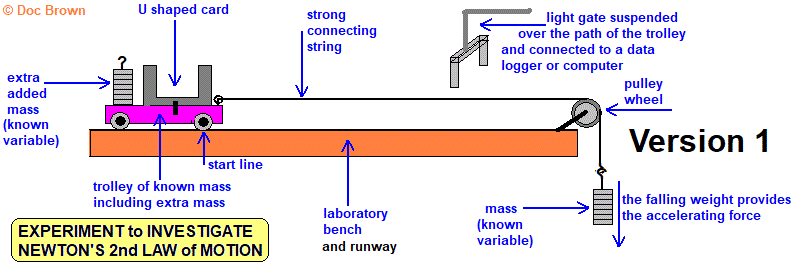
In version 1, with one light gate, you
use an inverted Π shaped card (rectangle with a middle section cut out).
The lengths of the upright sections that cut
the light beam are d1 and d2 (which you can make the same).
As the trolley and card pass through the
light gate, the first section of card of length d1, cuts light beam for time t1
(for speed 1).
When the second section of the card of length
d2 passes through the light gate, the beam is cut for time t2 (for speed 2).
At this point the combined light gate also
records the time difference t3 between the two speed measurements (for
acceleration a). So for speed s ...
s1 = d1/t1, s2 = d2/t2, acceleration = change
in speed / time taken = a = (s2 - s1)
/ t3
However, all you do is input d1 (= d2) into
the computer and the software does the acceleration calculation for you!
Obviously, the computer software system must
be set up to suit the way you have set up the experiment.
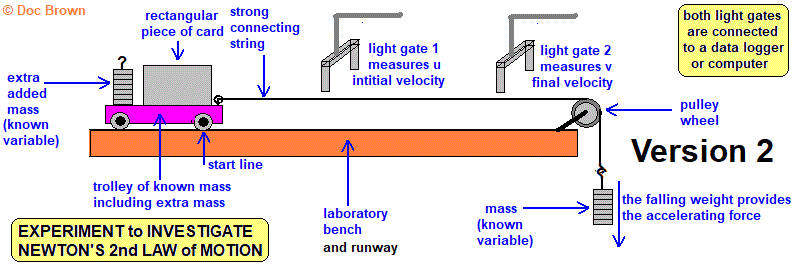
In version 2, with two light gates,
you use a rectangular shaped card
[ ]
of length
d.
You set up two light gates a suitable
distance apart.
When the trolley and card pass through the
first light gate, the beam is cut for t1.
After passing through the 2nd light gate,
time t2 is recorded.
At this point the combined light gates also
record the time difference t3 between the two speed measurements.
Its now a similar data situation to version 1
of the experiment, so for speed s ....
s1 = d/t1, s2 = d/t2, acceleration = change
in speed / time taken = a = (s2 - s1)
/ t3
Again, the computer software system must be
set up to suit the way you have set up the experiment and will do the
acceleration calculation for you.
Example of calculation for experiment version 2
Suppose the length of the trolley is 10
cm (0.10 m) and interrupts the 1st light gate for 0.25 s.
The velocity at the 1st light gate is
0.10 / 0.25 = 0.40 m/s.
The trolley interrupts the 2nd light gate
for 0.10 s.
The velocity at the 2nd light gate is
0.10 / 0.10 = 1.0 m/s.
The time taken for the trolley to travel
between the light gates was 0.80 s.
Therefore the
acceleration =
(v - u ) / ∆t = (1.0 - 0.40) / 0.80 = 0.75
m/s2
Investigation version 1 using one light
gate
Error correction
NOT shown in the diagram above
Strictly speaking you should do the
experiment on a slightly tilted running board rather than the horizontal
laboratory bench shown in the diagrams above.
You tilt the running board ramp down to
the right until the trolley (without hook attached) just begins to move on
its own.
You then prop up the left-hand end at the
same height and then perform the experiments as described.
After doing this, the weight of the
trolley down the slope will compensate for the friction acting between the
wheels of the trolley and the running board ramp.
It is also possible to do these
investigations with a horizontal air track on which a 'trolley' hovers on
jets of air - this is an alternative investigation design to minimise the
effects of friction in the experiments.
The experiment is conducted on a smooth bench on which a trolley
can freely run.
You need to mark on a start line to keep
things consistent.
The total mass of the trolley and extra
weights (m) is measured and can be altered by adding
extra weights.
On the trolley is fixed a 'rectangular' Џ
shaped card, whose two arms will block the light beam twice when the trolley
passes through the light gate when it measures the time taken twice.
The trolley is connected by wire or string to
the weights via the pulley wheel, that on falling, provide the downward force to
accelerate the trolley along the 'runway'
The time measured by the light gate system is
recorded electronically and passed to the connected data logger or computer.
As the Џ card passes through the light
gate, the light beam is cut off twice, so two velocities are measured and the
time interval between them.
The principles of the
F = ma
calculations for version 1.
The accelerating force
F is given by
the falling weight: mass in kg x 9.8 N/kg
The mass being accelerated = total mass of
trolley plus weights (m)
The acceleration is given by the light gate
velocities divided by the time interval between them:
a = v2 -
v1 / Δt
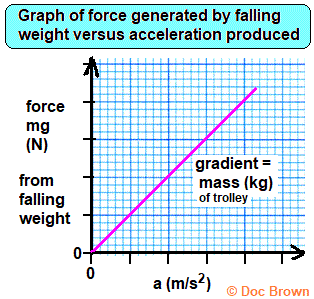 You can do a series of experiments with
constant trolley mass m, and varying the accelerating force F by varying the falling weights
on the end of the hook.
You can do a series of experiments with
constant trolley mass m, and varying the accelerating force F by varying the falling weights
on the end of the hook.
Theoretically, a graph of force F versus
acceleration a should be linear - or look something like it!
The gradient is given by the
trolley mass
m (the constant).
You should definitely be able to show
that increasing the applied force a greater acceleration is produced,
ideally your results are a linear graph.
Newton's 2nd law equation: F = ma,
F
 a, and the constant gradient should be the total mass of the trolley.
Extending the investigation
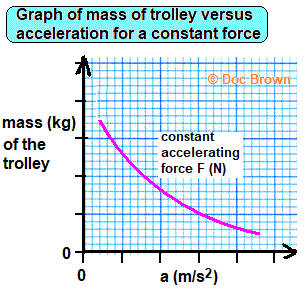 You can then investigate the effect
of varying the weights on the trolley, to vary its mass and applying a
constant force of acceleration using the same falling weight.
You can then investigate the effect
of varying the weights on the trolley, to vary its mass and applying a
constant force of acceleration using the same falling weight.
You measure the acceleration in
the same way as described.
You should be able to show the
greater the total mass of the trolley m (the greater its inertia), the
smaller the acceleration
produced by a constant accelerating force (F).
A graph of mass versus acceleration
should be a downward curve.
F = ma, as m gets
bigger, a gets smaller for constant F.
m = F/a and
a = F / m
You can do a linear graph analysis of
your results e.g.
A graph of m versus 1/a should be
linear with a gradient F.
A graph of acceleration a
versus 1/m should be linear with a gradient F.
Sources of error
Friction in the wheel axles and friction
between the wheels and the running board will have a small retarding effect.
This will reduce the acceleration a little bit.
One way to compensate for this is to
tilt the running board slightly until the trolley just moves, but don't
overdo it or you will record accelerations greater than you should.
You can do more accurate experiments
using an air track on which the 'trolley' is made to hover on
jets of air.
Using the light gates and a computer is
more accurate than trying to make direct observations with a stopwatch.
Investigation version 2 using two light
gates
Error correction
NOT shown in the diagram above
Strictly speaking you should do the
experiment on a slightly tilted running board rather than the horizontal
laboratory bench shown in the diagrams above.
You tilt the running board ramp down to
the right until the trolley (without hook attached) just begins to move on
its own.
You then prop up the left-hand end at the
same height and then perform the experiments as described.
After doing this, the weight of the
trolley down the slope will compensate for the friction acting between the
wheels of the trolley and the running board ramp.
It is also possible to do these
investigations with a horizontal air track on which a 'trolley' hovers on
jets of air - this is an alternative investigation design to minimise the
effects of friction in the experiments.
As the
[ ] card goes past the light gates, the
two
time intervals for blocking the light give you an initial and final velocity,
and the time interval between these two events can be used to calculate the
acceleration of the trolley.
The investigations, calculations and graphs
you can do are described above in method 1.
Version 3 of
acceleration experiments.
You can run the trolley down an inclined ramp onto the level
running board and then past two light gates (2 and 3) to measure the final
velocity.
You can set the first light gate (1) near the start line of
the inclined ramp - the initial velocity should be close to zero.
You can vary the angle of the ramp - the steeper angle
should give a greater acceleration.
You can vary the length of the inclined ramp to see if a
longer running downhill distance increases acceleration.
You can vary the total mass of the trolley to if this has
any effect on the acceleration.
INDEX for physics notes on
Newton's Laws of Motion
Key points
on
Newton's laws of motion: Experiments to investigate Newton's 2nd Law of Motion
Information
sources for Doc Brown's key points: IGCSE-GCSE physics are based on
textbooks & syllabus-specifications for students taking the UK AQA, Edexcel,
OCR 21st Century Science, OCR Gateway science suite, WJEC, CCEA and CIE GCSE
physics 9-1 level science examinations
A structured set of summary
revision notes on school laboratory experiments
investigating Newton’s Second Law of Motion (F = ma), tailored to
the GCSE/IGCSE Physics specifications across major UK exam
boards: WJEC, CCEA, CIE, AQA, Edexcel, and OCR.
Newton’s Second Law – Required Practical
Overview
Core Principle
Newton’s Second Law:
The acceleration of an object is directly proportional to the resultant
force acting on it and inversely proportional to its mass.
Expressed as: F = m × a
Common Experimental Setup for Newton's 2nd law
investigations
Apparatus
- Trolley or glider
- Pulley and string
- Slotted masses
- Light gates or motion sensor
- Stopwatch (if no sensors)
- Data logger (optional)
- Ramp or air track
- Mass balance
- Ruler or measuring tape
Variables for Newton's 2nd law investigations
| Type |
Description |
| Independent |
Force (via hanging mass) or Mass of
trolley |
| Dependent |
Acceleration of trolley |
| Control |
Friction, ramp angle, string tension,
trolley type |
Method 1: Varying Force (Constant Mass) for
Newton's 2nd law investigations
- Set up trolley connected to hanging mass
via pulley.
- Keep trolley mass constant.
- Vary hanging mass to change force.
- Release trolley and measure acceleration
using light gates or motion sensor.
- Repeat for different forces.
- Plot Force (N) versus
Acceleration (m/s²) → should be a straight line.
Method 2: Varying Mass (Constant Force) for
Newton's 2nd law investigations
- Keep hanging mass constant.
- Add masses to trolley to increase total
mass.
- Measure acceleration for each mass
configuration.
- Plot 1/Mass (1/kg) versus
Acceleration (m/s²) → should be a straight line.
Typical Exam Board Specification Contents for
Newton's 2nd law experimental investigations
|
Required Practical
Focus |
| Investigate how force affects
acceleration; use light gates or stopwatch; plot graphs and interpret
gradients |
| Prescribed practicals include motion
on inclined runway and Hooke’s Law; focus on average speed and
acceleration |
| Extended tier students must analyse
motion data and apply F = ma; use formula triangle and interpret graphs |
| Required practical: investigate force
versus acceleration; use trolley, pulley, and light gates; evaluate
accuracy and errors |
| Core practical: use light gates and
data logger; plot acceleration versus force and versus 1/mass; interpret
inverse and direct relationships |
| Gateway Science includes practicals on
acceleration and Newton’s laws; emphasis on vector diagrams and inertia |
Data Analysis Tips for Newton's 2nd law
experiment
- Use
a = (v - u)/t or
v² - u² = 2as to calculate acceleration.
- Plot graphs to identify proportional
relationships.
- Use gradients to estimate mass or force.
- Evaluate sources of error: friction,
timing accuracy, pulley resistance.
Student Tips on experiments to investigate
Newton's 2nd law of motion
- Practice both methods:
varying force and varying mass.
- Use light gates
for precision; avoid stopwatch unless necessary.
- Graph interpretation
is key - know what a straight line means!
- Rearrange F = ma
confidently for different unknowns.
- Understand inertia:
heavier objects resist acceleration more.
- Repeat trials
and average results to reduce random error.
Keywords, phrases and learning objectives for experiments to show the validity
of Newton's 2nd law of motion
Be able, with the aid of diagrams, describe and explain experiments to investigate Newton's 2nd law of motion using light gates
and an accelerating wheeled object of some description.
Be able to the methods and procedures to gather data and calculate the results
and produce graphs that prove Newton's second law of motion.
INDEX for physics notes on
Newton's Laws of Motion
Website content © Dr Phil Brown
2000+. All copyrights reserved on Doc Brown's physics revision notes,
images, quizzes, worksheets etc. Copying of website material is NOT
permitted. Exam revision summaries and references to science course
specifications are unofficial. Explaining the importance of Newton's 2nd
law of motion experiments and investigation calculations
in GCSE physics, What you need to know about Newton's 2nd law of motion
experiments and investigation calculations for IGCSE physics,
Explaining the use of Newton's 2nd law of motion experiments and
investigation calculations knowledge in GCSE physics, Examples of
Newton's 2nd law of motion experiments and investigation
calculations explained
for GCSE physics exams, What is
the significance of Newton's 2nd law of motion experiments and
investigation calculations in studying for physics exams, What is the use of
Newton's 2nd law of motion experiments and investigation
calculations ? Describing and
explaining the theory of Newton's 2nd law of motion experiments and
investigation calculations, revision preparation for AQA GCSE physics,
Edexcel GCSE physics, OCR GCSE physics. Website content © Dr
Phil Brown 2000+. All copyrights reserved on Doc Brown's physics revision notes, images,
quizzes, worksheets etc. Copying of website material is NOT
permitted. Exam revision summaries and references to science course specifications
are unofficial. These revision notes on Newton's 2nd law of
motion experiments and investigation calculations are suitable for AQA gcse
physics,
Newton's 2nd law of motion experiments and investigation
calculations revision notes for Edexcel gcse physics, Newton's 2nd
law of motion experiments and investigation calculations revision notes for OCR gcse Gateway science
physics,
Newton's 2nd law of motion experiments and investigation
calculations revision notes for OCR 21st Century
science physics, Newton's 2nd law of motion experiments and
investigation calculations revision notes WJEC GCSE physics,
Newton's 2nd law of motion experiments and investigation
calculations revision
notes for CCEA gcse physics, Newton's 2nd law of motion experiments and
investigation calculations revision notes for CIE Cambridge IGCSE
physics exams. Newton's 2nd law of motion experiments and
investigation calculations explained with examples, help in revising
Newton's 2nd law of motion experiments and investigation
calculations for
gcse physics exams, knowing the importance of Newton's 2nd law of motion
experiments and investigation calculations for gcse physics
exams, key points to know about Newton's 2nd law of motion experiments
and investigation calculations, exam revision notes for Newton's 2nd
law of motion experiments and investigation calculations, what
you need to know about Newton's 2nd law of motion experiments and
investigation calculations, revision help in learning about Newton's
2nd law of motion experiments and investigation calculations,
importance of Experiments to
investigate Newton's 2nd Law of Motion
in GCSE level physics, What you need to know about Experiments to
investigate Newton's 2nd Law of Motion for
GCSE level
physics,
Explaining the use of Experiments to investigate Newton's 2nd Law
of Motion knowledge in GCSE level physics, Examples of Experiments
to investigate Newton's 2nd Law of Motion explained
when studying GCSE level physics, What is
significant about Experiments to investigate Newton's 2nd Law of
Motion, describing the theory of Experiments to investigate
Newton's 2nd Law of Motion when studying
GCSE level physics, revision notes for Experiments to investigate
Newton's 2nd Law of Motion in exams, online exam help
for Experiments to investigate Newton's 2nd Law of Motion, revision notes about
Experiments to investigate Newton's 2nd Law of Motion, what do I need to learn about
Experiments to investigate Newton's 2nd Law of Motion for
by GCSE physics exam?
help to understand the Experiments to investigate Newton's 2nd Law
of Motion topic in preparation for GCSE physics exam
question, how to
prepare for questions involving Experiments to investigate
Newton's 2nd Law of Motion in a GCSE physics examination?
Revision notes on Experiments to investigate Newton's 2nd Law of
Motion based on the syllabus-specifications
for students taking IGCSE/GCSE level physics examinations, summary
revision notes and key points on Experiments to investigate
Newton's 2nd Law of Motion for students taking the AQA
igcse/gcse physics notes on Experiments to investigate Newton's 2nd Law of
Motion, Edexcel gcse
physics notes on Experiments to investigate Newton's 2nd Law
of Motion, OCR 21st century GCSE
physics notes on Experiments to investigate Newton's 2nd Law
of Motion, OCR gateway
GCSE physics notes on Experiments to investigate Newton's 2nd
Law of Motion, WJEC gcse physics notes on Experiments to investigate
Newton's 2nd Law of Motion, CCEA
gcse physics notes on Experiments to investigate Newton's 2nd Law
of Motion for students taking CIE Cambridge igcse
physics, exam revision notes on
Experiments to investigate Newton's 2nd Law of Motion, useful for US grade 9-10 physics courses
SITEMAP
Website content © Dr
Phil Brown 2000+. All copyrights reserved on Doc Brown's physics revision notes, images,
quizzes, worksheets etc. Copying of website material is NOT
permitted. Exam revision summaries and references to GCSE science course specifications
are unofficial.
