|
GCSE level Physics exam revision notes on
Forces & Motion Part 4
Forces and Newton's Laws of Motion Part 4.5
Newton's Third law of Motion
- defined and examples explained
[Author
©
Dr Phil Brown PhD:
Doc Brown's physics exam revision notes suitable for students of UK
IGCSE & GCSE level physics courses, ~ US grades 9-10 physics
[forces-motion-4 updated
Mar 24th 2026]
[ KEY
POINTS and learning objectives for this page, after initial notes]
email doc
brown: comments? query?
*
[privacy & cookies policy & disclaimer]
*
[SEARCH]
INDEX for physics notes on
Newton's Laws of Motion: concepts, formulae, calculations and problem
solving
4.5 Newton's Third law of Motion
What is Newton's third law of motion?
Newton's Third Law of motion states that
when two objects interact, the forces they exert on each other are equal in
numerical value, act in opposite directions and are of the same type.
This at first suggests that neither object
can move anywhere, but you have two objects and two outcomes!
In general, what can you can say for the
forces in a pair of objects interacting?
They are the same size.
They act in opposite directions.
They act on different objects.
They are the same type of force.
These four points will be illustrated
in the following examples.
(Context 1)
A stationary example of Newton's 3rd
Law
A bit
more messy to analyse than you think !!!
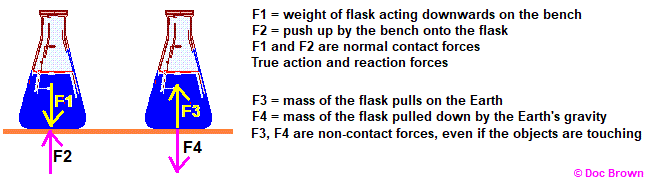
Consider the flask of liquid standing
motionless on a laboratory bench.
There are two sets of forces operating shown
by the arrows of opposing direction, but the same length - same magnitude of
force.
Both sets of forces are examples of Newton's 3rd Law, but don't mix the
two up!
(i) The normal contact force due to the
weight of the object acting (pushing) down on the surface of the bench (F1) is
balanced by the bench under minute compression of the atoms pushing back up to an equal and
opposite extent onto the flask (F2).
A similar argument applies to when you
push against an object that isn't moving.
The force of your push is balanced by the compressed atoms of the object
pushing back!
(ii) At the same time both the flask and the Earth
(including the bench) are mutually attracting each other (F3 and F4) to an equal
and opposite extent due to the non-contact force of gravity.
The Earth attracts the flask and the
flask attracts the Earth.
It makes no
difference whether the objects are in contact or not, here gravity acts
throughout everything!).
(Just because objects
are touching each other, there can still be non-contact forces
acting)
In the cases described so far there is
no
resultant force, everything is balanced.
If the forces were not balanced and
there was some net resultant force, the object would move or be reshaped
- something would change!
For stationary objects, if the resultant
force acting on the object is zero the object is said to be in equilibrium (effectively means a state of balance).
Take care with equilibrium situations
which might look like examples of Newton's Third Law of motion
e.g. suppose a watch is hanging on the
end of gold chain in a stationary equilibrium situation.
Does this conform with Newton's Third
Law.
The answer is no because the
forces are not of the same type and they both acting on the watch.
The weight of the watch is acting
downwards due to a gravitational field..
The tension in the chain is acting
upwards from the watch - the tension is due to atoms pulling on
each other.
(Context 2)
'Movement' examples of Newton's 3rd Law
and motion consequences
illustrating all four points
listed above
Situation 1. Ice skaters on
an ice rink.
Suppose two ice skaters, of similar
mass, are standing next to each other, and then one of them pushes the
other with a force of 80 N, what happens next?
Both skaters experience the same
normal contact force of 80 N, but in opposite directions.
Both skaters will accelerate away
from each other in opposite directions.
However, they will only
accelerate away from each other with the same acceleration if they
of the same mass.
Since F = ma and a = F/m,
if one of the skaters has a
smaller mass than the other, the skater of smaller mass will move in
the opposite direction with a greater acceleration (F is a constant
and a
 1/m).
1/m).
Situation 2. Astronaut with a rocket
back pack
In 'outer space' in a zero gravity
situation, an astronaut could manoeuvre around using a small jet pack
attached to the back of a spacesuit.
When fired, the gases are accelerated
one way and an equal and opposite force acts on the astronaut who is
accelerated in the opposite direction - hopefully back to the space
station or spaceship!
Situation 3. A head-on
collision of two objects

Suppose two balls m1 and m2, of masses m1
and m2 collide head-on with a certain normal contact force.
Assume mass m1 is smaller than mass m2.
Let us assume, before impact, they are
moving at the same velocity towards each other.
On impact they both fly backwards in the
opposite direction than before impact.
According to Newton's 3rd Law, both
balls experience exactly the same force, but acting in opposite directions.
However
because they have different
inertial masses, so, as a consequence of a = F/m (Newton's 2nd Law)
..
the smaller inertial mass, ball m1, will
be accelerated more and fly off with a greater velocity than ball m2,
the larger inertial mass, ball m2, will
be accelerated less and fly off with a smaller velocity than ball m1,
(Context 3)
A head-on collision between two road
vehicles
In example (ii) the balls rebounded of
each other, but what are the consequences of two objects colliding head on
and 'crunching' together.

So, imagine a 1000 kg car travelling
crashing head-on into a 500 kg car travelling in the opposite direction.
(a) What can you say about the impact
force experienced by each car?
According to Newton's 3rd law of
motion, both cars experience the same impact force, but in opposite
directions.
(b) What can you say about the relative
deceleration of each car and their relative inertial masses?
Newton's 2nd law of motion can be
stated as F = ma,
F = impact force, m =
inertial mass and a = deceleration (negative acceleration).
Since the impact force is the same,
mag for the 1000 kg green car = mab
for the 500 kg blue car.
This means that the deceleration
(negative a) for the green car of larger mass must be less than that for
the blue car of smaller mass.
In fact, we can say mathematically,
for the same impact force F
1000 x agreen car =
500 x ablue car
Which means that the relative
deceleration of the blue/green cars is 1000/500 = 2.
So, the 'lighter' blue car
decelerates at twice the rate of the 'heavier' green car.
The green car has a much greater
inertial mass, and is more difficult to slow down than the blue car
of much smaller inertial mass, for the same impact force.
(c) What are the consequences for each
driver from your answers to (b)?
The consequences for the driver of
the blue car are potentially much more serious than the consequences for
the driver of the green car.
The blue car driver will be
accelerated forwards at twice as much as the green car driver, with
potentially greater impact injuries - although all should be wearing
safety belts, there is still the possibility of 'whiplash' injuries.
You could also presume, in the case
of either driver, the smaller the mass of the driver, the more the would
be accelerated forwards.
(d) If the cards were travelling at the
same speed prior to impact, and the crunch combination continued moving as a
single object, which direction would the 'wreck' move and why?
(i) The 'combination wreck' would
continue moving to the right.
Eventually it would come to a
halt due to friction with the road.
(ii) The 'combination wreck' would
continue moving to the right because of he heavier mass of the green
car.
The green car has twice the
momentum (mass x velocity) of the blue car.
For more on (d) see Q2.7 on
momentum
calculations and Newton's 2nd law of motion
(Context 4) A cat leaping up from the ground to catch a
butterfly!
The 'force' sequences (neglecting air
resistance)
-
At the start a pair of equal
non-contact gravitational forces operate - the Earth attracts the cat
and the cat attracts the Earth.
-
Coincident are the normal contact
forces operating - the weight of the cat pushes down on the ground via
the cat's paws and the compressed ground pushes back up with an equal
opposite action force.
-
On leaping up, the cat's muscles
exert an increased normal contact force on the ground through its back
legs and, again, the ground pushes up with an increased equal an
opposite normal contact force.
-
The normal contact forces are no
longer operating and the upward acting force generated by the cat's
muscles must initially exceed the weight of the cat due to gravity - the
cat's acceleration must exceed the Earth's gravitational pull on it -
otherwise it can't leave the ground.
-
The cat's kinetic energy store (KE)
decreases and its gravitational potential energy store (GPE) increases
to a maximum at the maximum height the cat reaches into the air - the KE
is zero just for a moment, then as it falls the cat's GPE is converted
back to KE.
-
The cat is attracting the Earth and
the Earth is equally attracting the cat, which now falls to the ground.
-
The normal contact force of the cat's
impact on the ground is equalled by the atoms of the ground pressing
back up.
See
also Forces and Motion Section 6.
Elastic/non-elastic collisions, momentum calculations, Newton's 2nd law
INDEX for physics notes on
Newton's Laws of Motion
Key points
on
Newton's laws of motion:
Newton's Third law of Motion
- defined and examples explained
Information
sources for Doc Brown's key points: IGCSE-GCSE physics are based on
textbooks & syllabus-specifications for students taking the UK AQA, Edexcel,
OCR 21st Century Science, OCR Gateway science suite, WJEC, CCEA and CIE GCSE
physics 9-1 level science examinations
A structured set of summary revision notes on
Newton’s Third Law of
Motion, tailored to the GCSE/IGCSE Physics specifications
across major UK exam boards: WJEC, CCEA, CIE, AQA, Edexcel, and OCR.
Newton’s Third Law of Motion – Summary
Revision Notes
Definition (Universal Across All Boards)
For every action, there is an
equal and opposite reaction.
This means that when two
objects interact, they exert forces of equal magnitude
but in opposite directions on each other.
Key Concepts
for Newton's 3rd law of motion
- Force Pairs:
Forces always occur in pairs acting on different objects.
- Equal Magnitude:
Both forces are the same size.
- Opposite Direction:
The forces act in opposite directions.
- Same Type of Force:
Both forces are of the same nature (e.g. gravitational, contact,
electrostatic).
Real-Life Examples
of Newton's 3rd law of motion
| Scenario |
Action |
Reaction |
| Walking |
Foot pushes ground backward |
Ground pushes foot forward |
| Swimming |
Swimmer pushes water backward |
Water pushes swimmer forward |
| Rocket launch |
Rocket pushes gases downward |
Gases push rocket upward |
| Sitting on a chair |
Body pushes down on chair |
Chair pushes up on body |
| Recoil of a gun |
Bullet pushed forward |
Gun pushed backward |
Typical Exam Board syllabus
specifications for Newton's 3rd law of motion
|
Specific
Requirements |
| Higher tier: define and apply the
law to interactions; use examples like walking and collisions |
| Explain action-reaction pairs;
apply to contact and non-contact forces |
| Define and identify force pairs;
extended tier: apply to momentum and collisions |
| Recognise force pairs in diagrams;
apply to equilibrium and motion scenarios |
| Use examples to explain force
pairs; apply to walking, collisions, and propulsion |
| Gateway Science: identify third
law pairs; apply to motion and equilibrium |
Common Misconceptions
about Newton's 3rd law of motion
- “Action and reaction forces cancel
out.”
➤ They don’t cancel because they act on
different objects.
- “Rection happens after action.”
➤ Both forces occur simultaneously.
Student
Exam Tips
for Newton's 3rd law of motion
- Memorise the definition
- especially for higher-tier exams.
- Use diagrams
to show force pairs clearly.
- Check object labels
- third law forces act on different objects.
- Practice with examples:
walking, collisions, rockets, swimming.
- Distinguish from First Law:
First Law = forces on one object; Third Law = forces between two
objects.
Keywords, phrases and learning objectives for Newton's 3rd law of motion
Be able to define and quote
Newton's Third law of Motion that when two objects interact the forces
exerted on each other are numerically equal and act
in opposite directions
Be able to analyse and explain what happens when two
objects interact and the forces they exert on each other in terms of
Newton's third law of motion.
WHAT NEXT?
TOP of page
INDEX for physics notes on
Newton's Laws of Motion: concepts, formulae, calculations and problem
solving
INDEX of all my physics notes on FORCES
and MOTION
INDEX of all my physics notes on FORCES
INDEX of all my PHYSICS NOTES
email doc
brown - comments - query?
BIG website, using the [SEARCH
BOX] below, maybe quicker than navigating the
many sub-indexes
HOME PAGE of Doc Brown's Science
Basic Science Quizzes for
UK KS3 science students aged ~12-14, ~US grades 6-8
Biology * Chemistry
* Physics for UK
GCSE level students aged ~14-16, ~US grades 9-10
Advanced Level Chemistry
for pre-university age ~16-18 ~US grades 11-12, K12 Honors
Find your GCSE/IGCSE
science course for more help links to all science revision notes
importance of Newton's 3rd law of
Motion, concept defined, examples explained
in GCSE level physics, What you need to know about Newton's 3rd
law of Motion, concept defined, examples explained for
GCSE level
physics,
Explaining the use of Newton's 3rd law of Motion, concept defined,
examples explained knowledge in GCSE level physics, Examples of Newton's
3rd law of Motion, concept defined, examples explained
when studying GCSE level physics, What is
significant about Newton's 3rd law of Motion, concept defined,
examples explained, describing the theory of Newton's 3rd law
of Motion, concept defined, examples explained when studying
GCSE level physics, revision notes for Newton's 3rd law of Motion,
concept defined, examples explained in exams, online exam help
for Newton's 3rd law of Motion, concept defined, examples
explained, revision notes about Newton's 3rd law of Motion,
concept defined, examples explained, what do I need to learn about
Newton's 3rd law of Motion, concept defined, examples
explained for
by GCSE physics exam?
help to understand the Newton's 3rd law of Motion, concept
defined, examples explained topic in preparation for GCSE physics exam
question, how to
prepare for questions involving Newton's 3rd law of Motion,
concept defined, examples explained in a GCSE physics examination?
Revision notes on Newton's 3rd law of Motion, concept defined,
examples explained b ased on the syllabus-specifications
for students taking IGCSE/GCSE level physics examinations, summary
revision notes and key points on Newton's 3rd law of Motion,
concept defined, examples explained for students taking the AQA
igcse/gcse physics notes on Newton's 3rd law of Motion, concept defined,
examples explained, Edexcel gcse
physics notes on Newton's 3rd law of Motion, concept defined,
examples explained, OCR 21st century GCSE
physics notes on Newton's 3rd law of Motion, concept defined,
examples explained, OCR gateway
GCSE physics notes on Newton's 3rd law of Motion, concept
defined, examples explained, WJEC gcse physics notes on Newton's
3rd law of Motion, concept defined, examples explained, CCEA
gcse physics notes on Newton's 3rd law of Motion, concept defined,
examples explained for students taking CIE Cambridge igcse
physics, exam revision notes on
Newton's 3rd law of Motion, concept defined, examples
explained, useful for US grade 9-10 physics courses
SITEMAP
Website content © Dr
Phil Brown 2000+. All copyrights reserved on Doc Brown's physics revision notes, images,
quizzes, worksheets etc. Copying of website material is NOT
permitted. Exam revision summaries and references to GCSE science course specifications
are unofficial.
INDEX for physics notes on
Newton's Laws of Motion
|
