|
GCSE level Physics exam revision notes on
Forces & Motion Part 6
Forces and Newton's Laws of Motion Part 6.4
Worked out problem solving questions involving more complex momentum
calculations for exam practice
[Author
©
Dr Phil Brown PhD:
Doc Brown's physics exam revision notes suitable for students of UK
IGCSE & GCSE level physics courses, ~ US grades 9-10 physics
[forces-motion-6- updated Mar 28th 2026]
email doc
brown: comments? query?
*
[privacy & cookies policy & disclaimer]
*
[SEARCH]
INDEX physics notes:
Conservation of momentum, elastic & non-elastic collisions, Newton's 2nd
law calculations
This page contains some online questions
for you to do.
Jot down
your answers and check them against the worked out answers at the end of
the page
6.4 Problem solving questions involving more complex momentum
calculations
You must study Part 6.2 before attempting these
questions
Q1 The diagram below shows the sequence of events when a moving
green ball collides with a stationary purple ball.

The green ball has a mass of 2.0 kg and is moving at 4.0 m/s prior
to colliding with the stationary purple ball.
After the collision both balls are moving in
a forward direction.
If the green ball is still moving forward at 1.5 m/s,
calculate
the velocity of the purple ball.
Worked out ANSWERS
Q2(a) Why does a gun recoil (move backwards) when fired?
(b) A 10 g bullet accelerates to 400 m/s
after being fired from a gun with a mass of 2.0 kg.
(i) What is the momentum of the
bullet? (kg = g/1000)
(ii) What is the momentum of the gun?
(iii) What is the velocity of the
recoiling gun?
(c) Why is it an advantages to the gunner
to fire with
a heavier gun?
Worked out ANSWERS
Q3
The diagram below shows the sequence of events when a moving car crashes into a
stationary car and they combine together and move forward.

The green car (1), of mass 1000 kg, crashes into
the stationary blue car (2) of mass 800 kg.
After the collision, the two cars are locked
together.
(a) Calculate the velocity of the
combined wrecked cars
immediately after the condition.
(b) Calculate the kinetic energy of all
three objects in the diagram.
(c) Calculate the difference, if any, of
the total initial kinetic energies of the cars and that of the wreck,
(d) Explain your answer to (c)
Worked out ANSWERS
Q4 Imagine a 0.2 kg ball moving at 5 m/s colliding with a 0.3 kg
ball moving at 2 m/s in the same direction.

After the collision the 0.2 kg green ball stops moving and the 0.3 kg
purple ball continues moving in the same direction.
Calculate the final velocity of the of the 0.3 kg
purple ball.
First sort out all the masses and velocities
total momentum of two of objects before
collision = total moment of objects after collision
Then substitute everything in the equation,
rearrange and deduce the answer (v4).
Worked out ANSWERS
Q5 Imagine a 0.2 kg ball moving at 5 m/s hitting a 0.3 kg ball
moving at 2 m/s in the same direction.
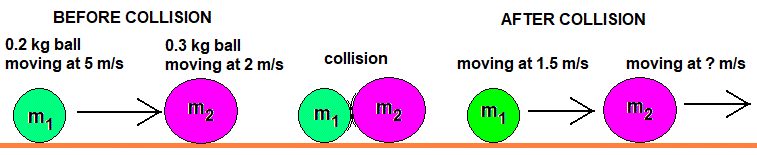
After the collision both balls keep moving in the same
direction, but with different velocities.
If the 0.2 kg ball continues to move at a velocity of 1.5 m/s,
calculate the final velocity of the 0.3 kg ball.
This is an almost identical problem to Q2.4, except there is no
zero momentum term.
Worked
out ANSWERS
Q6 Snooker players can hit the white ball 'dead centre' into a
stationary red ball. The stationary red ball then flies off at the same velocity
as the incoming white ball and the white ball is left in a stationary position
where the red ball was.
Ignoring friction and assuming the balls
have the same mass, explain this observation in terms of the law of
conservation of momentum.
Worked out ANSWERS
Q7
Imagine a 1000 kg car travelling with a velocity of 10 m/s crashing head-on into
a 500 kg car travelling in the opposite direction with a velocity of 15 m/s.
Assume they 'crunch' together to form a single object - the 'wreck'!

(a) Calculate the momentum of both cars.
(b) Calculate the momentum p of
the 'wreck'
(c) What is the immediate velocity of the
wreck after the impact and in what direction? (in terms of diagram)
(d) Is kinetic energy conserved in this
collision?
Reminder of diagram
A reminder of the data and the final
velocity was 1.67 m/s to the right!
(e) If the impact time is 0.10 seconds
calculate the decelerations of the two cars.
(f) Calculate the
impact force experienced by each car.
(g) Comment on your answer to (f) in
terms of Newton's 3rd Law of motion.
Worked out ANSWERS
Q8
A momentum question involving Newton's 3rd Law, conservation of momentum and
conservation of kinetic energy.
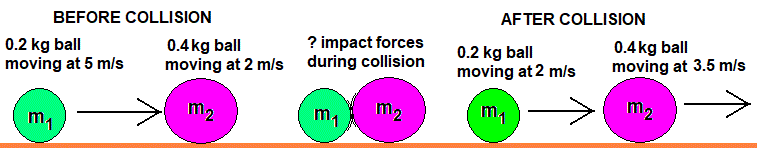
A 0.20 kg green ball (m1) moving at 5.0
m/s collides in line with a 0.40 kg purple ball (m2) moving at 2.0 m/s.
Also, from high speed photography, the
collision impact time was found to be 0.05 seconds.
After the collision, with both moving in
the same direction, the 0.20 kg green ball continues moving forwards at a
slower speed of 2.0 m/s and the purple ball also continues moving forwards
at an increased speed of 3.50 m/s.
(a) Using Newton's 2nd Law, calculate the
force involved in causing the changes in velocity.
(b) Do the results of your calculations
in (a) comply with Newton's 3rd Law of Motion?
Data
reminder!
(c) Does the experiment comply with (i)
the concept of a 'closed' system AND (ii) do the observations comply with
the law of conservation of momentum?
(d) Show by calculation whether kinetic
energy is conserved or otherwise? Comment on your results.
Worked out ANSWERS
INDEX physics notes:
Conservation of momentum, elastic and non-elastic collisions, Newton's 2nd
law calculations - problem solving
Keywords, phrases and learning objectives for elastic/inelastic collisions and
momentum
Be able to solve problem involving more complex momentum calculations.
Information
sources for Doc Brown's key points: IGCSE-GCSE physics are based on
textbooks & syllabus-specifications for students taking the UK AQA, Edexcel,
OCR 21st Century Science, OCR Gateway science suite, WJEC, CCEA and CIE GCSE
physics 9-1 level science examinations
SITEMAP
Website content © Dr
Phil Brown 2000+. All copyrights reserved on Doc Brown's physics revision notes, images,
quizzes, worksheets etc. Copying of website material is NOT
permitted. Exam revision summaries and references to GCSE science course specifications
are unofficial.
INDEX physics notes:
Conservation of momentum, elastic and non-elastic collisions, Newton's 2nd
law calculations - problem solving
|
|
Worked out
ANSWERS
to the collision-momentum calculation questions - problem solving more
complex situations
Q1 The diagram below shows the sequence of events when a moving
green ball collides with a stationary purple ball.
The green ball has a mass of 2.0 kg and is moving at 4.0 m/s prior
to colliding with the stationary purple ball.
After the collision both balls are moving in
a forward direction.
If the green ball is still moving forward at 1.5 m/s,
calculate
the velocity of the purple ball.
From the law of conservation of momentum
total momentum before collision = total
momentum after collision
m1v1 + m2v2
= m1v3 + m1v4
(2 x 4) + (3 x 0) = (2 x 1.5) + (3 x v4)
8 + 0 = 3 + 3v4, 3v4
= 8 - 3 = 5, therefore V4 = 5/3 =
1.7 m/s (2sf)
Q2(a) Why does a gun recoil (move backwards) when fired?
At the start both the gun and the
bullet have zero moment.
After firing the bullet then has its
own momentum in a forward direction from the shooter.
BUT, this must be balanced by a
momentum in the opposite direction because total momentum must be
conserved.
So, on firing, the gun itself must
get its own equal but opposite momentum (remember that momentum is a
vector quantity!).
Therefore the gun's equal and
opposite momentum causes it to recoil backwards.
(b) A 10 g bullet accelerates to 400 m/s
after being fired from a gun with a mass of 2.0 kg.
(i) What is the momentum of the
bullet? (kg = g/1000)
p = m × v = (10/1000) x
400 =
4.0 kg m/s
(ii) What is the momentum of the gun?
From the law of conservation of
momentum, the gun must have a momentum equal and opposite to that of
the bullet.
Therefore gun momentum =
-4.0 kg m/s
(the minus sign is important,
particularly in more complex calculations, the gun recoils in the
opposite direction to the bullet - Newton's 3rd Law in action).
(iii) What is the velocity of the
recoiling gun?
The momentum of the gun and
bullet must be equal
(from the law of conservation of
momentum)
therefore numerically: mgunvgun
= mbulletvbullet
mgunvgun =
-4.0 = 2.0 x vgun, vgun = 4.0/2.0 =
-2.0 m/s
(again, note the minus sign,
because the gun recoils in the opposite direction to the bullet).
(c) Why is it an advantages to the gunner
to fire with
a heavier gun?
From the equation: momentum = mass x
velocity
The bigger the mass of the gun,
for the same momentum, the lower the recoil velocity and the lesser
impact on the person firing the gun.
Q3
The diagram below shows the sequence of events when a moving car crashes into a
stationary car and they combine together and move forward.
The green car (1), of mass 1000 kg, crashes into
the stationary blue car (2) of mass 800 kg.
After the collision, the two cars are locked
together.
(a) Calculate the velocity of the
combined wrecked cars
immediately after the condition.
From the law of conservation of momentum
total momentum before collision = total
momentum after collision
m1v1 + m2v2
= m3v3 (m3 = m1
+ m2)
(1000 x 20) + (800 x 0) = (1000 + 800) x
v3
20 000 + 0 = 1800v3, v3
= 20 000/1800 = 11.1 m/s
(3sf)
(b) Calculate the kinetic energy of all
three objects in the diagram.
KE = ½mv2
KEgreen car = ½ x 1000 x
202, =
200 000 J
KEblue car = ½ x 800 x 02
= 0 J
KEwreck = ½ x 1800 x 11.12,
= 110 889 = 111 000
J (to 3 sf)
(c) Calculate the difference, if any, of
the total initial kinetic energies of the cars and that of the wreck,
and comment on the results of your
calculations.
Kinetic energy is NOT conserved.
The loss of kinetic energy = 200 000
- 110 889 = 89 111 = 89 100 J
(to 3 sf)
Lots of sound and thermal energy
created!
(d) Explain your answer to (c)
The loss of kinetic energy involves
several changes of energy stores.
There is a loud bang on impact, so
some energy is lost as sound.
The cars are compressed and the
increase in potential energy plus friction effects, increases the
thermal energy store of the wreck - which then cools down.
So, in the end, all the lost kinetic
energy of the cars energy stores increases the thermal energy store of
the surroundings - lost KE somewhat dissipated!
Q4 Imagine a 0.2 kg ball moving at 5 m/s colliding with a 0.3 kg
ball moving at 2 m/s in the same direction.
After the collision the 0.2 kg green ball stops moving and the 0.3 kg
purple ball continues moving in the same direction.
Calculate the final velocity of the of the 0.3 kg
purple ball.
First sort out all the masses and velocities
where v1 and v2
are the initial velocities and v3 and v4 the
velocities after the collision
m1 = 0.2 kg, initial velocity
v1 = 5 m/s, final velocity v3 = 0 m/s
m2 = 0.3 kg, initial velocity
v2 = 2 m/s, final velocity v4 = ? m/s
total momentum of two of objects before
collision = total moment of objects after collision
for two colliding objects, where
p = momentum: p1 + p2 = p3 + p4
substituting m and v for the mass
and velocity of the two objects gives ...
m1v1 + m2v2
= m1v3 + m2v4
Then substitute everything in the equation,
rearrange and deduce the answer (v4).
(0.2 x 5) + (0.3 x 2) = (0.2 x 0) + (0.3
x v4)
1.0 + 0.6 = 0 + 0.3v4,
0.3v4 = 1.6
therefore the final velocity of the 0.3
kg ball = v4 = 1.6/0.3 =
5.3 m/s (2 sf)
Q5 Imagine a 0.2 kg ball moving at 5 m/s hitting a 0.3 kg ball
moving at 2 m/s in the same direction.
After the collision both balls keep moving in the same
direction, but with different velocities.
If the 0.2 kg ball continues to move at a velocity of 1.5 m/s,
calculate the final velocity of the 0.3 kg ball.
This is an almost identical problem to Q2.4, except there is no
zero momentum term.
So, sorting out all the masses and velocities
where v1 and v2
are the initial velocities and v3 and v4 the
velocities after the collision
m1 = 0.2 kg, initial velocity
v1 = 5 m/s, final velocity v3 = 1.5 m/s
m2 = 0.3 kg, initial velocity
v2 = 2 m/s, final velocity v4 = ? m/s
total momentum of two objects before
collision = total moment of objects after collision
for two colliding objects, where
p = momentum: p1 + p2 = p3 + p4
substituting m and v for the mass
and velocity of the two objects gives ...
m1v1 + m2v2
= m1v3 + m2v4
where v1 and v2
are the initial velocities and v3 and v4 the
velocities after the collision
Then substitute everything in the equation,
rearrange and deduce the answer (v4).
(0.2 x 5) + (0.3 x 2) = (0.2 x 1.5) +
(0.3 x v4)
1.0 + 0.6 = 0.3 + 0.3v4,
0.3v4 = 1.6 - 0.3 = 1.3
therefore the final velocity of the 0.3
kg ball = v4 = 1.3/0.3 =
4.3 m/s (2 sf)
Note the final velocity of the 0.3 kg
ball is less than in Q2.4 because in Q2.4 it received all the momentum from
the collision.
Q6 Snooker players can hit the white ball 'dead centre' into a
stationary red ball. The stationary red ball then flies off at the same velocity
as the incoming white ball and the white ball is left in a stationary position
where the red ball was.
Ignoring friction and assuming the balls
have the same mass, explain this observation.
The law of conservation states the total
momentum must be the same before and after the collision.
mwhitevintitial + mredvinitial
= mwhitevfinal + mredvfinal
mredvinitial
is zero, since the red ball is initially stationary with a momentum of zero.
mwhitevfinal
is zero, since the white ball is now stationary, also with a momentum of
zero.
Therefore: mwhitevintitial
= mredvfinal
and since the masses are equal, mwhite
= mred, then the final velocity of the red ball must equal
the initial velocity of the white ball.
It should be noted that skilled snooker
players can play all sorts of tricks with the 'physics' of snooker and often
have a total disregard for the law of conservation of momentum!
Q7
Imagine a 1000 kg car travelling with a velocity of 10 m/s crashing head-on into
a 500 kg car travelling in the opposite direction with a velocity of 15 m/s.
Assume they 'crunch' together to form a single object - the 'wreck'!
(a) Calculate the momentum of both cars.
(i) green car momentum = 1000 x 10 =
+10 000 kg m/s (to the right)
(ii) blue car momentum = 500 x 15 =
-7 500 kg m/s (to the left)
(you must assign a positive and
negative signs, vector quantity, opposite directions)
(b) Calculate the momentum p of
the 'wreck'
From the law of conservation of
momentum
pwreck = pgreen car
+ pblue car
pwreck = +10 000 + -7 500
=
+2
500 kg m/s
(c) What is the immediate velocity of the
wreck after the impact and in what direction? (in terms of diagram)
total mass = 1000 + 500 = 1500 kg
pwreck = mwreck
x vwreck
2500 = 1500v, v = 2500 / 1500 = 1.6r
=
1.67 m/s to the right (in terms of diagram and to 3 sf
too!)
Note: Although the speed of the blue
car is greater than the green, it has a greater momentum, so the
resultant movement of the 'wreck' is to the right.
(d) Is kinetic energy conserved in this
collision?
(i) You need to calculate the kinetic
energies of all the objects concerned
KE = ½mv2
KEgreen car = ½ x 1000
x 102, =
50
000 J
KEblue car = ½ x 500 x
152 = 56
250 J
KEwreck = ½ x 1500 x
1.672, = 110 889 =
2 092 J
(to 3 sf)
(ii) Kinetic energy is NOT conserved.
In fact, most of the kinetic
energy of the colliding cars is lost on impact.
Reminder of diagram
A reminder of the data and the final
velocity was 1.67 m/s to the right!
(e) If the impact time is 0.10 seconds
calculate the decelerations of the two cars.
(velocities are vector quantities,
watch the signs, + to right, - to the left).
a = ∆v / ∆t = (v -
u) / ∆t (u = initial velocity, v = final velocity)
agreen
car = (1.6r - 10) / 0.1 =
-83.3 m/s2 (3 sf, r meaning
recurring)
ablue
car = (1.6r - -15) = 16.6r / 0.1 = 166.6r =
167 m/s2
(3 sf, r meaning recurring)
(f) Calculate the
impact force experienced by each car.
F = ma
Fgreen
car = 1000 x -83.3r = 83 333 =
-83 300 N (3 sf)
Fblue
car = 500 x 166.7 = 83 333 =
83 300 N (3 sf)
(g) Comment on your answer to (f) in
terms of Newton's 3rd Law of motion.
The two forces are equal numerically,
but act in opposite directions.
Newton's Third Law of motion states that
when two objects interact, the forces they exert on each other are equal in
numerical value and act in opposite directions and in this case they both normal
contact forces.
Q8
A momentum question involving Newton's 3rd Law, conservation of momentum and
conservation of kinetic energy.
A 0.20 kg green ball (m1) moving at 5.0
m/s collides in line with a 0.40 kg purple ball (m2) moving at 2.0 m/s.
Also, from high speed photography, the
collision impact time was found to be 0.05 seconds.
After the collision, with both moving in
the same direction, the 0.20 kg green ball continues moving forwards at a
slower speed of 2.0 m/s and the purple ball also continues moving forwards
at an increased speed of 3.50 m/s.
(a) Using Newton's 2nd Law, calculate the
force involved in causing the changes in velocity.
F = ma = m∆v/∆t =
m(v-u) ÷ 0.05, where F = force (N), m = mass
(kg), v and u = final and initial velocities.
For the green ball: F = 0.2 x (2 - 5) ÷
0.05 = -12 N
For the purple ball: F = 0.4 x (3.5 -
2) ÷ 0.05 =
12 N
(b) Do the results of your calculations
in (a) comply with Newton's 3rd Law of Motion?
Yes they do. See notes on
Newton's 3rd Law
Newton's Third Law of motion states that
when two objects interact, the forces they exert on each other are equal in
numerical value, act in opposite directions and are of the same type.
The impact forces are the same size and act in opposite directions.
The impact forces act on two different objects
with same type of normal contact force.
Data
reminder!
(c) Does the experiment comply with (i)
the concept of a 'closed' system AND (ii) do the observations comply with
the law of conservation of momentum?
(i)
The collision does take place
in a closed system - the experiment is a
physical system that does not allow transfer of matter in or out of the
system, and is so fast there is no time for energy to leave or enter the
system.
(ii) momentum p = mv, where p
in kg m/s, m in kg, v in m/s.
Momentums before collision:
for green ball p = 0.2 x 5 =
1.0 kg m/s
for purple ball p = 0.4 x 2 =
0.8 kg m/s
total momentum before
collision = 1.0 + 0.8 =
1.8 k m/s
Momentums after collision:
for green ball p = 0.2 x 2 =
0.4 kg m/s
for purple ball p = 0.4 x 3.5
= 1.4 kg m/s
total momentum after
collision = 0.4 + 1.4 =
1.8 k m/s
The total momentum is the same as
before and after the collision, so the
law of conservation of momentum is obeyed.
(d) Show by calculation whether kinetic
energy is conserved or otherwise? Comment on your results.
KE = ½mv2, where KE in J,
m = mass of object in kg and velocity in m/s.
Kinetic energies before collision:
green ball KE = ½ x 0.2 x 52
= 2.5 J
purple ball KE = ½ x 0.4 x 22
= 0.8 J
total kinetic energy before
collision = 2.5 + 0.8 =
3.3 J
Kinetic energies after collision:
green ball KE = ½ x 0.2 x 22
= 0.4 J
purple ball KE = ½ x 0.4 x 3.52
= 2.45 J
total kinetic energy after
collision = 0.4 + 2.45 =
2.85 J (2.9 2sf)
You can see from the calculations
that
kinetic energy is not conserved in this collision of two objects.
This is an
inelastic collision.
The atoms of the object are
compressed and kinetic energy is converted into potential energy,
thermal energy and sound.
importance of exam
practise questions on complex momentum calculations
in GCSE level physics, What you need to know about exam practise
questions on complex momentum calculations for
GCSE level
physics,
Explaining the use of exam practise questions on complex momentum
calculations knowledge in GCSE level physics, Examples of exam practise
questions on complex momentum calculations explained
when studying GCSE level physics, What is
significant about exam practise questions on complex momentum
calculations, describing the theory of exam practise questions on
complex momentum calculations when studying
GCSE level physics, revision notes for exam practise questions on
complex momentum calculations in exams, online exam help
for exam practise questions on complex momentum calculations, revision notes about
exam practise questions on complex momentum calculations, what do I need to learn about
exam practise questions on complex momentum calculations for
by GCSE physics exam?
help to understand the exam practise questions on complex momentum
calculations topic in preparation for GCSE physics exam
question, how to
prepare for questions involving exam practise questions on complex
momentum calculations in a GCSE physics examination?
Revision notes on exam practise questions on complex momentum
calculations b ased on the syllabus-specifications
for students taking IGCSE/GCSE level physics examinations, summary
revision notes and key points on exam practise questions on complex
momentum calculations for students taking the AQA
igcse/gcse physics notes on exam practise questions on complex momentum
calculations, Edexcel gcse
physics notes on exam practise questions on complex momentum
calculations, OCR 21st century GCSE
physics notes on exam practise questions on complex momentum
calculations, OCR gateway
GCSE physics notes on exam practise questions on complex momentum
calculations, WJEC gcse physics notes on exam practise questions on
complex momentum calculations, CCEA
gcse physics notes on exam practise questions on complex momentum
calculations for students taking CIE Cambridge igcse
physics, exam revision notes on
exam practise questions on complex momentum calculations, useful for US grade 9-10 physics courses
INDEX physics notes:
Conservation of momentum, elastic and non-elastic collisions, Newton's 2nd
law calculations - problem solving
|
