HOME PAGE * SEARCH * UK KS3 level Science Quizzes for students aged ~13-14

UK GCSE level BiologyChemistryPhysics age ~14-16 * Advanced Level Chemistry age ~16-18

Thermal energy 2.5 Measuring specific heat capacity of a solid indirectly

GCSE level Physics exam revision notes on specific heat

Thermal energy: 2.5 Ways of measuring the specific heat capacity of a solid using an indirect method involving preheating or precooling the material in a liquid of known specific heat capacity

[Author © Dr Phil Brown PhD: Doc Brown's physics exam revision notes suitable for students of UK IGCSE & GCSE level physics courses, ~ US grades 9-10 physics [heat-2- page updated April 1st 2026 *]

 email doc brown: problems?, comments? query? * [privacy & cookies policies & disclaimer]

[KEY POINTS and learning objectives for this page, after initial notes]

INDEX for my physics notes on specific heat capacity


2.5a Ways of measuring the heat capacity of a solid using an indirect method (A)

(Procedures (iv)(A) and (iv)(B)  relate to part 2.2 calculation Q5 in the set of specific heat capacity questions above)

This method relies on the transfer between a brass weight's thermal energy store and the thermal energy store of water.

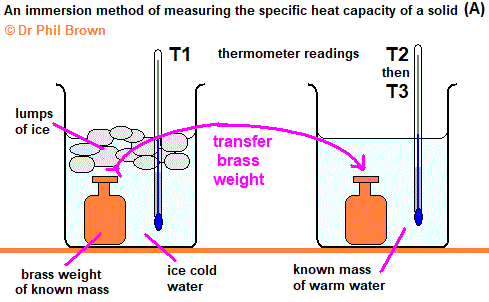
Illustration of procedure A

Method (procedure A)

A brass weight is accurately weighed and placed in beaker of ice-cold water (tap water plus lumps of ice)

This is left for some time and occasionally stirred, until the brass weight is at the same temperature as the water.

250 g of water is weighed into a beaker and heated until its about 80oC (no need to boil, increases hazard).

After a gentle stir, the temperature of the warm water is taken (T2), immediately before transfer.

The temperature (T1) of the iced-water is also taken just before transferring the brass weight from the iced-water to the warm water using tongs or thin wire and loop.

After transferring the cold brass weight to the warm water, allow time for the thermal heat transfer into the brass weight to complete and after a gentle stir read the final temperature (T3)


Results and calculation (A)

Typical results:

Mass of brass weight 200 g (0.200 kg), mass of water 250 g (0.250 kg), SHC water = 4180 J/kgoC

Initial temperature of iced water T1 = 0.5oC

Initial temperature of the warm water (T2) = 79.5oC

Final temperature of water/brass in 2nd beaker (T3) = 74.0oC (cooler, as brass weight absorbs heat)

E = Thermal energy transfer to brass weight = Thermal energy transfer from water (all in J)

E = m x c x ∆T = 0.200 x SHCbrass x (T3 - T1) = 0.250 x 4180 x (T2 - T3) = 5747.5

E = 0.200 x SHCbrass x (74.0 - 0.5) = 0.250 x 4180 x (79.5 - 74.0) = 5747.5

0.20 x SHCbrass x 73.5 = 5747.5

14.7 x SHCbrass = 5747.5

SHCbrass = 5747.5 / 14.7 = 391 J/kgoC (3 sf)


Improvements and sources of error (A)

(i) Could not be quite sure if the brass weight has completely cooled down to ~0oC (T1).

(ii) The hot water in the beaker is losing heat all the time giving a greater cooling effect than just from the brass weight - might be better to use a lower start temperature in the 2nd beaker e.g. 40-50oC.


2.5b Alternative procedure, but a similar methodology (B)

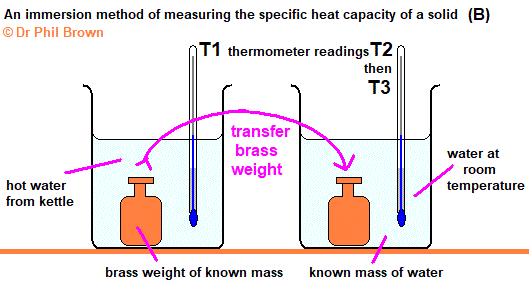
Illustration of procedure B

Method (procedure B)

You could do a similar experiment to (A) by putting the brass weight into hot water for some to heat up to ~80-90oC.

You could heat the water directly in a beaker to ~80-90oC.

Allow time for the brass weight to heat up.

After a careful gentle stir, measure the initial temperature of the brass weight (T1, ~90oC) in the hot water.

Measure the initial temperature of the cold water in the 2nd beaker (T2, ~20oC)

Pick up the brass weight with tongs or a thin wire and loop and transfer it to a beaker of water at room temperature.

Allow time for the thermal energy store transfers to take place.

After a careful gentle stir, measure the final temperature of the brass weight/water (T3) in the 'warmed up' water.


You can then do a similar calculation as above e.g.

Results and calculation (B)

Typical results:

Mass of brass weight 200 g (0.200 kg), mass of water 250 g (0.250 kg), SHC water = 4180 J/kgoC

Initial temperature of heated water/brass weight (T1) = 85.0oC

Initial temperature of the cold water (T2) = 20.5oC

Final temperature of water/brass in 2nd beaker(T3) = 24.9oC

E = Thermal energy transfer from hot brass weight = Thermal energy transfer to water (all in J)

E = m x c x ∆T = 0.200 x SHCbrass x (T1 - T3) = 0.250 x 4180 x (T3 - T2) = ?

E = 0.200 x SHCbrass x (85.0 - 24.9) = 0.250 x 4180 x (24.9 - 20.5) = 4598

0.20 x SHCbrass x 60.1 = 4598

12.02 x SHCbrass = 4598

SHCbrass = 4598 / 12.02 = 383 J/kgoC (3 sf)


Improvements and sources of error (B)

(i) Could not be quite sure if the brass weight has completely warmed up to ~80-90oC (T1)

(ii) Not absolutely sure the thermal energy transfer from the hot brass weight to the water is complete - if left too long the 2nd beaker of water will start to cool give a greater temperature change than should be measured.

(iii) The beaker absorbs some of the extra thermal energy transferred to the water's thermal energy store.

INDEX for my physics notes on specific heat capacity


Key points Specific heat capacity: Indirectly measuring the specific heat capacity of a solid

Information sources for Doc Brown's key points: IGCSE-GCSE physics are based on textbooks & syllabus-specifications for students taking the UK AQA, Edexcel, OCR 21st Century Science, OCR Gateway science suite, WJEC, CCEA and CIE GCSE physics 9-1 level science examinations

Keywords, phrases and learning objectives for measuring the specific heat capacity of a solid by an indirect method

Understand how to measure the heat capacity of solid using indirect method involving pre-cooling or preheating material in a liquid of known specific heat capacity like water.


WHAT NEXT?

TOP of page

INDEX for physics notes on specific heat capacity

INDEX of all my THERMAL ENERGY notes

INDEX of all my PHYSICS NOTES

email doc brown - comments - query?

BIG website, using the [SEARCH BOX] below, maybe quicker than navigating the many sub-indexes

HOME PAGE of Doc Brown's Science

Basic Science Quizzes for UK KS3 science students aged ~12-14, ~US grades 6-8

BiologyChemistryPhysics for UK GCSE level students aged ~14-16, ~US grades 9-10

Advanced Level Chemistry for pre-university age ~16-18 ~US grades 11-12, K12 Honors

Find your GCSE/IGCSE science course for more help links to all science revision notes


importance of experiment to indirectly determine specific heat capacity of a substance by preheating it in GCSE level physics, What you need to know about experiment to indirectly determine specific heat capacity of a substance by preheating it for GCSE level physics, Explaining the use of experiment to indirectly determine specific heat capacity of a substance by preheating it knowledge in GCSE level physics, Examples of experiment to indirectly determine specific heat capacity of a substance by preheating it explained when studying GCSE level physics, What is significant about experiment to indirectly determine specific heat capacity of a substance by preheating it, describing the theory of experiment to indirectly determine specific heat capacity of a substance by preheating it when studying GCSE level physics, revision notes for experiment to indirectly determine specific heat capacity of a substance by preheating it in exams, online exam help for experiment to indirectly determine specific heat capacity of a substance by preheating it, revision notes about experiment to indirectly determine specific heat capacity of a substance by preheating it, what do I need to learn about experiment to indirectly determine specific heat capacity of a substance by preheating it for by GCSE physics exam? help to understand the experiment to indirectly determine specific heat capacity of a substance by preheating it topic in preparation for GCSE physics exam question, how to prepare for questions involving experiment to indirectly determine specific heat capacity of a substance by preheating it in a GCSE physics examination? Revision notes on experiment to indirectly determine specific heat capacity of a substance by preheating it based on the syllabus-specifications for students taking IGCSE/GCSE level physics examinations, summary revision notes and key points on experiment to indirectly determine specific heat capacity of a substance by preheating it for students taking the AQA igcse/gcse physics notes on experiment to indirectly determine specific heat capacity of a substance by preheating it, Edexcel gcse physics notes on experiment to indirectly determine specific heat capacity of a substance by preheating it,  OCR 21st century GCSE physics notes on experiment to indirectly determine specific heat capacity of a substance by preheating it, OCR gateway GCSE physics notes on experiment to indirectly determine specific heat capacity of a substance by preheating it, WJEC gcse physics notes on experiment to indirectly determine specific heat capacity of a substance by preheating it, CCEA gcse physics notes on experiment to indirectly determine specific heat capacity of a substance by preheating it for students taking CIE Cambridge igcse physics, exam revision notes on experiment to indirectly determine specific heat capacity of a substance by preheating it, useful for US grade 9-10 physics courses


SITEMAP Website content © Dr Phil Brown 2000+. All copyrights reserved on Doc Brown's physics revision notes, images, quizzes, worksheets etc. Copying of website material is NOT permitted. Exam revision summaries and references to GCSE science course specifications are unofficial.


INDEX for my physics notes on specific heat capacity

TOP OF PAGE