|
GCSE level Physics exam revision notes on waves
Introduction to waves: Part 10.
WAVE CALCULATIONS - formulae and how to solve wave problem
questions
[Author
©
Dr Phil Brown PhD:
Doc Brown's physics exam revision notes suitable for students of UK
IGCSE & GCSE level physics courses, ~ US grades 9-10 physics
[waves-intro- page updated
RE-EDIT]
email doc
brown: problems?, comments? query?
*
[privacy & cookies policies & disclaimer]
[ KEY
POINTS and learning objectives for section 10, after initial notes]
INDEX physics notes: Investigating
& introducing properties of waves
10.
WAVE CALCULATIONS - formulae and how to solve wave problem
questions
This page contains online questions only. Jot down
your answers and check them against the worked out answers at the end of
the page
See also on this page
3.
Introduction to transverse waves
Examples of wave calculations
- practise exam questions with worked out answers
Q1
A wave has a speed of 0.25 m/s and a wavelength of 5.0 cm.
(a) Calculate the frequency of the wave
(b) Calculate the period of the wave.
Worked out ANSWERS to wave
calculation questions
Q2 The
frequency of sound in air at room temperature and pressure is 343 m/s.
The musical note middle C has a frequency of 262 Hz.
Calculate the wavelength of the middle C sound.
Worked out ANSWERS to wave
calculation questions
Q3
A set of ocean waves has a frequency of 0.50 Hz.
If the average distance between the
crests of the waves is 10 m, what is the average speed of the ocean waves?
Worked out ANSWERS to wave
calculation questions
Q4
The time period of a radio electromagnetic wave is 5.0 x 10⁻⁵ seconds
(a) What is the frequency of the radio
wave?
(b) If the 'speed of light' is 3.0 x 10⁸
m/s, calculate the wavelength of the radio wave in m.
(c) If the distance from the radio
station to your radio is 200 km, how long does it take the signal to reach
you?
Worked out ANSWERS to wave
calculation questions
Q5 A water wave has a frequency of 0.50 Hz
and a wavelength of 150 cm.
(a) Calculate the speed of the wave in
m/s.
(b) If the frequency of this wave
triples, what will be its wavelength? and what assumption have you made?
(c) If the frequency of the original wave
doubles, and the wavelength of the wave quadruples, what will be the new
speed of the wave?
Worked out ANSWERS to wave
calculation questions
Q6
Suppose an airliner sends out a microwave radar signal of wavelength of 1.20 cm.
The microwave reflects off another
aircraft and the echo is detected after a time lapse of 6.0
µs.
The
speed of electromagnetic radiation = 3.00 x 10⁸ m/s.
(a)
What is the frequency of the microwave beam?
Worked out ANSWERS to wave
calculation questions
(b)
What is the distance between the two aircraft?
Worked out ANSWERS to wave
calculation questions
Q7
A satellite is 75 km above the Earth's surface. (speed of light 3.00 x 10⁸
m/s)
What is the shortest time that a
microwave signal would take to reach the satellite from the Earth's surface?
Worked out ANSWERS to wave
calculation questions
Q8
A red light wave has a wavelength of 7.0 x 10⁻⁷ m. (speed of light
3.00 x 10⁸ m/s)
What is the frequency of the light wave?
Worked out ANSWERS to wave
calculation questions
INDEX notes: Investigating and introducing
the properties of waves
See also on this page
3.
Introduction to transverse waves
Key points (2) for Part 10 Introduction to waves:
How
to do wave calculations
Information
sources for Doc Brown's key points: IGCSE-GCSE physics are based on
textbooks & syllabus-specifications for students taking the UK AQA, Edexcel,
OCR 21st Century Science, OCR Gateway science suite, WJEC, CCEA and CIE GCSE
physics 9-1 level science examinations
Here's a structured set of summary revision notes on
how to do wave
calculations, aligned with the core requirements across
major UK GCSE/IGCSE exam boards (WJEC, CCEA, CIE, AQA, Edexcel,
OCR). These notes cover essential equations, units, worked examples,
and common pitfalls to help students master wave maths with
confidence.
Wave Calculations: Summary Revision
Notes
Key Equations
| Equation |
Meaning |
Units |
v = λ x f |
Wave speed = wavelength x
frequency |
( v ): m/s, ( f ): Hz, (
\lambda ): m |
| f = 1 / T |
Frequency = 1 ÷ time period |
( T ): seconds, (f) Hz |
| T = 1 / f |
Time period = 1 ÷ frequency |
( T ): seconds, (f) Hz |
Definitions
- Wave speed (v):
How fast the wave travels through a medium
- Frequency (f):
Number of waves passing a point per second
- Wavelength (λ):
Distance between two identical points on adjacent waves
- Time period (T):
Time taken for one complete wave to pass a point
Worked Examples of wave calculations
Example 1: Calculating Wave Speed
A wave has a frequency of 50 Hz and
a wavelength of 2 m.
speed = v =
λ x f
= 50 x 2 =
100 m/s
Example 2: Finding Frequency from Time
Period
A wave has a time period of 0.2 s.
frequency = f = 1/ T} = 1 / 0.2 =
5 Hz
Example 3: Rearranging the Wave
Equation for wavelength
If wave speed is 330 m/s and
frequency is 110 Hz:
wavelength = λ = v / f
= 330 / 110 = 3 m
Example 4: Calculating frequency
given speed and wavelength
A sound wave travels through
air at 330 m per second with a wavelength of 3 m.
Calculate the frequency of the
sound wave
v =
			λ x f, so f = v / λ
			= 330 / 3 =
			110 Hz
See also on this page
3.
Introduction to transverse waves
Typical Exam Board Coverage of wave
calculations
| Wave Equation |
Frequency & Period |
Required Practicals |
v =
λ x f |
( f = 1/T ) |
Sound & ripple tank |
| Wave speed & rearranging |
Frequency & time |
Sound in air |
| Wave maths & graphs |
Period & frequency |
Wave speed |
| Wave speed & units |
Time period |
Ripple tank |
| Echo calculations |
Frequency & ultrasound |
Sound wave speed |
| Wave equation & Snell’s
Law |
Frequency & period |
Ray box & ripple tank |
Student Tips about wave
calculations
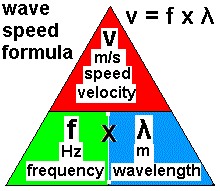
- Use a formula triangle
to help rearrange equations (don't like ∆)
- speed = wavelength x frequency
-
v =
			λ x f, better
			to know how to rearrange
- Always check units:
convert cm to m, kHz to Hz
- Practise rearranging
equations algebraically
- Use graphs to
extract frequency and wavelength from waveforms
- Link calculations to
real-world examples (e.g. sound in air, light in glass)
Common Misconceptions about wave
calculations
- “Wavelength and
frequency are the same.”
They’re inversely related: higher frequency = shorter
wavelength
- “Wave speed always stays
the same.”
It depends on the medium (e.g. sound travels faster in
solids)
- “Time period and
frequency are unrelated.”
They’re reciprocals: ( f = \frac{1}{T} )
- “Units don’t matter.”
Incorrect units lead to wrong answers - always convert!
Keywords, phrases and learning objectives for
how to do
waves -
problem solving and rearranging the wave formula
Be able to use the wave equation formula to perform calculation
using the correct appropriate units.
Know how to solve wave problem questions in a
variety of situations and for different types of waves.
SITEMAP
Website content © Dr
Phil Brown 2000+. All copyrights reserved on Doc Brown's physics revision notes, images,
quizzes, worksheets etc. Copying of website material is NOT
permitted. Exam revision summaries and references to GCSE science course specifications
are unofficial.
See also on this page
3.
Introduction to transverse waves
|
|
Worked out
ANSWERS to the wave calculation questions
Q1
A wave has a speed of 0.25 m/s and a wavelength of 5.0 cm.
(a) Calculate the frequency of the wave
f = v ÷ λ
5.0 cm
≡
5/100 m = 0.05 m
Therefore frequency = 0.25/0.05 =
5.0
Hz
(b) Calculate the period of the wave.
period = 1 / frequency = 1 / 5 =
0.20 s
Q2 The
frequency of sound in air at room temperature and pressure is 343 m/s.
The musical note middle C has a frequency of 262 Hz.
Calculate the wavelength of the middle C sound.
λ
= v ÷ f
wavelength = 343 ÷ 262 =
1.31 m (131 cm, 3
s.f.)
Q3
A set of ocean waves has a frequency of 0.50 Hz.
If the average distance between the
crests of the waves is 10 m, what is the average speed of the ocean waves?
v = f x
λ
speed (m/s) = frequency (Hz) x wavelength
(m)
speed = 0.5 x 10 =
5.0 m/s
Q4
The time period of a radio electromagnetic wave is 5.0 x 10⁻⁵ seconds
(a) What is the frequency of the radio
wave?
period = 1 / frequency
f = 1 / period = 1 /
(5.0 x 10⁻⁵) =
2.0
x 104
Hz
(b) If the 'speed of light' is 3.0 x 10⁸
m/s, calculate the wavelength of the radio wave in m.
λ
= v ÷ f = 3.0 x 10⁸ / 2 x 104 =
1.5 x 10⁴ m
(c) If the distance from the radio
station to your radio is 200 km, how long does it take the signal to reach
you?
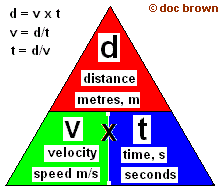
The speed formula is v = d / t,
so t = d / v
= (200 x 1000) / (3.0 x 10⁸) =
6.7 x 10⁻⁴
s
Q5 A water wave has a frequency of 0.50 Hz
and a wavelength of 150 cm.
(a) Calculate the speed of the wave in
m/s.
v = f x
λ = 0.50 x (150/100) =
0.075 m/s
(b) If the frequency of this wave
triples, what will be its wavelength? and what assumption have you made?
If you assume the speed stays the
same, the wavelength will be a third of 150 cm, 50 cm or
0.50 m,
because frequency x wavelength (f
x λ) is a constant for a constant speed.
(c) If the frequency of the original wave
doubles, and the wavelength of the wave quadruples, what will be the new
speed of the wave?
v = f x
λ, putting in the factors gives 2 x (1/4) = 0.5, so the new
speed will be 0.5 x 0.075 =
0.038 m/s (2 sf)
Q6
Suppose an airliner sends out a microwave radar signal of wavelength of 1.20 cm.
The microwave reflects off another
aircraft and the echo is detected after a time lapse of 6.0
µs.
The
speed of electromagnetic radiation = 3.00 x 10⁸ m/s.
(a)
What is the frequency of the microwave beam?
speed =
wavelength x frequency
f = v ÷ λ = 3.00
x 108 ÷ (1.20 / 100) =
2.50 x 10¹⁰
Hz
(b)
What is the distance between the two aircraft?
s = d / t,
d = s x t = 3.00 x 108 x 6.0 x 10-6 = 1800 m
(total distance including echo)
distance
between aircraft = 1800 ÷
2 =
900 m
(µ
is micro = 10-6, and total distance is halved because it
involves 'there and back')
Q7
A satellite is 75 km above the Earth's surface. (speed of light 3.00 x 10⁸
m/s)
What is the shortest time that a
microwave signal would take to reach the satellite from the Earth's surface?
s = d / t, t = d / s = (75 x 1000)
/ (3.00 x 10⁸) =
2.50 x
10-4
seconds
Q8
A red light wave has a wavelength of 7.0 x 10⁻⁷ m. (speed of light
3.00 x 10⁸ m/s)
What is the frequency of the light wave?
v = f x λ * f = v / λ
= 3 x 10⁸ / (7.0 x 10⁻⁷ m) =
4.29 x
1014
Hz (3 sf)
See also on this page
3.
Introduction to transverse waves
importance of how to do
wave calculations & problem solving with wave formula v=fxλ, f=v÷λ,
λ=v÷f
in GCSE level physics, What you need to know about how to do wave
calculations & problem solving with wave formula v=fxλ, f=v÷λ, λ=v÷f for
GCSE level
physics,
Explaining the use of how to do wave calculations & problem solving with
wave formula v=fxλ, f=v÷λ, λ=v÷f knowledge in GCSE level physics, Examples of
how to do wave calculations & problem solving with wave formula v=fxλ,
f=v÷λ, λ=v÷f explained
when studying GCSE level physics, What is
significant about how to do wave calculations & problem solving with
wave formula v=fxλ, f=v÷λ, λ=v÷f, describing the theory of how to
do wave calculations & problem solving with wave formula v=fxλ, f=v÷λ,
λ=v÷f when studying
GCSE level physics, revision notes for how to do wave calculations &
problem solving with wave formula v=fxλ, f=v÷λ, λ=v÷f in exams, online exam help
for how to do wave calculations & problem solving with wave formula
v=fxλ, f=v÷λ, λ=v÷f, revision notes about how to do wave calculations &
problem solving with wave formula v=fxλ, f=v÷λ, λ=v÷f, what do I need to learn about
how to do wave calculations & problem solving with wave formula v=fxλ,
f=v÷λ, λ=v÷f for
by GCSE physics exam?
help to understand the how to do wave calculations & problem solving
with wave formula v=fxλ, f=v÷λ, λ=v÷f topic in preparation for GCSE physics exam
question, how to
prepare for questions involving how to do wave calculations & problem
solving with wave formula v=fxλ, f=v÷λ, λ=v÷f in a GCSE physics examination?
Revision notes on how to do wave calculations & problem solving with
wave formula v=fxλ, f=v÷λ, λ=v÷f b ased on the syllabus-specifications
for students taking IGCSE/GCSE level physics examinations, summary
revision notes and key points on how to do wave calculations & problem
solving with wave formula v=fxλ, f=v÷λ, λ=v÷f for students taking the AQA
igcse/gcse physics notes on how to do wave calculations & problem solving with
wave formula v=fxλ, f=v÷λ, λ=v÷f, Edexcel gcse
physics notes on how to do wave calculations & problem solving with
wave formula v=fxλ, f=v÷λ, λ=v÷f, OCR 21st century GCSE
physics notes on how to do wave calculations & problem solving with
wave formula v=fxλ, f=v÷λ, λ=v÷f, OCR gateway
GCSE physics notes on how to do wave calculations & problem solving
with wave formula v=fxλ, f=v÷λ, λ=v÷f, WJEC gcse physics notes on how to
do wave calculations & problem solving with wave formula v=fxλ, f=v÷λ,
λ=v÷f, CCEA
gcse physics notes on how to do wave calculations & problem solving with
wave formula v=fxλ, f=v÷λ, λ=v÷f for students taking CIE Cambridge igcse
physics, exam revision notes on
how to do wave calculations & problem solving with wave formula v=fxλ,
f=v÷λ, λ=v÷f, useful for US grade 9-10 physics courses
INDEX notes: Investigating and introducing
the properties of waves
|

 ,
(b)
,
(b)