HOME PAGE * SEARCH * UK KS3 level Science Quizzes for students aged ~13-14
UK GCSE level Biology * Chemistry * Physics ~14-16 * Advanced pre-university Chemistry ~16-18
School Chemistry Notes: Important chemistry definitions explained with examples


|
Section 1.1 Introduction and Some keywords (see also pictures) Many of these terms overlap with each other, so there is some repetition - no harm in that? |
|||||||
|
1.1a ATOMS
|
Why can't we trust atoms? Because they make up
everything! (i) Even as far back as ancient Greece ~500 BC philosophers had considered the concept of what would be formed on continuously dividing matter i.e. what was the smallest 'bit' left of any substance. In 1808 the English scientist-chemist Dalton proposed his 'atomic theory' - that all matter was made up of tiny individual units called atoms which could NOT be subdivided into simpler substances. What is more, he proposed the idea that there were different types of atoms which we now call 'elements' and combinations of them produce all the different substances which exist. The different types of atoms are called elements (examples below).
Therefore, more simply, 'atoms are the smallest bits ('building blocks') of an element that can exist'. This also means it is the smallest part of an element that can take part in a chemical reaction. (ii) BUT, remember atoms are built up of even more fundamental sub-atomic particles - the electron, proton and neutron. The centre of an atom, called the nucleus, consists of proton and neutron particles and the electrons move around the nucleus in 'orbital' energy levels. For more details see the Atomic Structure Notes. (iii) In chemical reactions, the atoms rearrange themselves in changing from reactants to new products, usually involving at least two elements and often many more (see chemical change on this page). The mass of atoms varies from about 1 x 10-23 to 1 x 10-21 g The diameter of atoms varies from about 1 x 10⁻¹⁰ to 5 x 10⁻¹⁰ m (0.1 to 0.5 nm) |
||||||
|
1.1b ELEMENTs and symbols
H I Th Er Ho W Ar U? Element Symbol-name quizzes: easier-pictorial! Metals and non-metals |
(i) A basic
definition of an element
(ii) Extended ideas on elements
Element symbol & name QUIZ - easier-pictorial or Element symbol & name QUIZ harder - no pictures! |
||||||

|
|||||||
|
1.1c MOLECULES and FORMULAE and their representations
and a FORMULA shows which atoms are in a compound and how many of each element are present in the molecule A formula can summarise the atoms present e.g. C2H6
or show how the atoms are connected by their chemical
bonds e.g.
and short note on Nanoparticles |
A MOLECULE is a larger particle formed by the
chemical
combination of two or more atoms.
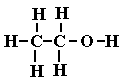
The molecule may be made up of atoms of a single element e.g. hydrogen formula H2 (H-H, two atoms combined, all atoms the same). Other molecular examples are oxygen O2, nitrogen N2, one form of phosphorus is P4 and one form of sulfur consists of S8 ring molecules, and another form of carbon is a C60 molecule! OR if two different symbols appear in the formula, it must denote a compound and it must have a formula! A compound (a chemical combination of two or more different elements and NOT a mixture - more examples below) e.g. carbon dioxide formula CO2 (O=C=O, three atoms combined) and in each case the atoms are held together by chemical bonds. (detailed GCSE bonding notes and examples) You can represent molecule in various styles of diagram. For example, you can colour and size code the atoms of different elements, so in the molecule pictured on the upper left, you can tell there are five types of atom (elements) and six atoms in total in the molecule. The second molecule (lower left) shows the molecular structure of ethanol ('alcohol') which consists of two carbon atoms, six hydrogen atoms and one oxygen atom.
You will also come across shorthand versions of this diagrammatic style written like
Why they are combined in this particular number and order depends primarily on an atoms combining power (its valence) an advanced concept dealt with in Part 3 equations, formula and valence. There are also styles to give a much greater '3D' impression of the shape of a molecule and they attempt to show the '3D' spatial arrangement of the atoms in a molecule and how the bonds connect them together.
Watch out for some styles of abbreviated formula e.g. pentane can be written as CH3CH2CH2CH2CH3, but, using brackets it can be written as CH3(CH2)3CH3 This abbreviated style is particularly useful for long molecules like decane CH3(CH2)8CH3 A shorthand way of expressing the 10 carbon atoms and 22 hydrogen atoms of decane! Some more examples of molecular formulae
You should be able to recognise which are elements and which are compounds. 1. HI hydrogen iodide, 2. CO2 carbon dioxide, 3 He helium atoms, 4. H2O water, 5. H2 hydrogen 6. P4 phosphorus, 7. CH4 methane, 8. NOCl molecule, 9. H2SO4 sulfuric acid Nanoparticles are bigger than the simple molecules described above. They are typically composed of ~100 atoms and range from 1 nm to 100 nm in size. Particle size comparison: nuclear radius < atomic radius < simple 'small' molecule < nanoparticle < polymer molecules |
||||||
|
1.1d CHEMICAL BOND |
|
||||||
|
1.1e COMPOUNDS, and MOLECULES |
|
||||||
|
1.1f More on formulae and COMPOUNDS
methane CH4
ethane C2H6
|
|
||||||
| A note on the names of chemicals |
Notes on the
names of compounds In most cases the metallic element retains its elemental name in the compound. However, this is not the case with non-metallic elements. When the following non-metals combine with other different elements its name changes e.g.
There are examples where a non-metal retains its element name e.g.
You might also come across the following 'parts' of names .. mono meaning one e.g. carbon monoxide (CO, one oxygen) di meaning two e.g. carbon dioxide (CO2, two oxygen atoms), sulfur dioxide (SO2, two oxygen atoms)
tri meaning three e.g. phosphorus trichloride (PCl3, three chlorine atoms), sulfur trioxide (SO3, 3 O atoms)
You can get 'mixed' numerical names e.g. Fe3O4 can be called triiron tetroxide !! There is another context in which mono..., di... and tri... etc. are used. It is used as a prefix to indicate the number of atoms in a molecule irrespective of the name. The noble gases exist as single atoms e.g. He, Ar, Ne etc. are sometimes referred to as monatomic molecules - but at this level best to think of them as elements consisting of single atoms. Diatomic molecules consist of two atoms e.g. H2, HCl, O2, N2, CO Triatomic molecules consist of three atoms e.g. O3, H2O, CO2
|
||||||
|
1.1g CHEMICAL EQUATION |
A chemical change can be represented by a
chemical equation,
either in words or chemical symbols e.g. word equation: sodium hydroxide + hydrochloric acid ==> sodium chloride + water
picture equation:
symbol equation: NaOH + HCl ==> NaCl + H2O symbol equation with state symbols: NaOH(aq) + HCl(aq) ==> NaCl(aq) + H2O(l) The chemicals on the left-hand side of the equation are called the REACTANTS. The chemicals on the right-hand side of the equation are called the PRODUCTS. To summarise the essence of chemistry is:
For lots more examples and how to balance equations see HOW TO WRITE CHEMICAL EQUATIONS with lots of worked examples explained in detail. |
||||||
|
1.1h (1) MIXTURE compared to a pure substance described below |
|
||||||
|
1.1h (2) FORMULATION MIXTURES compared to a pure substance described below or a mixture described above |
Formulations are useful mixtures
made up of measured out precise amounts (precise ratio) of two or
more substances. They are special mixtures designed for some particular purpose. Each component in the mixture contributes to the properties of the formulation. Commercially, they are made up from recipes of tried and tested formulations for that particular purpose. If you look around the house, especially in the kitchen and bathroom, you will lists of ingredients on the side of the bottle or package of products - percentages or relative amounts of the components in the formulation. See also lots of detailed descriptions of examples of formulations |
||||||
|
1.1i A PURE SUBSTANCE and a note on melting point and boiling point |
|
||||||
|
1.1j IMPURE SUBSTANCES |
|
||||||
|
1.1k PURIFICATION |
|
||||||
|
1.1l IONS |
An ion is an atom or a group atoms that carries an overall positive or
negative electric charge. In other words they are NOT a neutral particle like a molecule of water H2O or methane CH4. Examples of positive ions: sodium ion Na+, ammonium ion NH4+, aluminium ion Al3+ Examples of negative ions: chloride ion Cl-, sulfate ion SO42- The charge is notated as a superscript at the top right of the chemical symbol. Apart from a charge of single +/- a number must be used to indicate the overall charge e.g. 2+, 2-, 3+ 3- For ionic equations see a section HOW TO WRITE CHEMICAL EQUATIONS |
||||||
|
Easy revision quizzes on some basic chemistry concepts 4 linked easy quizzes on "Separation of Mixtures" 7Hwf1 * 7Hwf2 * 7Hwf3 * 7Hwf4 Easy matching pair quiz based on "Solubility and Solutions" 7Hmp1 (important words and definitions) 4 Easy linked word-fill quizzes on "Atoms, Elements and Compounds" 8Ewf1 * 8Ewf2 * 8Ewf3 * 8Ewf4 5 Easy linked word-fill quizzes on "Compounds and Mixtures" 8Fwf1 * 8Fwf2 * 8Fwf3 * 8Fwf4 * 8Fwf5 Easy matching pair quiz on "Elements, Compounds and Mixtures" ecm1mp (matching particle model pictures) |
|||||||

 An
An

 An
element consist of one type of atom only and all the atoms of an element
have the same atomic number (number of protons in nucleus).
An
element consist of one type of atom only and all the atoms of an element
have the same atomic number (number of protons in nucleus). a particle picture model of gaseous helium atoms
 a particle picture model of gaseous O2 oxygen molecules
 a particle picture model of solid iron atoms


 The
chemical composition of a
pure substance can be represented using the element symbols, and where
necessary, subscripted numbers.
The
chemical composition of a
pure substance can be represented using the element symbols, and where
necessary, subscripted numbers. or
or  a particle model picture of gaseous water (vapour or steam)
 a particle model picture of gaseous hydrogen chloride HCl
 a particle model picture of solid hydrogen chloride
 and
(ii)
and
(ii)


 A summary of all the atoms in
the individual molecule is called the molecular formula eg (ii)
above and C4H10 on the right. The number of atoms of each element is shown as a subscript
number in the formula. 14 atoms in total
A summary of all the atoms in
the individual molecule is called the molecular formula eg (ii)
above and C4H10 on the right. The number of atoms of each element is shown as a subscript
number in the formula. 14 atoms in total


 sodium chloride NaCl, ionic
compound, 2 elements, 1 atom of sodium to everyone 1 atom of chlorine).
sodium chloride NaCl, ionic
compound, 2 elements, 1 atom of sodium to everyone 1 atom of chlorine). methane CH4, covalent
compound molecule, has 2 elements in it, 1 atoms of carbon and 4
atoms of hydrogen. The lines in the diagram of methane represent the
four bonds in the molecule, and in this style of diagram attempts to
portray a 3D image of methane in 2D!
methane CH4, covalent
compound molecule, has 2 elements in it, 1 atoms of carbon and 4
atoms of hydrogen. The lines in the diagram of methane represent the
four bonds in the molecule, and in this style of diagram attempts to
portray a 3D image of methane in 2D! ethane C2H6,
two atoms of carbon combined with 6 atoms of hydrogen and note that the
same two
elements can form two different compounds because of different atom
ratios i.e. compared with methane.
ethane C2H6,
two atoms of carbon combined with 6 atoms of hydrogen and note that the
same two
elements can form two different compounds because of different atom
ratios i.e. compared with methane. carbon monoxide CO
(1C + 1O atoms) and
carbon monoxide CO
(1C + 1O atoms) and carbon dioxide CO2
(1C + 2O atoms)
carbon dioxide CO2
(1C + 2O atoms) There must be at least two different types of atom (elements) in a
compound.
There must be at least two different types of atom (elements) in a
compound.
 particle model picture of a gaseous mixture e.g. nitrogen and water
vapour
particle model picture of a gaseous mixture e.g. nitrogen and water
vapour particle model picture of a solid mixture of two substances
 a particle picture of a pure liquid
 a particle picture of an impure liquid, effectively a dilute solution.
 particle picture of a pure solid crystal
 a particle picture of a slightly impure solid crystal
Section 1.2 Particle Picture examples of Elements, Compounds and Mixtures - useful visual images
The particle model for gases, liquids and solids is fully described and discussed on the States of Matter page

 Section
1.3
PHYSICAL
CHANGES - no new substance formed Section
1.3
PHYSICAL
CHANGES - no new substance formed
These are changes which do NOT lead to new substances being formed. Only the physical state of the SAME material substance changes. The substance retains exactly the same chemical composition - the same atoms, ions or molecules. Examples ... Melting/fusing, solid to liquid, easily reversed by cooling e.g. ice and liquid water are still the same H2O molecules. Dissolving, e.g. solid mixes completely with a liquid to form a solution, easily reversed by evaporating the liquid e.g. dissolving salt in water, on evaporation the original salt is regained. So freezing, evaporating, boiling, condensing are all physical changes and may be involved in separating a mixture. Separating a physical mixture e.g. chromatography, e.g. a coloured dye solution is easily separated on paper using a solvent, they can all be re-dissolved and mixed to form the original dye. Distillation, filtering are also physical changes. See also '3 States of Matter' - gases, liquids and solids for more examples and particle theory models to explain state changes and the properties of gases, liquids and solids. |
|
Section 1.4 CHEMICAL CHANGES - CHEMICAL REACTIONS - reactants and products
A 'chemical change' involves the formation of at least one NEW substance AND there is always an energy change - which might, in some circumstances, be detectable with a thermometer. There are often colour changes and the products may look quite different from the reactants A chemical change involves: STARTER REACTANTS === energy change ===> NEW PRODUCTS Heating iron and sulfur is classic chemistry experiment to illustrate what is meant by CHEMICAL CHANGE and you can adapt the general conclusions described at the end of this section to any chemical reaction. A mixture of silvery grey iron filings and yellow sulfur powder is made. The iron can be plucked out with a magnet i.e. an easily achieved physical separation because the iron and sulfur are not chemically combined yet! They are still the same iron and sulfur e.g. even in the mixture iron will dissolve in acids to form a salt and hydrogen, sulfur will burn to form sulfur dioxide gas. However, on heating the mixture, it eventually glows red on its own and a dark grey solid called iron sulfide is formed. Both observations indicate a chemical change is happening i.e. a new substance is being formed. We no longer have iron or sulfur BUT a new compound with different physical properties (e.g. colour) and chemical properties (unlike iron which forms hydrogen with acids, iron sulfide forms toxic nasty smelling hydrogen sulfide!). word equation: iron + sulfur (sulfur) ==> iron sulfide (iron sulfide) or in a symbol chemical equation: Fe + S ==> FeS AND it is no longer possible to separate the iron from the sulfur using a magnet! Note that chemical changes can be expressed in a chemical equation. In chemical reactions, the atoms cannot be made or destroyed, but atoms rearrange themselves in changing from reactants to new products. There is no loss or gain of mass - see 'Law of Conservation of Mass' Further proof of a new substance formed: The original reactant iron, and the iron sulfide product, can be shown to be different substances by their reactions with dilute acid.
What next? Associated Pages Uses of Chemicals : over 220 examples briefly described Types of Chemical Reactions or Chemical Processes ALL my GCSE Level (~US grade 8-10) School Chemistry Notes (students aged ~14-16) Find your GCSE science course for more help links to revision notes ALL my Advanced Level pre-university Chemistry Notes (students aged ~17-18)
QUESTIONS - QUIZZES - WORKSHEETS: GCSE Chemistry word-fill exercises Some "Chemistry Basics" online gap-fill worksheet exercises Word-fill quiz "Balancing chemical symbol equations" Word-fill quiz "(1) Important terms used in chemistry" Word-fill quiz "(2) Other terms and chemical symbols" Word-fill quiz "(3) More important terms used in chemistry" Word-fill quiz "Elements and compounds" Word-fill quiz "Particle models of elements, compounds and mixtures" Patterns in properties of elements, compounds & periodic table BIG crossword puzzle (Crossword puzzle answers) Common chemical reactions BIG crossword puzzle (Crossword puzzle answers) GCSE level balancing and completing equation exercises:
(1)
GCSE 'name and formula' of a compound quizzes
(1)
Based on the syllabus-specifications for students taking the IGCSE/GCSE level chemistry examinations summary revision notes and key points on important definitions for students taking the AQA igcse/gcse chemistry notes on important definitions, Edexcel gcse chemistry notes on important definitions, OCR 21st century GCSE chemistry notes on important definitions, OCR gateway GCSE chemistry notes on important definitions, WJEC gcse chemistry notes on important definitions, CCEA gcse chemistry notes on important definitions for students taking CIE Cambridge igcse chemistry, or any other GCSE or IGCSE level chemistry exams notes on important definitions, useful for US grade 9-10 chemistry courses, Explaining the importance of differences between physical & chemical changes in GCSE level chemistry, What you need to know about differences between physical & chemical changes for GCSE level chemistry, Explaining the use of differences between physical & chemical changes knowledge in GCSE level chemistry, Examples of differences between physical & chemical changes explained when studying GCSE level chemistry, What is the significance of differences between physical & chemical changes in GCSE level chemistry, describing and explaining the theory of differences between physical & chemical changes when studying GCSE level chemistry, revision notes for differences between physical & chemical changes in exams, online help for understanding differences between physical & chemical changes, exam revision notes for differences between physical & chemical changes, what do I need to learn about differences between physical & chemical changes? revision summary for differences between physical & chemical changes, learning notes for differences between physical & chemical changes, help to pass the differences between physical & chemical changes topic in an exam question, how to prepare for questions on differences between physical & chemical changes in a GCSE chemistry examination?
|

 KS3 Science GCSE/IGCSE Chemistry States of
Matter - kinetic particle theory of Gases, Liquids and Solids
revision notes
KS3 Science GCSE/IGCSE Chemistry States of
Matter - kinetic particle theory of Gases, Liquids and Solids
revision notes multiple
choice
multiple
choice GCSE/IGCSE
formula quiz given the name, type in the formula
GCSE/IGCSE
formula quiz given the name, type in the formula|
|
 For searching