HOME PAGE * SEARCH * UK KS3 level Science Quizzes for students aged ~13-14

UK GCSE level Biology * Chemistry * Physics age ~14-16 * Advanced Level Chemistry age ~16-18

STATES OF MATTER - properties of gases and liquids (fluids) and solids

Part 2. Simple kinetic particle model of gases to explain their physical properties including gas pressure and the effect of temperature change

[Author © Dr Phil Brown GRIC, PhD: Doc Brown's chemistry exam revision notes on states of matter - physical properties of gases, liquids and solids, suitable for students of UK GCSE level and international IGCSE/O level chemistry courses, ~US grades 9-10 chemistry notes [page updated RE-EDIT]

 EMAIL query ? comment * [privacy, cookies and disclaimer]

INDEX of all my notes on the states of matter

GCSE (~US grades 8-10) level multiple choice QUIZ on the states of matter: gases, liquids & solids

See also on this page Part 3.

Three states of matter - what can we expect from particle models and are there limitations?


(c) doc b 3. The particle model of a GAS

  • WHAT IS THE GASEOUS STATE OF MATTER?
  • WHAT ARE THE PROPERTIES OF A GAS?
  • HOW DO GASEOUS PARTICLES BEHAVE?
  • How does the kinetic particle theory of gases explain the properties of gases?
  • A gas has no fixed shape or volume, but always spreads out to fill any container - the gas molecules will diffuse into any space available.
  • There are almost no forces of attraction between gas particles so they are completely free of each other and spread out to completely fill a container - hence their very low density.
  • The particles are widely spaced and scattered and always moving rapidly at random throughout the container so there is no order in the system.
  • The particles move linearly and rapidly in all directions, and frequently collide with each other and the side of the container.
  • The collision of gas particles with the surface of a container causes gas pressure, on bouncing off a surface they exert a force in doing so.
  • With increase in temperature, the particles move faster as they gain kinetic energy, the rate of collisions between the particles themselves and the container surface increases and this increases gas pressure eg in a steam locomotive or the volume of the container if it can expand eg like a balloon.

Using the particle model to explain the properties of a Gas

  • Gases have a very low density (‘light’) because the particles are so spaced out in the container (density = mass / volume) - the particles are unrestricted and spread out to fill any container.
    • The particle intermolecular forces are very weak and their kinetic energy is high enough to prevent then condensing to the considerably more dense state of liquid.
    • Density order: solid > liquid >>> gases
  • Gases flow freely because there are no effective forces of attraction between the gaseous particles – molecules.
    • Ease of flow order: gases > liquids >>> solids (no real flow in solid unless you finely powder it!)
    • Because of this gases and liquids are described as fluids.
  • Gases have no surface, and no fixed shape or volume, and because of lack of particle attraction, they always spread out and fill any container (so gas volume = container volume).
  • Gases are readily compressed because of the ‘empty’ space between the particles.
    • Ease of compression order: gases >>> liquids > solids (almost impossible to compress a solid)
  • Gas pressure
    • When a gas is confined in a container the particles will cause and exert a gas pressure which is measured in atmospheres (atm) or Pascals (1.0 Pa = 1.0 N/m2), pressure is force/area i.e. the effect of all the collisions on the surface of the container.
      • All particles have mass and their movement gives them kinetic energy and momentum.
      • The gas pressure is caused by the force created by millions of impacts of the tiny individual gas particles on the sides of a container.
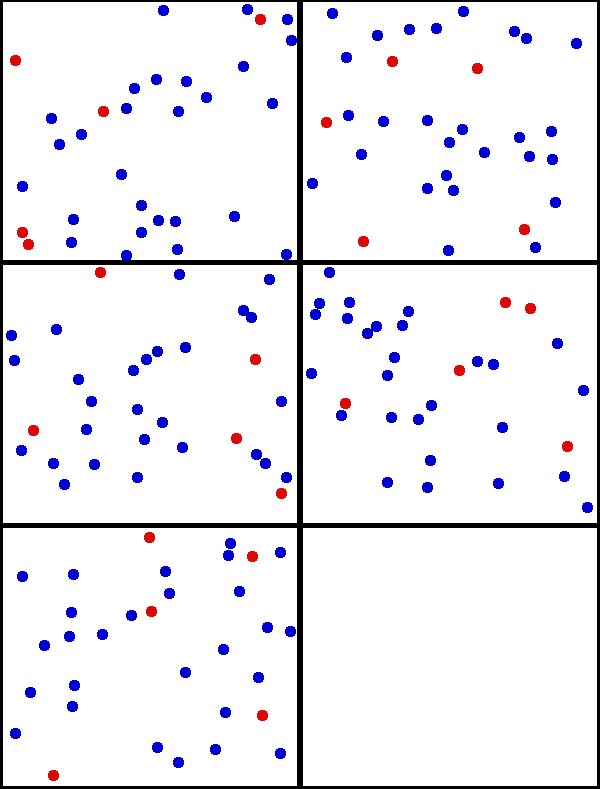
      • For example – if the number of gaseous particles in a container is doubled, the gas pressure is doubled because doubling the number of molecules doubles the number of impacts (collisions) on the side of the container so the total impact force per unit area is also doubled.
      • This doubling of the particle impacts doubling the pressure is pictured in diagrams below.
  • Effect of temperature change
  • If the volume of a sealed container is kept constant and the gas inside is heated to a higher temperature, the gas pressure increases.
    • The reason for this is that as the particles are heated they gain kinetic energy and on average move faster.
    • Therefore they will collide with the sides of the container with a greater force of impact, so increasing the pressure.
    • There is also a greater frequency of collision with the sides of the container BUT this is a minor factor compared to the effect of increased kinetic energy and the increase in the average force of impact.
    • Therefore a fixed amount of gas in a sealed container of constant volume, the higher the temperature the greater the pressure and the lower the temperature the lesser the pressure.
    • See Part 19. Particle model - gas pressure-volume-temperature calculations

    • See Part 20.  The Combined gas law equation - more complicated calculations involving P-V-T

  • If the ‘container’ volume can change, gases readily expand* on heating because of the lack of particle attraction, and readily contract on cooling.
    • On heating, gas particles gain kinetic energy, move faster and hit the sides of the container more frequently, and significantly, they hit with a greater force.
    • Depending on the container situation, either or both of the pressure or volume will increase (reverse on cooling).
    • Note: * It is the gas volume that expands NOT the molecules, they stay the same size!
    • If there is no volume restriction the expansion on heating is much greater for gases than liquids or solids because there is no significant attraction between gaseous particles. The increased average kinetic energy will make the gas pressure rise and so the gas will try to expand in volume if allowed to e.g. balloons in a warm room are significantly bigger than the same balloon in a cold room!
  • Thermal energy (heat energy) conduction in gases
    • All gases are very poor conductors of thermal energy, energy which is due to the kinetic energy of the moving particles.
    • Heat energy is transferred by 'hotter' higher kinetic energy gas particles colliding with 'cooler' lower kinetic energy particles so raising their kinetic energy and spreading the heat energy.
    • However, the density of gases is very low, so the density or rate of 'collision transfer' is quite low.
    • Therefore gases are very good insulators e.g. think of their used in house insulation where air is trapped in various ways like foam or fibre glass loft insulation.
  • Electrical conduction in gases
    • Electrical conduction requires the presence of free IONS or free ELECTRONS i.e. particles that can carry an electrical charge.
    • Gases are poor conductors of electricity because they are usually not in an ionic or ionised form.
    • However, applying a very high potential difference of thousands of volts, especially with a low gas pressure, can cause the formation of free ions and electrons and electrical conduction can happen.
    • Strip lighting and neon signs use this effect.
  • Diffusion in gases
  • Brownian motion in gases
    • When smoke particles suspended in air are viewed under a microscope they appear to 'dance around' when illuminated with a light beam at 90o to the viewing direction.
    • This is because the pollen grains show up by reflected light and 'dance' due to the millions of random hits from the fast moving air molecules.
    • This phenomenon is called 'Brownian motion' after a botanist called Brown first described the effect (see Part 5 for evidence for Brownian motion in gases).
    • At any given instant of time, the particle hits will not be even all round the surface of the smoke particles, so they get a greater number of hits in a random direction and then another, hence the smoke particles zig-zag around in all directions with random movement.

Learning objectives for using the particle model of a gas to explain its properties

Image adapted from Wikipedia, but in reality the 'red and blue' particles are moving much faster (e.g. 200 m/s) and colliding millions of time a second.

Be able to describe the kinetic particle model of a gas.

Be able to draw particle pictures to illustrate and explain the physical properties of gases.

Know, and why, for the same substance, gases have a much lower density than liquids or solids.

Know and explain that gases have no shape or fixed volume - the particles move and spread out to fill any container.

Know and explain why gases are much more easily compressed to a smaller volume compared to solids and liquids because of the relatively large space between gas particles.

Be able to explain pressure in terms of the kinetic particle model of a gas i.e. the collective effect of many impacts of gas molecules on the enclosing surface..

Know and explain that very weak forces between gas particles allows a gas to be a fluid and flow freely e.g. under pressure in a gas pipe.

Explain using the particle model that increasing the number of gas particles in a container, increases the number of collisions of gas particles with the surface and so increases pressure.

Be able to explain the effect of changing temperature in terms of the kinetic particle model of a gas e.g. increasing temperature can increase volume or pressure depending on conditions and explain this is due to the increase in the average kinetic energy of the particles.

Know that the thermal energy, the internal energy of a gas is the kinetic energy of the particles.

Know that gas particles are not usually electrically charged, gases are very poor conductors of electricity (but a high p.d. may produce ions and electrical conduction).

Be able to describe and explain microscope observations of Brownian motion in gases e.g. the motion of suspended smoke particles in air.


A summary revision guide on the Kinetic Particle Theory of Gases,

tailored for GCSE/IGCSE chemistry students across exam boards (WJEC, CCEA, CIE, AQA, Edexcel, OCR, and equivalent US Grade 9–10 courses).


Kinetic Particle Theory of Gases

Key Ideas

  • Particles in gases:
    • Far apart compared to solids/liquids.
    • Move randomly and rapidly in all directions.
    • Weak/no forces between particles (except during collisions).
  • Collisions:
    • Elastic (no loss of kinetic energy overall).
    • Cause observable effects like pressure.

Cause of Gas Pressure

  • Definition: Pressure is the force exerted per unit area.
  • Origin in gases:
    • Gas particles collide with the walls of the container.
    • Each collision exerts a tiny force.
    • The total force from many collisions per unit area = gas pressure.
  • Factors affecting pressure:
    • More frequent collisions → higher pressure.
    • Stronger collisions (higher particle speed) → higher pressure.

Effect of Temperature

  • Temperature and kinetic energy:
    • Temperature is a measure of the average kinetic energy of particles.
    • Higher temperature → particles move faster.
  • Consequences:
    • Faster particles collide with container walls more often and with greater force.
    • Pressure increases if volume is fixed.
  • Practical links:
    • Heating a sealed container increases pressure (risk of explosion).
    • Cooling reduces particle speed → lower pressure.

Typical Exam Board Requirements

Specification Emphasis

Kinetic theory, pressure-temperature relationship, gas laws context.
Cause of pressure, effect of temperature, particle motion.
Particle theory, pressure from collisions, temperature effects.
Gas particle motion, pressure definition, temperature link to kinetic energy.

Common Misconceptions

  •  Pressure is caused by particles "pushing" each other → Incorrect.
     Pressure is due to collisions with container walls.
  •  Temperature only affects pressure if particles "expand" → Incorrect.
     Temperature increases particle speed and collision force.
  •  Particles stop moving at low temperature → Incorrect.
     They slow down, but only stop at absolute zero (0 K).

Exam Tips

  • Use keywords: random motion, collisions, kinetic energy, pressure, temperature.
  • Link cause → effect clearly: "Higher temperature → faster particles → more frequent/forceful collisions → higher pressure."
  • Diagrams of particles in a container at different temperatures often appear in exams—be ready to annotate them.
  • Remember: Pressure proportional to collision frequency × collision force (qualitative, not quantitative at GCSE level).

All my UK GCSE level (~US grade 8-10) school chemistry revision notes

All my UK advanced level (~US grades 11-12) pre-university chemistry revision notes

This is a BIG website, you need to take time to explore it [SEARCH BOX]

Email doc brown - comment? query?


Explaining importance of particle model to explain gas pressure & effect of temperature in GCSE level chemistry, What you need to know about particle model to explain gas pressure & effect of temperature for GCSE level chemistry, Explaining use of particle model to explain gas pressure & effect of temperature knowledge in GCSE level chemistry, Examples of particle model to explain gas pressure & effect of temperature explained when studying GCSE level chemistry, What is the significance of particle model to explain gas pressure & effect of temperature in GCSE level chemistry, describing explaining theory of particle model to explain gas pressure & effect of temperature when studying GCSE level chemistry, exam revision notes for particle model to explain gas pressure & effect of temperature, online help for understanding particle model to explain gas pressure & effect of temperature in GCSE chemistry, what do I need to learn about particle model to explain gas pressure & effect of temperature? what do I need to know about particle model to explain gas pressure & effect of temperature for GCSE chemistry exams, how to prepare for questions on particle model to explain gas pressure & effect of temperature in GCSE chemistry examination? particle model to explain gas pressure & effect of temperature for syllabus-specifications for students taking the IGCSE/GCSE level chemistry examinations, summary revision notes key points on particle model to explain gas pressure & effect of temperature for students studying AQA igcse/gcse chemistry notes on particle model to explain gas pressure & effect of temperature, Edexcel gcse chemistry notes on particle model to explain gas pressure & effect of temperature,  OCR 21st century GCSE chemistry notes on particle model to explain gas pressure & effect of temperature, OCR gateway GCSE chemistry notes on particle model to explain gas pressure & effect of temperature, WJEC gcse chemistry notes on particle model to explain gas pressure & effect of temperature, CCEA gcse chemistry notes on particle model to explain gas pressure & effect of temperature, CIE Cambridge igcse chemistry, notes on particle model to explain gas pressure & effect of temperature useful for US grade 9-10 chemistry student courses
extra advanced notes on gas laws, ideal and non-ideal gasesWebsite content © Dr Phil Brown 2000+. All copyrights reserved on Doc Brown's Chemistry revision notes, images, quizzes, worksheets etc. Copying of website material is NOT permitted. GCSE level and advanced pre-university level revision notes. Detailed notes on the states of matter and their properties. Based on the syllabus-specifications for students taking the IGCSE/GCSE level physics examinations summary revision notes and key points about the kinetic particle theory for a gas - pressure and effect of temperature, for students taking the WJEC gcse chemistry/physics, CCEA gcse chemistry/physics, CIE igcse chemistry/physics, AQA igcse/gcse physics, Edexcel gcse chemistry/physics, OCR 21st century chemistry/physics, OCR gateway chemistry/physics or any other GCSE or IGCSE level chemistry/physics exams e.g. US grade 9-10 physics courses

INDEX of all my notes on the states of matter

GCSE (~US grades 8-10) level multiple choice QUIZ on the states of matter: gases, liquids & solids

TOP OF PAGE and main indexes

Part 3. of STATES OF MATTER - introduction to the kinetic particle theory of matter contd., What we might expect & its limitations in describing the properties & behaviour of gases & liquids (both fluids) & solids

[Author © Dr Phil Brown GRIC, PhD: Doc Brown's chemistry exam revision notes on states of matter - physical properties of gases, liquids and solids, suitable for students of UK GCSE level and international IGCSE/O level chemistry courses, ~US grades 9-10 chemistry notes [page updated RE-EDIT]

 EMAIL query ? comment * [privacy, cookies and disclaimer]

INDEX of all my notes on the states of matter

GCSE (~US grades 8-10) level multiple choice QUIZ on the states of matter: gases, liquids & solids

See also on this page Part 2

A kinetic particle model of a gas, properties, pressure and the effect of temperature change


3. What can we expect from gas–liquid–solid particle theory models?

The three states of matter are solid, liquid and gas.

Either melting and freezing can take place at the melting point, whereas boiling and condensing take place at the boiling point.

Evaporation can take place at any temperature from a liquid surface.

You can represent the three states of matter with a simple particle model.

In this model–diagrams, the particles are represented by small solid inelastic spheres (electron structure is ignored).

Kinetic particle theory can help to explain changes of state like melting, boiling, freezing and condensing.

The amount of energy needed to change state from solid to liquid or from liquid to gas depends on the strength of the forces between the particles of the substance.

These inter-particle forces may be relatively weak intermolecular forces (intermolecular bonding) or strong chemical bonds (ionic, covalent or metallic).

The nature of the particles involved depends on the type of chemical bonding and the structure of the substance.

The stronger the attractive forces between the particles the higher the melting point and boiling point of the substance

  • WHAT ARE THE THREE STATES OF MATTER?

    • Most materials can be simply described as a gas, a liquid or a solid.

  • WHY ARE THEY LIKE - WHAT STATE THEY ARE?

    • Just knowing isn't enough, we need a comprehensive theory of gases, that can explain their behaviour and make predictions about what happens e.g. if we change temperature or pressure.

  • HOW CAN WE EXPLAIN HOW THEY BEHAVE?

    • We need a theoretical model  e.g. 'particle theory' that is supported by experimental evidence.

  • CAN PARTICLE MODELS HELP US UNDERSTAND THEIR PROPERTIES and CHARACTERISTICS?

    • In a word, YES!

  • WHY IS IT IMPORTANT TO KNOW THE PROPERTIES OF GASES, LIQUIDS AND SOLIDS?

    • It is important in the chemical industry to know about the behaviour of gases, liquids and solids in chemical processes e.g. what happens to the different states with changes in temperature and pressure.

  • What is the KINETIC PARTICLE THEORY of gases, liquids and solids?

    • The kinetic particle theory of the states of matter is based on the idea of all materials existing as very tiny particles which may be individual atoms or molecules and the their interaction with each other either by collision in gases or liquids or by vibration and chemical bonding in solids.

  • CAN WE MAKE PREDICTIONS BASED ON THEIR CHARACTERISTIC PROPERTIES?

    • This page introduces general physical descriptions of substances in the simplest physical (non–chemical) classification level i.e. is it a gas, liquid or a solid.

    • BUT, this web page also introduces 'particle models' in which a small circle represents an atom or a molecule i.e. a particular particle or simplest unit of a substance.

    • This section is quite abstract in a way because you are talking about particles you can't see individually, you just the 'bulk' material and its physical character and properties.

  • Are there LIMITATIONS to the particle model?

    • Well, yes! e.g.

    • The particles are treated as simple minute inelastic spheres and just behave like minute snooker balls flying around, not quite true, but they do fly around non-stop at random!

    • Although the particles are assumed to be hard spheres and inelastic, in reality they are atoms, ions or molecules.

    • Apart from lone atoms, they can be all sorts of shapes and twist and bend on collision with other particles and when they react they split into fragments when bonds break.

    • The simple model assumes no forces between the particles, but this is untrue, the model takes little account of the forces between the particles, even in gases you get very weak intermolecular bonding forces.

    • The particle model takes no account of the actual size of the particles e.g. ions/molecules can be widely different in size e.g. compare an ethene molecule with a poly(ethene) molecule!

    • Neither does it take account of any space that may exist between the particles.

  • A note on 'forces'

    • Forces between particles are mentioned on this page and some ideas will seem more abstract than others – but think about it ...

    • A gas spreads everywhere in a given space, so there can't be much attraction between the molecules/particles.

    • Something must hold liquid molecules together or how can a liquid form from a gas?

    • In fact between liquid molecules there are actually weak electrical forces of attraction called intermolecular forces, but they can't be strong enough to create a rigid solid structure.

    • However, in solids, these forces must be stronger to create the rigid structure.

    • Intermolecular forces are also called 'intermolecular bonds' BUT these are not the same as covalent, ionic or metallic bonds and are much weaker than these true chemical bonds.


Summary of the Kinetic Particle Theory of Matter – GCSE/IGCSE Level Revision Notes

Core Idea

The kinetic particle theory explains the properties of solids, liquids, and gases in terms of the arrangement, movement, and energy of particles.

Below are a list of situations which the kinetic particle model of matter tries to explain, with much success, but far from perfect.


1. States of Matter


2. Changes of State


3. Diffusion


4. Pressure in Gases


Limitations of the Kinetic Particle Theory

  • Simplified model: represents particles as spheres, ignores real atomic/molecular shapes.
  • No account of forces: diagrams often omit attractive/repulsive forces between particles.
  • Not scale-accurate: spacing and relative sizes are exaggerated for clarity.
  • Doesn’t explain complex phenomena: e.g., solubility, chemical bonding, or why different substances have different melting/boiling points.
  • Idealised assumptions: assumes perfectly elastic collisions and ignores intermolecular variations.

Exam Tips

  • Use particle diagrams: draw clear, labelled diagrams for solids, liquids, gases.
  • Link energy to movement: always mention kinetic energy when explaining changes of state.
  • Pressure questions: connect temperature → kinetic energy → collision frequency/force → pressure.
  • Diffusion explanations: compare particle spacing and forces in gases versus liquids.
  • State properties: examiners expect you to connect arrangement + movement → observed properties.

Typical Misconceptions

  • Thinking particles expand when heated → correction: particles move faster, spacing increases, but particles themselves do not expand.
  • Believing liquids are easily compressed → correction: particles are close together, so liquids are not easily compressed.
  • Assuming all gases diffuse at the same rate → correction: diffusion rate depends on particle mass (lighter gases diffuse faster).
  • Forgetting that melting and boiling involve energy transfer → correction: energy is used to overcome forces, not to increase temperature during the change of state (plateau on heating curve).
  • Confusing particle movement with bulk movement → correction: diffusion is due to random particle motion, not directed flow.

Typical exam board requirements

Key Emphasis

Clear particle diagrams, diffusion experiments, linking energy to state changes
Pressure in gases, diffusion in air, heating curves
Focus on diffusion, sublimation, particle diagrams
Explaining properties of states, heating/cooling curves, pressure-temperature link
Particle diagrams, diffusion, pressure, energy transfer during state changes
Practical applications (e.g., diffusion in gases), particle model limitations
Emphasis on model strengths/limitations, linking theory to real-world phenomena

Revision Strategy:

  • Practice drawing particle diagrams for each state.
  • Memorise properties → particle explanation links.
  • Revise limitations (often tested in evaluation-style questions).
  • Use past papers to spot how each exam board phrases diffusion/pressure/state change questions.

Learning objectives for the kinetic particle model of gases, liquids and solids

Know what do we want or expect from a particle model of gases, liquids and solids.

Know that any particle theory must be supported from experimental observations and experiments to match the kinetic particle theory.

Know why it is so important to understand the particle nature of gases, liquids and solids.

Know, and be able to explain and describe how the kinetic particle theory of the states of matter is based on the idea of all materials existing as extremely tiny particles which may be individual atoms or molecules and the their interaction with each other either by collision in gases or liquids or by vibration in solids.

Be able to describe and explain some limitations to the particle model e.g. they are not simple tiny inelastic spheres of zero volume with no attractive forces between them e.g. in a gas or liquid.

BUT ...

(i) The particles in gases have a real volume, which is assumed to be zero when doing gas law calculations.

(ii) There are always weak intermolecular forces attractive forces between ALL particles in gases, liquids or solids in the order solids > liquids >> gases (put in main text)


All my UK GCSE level (~US grade 8-10) school chemistry revision notes

All my UK advanced level (~US grades 11-12) pre-university chemistry revision notes

This is a BIG website, you need to take time to explore it [SEARCH BOX]

Email doc brown - comment? query?


Explaining importance of kinetic particle model of gases & its limitations in GCSE level chemistry, What you need to know about kinetic particle model of gases & its limitations for GCSE level chemistry, Explaining use of kinetic particle model of gases & its limitations knowledge in GCSE level chemistry, Examples of kinetic particle model of gases & its limitations explained when studying GCSE level chemistry, What is the significance of kinetic particle model of gases & its limitations in GCSE level chemistry, describing explaining theory of kinetic particle model of gases & its limitations when studying GCSE level chemistry, exam revision notes for kinetic particle model of gases & its limitations, online help for understanding kinetic particle model of gases & its limitations in GCSE chemistry, what do I need to learn about kinetic particle model of gases & its limitations? what do I need to know about kinetic particle model of gases & its limitations for GCSE chemistry exams, how to prepare for questions on kinetic particle model of gases & its limitations in GCSE chemistry examination? kinetic particle model of gases & its limitations for syllabus-specifications for students taking the IGCSE/GCSE level chemistry examinations, summary revision notes key points on kinetic particle model of gases & its limitations for students studying AQA igcse/gcse chemistry notes on kinetic particle model of gases & its limitations, Edexcel gcse chemistry notes on kinetic particle model of gases & its limitations,  OCR 21st century GCSE chemistry notes on kinetic particle model of gases & its limitations, OCR gateway GCSE chemistry notes on kinetic particle model of gases & its limitations, WJEC gcse chemistry notes on kinetic particle model of gases & its limitations, CCEA gcse chemistry notes on kinetic particle model of gases & its limitations, CIE Cambridge igcse chemistry, notes on kinetic particle model of gases & its limitations useful for US grade 9-10 chemistry student courses
extra advanced notes on gas laws, ideal and non-ideal gasesWebsite content © Dr Phil Brown 2000+. All copyrights reserved on Doc Brown's Chemistry revision notes, images, quizzes, worksheets etc. Copying of website material is NOT permitted. GCSE level and advanced pre-university level revision notes. Detailed notes on the states of matter and their properties. Based on the syllabus-specifications for students taking the IGCSE/GCSE level physics examinations summary revision notes and key points about Introduction to the kinetic particle theory of matter and its limitations, for students taking the WJEC gcse chemistry/physics, CCEA gcse chemistry/physics, CIE igcse chemistry/physics, AQA igcse/gcse physics, Edexcel gcse chemistry/physics, OCR 21st century chemistry/physics, OCR gateway chemistry/physics or any other GCSE or IGCSE level chemistry/physics exams e.g. US grade 9-10 physics courses

INDEX of all my notes on the states of matter

GCSE (~US grades 8-10) level multiple choice QUIZ on the states of matter: gases, liquids & solids

TOP OF PAGE and main indexes