|
Doc
Brown's chemistry notes on atomic and electron structure
5.
The electronic
structure of atoms
– configuration rules and the connection between an element's electron
arrangement and its position in the periodic table of elements
[Author
©
Dr Phil Brown GRIC, PhD:
Doc Brown's chemistry exam revision notes
on
electronic
structure of atoms and the periodic table
suitable for students of UK GCSE/A
advanced
level and international
IGCSE/O/Advanced A level chemistry courses, ~US grades 9-12 chemistry notes [page updated
RE-EDIT]
email doc
brown: query? comment? *
[privacy policy, cookies &
disclaimer]
INDEX of atomic structure exam
revision notes
For advanced A-level
students only
Electron configurations using a
more advanced notation).
5.
The Electronic Structure of Atoms
– assignment rules
and the connection of an element's electron
arrangement and its place in the
Periodic Table
WHAT DO WE MEAN BY the electron
configuration?, electronic structure of atoms?
that is what is the arrangement of
electrons in the shells or energy levels?
What is the relationship between an
atom's electronic structure and its position in the Periodic
Table?
-
The Bohr model of the atom in its more
elaborate form involves the maximum numbers of electrons that each shell or
energy level can hold and how the shells are progressively filled with
electrons from atom to another with increase in proton/atomic number.
-
The electrons are arranged in energy levels or shells around the nucleus and with
'orbits' on average increasing in distance from the nucleus.
-
Electrons in an atom occupy the lowest available energy levels (the
innermost available shells).
-
The lowest energy levels are
always filled first, you can think of the lower the shell, the nearer the
nucleus, and numbered 1, 2, 3 etc. as the shell gets further from the
nucleus.
-
Each electron in an atom is in a
particular energy level
(or shell) and the electrons must occupy the
lowest available energy level (or shell) available nearest the nucleus.
-
When the level is full, the next electron goes into the next highest level (shell) available.
-
There are rules to learn about the maximum number of electrons allowed in each shell and you have to be able to work out the arrangements for the first 20
elements (for GCSE students),
-
BUT
up to at least 36 for Advanced A-level students
using a more advanced notation).
-
So, for GCSE level students
-
The 1st shell
can contain a maximum of 2 electrons (electrons 1–2)
-
The 2nd shell can contain a maximum of 8 electrons
(electrons 3–10)
-
The 3rd shell also has a maximum of 8 electrons
(electrons 11–18)
-
The 19th and 20th electrons go into the 4th
shell, (required limit of GCSE chemistry knowledge).
-
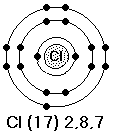
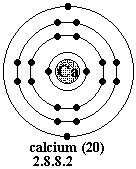
Examples
and remember the (atomic number) = electron number of a neutral atom
-
 , ,  ,
,  ,
,
-
A few more 'snappy' examples –
given atomic number, work out electron configuration (abbreviated to e.c.)
Z = 3 e.c. 2,1
,
Z = 7 e.c. = 2,5 , Z = 14 e.c. = 2,8,4 , Z =
19 e.c. = 2,8,8,1
-
If you know the atomic (proton) number,
you know it equals the number of electrons in a neutral atom, you then apply
the above rules to work out the electron arrangement (configuration). -
For elements 1 to 20 the electron
arrangements/configurations are written out in the following manner:
- Note that each number represents the number of
electrons in a particular shell, dots or commas are used to separate the numbers of
electrons in each shell. They are written out in order of increasing average
distance from the positive nucleus which holds these negative electrons in
their energy levels (shells).
The
connection between electron arrangement and an element's position in the
periodic table.
The electron configurations or
electron
arrangements are
summarised below with reference to the periods of the periodic table and in
order of increasing atomic number up to proton number 20.
-
Period 1 – elements 1 to 2
(2 elements)
-
Period 2 – elements 3 to 10
(8 elements)
-
Period 3 – elements 11 to 18
(8 elements)
-
are denoted by 2,8,1 to 2,8,8 (1st
& 2nd
shells full with 2 & 8 electrons, i.e. 2.8)
-
2,8,3 would mean two electrons in
the 1st level (shell), eight in the 2nd level (full shell) and three
electrons in the 3rd outer level (shell).
-
Period 4 – first two elements
19 to 20
-
are written out as
2,8,8,1 and
2,8,8,2 (1st, 2nd, 3rd full shells with 2,8,8
electrons)
-
2,8,8,1 would mean two electrons
in the 1st level (shell), eight in the 2nd level, eight electrons in the 3rd
level (shell) and one electron in the 4th outer level (shell).
-
Reminder – this is as far as
GCSE students need to know, after that things get more complicated, BUT only
for advanced level students!
-
For example, after element 18,
the 3rd shell can hold a maximum of 18 electrons!
-
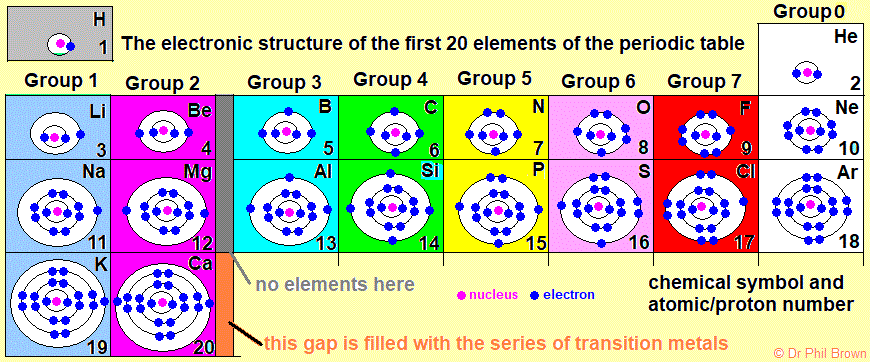
The above is summarised in the
diagram below
-

-
The first 20 elements of the
periodic table in terms of their
electronic structure in shells and numbers.
-
I've repeated the same 20 elements of the
periodic table showing simple diagrams of their electronic
structure and group numbers with full diagrams of the shells of electrons.
-
Group 1 are the alkali metals, Group 7 are the
halogens and group 0/8 are the noble gases.
-
You should note that the group number of
the element equals the number of electrons in the outer shell (1-8).
-
The electron shell arrangements are quoted in
numbers e.g. 2,4 for C (carbon) but you need to be able to draw electron
diagrams showing the electronic structure of the atom.
-
In the above table, check out the atomic
number, the lower subscript on the element symbol, and apply the rules, and
hopefully it makes sense.
-
Some examples of electronic diagrams are given below
and GCSE/IGCSE/O level students need to be able to work and draw the
electronic structures of the first 20 elements.
-
You should notice that the
number of shells used equals the period number of the element in the
periodic table.
-
They can be all worked by the
'shell filling' rules described above.
-
For the rest of Period 4 and
other Periods you need a more
advanced
electron configuration system up to at least Z=36 using s, p, d and f orbital
notation BUT this is for advanced A level chemistry
students only!
Examples: diagram, symbol or name of element (Atomic Number = number of
protons and the number of electrons in a neutral atom), shorthand electron arrangement
and a diagram to help you follow the numbers.
Filling 1st shell, electron level 1 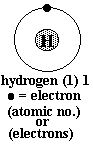 2 elements only,
Period 1 of the Periodic Table
2 elements only,
Period 1 of the Periodic Table
Filling 2nd shell, electron level 2  to to
to to  3 of the 8 elements of Period 2
Filling 3rd shell, electron level 3 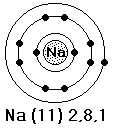 to
to
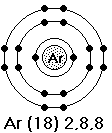 3
of the 8 elements of Period 3 3
of the 8 elements of Period 3
The first 2 elements
using the 4th shell 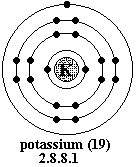 to Kr [2.8.18.8],
start of Period 4
to Kr [2.8.18.8],
start of Period 4
Only the first 2 of the 18 elements of Period 4 are shown
above, the rule for 3rd shell changes from element 21 Sc onwards
(studied at Advanced level, so GCSE students don't worry!)
5.
The Periodic Table and
Electronic Structure – more
on electron configuration patterns!
Selected Elements of the Periodic Table are shown below
with
atomic number and chemical symbol.
HOW DOES AN ELEMENT'S ELECTRON ARRANGEMENT
RELATE TO ITS POSITION IN THE PERIODIC TABLE?

-
The elements are laid out in order of
Atomic Number – that is the number of protons in the nucleus.
-
It is important to realise
that the 'chemical structure' of the periodic Table
(shown above), that is the chemical similarity of vertical groups 'like'
elements (apart from the
Noble Gases),
was known well before the electronic structure of atoms was understood.
-
In other words the elements are laid
out in vertical columns (groups) and horizontal rows (periods) so that
chemically (usually) VERY similar elements appear under each other – and there
is a very good electronic structure reason for this!
-
However, it wasn't understood why they behaved in the same way chemically
e.g. similar compound formulae and reactions etc. nor was it understood at
first why Noble Gases were so unreactive towards other elements.
-
BUT, once
the electronic structure of atoms was understood, 'electronic' theories
could then be applied to explain the chemical similarity of elements in a
vertical Group of the Periodic Table.
Originally the
elements were
laid out in order of 'atomic weight'
(now called relative atomic mass).
-
This is not correct for some elements now that we know their
detailed atomic structure in terms of protons, neutrons and electrons, and of
course, their chemical and physical properties in more accurate and extensive
detail.
For example:
Argon (at. no.
18, electrons 2,8,8) has a relative atomic mass of 40. Potassium (at.
no. 19, electrons 2,8,8,1) has a relative atomic mass of 39. BUT Argon, in terms
of its physical, chemical and electronic properties is clearly a Noble Gas in
Group 0. Likewise, potassium is clearly an Alkali Metal in Group 1.
Hydrogen, 1, H, does not readily fit into any group
A Group is a vertical column of chemically and physically similar elements
e.g.
-
Group 1 The Alkali Metals (Li, Na, K etc.)
with one outer electron (one more than a Noble Gas structure) in the
outer shell.
-
Group 7 The Halogens (F, Cl, Br, I etc.)
with seven outer electrons (one short of a Noble Gas arrangement) in the
outer shell.
-
and Group 0 The Noble Gases (He, Ne, Ar etc.).
These elements have the maximum possible number of electrons permitted in the
outer shell.
A Period is a horizontal row of elements with a variety of properties,
with 'observable trends'
-
(left to right goes from metallic to non–metallic elements.
-
All the elements use the same number of electron shells which equals the period number (e.g. sodium's electron arrangement 2.8.1, the first element in Period 3).
The ten elements Sc to Zn are
called the Transition Metals Series and form part of a
period between Group 2 and Group 3 from Period 4 onwards.
Below are the electron arrangements
for elements 1 to 20 set out in
Periodic Table
format
-
(Hydrogen and The Transition metals etc. have been omitted).
-
When you move down to the next period you start to fill in the next shell according to the maximum electrons in a shell rule (see previous section).
NOTE: For
advanced level pre-university/college level students, in the most
modern periodic table notation Groups 3–7 and 0 are numbered Groups 3 to 18.

-
The first element in a period has one outer
electron (e.g. sodium Na 2.8.1), and the last element has a full outer shell
(e.g.
argon Ar 2.8.8)
-
Apart from hydrogen (H, 1) and helium (He, 2) the last electron number is the group number
(in the old notation) and the number of shells used is equal to the Period
number.
-
The periodicity of
elements i.e. the repetition of very chemically similar elements in a group is due to the
repetition of a the same outer electron structure
– check out the last number from element 3 onwards.
 More GCSE/IGCSE notes on the Periodic Table
and the
electronic explanations of
chemical bonding–formulae
 Advanced Level Chemistry –
electron configurations and the Periodic Table
Advanced Level Chemistry –
electron configurations and the Periodic Table
Quizzes - practice exam questions
INDEX of atomic structure exam
revision notes
|
