The development of the 'atomic model'
is an excellent example of how new experiment evidence initiates the
need to change an existing scientific model or even come up with a
different theoretical model, in this case for atomic structure.
You should appreciate that knowledge and understanding of atomic
structure has evolved over time and as a scientific model of atomic
structure, it must explain current experimental observations and pose
questions for future investigations.
Any further change in an atomic
structure hypothesis e.g. because of new evidence, must be
re-tested out in the laboratory and the results checked by other research
groups from around the world.
Plus a transparent peer group review of
any research paper to be published, which means scientists having their
work checked by other scientists. I
they don't agree, somebody has got something wrong or made false claims
or just done the experiment badly! If further experimental checks don't back
up a hypothesis, it must be modified or abandoned in favour of other
ideas.
When a hypothesis is backed up by
experimental evidence from different scientists and lots of
cross-checking of results e.g. the Bohr theory of the atom, it becomes
an accepted theoretical model of an atom.
Even to this day the atomic
structure model is still developing e.g. the hypothesis that neutrons
and protons are made of quarks which are held together by gluons, but at
this point I'm out of my depth! Nothing stands still in scientific
theory, even with atomic structure, and the hypotheses of modern quantum
physicists about the structure of the nucleus I find pretty 'whacky',
actually, pretty incomprehensible!
The ancient Greeks thought that
everything was made of four basic 'elements'
- air, earth, fire and
water. However, at the height of the great classical Greek
civilisation, the
Greeks
Leucippus and Democritus and others ~400 BC, wondered what was the result of
continually dividing a substance i.e. what was the end product or
smallest bit i.e. what was left that was indivisible – the word atomic
is from Greek adjective meaning 'not divisible'.
The Greeks idea was not
forgotten and later revived by Boyle and Newton but with little
chemical progress.
However, in 1808
Dalton
at the beginning of the 19th century,
proposed his
atomic theory
that all matter was made up of tiny hard particles/spheres called
atoms.
Dalton also proposed (correctly) the theory
that different types of atoms (elements)
combined together to give all the different substances of the physical
world (all which of course is true, except for the 'hard solid
indivisible spheres'!).
He also produced the first list of 'atomic
weights' (we now call relative atomic masses) on a scale based on
hydrogen – given the arbitrary value of 1 since it was lightest element
known, and, as it happens, correctly so.
He was incorrect by stating that atoms were indivisible, because we now know that atoms consist of
electrons, protons and neutrons and that atoms can be 'taken apart' by
ionisation or nuclear changes e.g.
radioactivity.
Until the discovery of the electron, atoms were thought of as hard
indivisible spheres, but brilliant 'JJ' Thompson changed all that.
New experimental evidence led to a
new scientific model of the atom
with the discovery of the electron, recognised as the
first known 'sub-atomic particle', change was on the way.
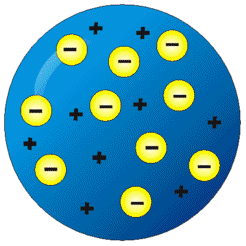 J J
Thomson
around 1897 proposed his 'plum pudding model' theory
(picture on right) based on the growing evidence
that atoms were themselves composed of even smaller more fundamental
particles like the electron i.e. atoms
were not hard indivisible spheres, so the solid sphere had to go.
J J
Thomson
around 1897 proposed his 'plum pudding model' theory
(picture on right) based on the growing evidence
that atoms were themselves composed of even smaller more fundamental
particles like the electron i.e. atoms
were not hard indivisible spheres, so the solid sphere had to go.
He based his model on experiments that showed that atoms
contained even smaller negatively charged particle called electrons which could
be removed from atoms using a vacuum tube and applying a high potential
difference (voltage) to a very low pressure gas. He showed that the mass
of an electron was much less than the mass of an atom and that it
had a negative electric charge. Therefore the
'hard indivisible sphere' model of an atom was wrong.
From his experiments Thomson
envisaged a plumb pudding atom consisting of a positively charged
'pudding' (a sort of ball of positive charge) with just enough lighter negatively charged electrons embedded
in it to produce a neutral atom. Note that both the positive charges and
negative charges are evenly distributed through the sphere of the
atom (shown later by Rutherford and Bohr etc. to be completely wrong).
The idea of positive particles balancing the negative
particles was
correct but the relative size and nature of the nucleus and distribution
of electrons were not, BUT it was a more advanced model.
Ernest
Rutherford, assisted by Hans Geiger and Ernest Marsden
(the latter two were students of Rutherford at Cambridge
University) conducted alpha particle scattering experiments
(1902–1910, and described in detail below).
The famous alpha particle experiment in 1909 was designed to test the
plum pudding theory of JJ Thomson.
By 1911, these experiments established
(i) minute nature of the nucleus even
compared to the size of an atom.
(ii) the nucleus was positive and
the positive charge varied from element to element.
(iii) the positive charge was concentrated in the nucleus and able
to deflect other positive particles e.g. alpha particles.
Diagram
of the
famous Rutherford and Geiger–Marsden alpha particle scattering experiment
When
positive
alpha
particle beams are fired on very thin layers of metals (e.g. very fine
gold leaf) some rather surprising results were
made by
scientists of the early 20th century.
 By using a 360o
charged particle detection system it was found that ...
By using a 360o
charged particle detection system it was found that ...
3.
most
particles passed through un–deflected
(as if there was nothing there!), this was expected.
This was predicted from JJ Thompson's plumb pudding
model, but all the alpha particles were expected to pass
through or to be slightly detected (observation 2.
below), though NOT big deflections.
2.
a small
proportion were deflected slightly
(so there was
something there!), this again was not unexpected.
1.
about 1 in 20,000 were 'bounced' back through an angle of
over 90o,
in other words were reflected backwards, a
totally unexpected result
and quite shocked the experimenters - not what they were
expecting. This was because the JJ Thompson's plumb
pudding model
predicted the positive charge was spread out and not
sufficiently concentrated to cause, for some alpha
particles, a 180o deflection! So, whatever was
there, was substantial in mass and positive charge to cause
the repulsion 'bounce' of the positive alpha particles,
BUT what it was (the 'nucleus') it wasn't very big!
These results made it quite plain the
JJ Thompson plumb pudding model was in some way wrong i.e. the positive
charge was NOT spread throughout the volume of an atom, therefore a new
model must be proposed to take into account the new results.
From a detailed mathematical
analysis of the scattering experiment results, the only '
atomic model'
which could account for the pattern was an atom consisting of ...
1.
mainly
empty space
(which is why most alpha particles passed through undeflected),
thus completely contradicting JJ Thompson's 'plum pudding'
model. Other experiments showed that the electrons were orbiting
in energy levels around the nucleus, but occupying virtually no
significant volume in themselves as particles.
2a.
a relatively minute
positive centre (the nucleus) causing deflection
(like charges repel,
alpha particles are positively charged and so were being
repelled by the 'later
to be discovered' positive protons in the nucleus), we now
know the nucleus is positive due to protons,
2b.
a tiny
dense centre of similar or greater charge or mass to an
alpha particle
(which we now call the nucleus),
so most of the mass of an atom was in the central nucleus, we
know the mass is made of protons and neutrons.
3. Most of the atom is mainly empty space with a cloud of
negative electrons moving around the dense relatively massive positive nucleus.
Putting these three points together formed the
basis of the modern picture of the 'nuclear atom', in other
words the nuclear atomic model.
The Bohr model of the atom
BUT,
there was still a puzzle to solve - why didn't the negative
electrons collapse into the nucleus?
The great physicist Niels Bohr suggested the electrons orbited in
energy levels (shells) with sufficient energy that prevented electrons from being attracted
into the nucleus - but would experiments confirm this theory?
Later experiments did show that
electrons are arranged in energy levels, sort orbits around the nucleus,
ideas first proposed by scientists such as
Bohr.
Niels Bohr adapted the nuclear model by suggesting that
electrons orbit the nucleus at specific distances from the nucleus and
each orbit was a specific electron energy
level - a fixed electronic energies.
The theoretical calculations of Bohr agreed with experimental
observations.
Later experiments led to the idea that the positive charge
of any nucleus could be subdivided into a whole number of smaller
particles, each particle having the same amount of positive charge.
The
name proton was given to these particles.
This was a necessary extension and modification to the Rutherford model
of an atom, because this model could not account for why the electrons
were not attracted to the nucleus.
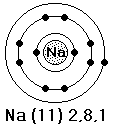 Bohr's
suggested that the negative electrons can only exist in certain
specific energy levels (shells) at fixed distances from the
nucleus and held in place by the positive
nucleus. This theory added too, and complimented the Rutherford model of the atom, to gives a
reasonably complete picture of an atom (at least for this
academic level!)
Bohr's
suggested that the negative electrons can only exist in certain
specific energy levels (shells) at fixed distances from the
nucleus and held in place by the positive
nucleus. This theory added too, and complimented the Rutherford model of the atom, to gives a
reasonably complete picture of an atom (at least for this
academic level!)
e.g. on the right the 'Bohr'
electronic diagram for sodium with the (Na) representing the
nucleus.
and below, a more
sophisticated diagram of a lithium atom.
Bohr envisaged the electrons
orbiting the nucleus in specific energy levels (or fixed shells) at specific distances
from the central nucleus with nothing in between. In other words the
electrons have sufficient energy to keep away from the nucleus and
be confined to these specific energy levels. The negative charge of the
electrons was still balanced by the positive charge (protons) of the nucleus.
So now, as far as we can tell (at GCSE/A level anyway) an atom is quite well represented by the
Bohr model of the atom
(picture below) which moves the Rutherford nuclear model another
step forward.
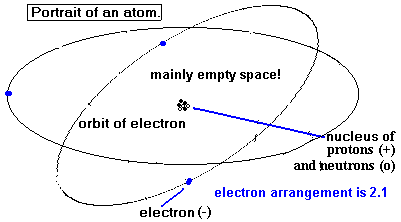

Diagrams
of a 'Bohr' lithium atom
AND, most importantly,
experimental results matched a theoretical mathematical model of
simple 'electronic' atoms like hydrogen.
So by now, earlier theories of atomic structure, e.g. the 'plum pudding'
model in which 'protons' and 'electrons' were scattered or arranged
evenly across the atom, were superseded by the nuclear model of
Rutherford and subsequently this was superseded by Bohr's electronic
energy level model.
It was the only
model that could explain the scattering of the high speed
alpha particles by a small dense and positive atomic centre
AND the behaviour of electrons.
Experiments had shown that the outer bits could be knocked off
atoms and these had a very tiny mass and a negative charge,
in other words the
electron!
Further experiments showed that the nucleus (partly) consisted of
positive particles with the same mass and charge as an ionised
hydrogen atom, that is a proton
(mass 1, charge +1).
(NOT
for GCSE level, hopefully
of interest to A-level chemistry students)
In 1913 Moseley
studied the X–rays emitted by highly energised–ionised atoms and from
the X–ray spectra of elements (the K alpha line,
Kα) he was
able to deduce the electric charge of the nucleus which we now know is
equal to the atomic number of protons in the nucleus - but he didn't
know it at the time.
Moseley showed that when atoms were bombarded with cathode rays
(electrons) X–rays where produced which he investigated with an X-ray
spectrometer.
It was found that the square root of
the highest energy emission line (called the K alpha line, Kα) gave a
linear plot with the apparent atomic number Z (it
wasn't known yet that this was the proton number),
Z = constant x √Kα
but the plot of √Kα against atomic weight
(now called relative atomic mass) gave a zig–zag plot, suggesting this 'atomic
number' was far more important the 'atomic weight' of an element in
terms of the atom's fundamental structure.
Note:
(i) The
K alpha line, Kα
is due to an electronic transition of the inner most electron
nearest the nucleus.
(ii) Sadly, Moseley was
killed in action during the First World War at Gallipoli in
1915, a great loss to science as well as his family and friends.
(iii) We now know that
Moseley's 'atomic number' is in fact the number of protons in
the nucleus (atomic number = proton number).
(iv) By 1898, thanks to the
German scientist Wilhelm Wien, the hydrogen ion (proton) had
been identified as the simplest basic unit of positive charge.
By 1925, later experiments by Rutherford and others, identified
the number Z as the value of the positive charge of the nucleus
and that it equated to Z protons in the nucleus - hence the
atomic number = proton number = Moseley's Z value.
However, there was
still the problem of why the atomic mass and atomic number where
different i.e. in the case of the lighter elements, the atomic weight
was often about twice the atomic number.
In 1919 Aston developed a
cathode ray tube i.e. like those used by Wien and Thompson etc. into a
'mass spectrograph', which we now know as a
mass spectrometer GCSE–AS
atomic structure notes.
This showed that atoms of the same
element had different masses but there was no experimental evidence that
they had different atomic numbers (which of course they didn't). These
different atoms of the same element were called isotopes.
In 1920
Rutherford suggested there might be a 'missing' neutral particle and in
1932 Chadwick discovered the neutron by bombarding beryllium atoms with
alpha particles which produced a beam of neutrons.
These were shown to have a
relative mass of 1 (same as a proton) and were electrically
neutral and quite penetrating into matter. This penetration and
lack of charge had made them difficult to detect.
Prior to this, Rutherford and
others had conducted experiments to show that the smallest
particle in an atom was equivalent to a hydrogen atom without
its electron, that is the proton.
It
was not until 1932 that the nature of the neutron
was finally deduced by
Chadwick,
and he showed that the nucleus also contained an electrically neutral
particle of similar mass to a proton.
This completely explained the nature of isotopes and backed up the
ideas from Moseley's work that the fundamentally important number that
characterises an element is its atomic number and NOT the atomic mass
(or mass number).
The neutron discovery, ~20 years after the discovery of the nucleus,
completed the 'modern' picture and theory of the composition of an atom
in terms of the three principal sub-atomic particles - which is
sufficient for the needs of us chemists!
