|
3k. The covalent bonding in the carbon dioxide CO2 molecule with
extra notes on its properties and uses
[Author
©
Dr Phil Brown GRIC, PhD:
Doc Brown's chemistry exam revision notes on
chemical bonding and
covalent molecules
and properties of carbon dioxide,
suitable for students of UK GCSE Science level
AQA, Edexcel, OCR, WJEC and CCEA GCSE chemistry
courses, ~US grades 9-10 chemistry, also useful for more advanced
pre-university A level chemistry courses
[CO2 covalent bonding page updated
RE-EDIT]
[email doc
b with any query ]
*
[privacy policy, cookies,
disclaimer]
*
]SEARCH
science website]
Foundation
tier (easier)
m/c QUIZ on structure, properties & chemical bonding
of materials
Higher
tier (harder) m/c QUIZ on structure, properties and chemical bonding of
materials
INDEX of notes on
Covalent Bonding: small molecules and properties
Some GCSE
level chemistry practise exam questions on the bonding,
structure and properties of carbon dioxide
OR
What next?
Bonding
diagrams for CO2
O=C=O
But first, where are
carbon and oxygen in the periodic table?

The 'approximate' division between metals \ non-metals (diagonal zig-zag line)
|
Pd |
metals |
Part of the modern Periodic Table
Pd = period,
Gp = group |
metals => non–metals |
|
Gp1 |
Gp2 |
Gp3 |
Gp4 |
Gp5 |
Gp6 |
Gp7 |
Gp0 |
|
1 |
1H
Note that hydrogen does not
readily fit into any group but is a non-metal |
2He |
|
2 |
3Li |
4Be |
atomic number
Chemical Symbol
e.g. 4Be |
5B |
6C |
7N |
8O |
9F |
10Ne |
|
3 |
11Na |
12Mg |
13Al |
14Si |
15P |
16S |
17Cl |
18Ar |
|
4 |
19K |
20Ca |
21Sc |
22Ti |
23V |
24Cr |
25Mn |
26Fe |
27Co |
28Ni |
29Cu |
30Zn |
31Ga |
32Ge |
33As |
34Se |
35Br |
36Kr |
|
5 |
37Rb |
38Sr |
39Y |
40Zr |
41Nb |
42Mo |
43Tc |
44Ru |
45Rh |
46Pd |
47Ag |
48Cd |
49In |
50Sn |
51Sb |
52Te |
53I |
54Xe |
|
6 |
55Cs |
56Ba |
Transition Metals |
81Tl |
82Pb |
83Bi |
84Po |
85At |
86Rn |
|
The
covalent molecule carbon dioxide from combining two non-metals, carbon
and oxygen |
Covalent bonding diagrams for CARBON
DIOXIDE
A
covalent molecule,
molecular formula CO2
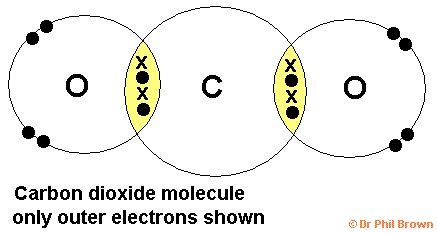

One atom of carbon (2.4) combines with two atoms of oxygen (2.6) to form
the compound carbon dioxide CO2 (only the outer shell of
carbon's electrons are shown).
The above left 'Venn diagram'
style is the best representation of the electronic structure of the
triatomic linear carbon
dioxide molecule.
Carbon is four electrons
short of a full outer shell (8 electrons) and oxygen is two electrons
short of a full outer shell (8 electrons), so one carbon atom shares its four
outer electrons with two outer electrons from each of the oxygen atoms, so all
three atoms now have a full outer shell of 8 electrons in the formation of two
double bonds (O=C=O).
Electronically, carbon (2.4)
becomes like neon (2.8) and oxygen (2.6), also becomes like neon (2.8), so the
hydrogen and carbon atoms effectively have full outer shells in forming the
covalent bonds when the atoms share their outer electrons.
The diagram above
left is the best style for carbon dioxide, clearly showing the
sharing of the pairs of electrons for the two double C=O covalent bonds in the carbon
dioxide molecule (in a sort of Venn diagram style).
 (Lewis diagram of carbon dioxide)
simplified 'dot and cross' electronic diagram for the covalently bonded
carbon dioxide molecule.
(Lewis diagram of carbon dioxide)
simplified 'dot and cross' electronic diagram for the covalently bonded
carbon dioxide molecule.
 The
right diagram is
the full 'dot and cross' electronic diagram for the covalent bonding in the
carbon dioxide molecule. The
right diagram is
the full 'dot and cross' electronic diagram for the covalent bonding in the
carbon dioxide molecule.
The electronic dot
and cross Lewis diagrams for covalent bonding in carbon
dioxide
The molecule can be shown as
 (displayed
formula)
with two carbon = oxygen double covalent
bonds. (displayed
formula)
with two carbon = oxygen double covalent
bonds.
(Advanced note: CO2 has a linear shape,
and the O=C=O bond angle is 180o.
The valencies of C and O are 4 and 2
respectively.
The carbon dioxide molecule is held
together by the strong C=O carbon–oxygen double covalent bonds by sharing
electrons.
Some GCSE
level chemistry practise exam questions on the bonding,
structure and properties of carbon dioxide
Comments
The 'melting
point' of solid carbon dioxide is -78
oC, but it changes immediately into a gas (sublimes). This low state
change temperature indicates the intermolecular bonds (intermolecular forces) are
weak between the molecules, contrasting with the very strong C=O bonds in the
molecule - sometimes referred to as the intramolecular bonding.
The weak intermolecular bonds
means the particle kinetic energies do not need to be so high to overcome
the intermolecular bonds in melting or boiling, hence the low
melting/boiling point (note that carbon dioxide actually sublimes at -78oC
at normal pressure).
Carbon dioxide doesn't have a boiling
point at normal atmospheric pressure, because the solid starts to sublime at -78oC ('dry ice'). Solid carbon dioxide gives
a smoke
effect when added to water - what you see on the 'stage' is clouds of condensed
water vapour in the denser carbon dioxide gas because of the low temperature
created by the CO2 bubbles up out of the water.
The strong double bonds
between the atoms in the carbon dioxide molecule make it
chemically quite stable and this stability allows it to accumulate in the
atmosphere and absorb infrared radiation contributing to the greenhouse
effect.
See
Greenhouse
effect and global warming from fossil fuel burning
Compressed carbon dioxide is used in fire extinguishers.
Carbon
dioxide is used in freeze drying food
Carbon dioxide
can be liquefied at low
temperatures and high pressure. The coffee beans are soaked in water so they
swell up. In carbon dioxide decaffeination of coffee, the coffee is placed,
at low temperature, in a container called an extraction chamber. Liquid
carbon dioxide is then forced at very high pressure into the extraction
chamber, dissolving out the caffeine and water from the coffee. The
liquefied carbon dioxide acts as a solvent. When the coffee beans are free
of caffeine, the carbon dioxide is removed and the beans dried and roasted
to give the commercial coffee product.
Carbon dioxide gas is produced
when acids react with carbonates or hydrogencarbonates
See
Acid reactions with
metals/oxides/hydroxides/carbonates/ammonia, neutralisation to give salts
Extra structured,
exam-board-aligned summary notes on carbon dioxide (CO2)
tailored for GCSE/IGCSE Chemistry students
across WJEC, CCEA, CIE, AQA, Edexcel, OCR Gateway, and OCR 21st Century
specifications.
Some GCSE
level chemistry practise exam questions on the bonding,
structure and properties of carbon dioxide
Bonding and
Structure of Carbon Dioxide (CO2)
Type of Bonding in
CO2
- Covalent bonding
between carbon and oxygen atoms.
- Carbon shares two pairs of
electrons with each oxygen atom → double covalent bonds.
Electron Configuration of
CO2
- Carbon: 4 outer electrons → needs 4 more.
- Oxygen: 6 outer electrons → needs 2 more.
- Dot-and-cross diagrams show two
double bonds and no lone pairs on carbon.
Molecular Geometry of the carbon dioxide
molecule
- Linear
shape.
- Bond angle = 180° due to
no lone pairs on central atom and equal repulsion.
- Symmetrical molecule → non-polar
overall, despite polar bonds.
Intermolecular Forces in carbon dioxide
- Weak van der Waals forces
between molecules.
- This is why ammonia has a very low melting
and boiling point.
- No hydrogen bonding.
Physical Properties
of carbon dioxide
| Property |
Explanation |
| Low boiling point |
Weak intermolecular forces → easy to
overcome |
| Gas at room temp |
Simple molecular structure |
| Soluble in water |
Forms carbonic acid (H2CO3)
in solution |
| Colourless & odourless |
Typical of small covalent gases |
Uses of Carbon
Dioxide - industrial and Everyday Uses
| Use |
Explanation |
| Carbonated drinks |
Dissolved under pressure →
effervescence |
| Fire extinguishers |
Dense gas displaces oxygen → smothers
flames |
| Photosynthesis |
Reactant for plants to produce glucose
and oxygen |
| Refrigeration |
Used in dry ice form (solid CO2) |
| Welding |
Inert atmosphere to prevent oxidation |
| Greenhouse gas |
Traps infrared radiation → contributes
to global warming |
Chemistry, Laboratory and Analytical Uses
- Test for CO2: limewater
turns cloudy due to formation of calcium carbonate.
- Used in acid-base reactions
and produced in thermal decomposition experiments.
- Carbon dioxide in fizzy drinks creates
carbonic acid, which adds a slightly sour-tart taste and enhances the
overall flavour profile. The CO2 bubbles also carry aromas to
your nose, intensifying the drink's taste, and have a palate-cleansing
effect that balances sweetness.
Common
Misconceptions about carbon dioxide
| Misconception |
Clarification |
| CO2 has ionic bonds |
It has covalent bonds
between non-metals |
| CO2 is a giant covalent
structure |
It is a simple molecular
substance |
| CO2 is acidic on its own |
It becomes acidic only
when dissolved in water (forms H2CO3) |
| CO2 is polar |
It has polar bonds,
but the molecule is
non-polar overall (advanced note) |
| Limewater test is definitive |
Other gases (e.g. SO2)
may also turn limewater cloudy → confirm identity |
| CO2 causes combustion |
It is a product of
combustion, not a fuel |
Exam Tips about
questions involving carbon dioxide
- Use dot-and-cross diagrams
to show double bonds clearly.
- Explain linear shape
using electron pair repulsion theory (advanced level).
- Link structure to properties
(e.g. gas at room temp due to weak forces).
- Know the limewater test
and its limitations.
- Understand CO2’s role in
photosynthesis, combustion, and
climate change.
Some GCSE
level chemistry practise exam questions on the bonding,
structure and properties of carbon dioxide
Learning objectives
for the bonding in a carbon dioxide molecule
Recognise the position of carbon and oxygen in the periodic
table - both non-metals.
Know that when two non-metallic elements combine, the
chemical bond is most likely to be covalent.
Know that for simple molecules
like carbon dioxide, the atoms try to attain an
electronic structure like a noble gas by sharing their out electrons.
Know and be able to describe and explain with a diagram the
formation of the covalent bonds in the carbon dioxide molecule by electron
sharing (between the two positive nuclei of the carbon and oxygen atoms).
Know what is meant by, and be able to describe and explain
the formation of a double bond e.g. in the carbon dioxide molecule.
Know that carbon dioxide has a very low melting point and
boiling point because the forces between the molecules are very weak - weak
intermolecular forces/bonding.
|
QUESTIONS
GCSE
level chemistry - practise exam questions on
the bonding,
structure and properties of carbon dioxide
Jot
down your responses and check out the answers:
ANSWERS
If you think there are
any errors, please email me asap at
chem55555@hotmail.com
I don't mind if students/teachers do a selected printout
of these questions and answers.
You can use a periodic table to help you answer the questions
Q1 What sort of bonding might you expect for the compound carbon dioxide? Explain your suggestion in terms of the periodic table and what sort of
structure might you predict for the substance carbon dioxide?
Q2 (a) Give the electron configurations for carbon (at. no. 6) and oxygen
(at. no. 8)
(b) Explain, using a dot and cross electron diagram, why the formula of
carbon dioxide is CO2.
(c) In the
context of carbon dioxide, what is meant by a double
bond?
Q3 Would you expect a relatively high or low melting point for carbon
dioxide? Give reasons for your answer.
Q4 In the liquid state, would you expect carbon dioxide to conduct
electricity,? Give reasons for your answer.
Q5 Carbon dioxide sublimes at -78oC. What is meant by sublimation?
Jot
down your responses and check out the answers:
ANSWERS
If you think there are
any errors, please email me asap at
chem55555@hotmail.com
I don't mind if students/teachers do a selected printout
of these questions and answers.
You can use a periodic table to help you answer the questions
Don't forget the wider ranging multiple choice exam
practise questions on bonding
Foundation
tier (easier)
m/c QUIZ on structure, properties & chemical bonding
of materials
Higher
tier (harder) m/c QUIZ on structure, properties and chemical bonding of
materials
|
What
next?
Test yourself with practice exam questions on chemical bonding?
Foundation
tier (easier)
m/c QUIZ on structure & bonding
& properties of materials
Higher
tier (harder) m/c QUIZ on structure & bonding & properties of materials
Recommend next:
The covalent bonding in the ethene
molecule
Explaining the properties of small
covalently bonded molecules
Sub-index for
Part 3.
Covalent Bonding: small molecules & properties
Index for ALL chemical
bonding and structure notes
All my
GCSE level chemistry revision
notes
All my advanced level pre-university chemistry revision notes
Email doc
brown - comment? query?
Perhaps of interest?
Gas preparations
including carbon dioxide
Carbon dioxide is produced in
the reaction of acids with carbonates
Use My Google search box
covalent bonding in carbon dioxide molecule explained, how to draw CO2 Lewis dot & cross electronic diagrams, weak intermolecular bonds/forces between molecules, low boiling point & melting point, physical properties described and explained, uses, manufacture Doc Brown's chemistry revision notes
how do
describe the covalent bonding in carbon dioxide CO2 how do you draw and
construct the covalent bonding diagram for carbon dioxide CO2, how to explain
the dot and cross electronic diagram for the covalent compound carbon
dioxide CO2, the properties of carbon dioxide CO2, the uses of carbon dioxide
CO2, the manufacture of carbon dioxide CO2, laboratory preparation of carbon
dioxide CO2, reactions of carbon dioxide CO2, reactions of CO2
|
ANSWERS
GCSE
level chemistry - practise exam questions on
the bonding,
structure and properties of carbon dioxide
If you think there are
any errors, please email me asap at
chem55555@hotmail.com
I don't mind if students/teachers do a selected printout
of these questions and answers.
You can use a periodic table to help you answer the questions
Q1 What sort of bonding might you expect for the compound carbon dioxide? Explain your suggestion in terms of the periodic table and what sort of
structure might you predict for the substance carbon dioxide?
ANSWERS
Both carbon and oxygen are non-metallic elements in
the top-right of the periodic table and you would expect
these two elements to form a covalent bond. The
atoms would be very likely to form small covalent
molecules.
Q2 (a) Give the electron configurations for carbon (at. no. 6) and oxygen
(at. no. 8)
(b) Explain, using a dot and cross electron diagram, why the formula of
carbon dioxide is CO2.
(c) In the
context of carbon dioxide, what is meant by a double
bond?
ANSWERS
(a) Carbon 2.4 and oxygen 2.6
(b) Carbon is 4 outer electrons short of a stable
octet (noble gas) electron arrangement.
Oxygen is 2 outer electrons short of a stable octet
(noble gas) electron arrangement.
Therefore two oxygen atoms will share with the four
outer electrons of the carbon atom, so both atoms have a
stable octet outer electron structure.
A simple dot and cross diagram
or a more elaborate diagram
which shows the electron
sharing more clearly and electron sharing is the basis
of a covalent bond.
(c) A double bond is where two atoms share two pairs
of electrons to form the covalent bond, so in the carbon
dioxide molecule there are two double bonds.
Q3 Would you expect a relatively high or low melting point for carbon
dioxide? Give reasons for your answer.
ANSWER
Carbon dioxide is a
small covalent molecule and only weak intermolecular
bonding forces attract the molecules together. The
weak intermolecular bonding forces means the particle
kinetic energies do not need to be very high to overcome
these forces to melt or boil carbon dioxide, hence you
would expect a low melting/boiling point (note that
carbon dioxide actually sublimes at -78oC at
normal pressure).
Q4 In the liquid state, would you expect carbon dioxide to conduct
electricity,? Give reasons for your answer.
ANSWER
You would not expect liquefied carbon dioxide to
conduct electricity. It is a small covalent molecule
with no free electrons or ions that can move and carry
an electric current e.g. unlike a metal (electrons) or a
molten salt (ions).
Q5 Carbon dioxide sublimes at -78oC. What is meant by sublimation?
ANSWER
The solid carbon dioxide turns directly into a gas
without going through a melting-liquid stage.
Don't forget the wider ranging multiple choice exam
practise questions on bonding
Foundation
tier (easier)
m/c QUIZ on structure, properties & chemical bonding
of materials
Higher
tier (harder) m/c QUIZ on structure, properties and chemical bonding of
materials
|
|
 For searching