HOME PAGE * SEARCH * UK KS3 level basic science quizzes for students aged ~13-14

UK GCSE level BiologyChemistryPhysics ~14-16 * Advanced pre-university Chemistry ~16-18

Chemistry Calculations: Calculating relative formula mass or relative molecular mass

GCSE & A level chemical calculations notes and practise questions

Check out what is available? Study the different examples then try the Quizzes!Relative molecular mass and relative formula mass

[Author © Dr Phil Brown PhD: Doc Brown's chemistry exam revision notes on relative molecular mass and relative formula mass chemical calculations suitable for students of UK GCSE or A advanced level chemistry and  ~US grades 9-12 chemistry courses  [chemical calculations page updated Mar 21st 2026 *]

[email doc b with any query ]  *  [privacy policy, cookies, disclaimer]  *  ]SEARCH website]

Index of all my online chemical calculation notes and quizzes

All my GCSE/IGCSE/US grade 8-10 Chemistry Revision notes

Advanced UK A/AS level, IB and US grade 11-12 pre-university chemistry

QUIZ 2. on calculating relative formula/molecular mass


2. How to calculate relative formula mass or relative molecular mass RFM or Mr

You must be able to correctly read a chemical formula!

Doc Brown's Chemistry - GCSE/IGCSE/GCE (basic A level) O Level, US grades 8-10  Online Chemical Calculations

QUIZ 2. on calculating relative formula/molecular mass

Keywords: Quantitative Chemistry calculations online Help for problem solving in doing relative formula mass calculations using atomic masses. Practice revision questions on calculating relative molecular mass from a chemical formula and atomic masses. This page describes, and explains, with worked out examples, the method of how to calculate the relative formula mass of a compound (ionic or covalent) or the relative molecular mass of an element or a covalent compound. Online practice exam chemistry CALCULATIONS and solved problems for KS4 Science GCSE/IGCSE CHEMISTRY and basic starter chemical calculations for A level AS/A2/IB courses. These revision notes and practice questions on calculating the relative formula mass or calculating relative molecular mass calculations in chemistry and worked examples should prove useful for the new AQA, Edexcel and OCR GCSE (9–1) chemistry science courses.

Spotted any careless error? EMAIL query ? comment or request a type of GCSE calculation not covered?

 Self-assessment Quizzes on relative formula mass or relative molecular mass:

QUIZ 2. on calculating relative formula/molecular mass

study examples carefully2. How to calculate relative formula mass or relative molecular mass RFM/RMM or just Mrstudy examples carefully

How do I calculate relative molecular mass? RMM

How to calculate relative formula mass? RFM

Is there any difference between RMM and RFM?

Does it matter whether the compound is ionic or covalent?

The relative molecular mass/relative formula mass is defined as the sum of all the individual atomic masses of ALL the atoms in the formula (Mr).

If the individual atomic masses of all the atoms in a formula are added together you have calculated the relative formula mass

Atomic masses are listed at the bottom of the page

e.g. for ionic compounds e.g. NaCl = 23 + 35.5 58.5) or molecular mass for covalent elements or compounds ...

e.g. Mr of N2 = 28 from (2 x 14) or compounds e.g. Mr of C6H12O6 = 180 from [(6 x 12) + (12 x 1) + (6 x 16)],

and more examples of how to calculate relative formula mass are further down the page, you get atomic masses from your periodic table.

In a balanced chemical symbol equation, the total of relative formula masses of the reactants is equal to the total relative formula masses of the products (see law of conservation of mass calculations).

To be honest, the term relative formula mass can be used with any compound whether it be ionic or covalent - it just seems NOT correct to talk about the molecular mass of an ionic compound when it doesn't consist of molecules, but is that one for the purists!

The shorthand Mr can be used for the formula of any element or compound and to repeat, 'it doesn't matter whether a compound is ionic or covalent'.

Numerically Mr = Relative formula mass = relative molecular mass

= the sum of all the atomic masses for ALL the atoms in a given formula

BUT, note ...

The term relative formula mass is usually applied to ionic compounds.

The term relative molecular mass is usually applied to covalent compounds i.e. those consisting of molecules and not ions.

NOTE: You cannot successfully calculate formula/molecular masses if you cannot read a formula correctly!

Whereas relative atomic mass (section 1. Relative Atomic Mass) only applies to a single atom, anything with at least two atoms in the formula requires the term relative formula mass or relative molecular mass to be used.

WARNING: The most common error is to use atomic/proton numbers instead of atomic masses, unfortunately, except for hydrogen, they are different!

Examples of relative formula mass or relative molecular mass calculations:

How to calculate relative molecular mass = How to calculate relative formula mass

Molecular/formula mass = total of all the atomic masses of ALL the atoms in the molecule/compound.

Watch out for brackets e.g. (OH)2 means two OH groups to add up!

  • Relative molecular mass calculation Example 2.1
    • The diatomic molecules of the elements hydrogen H2 and chlorine Cl2
    • relative atomic masses, Ar: H = 1, Cl = 35.5
    • Formula masses, RMM or Mr
      • relative molecular mass for hydrogen H2 = 2 x 1 = 2
      • relative molecular mass for chlorine Cl2 = 2 x 35.5 = 71 respectively.
  • Relative molecular mass calculation Example 2.2
    • The element phosphorus consists of P4 molecules. (atomic mass of P = 31)
    • relative molecular mass or Mr of phosphorus = 4 x its atomic mass = 4 x 31 = 124
  • Relative molecular mass calculation Example 2.3: The compound water H2O
    • relative atomic masses are H=1 and O=16
    • relative molecular mass or Mr = (1x2) + 16 = 18 (molecular mass of water)
  • Relative molecular mass calculation Example 2.4
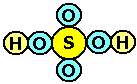
    • The compound sulphuric acid H2SO4  when pure, is a covalent compound
    • relative atomic masses are H = 1, S = 32 and O = 16
    • relative molecular mass or Mr = (1 x 2) + 32 + (4 x 16) = 98 (molecular mass of sulphuric acid )
  • Relative formula mass calculation Example 2.5
    • The ionic compound magnesium hydroxide Mg(OH)2 (ionic)
    • relative atomic masses are Mg = 24, H = 1 and O = 16
    • relative formula mass or Mr = 24 + 2 x (16+1) = 58
    • Important note on terminology
      • The term relative formula mass is also best applied to giant structure compounds
        • e.g. silicon dioxide SiO2 (RFM = 28 + 16 + 16 = 60, a 3D giant covalent lattice compound.
  • Relative formula mass calculation Example 2.6
    • The ionic compound aluminium oxide (Al3+)2(O2-)3 or just the plain formula Al2O3
    • but it makes no difference to the calculation of relative formula mass or relative molecular mass.
    • relative atomic masses are Al = 27 and O = 16
    • so the relative formula mass RFM or Mr = (2 x 27) + (3 x 16) = 102
  • Relative formula mass calculation Example 2.7
    • Calcium phosphate is also ionic but a more tricky formula to work out!
    • (Ca2+)3(PO43-)2 or Ca3(PO4)2, but it makes no difference to the calculation of relative formula mass or relative molecular mass.
    • atomic masses: Ca = 40, P = 31, O =16
    • relative formula mass or Mr = (3 x 40) + 2 x {31 + (4 x 16)} = (120) + (2 x 95) = 310
  • Relative molecular mass calculation Example 2.8
    • Glucose C6H12O6  a covalent compound
    • atomic masses: C = 12, O= 16, H = 1
    • relative molecular mass of glucose Mr(C6H12O6) = (6 x 12) + (12 x 1) + (6 x 16) = 180
  • Relative molecular mass calculation Example 2.9
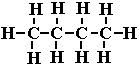
    •   butane C4H10
    • relative atomic masses: C = 12, H=1
    • Mr = (4 x 12) + (10 x 1) = 58
  • Relative formula mass calculation Example 2.10
    • copper(II) sulfate (copper sulfate, CuSO4, ionic)
    • relative atomic masses: Cu = 63.5, S = 32, O = 16
    • Mr = 63.5 + 32 + (4 x 16) = 159.5 (its 160 is you use Cu = 64)
  • Relative molecular mass calculation Example 2.11
    • propanol, C3H8O, CH3CH2CH2OH (the same formula can be expressed in different ways!)
    • relative atomic masses: C = 12, H=1, O = 16
    • Mr = (3 x 12) + (8 x 1) + 16 = 60
  • Relative formula mass calculation Example 2.12
    • magnesium nitrate, Mg(NO3)2
    • relative atomic masses: Mg = 24, N = 14, O = 16
    • Mr = 24 + (2 x 14) + (6 x 16) = 24 + 28 + 96 = 148
  • Relative formula mass calculation Example 2.13
    • blue hydrated copper sulfate crystals CuSO4.5H2O, again a bit more tricky!
    • Cu = 63.5, S = 32, H = 1, O =16
    • Just do this carefully in parts e.g.
    • CuSO4 = 63.5 + 32 + (4 x 16) = 159.5 (160 if you use Cu = 64)
    • H2O = (2 x 1) + 16 = 18, 5 x 18 = 90
    • Formula mass = 159.5 + 90 = 249.5 (250 if Cu = 64)

Self-assessment Quizzes on relative formula mass or relative molecular mass

QUIZ 2. on calculating formula/molecular mass


QUIZ on calculating formula/molecular mass


OTHER CALCULATION PAGES

  1. What is relative atomic mass?, relative isotopic mass and calculating relative atomic mass

  2. Calculating relative formula/molecular mass of a compound or element molecule (this page)

  3. Law of Conservation of Mass and simple reacting mass calculations

  4. Composition by percentage mass of elements in a compound

  5. Empirical formula and formula mass of a compound from reacting masses (easy start, not using moles)

  6. Reacting mass ratio calculations of reactants and products from equations (NOT using moles) and brief mention of actual percent % yield and theoretical yield, atom economy and formula mass determination

  7. Introducing moles: The connection between moles, mass and formula mass - the basis of reacting mole ratio calculations (relating reacting masses and formula mass)

  8. Using moles to calculate empirical formula and deduce molecular formula of a compound/molecule (starting with reacting masses or % composition)

  9. Moles and the molar volume of a gas, Avogadro's Law

  10. Reacting gas volume ratios, Avogadro's Law and Gay-Lussac's Law (ratio of gaseous reactants-products)

  11. Molarity, volumes and solution concentrations (and diagrams of apparatus)

  12. How to do acid-alkali titration calculations, diagrams of apparatus, details of procedures

  13. Electrolysis products calculations (negative cathode and positive anode products)

  14. Other calculations e.g. % purity, % percentage & theoretical yield, dilution of solutions (and diagrams of apparatus), water of crystallisation, quantity of reactants required, atom economy

  15. Energy transfers in physical/chemical changes, exothermic/endothermic reactions

  16. Gas calculations involving PVT relationships, Boyle's and Charles Laws

  17. Radioactivity & half-life calculations including dating materials

    [SEARCH BOX]

    QUIZ 2. on calculating relative formula/molecular mass


Explaining importance of how to calculate relative molecular/formula  mass in GCSE level & A level chemistry, What you need to know about how to calculate relative molecular/formula  mass for GCSE level & A level chemistry, Explaining use of how to calculate relative molecular/formula  mass knowledge in GCSE level & A level chemistry, Examples of how to calculate relative molecular/formula  mass explained when studying GCSE level & A level chemistry, What is the significance of how to calculate relative molecular/formula  mass in GCSE level & A level chemistry, describing explaining theory of how to calculate relative molecular/formula  mass when studying GCSE level & A level chemistry, exam revision notes for how to calculate relative molecular/formula  mass, online help for understanding how to calculate relative molecular/formula  mass in GCSE chemistry, what do I need to learn about how to calculate relative molecular/formula  mass? what do I need to know about how to calculate relative molecular/formula  mass for GCSE chemistry exams, how to prepare for questions on how to calculate relative molecular/formula  mass in GCSE chemistry examination? how to calculate relative molecular/formula  mass for syllabus-specifications for students taking the IGCSE/GCSE level & A level chemistry examinations, summary revision notes key points on how to calculate relative molecular/formula  mass for students studying AQA igcse/gcse/A level chemistry notes on how to calculate relative molecular/formula  mass, Edexcel gcse/A level chemistry notes on how to calculate relative molecular/formula  mass,  OCR 21st century GCSE/A level chemistry notes on how to calculate relative molecular/formula  mass, OCR gateway GCSE/A level chemistry notes on how to calculate relative molecular/formula  mass, WJEC gcse/A level chemistry notes on how to calculate relative molecular/formula  mass, CCEA gcse/A level chemistry notes on how to calculate relative molecular/formula  mass, CIE Cambridge igcse/A level chemistry, notes on how to calculate relative molecular/formula  mass useful for US grade 9, 10, 11 & 12 chemistry & AP honors chemistry courses, keywords and phrases: revision study notes for AQA Edexcel OCR IGCSE/GCSE chemistry science topics modules on describing explaining method of how to calculate relative formula mass working out relative molecular mass of element or compound given its formula gcse chemistry calculations practice chemical calculations for IB chemistry AQA Edexcel OCR Salters advanced A level chemistry question exercise on calculating relative formula mass and relative molecular mass

Website content © Dr Phil Brown 2000+. All copyrights reserved on revision notes, images, quizzes, worksheets etc. Copying of website material is NOT permitted. Exam revision summaries & references to science course specifications are unofficial. Chemical calculations. Examples explained. Online quizzes to test yourself

TOP OF PAGE