|
GCE A Level AS-A2 IB Acid-base and other non-redox
volumetric titration quantitative
calculation questions
Q21-35[Author
©
Dr
Phil Brown PhD:
Doc Brown's advanced level physical-theoretical chemistry exam revision notes
suitable for students of UK A level pre-university chemistry courses & US K12 grade
11, grade 12 and AP honors chemistry courses:
Non-redox
volumetric titrations SET 2. QUESTIONS
[RE-EDIT]
I don't
mind if students/teachers wish to do a selected printout of
particular questions/answers
SET 2 Questions 21 onwards
In
SET 2 of these A Level quantitative
chemistry calculation questions you have to work out the method a bit
more on your own!
I have not broken the problems down into 'mini-steps' for
you, but request you use your experience from solving the SET 1 Questions.
I have also included some 'gas volume' and 'gravimetric analysis' questions
to provide more variation of quantitative analysis questions and
standardising hydrochloric acid calculations.
 Calculations
index - all academic levels Calculations
index - all academic levels
All my advanced level
pre-university chemistry notes
The basics
of volumetric titrations and calculations
email doc
brown
(email if you think there is an error)
SET 1 Questions
SET 1
Question Answers
SET 2 Question Answers
Key points about volumetric
titration procedures and titration calculations
Redox
Titration Q's
Qualitative
Analysis
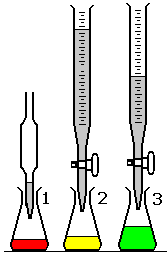
ILLUSTRATIONS OF ACID-ALKALI
TITRATIONS and SIMPLE STARTER CALCULATIONS
I
DO MY BEST TO CHECK MY CALCULATIONS, as you yourself should do, BUT I
AM HUMAN! AND IF YOU THINK THERE IS A 'TYPO' or CALCULATION ERROR PLEASE
EMAIL ME ASAP TO SORT IT OUT!

Relative atomic masses that may
be needed: H = 1, C = 12, O = 16, Na = 23, S = 32, Cl = 35.5, Ca = 40, Cu =
63.5, for questions 21 onwards
The non-redox
titration SET 2 Questions 21 to 33
I've tried to quote the data to the appropriate
significant figures and associated 'trailing zeros'.
Q21 Analysis of limewater. 25.0 cm3
aliquots of a calcium hydroxide solution were titrated with 0.100 mol dm-3
(0.100M) hydrochloric acid using phenolphthalein indicator. On average it took
10.50 cm3 of the acid to neutralise the limewater.
Calculate ...
(a) the molarity of the
calcium hydroxide solution
(b) the concentration of
calcium hydroxide in (i) g dm-3 and (ii) g/100 cm3
ANSWERS
to Q21 SET 2. volumetric questions (non-redox)
Q22 If it took 20.55 cm3 of 0.100 M HCl to
neutralise 25.0 cm3 of an NaOH solution, calculate the molarity of
the alkali.
ANSWERS
to Q22 SET 2. volumetric questions (non-redox)
Q23 A standardised solution of sodium hydroxide had
a concentration of 0.1025 mol dm-3 (0.1025M). If 25.0 cm3 of a sulfuric acid
solution required 17.65 cm3 of the NaOH to neutralise it, calculate
the molarity of the acid.
ANSWERS
to Q23 SET 2. volumetric questions (non-redox)
Q24 Citric acid has the formula
 and is
tribasic acid, forming the tri-sodium salt and is
tribasic acid, forming the tri-sodium salt
 on
complete neutralisation with sodium hydroxide. on
complete neutralisation with sodium hydroxide.
A 25.0 cm3 sample of a
concentrated citrus fruit cordial component (e.g. for lime juice), used in the
food & drinks industry, was diluted to 250 cm3 in a graduated
volumetric flask.
A 25.0 cm3 sample of this diluted solution,
required, on average, 22.5 cm3 of a standard 0.100 molar sodium
hydroxide solution using phenolphthalein indicator for the titration end-point.
Assuming all the acid in the cordial was citric acid, calculate the
concentration of the acid in g/dm3 in the original solution.
ANSWERS
to Q24 SET 2. volumetric questions (non-redox)
Q25 4.28 g of a hydrated form of the salt sodium
sulphate, Na2SO4.xH2O, was heated at 180oC
until the remaining mass became constant at 1.89 g.
Calculate x, the number of
molecules of 'water of crystallisation'.
ANSWERS
to Q25 SET 2. volumetric questions (non-redox)
Q26 On reaction with dilute hydrochloric acid, 0.428
g of a group 2 metal (M) formed 75.0 cm3 of hydrogen gas at 298K/1 atm pressure.
If the molar volume of gas is 24.0 dm3 at 298K/1 atm, deduce the atomic mass of
the metal and identify it from the periodic table.
ANSWERS
to Q26 SET 2. volumetric questions (non-redox)
Q27 To standardise a solution of hydrochloric acid,
it was titrated against accurate masses of anhydrous sodium carbonate (which
should be dried in an oven prior to use).
e.g. 0.132 g of Na2CO3
required 24.8 cm3 of the hydrochloric acid for complete
neutralisation, calculate the molarity of the hydrochloric acid.
ANSWERS
to Q27 SET 2. volumetric questions (non-redox)
Q28 Follows on from Q27. You can make up a solution
of sodium carbonate from which you pipette 25.0 cm3 aliquots to obtain an
accurate average titration value as an alternative to multiple weighings. 1.30g
of anhydrous sodium carbonate was dissolved in 250 cm3 of de-ionised water in a
volumetric flask. 25.0 cm3 aliquots were pipetted and titrated with a
hydrochloric acid solution (in the burette) to be standardised.
(a) Calculate the molarity of
the sodium carbonate solution.
(b) If the average titration
was 24.35 cm3 of hydrochloric acid, calculate the molarity of the
acid assuming the sodium carbonate is fully neutralised to sodium chloride.
ANSWERS
to Q28 SET 2. volumetric questions (non-redox)
Q29 The purity of anhydrous sodium carbonate can be determined
by titration with standard hydrochloric solution. The following results were
obtained on titrating accurately weighed amounts of sodium carbonate with 1.00
mol dm-3 hydrochloric acid (1.00 M HCl) to complete neutralisation given
by the equation below.
Na2CO3
+ 2HCl ==> 2NaCl + H2O + CO2
| Analysis Result |
Mass of Na2CO3 |
titration |
| (i) |
1.113 g |
20.95 cm3 |
| (ii) |
1.092 g |
20.55 cm3 |
| (iii) |
1.166 g |
22.00 cm3 |
The titration values were
recorded to the nearest 0.05 cm3 for a
burette calibrated in 0.1 cm3 increments.
In each case calculate (a) the moles of
HCl used in each titration, (b) the moles of Na2CO3 titrated based on
the moles of HCl used, (c) the mass of Na2CO3 titrated
based on (b), and finally, (d) from your (b) and (c) calculations, calculate
the % purity of the anhydrous sodium carbonate, quoting what you think is
the most accurate analytical result.
ANSWERS
to Q29 SET 2. volumetric questions (non-redox)
Q30 How to determine the water of crystallisation in hydrated sodium
carbonate crystals ('washing soda') by titration with standard hydrochloric acid
solution.
If 0.352g of hydrated sodium carbonate crystals, Na2CO3.xH2O,
was titrated with 0.100 mol dm-3 (0.100M) standard hydrochloric
solution. If the titration value was 24.65 cm3,
calculate the moles of Na2CO3
titrated and hence deduce x, the number of molecules of water of crystallisation
in washing soda crystals.
ANSWERS
to Q30 SET 2. volumetric questions (non-redox)
Q31 Blue hydrated copper(II) sulfate crystals have
the formula CuSO4.xH2O, where x is the number of molecules
of 'water of crystallization'.
If 3.33g of copper sulphate crystals where heated
at 150oC until the residue of anhydrous copper sulphate remained constant at
2.12g.
(a) Calculate the % water of
crystallisation in the blue copper sulphate.
(b) From your answer to (a)
calculate the value of x in the formula of the blue crystals.
ANSWERS
to Q31 SET 2. volumetric questions (non-redox)
Q32 It is possible to analyse a
mixture of sodium hydrogencarbonate and anhydrous sodium carbonate, either as a
solid or solution, by titration with a standard acid solution e.g. 0.1 to 1.0
mol/dm3 hydrochloric acid.
7.357 g of an solid anhydrous sodium
carbonate (Na2CO3)/sodium hydrogencarbonate (NaHCO3)
mixture was dissolved in deionised water and made up to 250 cm3
in a calibrated volumetric flask.
25.00 cm3 aliquots were
accurately pipetted into a conical flask and titrated with 0.5000 mol/dm3
hydrochloric acid.
Using (1) phenolphthalein indicator
(pKind = 9.3), the average titration was 9.80 cm3 of the HCl.
With (2) methyl orange indicator (pKind =
3.7), the average titration was 24.75 cm3 HCl.
(a)(i) On adding the acid to the
alkaline carbonate mixture solution, what are the colour changes for the
end-points of titration (1) and (2)?
(a)(ii) Give the equations for
what happens in each titration.
(b)(i) Calculate the moles of Na2CO3
in the prepared solution and calculate its molarity.
(b)(ii) Calculate the mass of
sodium carbonate in the solution and hence the percentage Na2CO3
in the original solid mixture.
Extra calculations for further
practice and will partly help you to solve Q33
(c)(i) In the titrations, what
total volume of the HCl was used to neutralise the Na2CO3?
(c)(ii) In titration (2) what
volume of HCl was used to neutralise the NaHCO3 in the original
mixture?
(c)(iii) Calculate the number of
moles of NaHCO3 in the 25.0 cm3 aliquot at the start,
and the total moles in the prepared solution.
(c)(iv) Calculate the mass off
NaHCO3 in the prepared solution, and hence its % in the original
solid mixture.
If your answer to (b)(ii) + (c)(iv)
do not add up to 100%, you have made an error somewhere!
ANSWERS
to 32 SET 2. volumetric questions (non-redox)
Q33
Sodium hydroxide solution can be used to absorb carbon dioxide gas.
2 dm3 (2 litres) of a sodium
hydroxide solution was used to cleanse a gas mixture of carbon dioxide. The
resulting solution X now consists of a mixture of unreacted sodium hydroxide and
sodium carbonate.
Solution X was titrated with standard 1.000 mol/dm3
hydrochloric acid ...
(1) using phenolphthalein
indicator.
(2) using methyl orange indicator and
From these titration values you can calculate the molarity of
unreacted sodium hydroxide, the molarity of the sodium carbonate formed and how
much carbon dioxide gas was absorbed.
Using 25.00 cm3 pipetted
aliquots of solution X, on average ...
titration (1) with phenolphthalein gave a value of 12.45
cm3 of 1.000 mol/dm3 HCl
titration (2) with methyl orange gave a
total value of 22.55
cm3 of 1.000 mol/dm3 HCl
(a) After some research, briefly explain
why titration ...
(1) using phenolphthalein indicator
corresponds to the end-point of the titration-half-neutralisation of
NaOH and Na2CO3
to NaHCO3
(2) using methyl orange indicator
corresponds to the end-point of the titration of the complete neutralisation of NaOH
plus all of Na2CO3
How you can do the analysis with a
single titration?
(b) Calculate the molarity of the sodium
carbonate formed.
(c) Calculate the molarity of the
unreacted sodium hydroxide.
(d) Calculate the volume of carbon
dioxide gas absorbed (assume molar gas volume = 24 dm3 at RTP).
ANSWERS
to Q33 SET 2. volumetric questions (non-redox)
[SEARCH
BOX]
|
Website content © Dr Phil Brown 2000+. All copyrights reserved
on revision notes, images, quizzes, worksheets etc. Copying of Doc Brown's
pre-university advanced level chemistry website material is NOT permitted. Exam
revision summaries & references to science course specifications are unofficial.
These revision questions on non-redox volumetric titrations are
suitable for use of pre-university students studying AQA advanced level
chemistry, Edexcel advanced level chemistry, OCR advanced level
chemistry, IB advanced level chemistry, WJEC (Eduqas) advanced level
chemistry, CIE advanced level chemistry, CCEA advanced level chemistry, US grade 11-12 AP honors
chemistry courses and they will also prove useful to
1st year undergraduate students of chemistry. |
|
