|
Part 7.9
The chemistry of
AROMATIC COMPOUNDS - physical and
chemical properties of phenol and some of its derivatives
[Author
© Dr
Phil Brown PhD: Doc
Brown's exam revision notes suitable
for A level chemistry students of advanced pre-university/college advanced level organic chemistry courses:
aromatic
chemistry revision notes on phenols
[aromatic page updated Mar 7th 2026 *]
email doc
brown - comments - query?
*
[privacy, cookies and disclaimer]
All my advanced level
aromatic chemistry notes
All my advanced A level organic
chemistry notes
Part 7.9 The
physical & chemical properties of phenol & selected derivatives & their uses
Sub-index for this page
on electrophilic substitution products of phenol including its reaction with
bromine and chlorine, its weak acid character, ester formation and its physical
properties
7.9.1
The structure and
physical properties of phenol and selected phenol derivatives
7.9.2
The structure of phenol
and its electrophilic substitution reactivity and product orientation
7.9.3
The electrophilic
substitution reactions of phenol
with chlorine water, bromine water and dilute nitric acid
7.9.4
Reaction of phenols as
an 'alcohol' e.g. esterification with acid anhydrides and acid chlorides (NOT
Friedel-Crafts)
7.9.5
Reactions of phenol as
a weak acid, comparing the acid strengths of alcohols, phenols and carboxylic
acids plus a specific test for phenols
7.9.6
Examples of the uses of
phenol and its derivatives
TOP OF PAGE and
sub-index
7.9.1 The structure and physical properties
of phenol and selected phenol derivatives
I f the OH group (hydroxy) is
directly attached to a benzene ring, the molecule is classified as a 'phenol'.
If not, the molecule is classified as an aliphatic alcohol.
Make sure you can distinguish the two
because some aliphatic alcohols may have a benzene (or other) ring.
 is classed as an aromatic phenolic compound and called
3-methylphenol and lots more examples of phenols illustrated in
the table below.
is classed as an aromatic phenolic compound and called
3-methylphenol and lots more examples of phenols illustrated in
the table below.
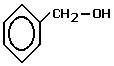 phenylmethanol
('benzyl alcohol') is a primary aliphatic alcohol,
an isomer of 3-methylphenol. phenylmethanol
('benzyl alcohol') is a primary aliphatic alcohol,
an isomer of 3-methylphenol.
 is cyclohexanol and is a secondary aliphatic (alicyclic) alcohol.
Phenols might referred to as 'aromatic
alcohols', do NOT do so, so beware how you use the term 'alcohol'
The 'phen' part of the name comes
from 'phenyl' C6H5, and the 'ol' comes
from the OH functional group, but these are NOT aliphatic alcohols -
they share some chemistry, but there are significant difference with phenols due
to the presence of the benzene ring.
Abbreviations used: mpt =
melting point; bpt = boiling point; sub. = sublimes,
dec.= thermally decomposes on
heating at atmospheric pressure before it can boil
|
Name of
'phenol' |
Structure |
Mpt/oC |
Bpt/oC |
Comments |
|
phenol |
 |
41 |
182 |
White crystalline solid
that smells like a disinfectant - which it is!, but is harmful to
touch - causes blistering to the skin. It's solubility is 8g/100 g
cold water, much more soluble in hot water |
|
2-methylphenol |
 
 |
31 |
191 |
Three
positional structural isomers.
Soluble
in hot water, only slightly in cold water. |
|
3-methylphenol |
12 |
202 |
|
4-methylphenol |
35 |
202 |
|
2-nitrophenol |


 |
45 |
216 |
Slightly soluble in hot
water.
Only 2-nitrophenol exhibits intramolecular hydrogen bonding,
all three isomers exhibit intermolecular hydrogen bonding |
|
3-nitrophenol |
97 |
high,
dec. |
Slightly soluble in cold
water, very soluble in hot water. |
|
4-nitrophenol |
114 |
dec. 279 |
Slightly soluble in cold
water, very soluble in hot water. |
|
2-chlorophenol |


 |
9 |
175 |
Moderately soluble in cold water. |
|
3-chlorophenol |
33 |
214 |
Slightly soluble in cold
water, soluble in hot water. |
|
4-chlorophenol |
43 |
220 |
Slightly soluble in cold
water, soluble in hot water. |
|
2-aminophenol |


 |
174 |
dec.? |
All three
isomers slightly soluble in cold water, more soluble in hot water.
Only 2-aminophenol exhibits intramolecular hydrogen bonding,
all three isomers exhibit intermolecular hydrogen bonding |
|
3-aminophenol |
122 |
dec.? |
|
4-aminophenol |
187 |
284 |
|
1-naphthol
naphthalen-1-ol |

 |
93 |
288 |
Insoluble cold water,
slightly soluble in hot water. |
|
2-naphthol
naphthalen-2-ol |
122 |
295 |
Insoluble in water. |
|
2,4,6-tribromophenol |
See diagram
below |
~92 |
~292 |
Very low solubility
0.007g/100g water at 25oC. |
|
2,4,6-trichlorophenol |
See diagram
below |
69 |
dec. |
Slightly soluble in cold
water, 0.08/100g water. |
|
2,4,6-trinitrophenol |
See diagram
below |
122 |
>300oC,
explodes |
Closely related to TNT.
Slightly soluble in cold water (1.27g/100g water), much more soluble in hot water.
Yellow crystals known historically as 'Picric acid' |
|
benzene-1,2-diol |
|
105 |
240 |
|
|
benzene-1,3-diol |
|
111 |
280 |
|
|
benzene-1,4-diol |
|
170 |
286 |
|
| |
|
|
|
|

Extra notes on physical data table
for phenols
(a) Comparing the melting and boiling
points of methylbenzene
 and phenol
.
and phenol
.
C6H5CH3:
mpt -95oC; bpt 111oC and C6H5OH:
mpt 41oC; bpt 182oC.

Both phenol and methylbenzene have a similar
size, shape, molecular
mass and numbers of electrons in the molecule, but, they have very
different melting points and boiling points.
Both molecules will exhibit
similar instantaneous dipole - induced dipole forces, but whereas
methylbenzene is a relatively non-polar molecule, phenol is a highly
polar molecule due to the highly polar
δ-O-Hδ+
bond.
(Pauling electronegativities:
H = 2.1 and O = 3.5, a big difference).
Therefore, the intermolecular
force between phenol molecules is much greater than that between
methylbenzene molecules because of the extra contribution of
permanent dipole - permanent dipole forces, which includes the
spatially directed hydrogen bond
δ-O-Hδ+llll:Oδ-.
The hydrogen bond angle is
usually ~170-180o. (see diagram above for phenol and
methylbenzene)
This means higher kinetic energy
molecules are required to weaken the intermolecular forces to melt
or vapourise phenol compared to methylbenzene - higher temperature
and higher enthalpies of fusion and vapourisation.
|
Property |
Methylbenzene |
Phenol |
|
Structure |
C6H5CH3 |
C6H5OH |
|
Melting point |
-95oC |
41oC |
|
Boiling point |
111oC |
182oC |
|
Enthalpy of fusion |
6.6
kJ/mol |
11.5
kJ/mol |
|
Enthalpy of
vaporisation |
37
kJ/mol |
48.1
kJ/mol |
(b) Comparing the solubility in water
of methylbenzene
and phenol
.

Methylbenzene is a relatively
non-polar molecules and is virtually insoluble in water - its
hydrophobic nature disrupts the hydrogen bonds of water without
compensation form other intermolecular forces i.e. it can't form
hydrogen bonds with water molecules.
Methylbenzene is very
soluble/miscible with other hydrocarbon solvents like benzene.
Phenol can hydrogen bond with
water (diagram above), allowing solvation to take place
(dissolving), and at room temperature phenol is quite soluble in
water (~6.7 g/100g water), but the bulky hydrophobic benzene ring
of phenol does
restrict it's solubility at room temperature - too much disruption
of hydrogen bonding between water molecules without similar
compensating intermolecular forces between solute and solvent.
Lower alcohols like methanol,
ethanol and propanols are miscible/very soluble with water due
to the strong solvating hydrogen bonding between solute and
solvent, but their much higher solubilities in water compared to
phenol are also due to a smaller less bulky hydrophobic alkyl
group, which is less disrupting to the hydrogen bonding
holding water molecules together in the liquid.
Although the solubility at
~25oC is not that high, from ~70oC upwards (well above the melting point
of phenol) the two liquids are fully miscible in any
proportions.
Despite its polar nature, phenol
is quite soluble in non-polar benzene (~8.3g/100g benzene), the
instantaneous - dipole - induced dipole intermolecular forces
between the benzene rings of phenol and benzene itself are great
enough for appreciable solvation to happen.
(c)
The relatively higher melting
points of aminophenols
This
because there are two functional groups, both
of which enable hydrogen bonding between the molecules
δ-O-Hδ+
and
δ-N-Hδ+.
e.g.
aminophenols have a
similar molecular mass, size, shape and numbers of electrons in the
molecule compared to methylphenols.
BUT, the
methylphenols melt between 12 and 35oC, whereas the
aminophenols with extra intermolecular hydrogen bonding, melt
between 122 to 187oC.
(d) An example of comparing intermolecular
hydrogen bonding and intramolecular hydrogen bonding.

In most cases of hydrogen bonding
you are dealing with is between molecules e.g. illustrated by phenol
(a previous diagram) and 3-nitrophenol and 4-nitrophenol.
These
intermolecular
hydrogen bonds are shown in the diagram above .
However, 2-nitrophenol can
hydrogen bond within the molecule itself, known as an
intramolecular
hydrogen bond.
A hexagonal arrangement of atoms
is involved of five covalent bonds and one hydrogen bond.
In the case of 2-nitrophenol the
intramolecular hydrogen bond angle is ~120o, whereas in
3-nitrophenol and 4-nitrophenol the intermolecular hydrogen bond
angle is ~170-180o. (see diagram above).
As a consequence ...
(i) 2-nitrophenol is only
slightly soluble in water, but 3-nitrophenol and 4-nitrophenol
are very soluble because, unlike 2-nitrophenol, they can
hydrogen bond with water, they are also very polar molecule.
(ii) 2-nitrophenol has a
lower melting point than 3-nitrophenol and 4-nitrophenol, again
because of the hydrogen bonding between the latter two molecules
in their crystal structures.
TOP OF PAGE and
sub-index
7.9.2
The structure of phenol and its electrophilic substitution
reactivity and orientation
The presence of the hydroxy group (OH) directly attached
to the benzene ring( making the molecule a 'phenol', increase the
electron density of the pi orbitals of the ring and greatly increases
the susceptibility of phenol towards electrophilic attack.

Phenol is much more reactive than benzene with respect to
electrophilic substitution.
This is due, as argued via the diagram above, because of the
increased electron density, specifically at the 2, 4 and 6 ring positions from the inductive effect of the hydroxy group of phenol
(see also the resonance structure diagram too).
It appears that the non-bonding lone pair of electrons of the pz
orbital of the oxygen atom interacts with the delocalised pi
electrons of the benzene ring orbitals - which themselves are formed
from the overlap of the pz orbitals of the 6 carbon atoms
of the benzene ring - the result is increased electron density at
the 2, 4 and 6 positions and the rapid reaction of phenol with
chlorine water and bromine water (details
in section 7.9.3).

Another approach to explaining the extra reactivity at
the 2, 4 and 6 positions of the benzene ring is to consider the three
Kekule resonance structures of phenol, shown on the right of the diagram above.
You can draw structures that place a negative charge
on carbon atoms 2, 4 and 6 of the ring, but not on ring carbons 3
and 5, where little substitution occurs with phenol.
Although these resonance structures contribute less
than the two classic Kekule structures on the left, the electron
density is sufficiently raised at the 2, 4 and 6 positions to
dictate the most probable sites of electrophilic attack and there
the orientation of the substitution positions.
The more negative the carbon atom, the more likely
it is to allow the attacking electrophile to substitute the hydrogen
atom.
If you imagine a blurred 'resonance hybrid' it would
resemble to 'fuzzy' orbital diagram of phenol above!

What you find in practice, fits in
with the orientation of products theory and with phenol you get far less
electrophilic substitution at the 3 and 5 positions compared to the 2, 4 and 6
positions of the benzene ring - see nitration of phenol in the next
section
7.9.3.
See also section 7.14
Explaining orientation of products when substituting into a monosubstituted benzene derivative
The +I electron shift interaction of the non-bonding electrons of the oxygen atom interacting
with the pi orbitals increasing the electron density of the benzene ring
overrides any minus
inductive effect from the more electronegative oxygen atom
(electronegativities: C = 2.5, oxygen 3.5).
This discussion so far has focussed on potential
electrophilic substitution reactions of phenol, but there is another
consequence of the 'interaction' described above on the chemistry of
phenols compared to aliphatic alcohols.
This interaction reduces the negative charge on the
oxygen atom (decrease δ-) reducing its reactivity as an alcohol (less
nucleophilic).
The pulling of oxygen's non-bonding electrons into the
benzene ring makes the hydrogen of the OH group more positive (increase
δ+) compared to aliphatic alcohols, enabling the proton to be lost more
easily, so phenols are more acidic than aliphatic alcohols.
The acid-base character of phenols compared to aliphatic
alcohols is discussed in detail in
section
7.9.5.
TOP OF PAGE and
sub-index
7.9.3
The reaction of phenol with chlorine water, bromine water and dilute nitric
acid.
The substitution reactions of less reactive benzene
require anhydrous conditions and often a catalyst too e.g. on separate
pages ...
7.3
Synthesis of arenes including alkylation
- electrophilic substitution
7.5
Electrophilic substitution -
nitration of benzene and methylbenzene
7.6
Electrophilic substitution - ring halogenation of benzene &
methylbenzene
However,
phenol is so reactive that undergoes electrophilic substitution
reactions with an aqueous solution of the electrophile at room
temperature e.g. with chlorine, bromine and nitric acid.
If the atom of the original group directly bonded to
the benzene ring does not have any π
bonding the ring is usually activated compared to benzene
itself. The -OH group increases the electron density of the ring and
more so at the 2, 4 and 6 positions, compared to the 3 and 5
positions.
Therefore the 2, 4 and 6 positions become the
preferred 2nd substitution point in the benzene ring. The small
electron density shift is sometimes described as a plus inductive
shift (+I effect), but this does not necessarily coincide with an
atom of electronegativity higher than carbon e.g. O. The reason
being a lone pairs of the O interact with the ring to increase the
electron density and this electron pair donation often overrides the
difference in electronegativity effect (this is all about
conjugation and possible resonance hybrid structures - see
section 7.14 for more details).
The increased electron density of the pi electron orbitals
due to the +I electron cloud shift effect of the OH group (O: lone pair specifically
interacts with the pi orbitals of the benzene ring.
This effect causes
chlorine and bromine molecules to be much easier polarised on collision with
phenol i.e. Clδ+Clδ- and Brδ+Brδ-
and become effective electrophiles.
The increase in electron density occurs more at the 2, 4
and 6 positions more than the 3 and 5 positions.
With excess chlorine water or bromine water room
temperature, phenol gives an immediate white precipitate of
2,4,6-trichlorophenol or 2,4,6-tribromophenol, with almost zero substitution at the 3 and 5 positions
of the benzene ring (structures in diagram below).
Both white crystalline solids have a 'disinfectant'
odour.

When chlorine dissolves in water, chloric(I) acid is
formed - it is a very weak acid with little ionisation.
Cl2(aq) + 2H2O(l)
 HOCl(aq) + H3O+(aq) +
Cl-(aq)
HOCl(aq) + H3O+(aq) +
Cl-(aq)
The polarised chloric(I) acid molecule can act as
the attacking electrophile
HOδ-Clδ+.
The simplified equation for the formation of
2,4,6-trichlorophenol is:
C6H5OH(aq) +
3Cl2(aq) ===> Cl3C6H2OH(s)
+ 3HBr(aq)
Again, the interaction of the OH group on the
benzene ring of phenol (via non-bonding O electrons) increases the
electron density of the benzene ring so much, that phenol's
reactivity towards the chlorine electrophile is so increased that 2,
4 and 6 position substitution rapidly takes place at room
temperature (diagram above showing the formation of
2,4,6-trichlorophenol).
The white solid rapidly forms and can be filtered
off and purified by re-crystallisation.
The trichlorophenol has a strong antiseptic odour!
See also section 7.14
Explaining orientation of products when substituting into a monosubstituted benzene derivative

Similarly, when bromine dissolves in water,
bromic(I) acid is formed - it is a very weak acid with little
ionisation.
Br2(aq) + 2H2O(l)
HOBr(aq) + H3O+(aq)
+ Br-(aq)
The polarised bromic(I) acid molecule can
act as the attacking electrophile
HOδ-Brδ+.
The simplified equation for the
formation of 2,4,6-tribromophenol is:
C6H5OH(aq) +
3Br2(aq) ===> Br3C6H2OH(s)
+ 3HBr(aq)
Again, the interaction of the OH group on
the benzene ring of phenol (via non-bonding O electrons)
increases the electron density of the benzene ring so much,
that phenol's reactivity towards the bromine electrophile is
so increased that 2, 4 and 6 position substitution rapidly
takes place at room temperature (diagram above showing the
formation of 2,4,6-tribromophenol).
As well as the precipitate of the
tribromophenol, you observe the rapid decolourisation of the
bromine water from re-brown to colourless solution of
hydrogen bromide (actually hydrobromic acid).
The white solid rapidly forms and can be
filtered off and purified by re-crystallisation.
The tribromophenol has a strong antiseptic
odour!
See also section 7.14
Explaining orientation of products when substituting into a monosubstituted benzene derivative

Nitration is another examples of phenol increased
reactivity compared to benzene.
Even at low temperature (<
20oC), with dilute nitric acid, electrophilic substitution
readily takes place at the 2, 4 and 6 positions on the benzene rings.
| The actual typical and theoretical
yields of products from low temperature nitration of phenol with
dilute nitric acid |
| Name of the isomer |
2-nitrophenol |
3-nitrophenol |
4-nitrophenol |
| Actual yield of each isomer |
53% |
<1% |
47% |
| Actual yield of 2- and 4- isomers |
>99% |
| Theoretical yield of each isomer |
40% |
40% |
20% |
| Theoretical yield of 2- and 4- isomers |
60% |
What you see is the vast majority of the product involves
substitution at the 2 and 4 positions of the benzene ring in phenol.
This fits in with the orientation of products theory
discussed in section
7.9.2.
On a random basis you might expect 40% of 3-nitrophenol, when all you get
is <1%.
Further substitution is inhibited by the 'deactivating' effect of
the nitro group of highly electronegative atoms.
See also section 7.14
Explaining orientation of products when substituting into a monosubstituted benzene derivative

You can make 2,4.6-trinitrophenol using a concentrated
mixture of nitric and sulfuric acids (equation above).
TOP OF PAGE and
sub-index
7.9.4 Reaction of
phenols as an alcohol e.g. esterification with acid anhydrides and acid chlorides (NOT a Friedel-Crafts reaction)
Phenols cannot be directly esterified
with carboxylic acids, even with an acid catalyst, but they can be
synthesised using acid chlorides and acid anhydrides.
(a) Reaction of a phenol with acid
chlorides
Phenols tend to react quite slowly
with acid chlorides where the a lone pair of non-bonding electrons on
the oxygen atom enables a phenol to behave as a nucleophile.
See mechanism and reactions of acid chlorides with alcohols to form
esters
You should note that aromatic
acid chlorides like C6H5COCl are less
reactive than aliphatic acid chlorides like CH3COCl
- see notes on reaction (a)(iii) where the presence of sodium
hydroxide generates a phenoxide ion - a much better nucleophile than
a neutral phenol molecule.
(i) ethanoyl chloride +
phenol ===> phenyl ethanoate + hydrogen chloride
 +
===>
+
===>
 + HCl
+ HCl
The ester, phenyl ethanoate, is
an insoluble colourless liquid, boiling point 196oC.
(ii) 2-hydroxybenzoic acid +
ethanoyl chloride ===>
2-ethanoylhydroxybenzoic acid + hydrogen chloride
 +
===>
+
===>
 + HCl
+ HCl
2-ethanoylhydroxybenzoic acid is
better known as acetylsalicylic acid, even better known as Aspirin
!
It is a white solid, melting
point 135oC.
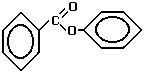
(iii) benzoyl chloride + phenol
===> phenyl benzoate + hydrochloric acid
 +
===>
+
===>
 + H+ + Cl-
The ester, phenyl benzoate, is a
white solid of melting point 71oC.
An acyl chloride
and alcohol usually readily react at room temperature, especially if
both are aliphatic.
However, phenols may require the presence of aqueous
sodium hydroxide to facilitate the reaction, especially if the acyl
chloride itself is itself a less reactive (than aliphatic) aromatic
acid chloride like benzoyl chloride
The alkali generates a negative
phenoxide ion (e.g. C6H5O–
from phenol C6H5OH), which is a more powerful
nucleophile than the original neutral phenol molecule and the white
solid of phenyl benzoate rapidly forms (this is an example of a
Schotten–Baumann reaction - just reminding myself of student days in
the 1960s when types of reaction were well remembered by the names
of chemists!).
Therefore you can represent
this reaction in a simplified way as:
C6H5O-
+ C6H5COCl ===> C6H5COOC6H5
+ Cl-
(b) Reaction of a phenol with an
acid anhydride
Acid anhydrides are less reactive
than acid chlorides, so an acid catalyst is used - a few drops of conc.
sulfuric acid is added to the phenol and acid anhydride mixture.
(i) phenol + ethanoic
anhydride ===> phenyl ethanoate + ethanoic acid
+
 ===>
+
===>
+

The ester formed is phenyl
ethanoate
(ii) 2-hydroxybenzoic acid +
ethanoic anhydride ===>
2-ethanoylhydroxybenzoic acid + ethanoic acid
+
===>
+
Another way of preparing
2-ethanoylhydroxybenzoic acid (also known as acetyl salicylic acid).
TOP OF PAGE and
sub-index
7.9.5
Reactions of phenol as a weak acid, comparing the acid strengths of alcohols,
phenols and carboxylic acids plus a specific test for phenols
Two reasons
why aromatic phenols are stronger acids than aliphatic alcohols
(1) The effect of the benzene ring on the O-H bond
Apart from increasing the electron density of the
benzene ring (increasing susceptibility to electrophilic attack), the
interaction of the non-bonding electrons of the oxygen with the pi
orbitals of the benzene ring has another important consequence.
This interaction reduces the negative charge on the oxygen
atom (decrease δ-) reducing its reactivity as an alcohol, making phenols
less nucleophilic and the conjugate base of phenols (e.g. phenoxide ion) is
less strongly basic than the corresponding conjugate base of an aliphatic
alcohol.
The net result of pulling of oxygen's non-bonding electrons
into the benzene ring makes the hydrogen of the δ-O-Hδ+
group more positive (increase δ+) compared to aliphatic alcohols, enabling
the proton to be lost more easily.
This makes phenols are more acidic than aliphatic
alcohols.
(2) The resonance stabilisation of the anion
Any anion derived from a phenol e.g. phenoxide ion, is
stabilised by the charge being partially delocalised in the benzene ring.
The diagram below of the phenoxide ion
illustrates the interaction of the pi orbital electrons of the benzene ring
with the non-bonding electrons of the oxygen atom.
By delocalising the negative charge
to some extent around the benzene ring, the potential energy of the
phenoxide ion is lowered slightly, enough for a tiny concentration of it
to exist in aqueous solution.

Another approach to understanding the
stability of 'phenolic anions' is to consider the resonance structures
of the phenoxide ion derived from phenol.

You can see all the structures carry
a negative charge at some point in the ion - the spreading out of the
charge on a time averaged basis, but most of the negative charge is
still carried by the oxygen atom.
If you imagine a blurred 'resonance hybrid' it would
resemble to 'fuzzy' orbital diagram of the phenoxide ion above!
The same arguments apply to all
phenols unless they have a basic group like an amino group attached to
the benzene ring e.g. an amino-phenol.
All of this explains why
'aromatic' phenols are stronger acids than 'aliphatic' alcohols.
An aqueous solution of ethanol
has a pH of ~7, the pH of a 0.10 mol dm-3 solution as a
pH of ~5.4.
(aq) + H2O(l)

 (aq) +
H3O+(aq)
(aq) +
H3O+(aq)
The acid dissociation constant:
Ka ~ 1.02 x 10⁻¹⁰ mol dm-3 at 25oC,
so phenol is a very weak acid, but it is a million times a stronger acid
than ethanol which has a Ka of ~10-16 mol dm-3
in aqueous solution and barely alters the pH.
Strongly electronegative groups
(-I effect) attached to the benzene ring increase the acidic nature of
any phenol, enabling an energetically more favourable transfer of the
O-H proton to a water molecule e.g.
Cl3C6H2OH(aq)
+ H2O(l)
Cl3C6H2O-(aq)
+
H3O+(aq)
The Ka for
2,4,6-trichlorophenol is 2.5 x 10⁻⁸ mol dm-3
Here you see the effect of
three quite electronegative chlorine atoms on the value of Ka.
(Pauling electronegativities:
H = 2.1; C = 2.5; N = 3.0; Cl = 3.0; O = 3.5)
(O2N)3C6H2OH(aq)
+ H2O(l)
(O2N)3C6H2O-(aq)
+
H3O+(aq)
The Ka for
2,4,6-trinitrophenol is 1.38 x 10⁻¹ mol dm-3
Here you see the effect of
nine electronegative chlorine atoms on the value of Ka.
To put all the Ka
values in a carboxylic perspective, Ka for ethanoic
acid is 1.74 x 10⁻⁵ mol dm-3
This means
2,4,6-trinitrophenol is nearly 10,000 times more strongly acid
than ethanoic acid AND will liberate carbon dioxide from sodium
hydrogencarbonate - beware the results of simple tests! See
table and comments further down in this section).
So, phenols are sufficiently acidic to form salts
with strong bases e.g. the alkali sodium hydroxide gives ....
C6H5OH(aq)
+
NaOH(aq)  C6H5O-Na+(aq)
+ H2O(l)
C6H5O-Na+(aq)
+ H2O(l)
 sodium
phenoxide (old name sodium phenate), the simplest 'phenolic'
salt - a white crystalline solid. sodium
phenoxide (old name sodium phenate), the simplest 'phenolic'
salt - a white crystalline solid.
Contrasting isomeric phenylmethanol
with methylphenols
C6H5CH2OH(aq)
+ NaOH(aq)
no
reaction, an aliphatic alcohol
CH3C6H4OH(aq)
+
NaOH(aq)
CH3C6H4O-Na+(aq)
+ H2O(l)
A comparison of
some test reactions for aliphatic alcohols, phenols and carboxylic acids
The table illustrates the
different/similar behaviour with three compounds containing a benzene
ring.
Non of these tests are definitive,
other types of compounds can give the same positive results.
However, although limited, the table
is a useful comparison of the behaviour of three types of functional
group based on -OH.
|
Compound |
Structure |
(a) Test
with blue litmus |
(b)
Effect of sodium hydroxide (aq) |
(c) Effect on sodium hydrogencarbonate |
(d) Add sodium |
(e) Add to iron(III) chloride |
|
Phenylmethanol - an aliphatic alcohol |
|
No change |
No
reaction |
No reaction |
Effervescence
H2 |
No colour change |
|
Phenol - a phenol |
|
Turns
pink |
Will form
a salt
|
No reaction |
Effervescence
H2 |
Violet colour |
|
Benzoic acid - a carboxylic acid |
 |
Turns
pink |
Will form
a salt
 |
Effervescence
CO2 |
Effervescence
H2 |
No colour change |
Notes on
the five above tests and results with respect to organic compounds listed
(a) Litmus Test on the sample mixed with water
Any acidic substance will give a blue to pink
colour change with blue litmus paper.
No alcohol will change the colour of litmus,
but most phenols and all carboxylic acids will give a pink colour,
the pH of the mixture being lowered below pH 7 because of ionisation
yielding hydrogen ions e.g.
C6H5CH2OH
no ionisation, no product, pH ~7
C6H5OH(aq)
+ H2O(l)
C6H5O-(aq)
+ H3O+(aq)
C6H5COOH(aq)
+ H2O(l)
C6H5COO-(aq)
+ H3O+(aq)
(b) Effect of aqueous sodium hydroxide
This isn't really a test, but if the compound
is insoluble, dissolving in dilute sodium hydroxide may indicate an
acidic nature. Of the three, only alcohols do not yield salts.
C6H5CH2OH(aq)
+ NaOH(aq)
no
reaction
C6H5OH(aq)
+
NaOH(aq)
C6H5O-Na+(aq)
+ H2O(l)
C6H5COOH(aq)
+ NaOH(aq)
C6H5COO-Na+(aq)
+ H2O(l)
(c) Effect of sodium hydrogencarbonate
Acidic materials mixed with water and sodium
hydrogencarbonate (solid or aqueous solution) should evolve carbon
dioxide gas - can test with limewater - white milky precipitate.
C6H5CH2OH(aq)
+ NaHCO3(aq)
no
reaction,
to weak an acid
C6H5OH(aq)
+
NaHCO3(aq)
no
reaction,
to weak an acid
C6H5COOH(aq)
+
NaHCO3(aq)
C6H5COO-Na+(aq)
+ H2O(l)
+ CO2(g)
Note that some phenols with strongly
electronegative substituent groups are acidic enough to liberate
carbon dioxide from sodium hydrogencarbonate e.g.
2,4,6-trinitrophenol
(O2N)3C6H2OH
+ NaHCO3(aq)
(O2N)3C6H2O-Na(aq)
+ H2O(l)
+ CO2(g)
(d) Adding a tiny piece of fresh sodium metal
to the material
If the organic compound is a liquid, no
problem, but if its a solid, you must melt it first or dissolve it in a DRY
solvent that does not react with sodium e.g. hexane.
You can test the gas with a lit splint -
squeaky pop of hydrogen combustion.
2C6H5CH2OH
+ 2Na
2C6H5CH2O-Na+
+ H2
2C6H5OH
+
2Na
2C6H5O-Na+
+
H2
2C6H5COOH
+ 2Na
C6H5COO-Na+ +
H2O + H2O
(e) Effect of neutral iron(III) chloride
solution ('Ferric chloride' test for phenols)
If no change, the iron(III) chloride solution
remains yellowish.
 If
a phenolic compound is present, it complexes with the iron(III) ion
giving a variety of colours e.g. red, green or blue and violet with
phenol itself. If
a phenolic compound is present, it complexes with the iron(III) ion
giving a variety of colours e.g. red, green or blue and violet with
phenol itself.
Iron(III) ion forms several typical
transition metals complexes with phenol and other substituted
phenols.
However, bifunctional group molecule like
2-hydroxybenzoic acid will also give a positive test for a phenol as
wells as positive tests for a carboxylic acid.
TOP OF PAGE and
sub-index
7.9.6
Examples of the uses of phenol and its derivatives
Several chlorophenols are used as
antiseptics. (need more diagrams)
Phenols are used in the synthesis of
dyes. (need x-ref to phenylamine page)

 2,4-dichlorophenol
(on the right) is an intermediate in
the manufacture of the herbicide 2,4-dichlorophenoxyethanoic acid (2,4-D).
It is also used in antiseptics like TCP and Dettol. 2,4-dichlorophenol
(on the right) is an intermediate in
the manufacture of the herbicide 2,4-dichlorophenoxyethanoic acid (2,4-D).
It is also used in antiseptics like TCP and Dettol.
2,4,5-trichlorophenol has been used as an
fungicide and herbicide and intermediate in the manufacture of
2,4,5-trichlorophenoxyethanoic acid (2,4,5-T). These two were used as
defoliants in the Vietnam War - the still lasting nasty, polluting and toxic
effects of 'Agent Orange'.
2,4,6-trichlorophenol, also known as TCP
is a chlorinated phenol that has been used as a fungicide, herbicide,
insecticide, antiseptic, defoliant, and glue preservative. It is a white to
yellowish crystalline solid with a strong, phenolic odour.
Many of theses chlorophenols are
considered environmental pollutants and associated with certain types of
cancer and their use is curtailed or strictly restricted and regulated
(maybe!).
BUT, not all chlorophenols are bad for us
and the environment.
4-chloro-3,5-dimethylphenol (diagram
above), known as 'chloroxylenol' also branded as 'Dettol', is an important
antiseptic and disinfectant which is used for skin disinfection, and
together with alcohol for cleaning surgical instruments. It is also used
within a number of household disinfectants and wound cleaners. It is
thought to act by disrupting microbial cell walls and inactivating
cellular enzymes. It is considered to be relatively non-toxic to us
unless ingested but poisonous to many animals like cats. Never-the-less,
it is on the World Health Organization's List of Essential Medicines
Phenol
is used in the Kolbe synthesis of 2-hydroxybenzoic acid, an intermediate in
the manufacture of
aspirin.
2-hydroxybenzoic acid (on the right)
has two functional groups, it is both a phenol and a carboxylic acid
Phenols are used in surfactants and
detergents
hydrocarbon hydrophobic end
R-C6H4-OH
hydrophilic phenolic end, where R = a long chain alkyl group.
Website content © Dr
Phil Brown 2000+. All copyrights reserved on Doc Brown's Chemistry revision notes, images,
quizzes, worksheets etc. Copying of website material is NOT
permitted. Doc Brown's chemistry of aromatic compounds exam revision notes,
Website content © Dr Phil Brown 2000+. All
copyrights reserved on revision notes, images, quizzes, worksheets etc. Copying
of website material is NOT permitted. Exam revision summaries & references to
science course specifications are unofficial.
Website content © Dr Phil Brown 2000+. All
copyrights reserved on these organic chemistry exam revision
notes on structure, physical properties, the chemistry and uses of phenol, these A level chemistry revision notes are suitable for use of pre-university students studying AQA advanced level
organic chemistry revision notes on structure, physical properties,
the chemistry and uses of phenol, Edexcel advanced level
organic chemistry revision notes on structure, physical properties,
the chemistry and uses of phenol, OCR advanced level
organic chemistry revision notes on structure, physical properties,
the chemistry and uses of phenol, IB advanced level
organic chemistry revision notes on structure, physical properties,
the chemistry and uses of phenol, WJEC (Eduqas) advanced level
organic chemistry revision notes on structure, physical properties,
the chemistry and uses of phenol, CIE Cambridge advanced level
organic chemistry revision notes on structure, physical properties,
the chemistry and uses of phenol, CCEA advanced level
organic chemistry revision notes on structure, physical properties,
the chemistry and uses of phenol, and useful for US grade 11 grade
12 AP honors organic chemistry courses involving structure, physical
properties, the chemistry and uses of phenol,
Explaining the importance of
relative acidity of phenol compared to alcohols and carboxylic acids
in organic chemistry, What you need to know about relative acidity of
phenol compared to alcohols and carboxylic acids for organic
chemistry,
Explaining the use of relative acidity of phenol compared to alcohols
and carboxylic acids knowledge in organic chemistry, Examples of
relative acidity of phenol compared to alcohols and carboxylic acids explained
when studying organic chemistry, What is
the significance of relative acidity of phenol compared to alcohols and
carboxylic acids in organic chemistry, What is the use of relative
acidity of phenol compared to alcohols and carboxylic acids
in organic chemistry Describing and
explaining the theory of relative acidity of phenol compared to alcohols
and carboxylic acids when studying organic chemistry, exam revision
notes for relative acidity of phenol compared to alcohols and carboxylic
acids in exams, online help for relative acidity of phenol compared
to alcohols and carboxylic acids, revision notes for relative
acidity of phenol compared to alcohols and carboxylic acids,
what do I need to learn for relative acidity of phenol compared to
alcohols and carboxylic acids in exams? revision summary for
relative acidity of phenol compared to alcohols and carboxylic acids, help in
teaching relative acidity of phenol compared to alcohols and carboxylic
acids, learning notes for relative acidity of phenol compared to
alcohols and carboxylic acids, help to pass the relative acidity of
phenol compared to alcohols and carboxylic acids exam, how to
prepare for examination questions on relative acidity of phenol compared
to alcohols and carboxylic acids? Explaining the importance of
halogen electrophilic substitution reactions of phenol
in organic chemistry, What you need to know about halogen electrophilic
substitution reactions of phenol for organic
chemistry,
Explaining the use of halogen electrophilic substitution reactions of
phenol knowledge in organic chemistry, Examples of halogen
electrophilic substitution reactions of phenol explained
when studying organic chemistry, What is
the significance of halogen electrophilic substitution reactions of
phenol in organic chemistry, What is the use of halogen
electrophilic substitution reactions of phenol
in organic chemistry Describing and
explaining the theory of halogen electrophilic substitution reactions of
phenol when studying organic chemistry, exam revision
notes for halogen electrophilic substitution reactions of phenol in exams, online help for
halogen electrophilic substitution reactions of phenol, revision notes for
halogen electrophilic substitution reactions of phenol,
what do I need to learn for halogen electrophilic substitution reactions
of phenol in exams? revision summary for halogen electrophilic
substitution reactions of phenol, help in
teaching halogen electrophilic substitution reactions of phenol, learning notes for
halogen electrophilic substitution reactions of phenol, help to pass the
halogen electrophilic substitution reactions of phenol exam, how to
prepare for examination questions on halogen electrophilic substitution
reactions of phenol?
[SEARCH
BOX]
All my advanced level
aromatic chemistry revision notes
All my advanced A level organic
chemistry notes |
|
