|
Doc Brown's Chemistry Advanced Organic Chemistry
Part 15. SPECTROSCOPY Revision Notes INDEX -
Spectroscopic methods
of analysis and molecular structure determination
[Author
©
Dr Phil Brown PhD:
Doc Brown's advanced level organic chemistry exam revision notes
on molecular spectroscopy suitable for students of UK based A level and IB chemistry courses & US K12 grade
11, grade 12 and AP honors chemistry courses
on spectroscopic methods of investigating molecular structure and quantitative
analysis
[updated
Mar 6th 2026 *]
[email doc b
query? comment?]
*
[privacy-policies-disclaimer]
*
]SEARCH doc b's
website]
My spectroscopy section
continues to be developed
as the database builds up! I welcome any
Email
comments or suggestions for spectra
to write up on my website, BUT only for pre-university level.
All my advanced A level organic chemistry notes
*
email doc
brown
This is a BIG
website, you need to take time to explore it [ SEARCH
BOX]
including spectra!
SPECTROSCOPY INDEX of
sub-indexes and spectral databases
15.0
Introduction
to the interaction of electromagnetic radiation with matter
(this page)
15.1
INDEX of mass spectrometry notes: mass spectrometry of organic
compounds, examples explained
15.2
INDEX of infrared spectroscopy notes: infrared spectra analysis
of organic compounds, examples explained
15.3
INDEX of nuclear magnetic resonance
spectroscopy: 1H NMR spectra of organic
compounds, examples explained
15.4
INDEX of nuclear magnetic resonance
spectroscopy: 13C NMR spectra of organic
compounds, examples explained
15.5
Emission and absorption
spectroscopy (uv and visible) including colorimetry and flame photometry
15.0 Introduction to
the interaction of electromagnetic radiation with matter
I use two abbreviations for electromagnetic
radiation:
emr and
EM radiation
Sub-index
for this page on spectroscopy
15.0.1
The
electromagnetic radiation spectrum
15.0.2
The
wave and particle nature of electromagnetic radiation (emr)
and two equations
15.0.3
Example of calculations using the two formulae described above
in 15.0.2 e.g. Planck's equation
15.0.4
What
can happen when
emr
interacts with matter and how does this relate to spectroscopy?
15.0.5
Some
extra questions for you to do based on Planck's equation
(answers at end of page)
See other important pages for
Spectroscopy and
the hydrogen spectrum and explaining the emission and absorption
spectra of elements
since there is little point in repeating this
page!
15.0.1 The electromagnetic
radiation spectrum
At pre-university level chemistry, most spectroscopy that
you will study, apart from mass spectrometry, will involve
the interaction of electromagnetic radiation and matter.
Here we are only dealing with the region
from radio waves to uv radiation
|
Type of electromagnetic radiation
===> |
Radio waves |
Microwaves |
Infrared radiation |
Visible light |
Ultraviolet light |
|
Spectroscopy involved |
NMR |
microwave |
infrared |
emission and absorption |
emission and absorption |
|
Type of quantum level change |
nuclear spin orientation |
molecular rotation |
covalent bond vibration |
electronic |
electronic |
|
~wavelength range/m |
>10-1 |
10-4 to 10-1 |
7 x 10⁻⁷
to 10-4 |
4-7 x 10⁻⁷ |
10-8 to
4 x 10⁻⁷ |
|
~typical wavelength/m |
103 |
10-2 |
10-5 |
5 x 10⁻⁷ |
10-8 |
|
~wavelength range/nm |
> 108 |
105 - 108 |
700 - 105 |
400 - 700 |
10 - 400 |
|
~frequency range/Hz |
< 3 x 10⁹ |
3 x 10⁹ to
3 x 10¹² |
3 x 10¹² to
4.3 x 10¹⁴ |
4.0 x 10¹⁴ to
7.5 x 10¹⁴ |
7.5 x 10¹⁴
to 3 x 10¹⁶ |
|
Photon energy trend |
=========== increasing
energy of radiation photons ========> |
|
Frequency trend |
=========== increasing frequency
of radiation (Hz) =========> |
|
Wavelength trend |
========== decreasing
wavelength of radiation (m) =========> |
|
'picture trend' |
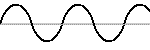 ====================>
 |
TOP OF PAGE
and indexes
15.0.2 The wave and particle
nature of electromagnetic radiation (emr) and two equations
Since emr, like visible light, can behave as
a wave,
its motion can be described by the simple wave equation.
c =
λ

where
c
= velocity of light (or any emr) =
3.00 x 10⁸
ms-1
λ
= wavelength, m (be prepared to work in other
units like nm = 10-9 m)
= frequency, Hz (s-1)
However, emr photons can
behave as
particles, in the sense they can act as little
'bullets' of energy called
quanta
(this term goes back to the origin of quantum physics).
The term photon
can be applied to any part of the emr spectrum.
Each quanta or
'quantum of energy' is very small.
The energy of an emr
photon is given by the
Planck
equation (named after the famous physicist
Max Planck, one of the founding people of quantum
physics.
E = h
E = energy of
the photon (the quanta), J (note that this
is just for ONE PHOTON!)
h = Planck's constant
= 6.63 x 10⁻³⁴ JHz-1
= frequency, Hz (s-1)
For any quantum level
change you can express the Planck equation as
∆E = h
where
∆E represents
the difference between two quantum levels, which equals
the photon energy emitted or absorbed in that quantum level change
e.g. molecular rotation (microwave), bond vibration
(infrared) or an electronic
energy level (visible or uv).
The above equation
only deal with a single photon e.g. interacting with a
single atom or molecule - that's why E or ∆E is so
small.
Since chemists often
work in molar quantities you can multiply the Planck
equation by the Avogadro number/constant,
NA,
to obtain the energy per mole of the matter-emr
interaction.
E = ∆E = h
x NA (Jmol-1),
where NA = 6.02 x 10²³ mol-1
You can then divide
by 1000 if you quantity the energy change in kJmol-1.
The measurement of
these quantum level changes and their pattern for a
molecule is the whole basis of the various types of emr
spectroscopy.
TOP OF PAGE
and indexes
15.0.3 Example of
calculations using the two formulae described above in 15.0.2
c =
λ
and
E = h
There are three constants you need to be
familiar with, but they are given in examinations.
(i) Speed of light for any emr:
3.00 x 10⁸ ms-1
(ii) Planck's constant:
6.63 x 10⁻³⁴ JHz-1
(iii) The Avogadro constant NA = 6.02 x 10²³ mol-1
Q1 If the wavelength of a visible blue
light laser beam is 460 nm, calculate its frequency.
c =
λ
, so
= c ÷
λ,
c
= velocity of light = 3.00 x 10⁸ ms-1
= 3.00 x 10⁸ ÷ (460 x 10-9)
=
6.52 x
1014 Hz
Q2
The frequency of a uv light beam is
4.51 x 10¹⁵ Hz,
What is its wavelength in m
and nm?
c =
λ
, so
λ
= c ÷
λ,
c
= velocity of light = 3.00 x 10⁸ ms-1
λ
= 4.51 x 10¹⁵ ÷
3.00 x 108
=
1.50 x 10⁻⁷ m
λ
= 4.51 x 10¹⁵ ÷
3.00 x 108
=
150 nm
Q3 An ultraviolet beam of light has a
frequency of 2.10 x 10¹⁵ Hz.
(a) Calculate the energy of each
photon
E = h,
h = Planck's constant
= 6.63 x 10⁻³⁴ JHz-1
Ephoton
= 6.63 x 10-34 x 2.10 x 1015
=
1.39 x 10⁻¹⁸ J
(b) Calculate the energy of the
photon in Jmol-1.
You multiply the above value
from (a) by the Avogadro number NA.
NA = 6.02 x 10²³
mol-1.
Ephoton
= 1.39 x
10-18 x 6.02 x 1023
= 838000 Jmol-1 (3 sig
figs)
(c) The bond enthalpy for chlorine
is +243 kJmol-1.
Will chlorine molecules be split
into radicals by this uv light? (3 sig figs)
Explain your answer.
The energy of the uv photons is
838000 ÷ 1000 = 838 kJmol-1.
This is more than sufficient
energy to excite the chlorine molecule (*) and
heterolytically break the bond to give two
chlorine radicals:
Cl2 ===>
Cl2* ===> 2Cl•
This is the first step of
initiation in the chlorination of alkanes to
make halogenoalkanes. For more details see
Chlorination of
alkanes
(d) What is the minimum frequency of
light that can theoretically split a chlorine
molecule? Use the bond enthalpy quoted in part (c).
(i) First calculate the bond
enthalpy for one molecule
Ebond = (243 x
1000) ÷ 6.022 x 1023 =
4.04 x 10⁻¹⁹ J/molecule
(ii) The substitute your answer
to (i) into a rearranged Planck's equation
E = h
,
=
E/h,
h =
Planck's constant = 6.63 x 10⁻³⁴
JHz-1
=
4.04 x 10⁻¹⁹ ÷
6.63 x 10-34
=
6.09 x 10¹⁴ Hz
This frequency is on the
borderline between visible and uv light.
Which is why, when using chlorine,
it should not be in contact with 'combustible'
material in a sunlit laboratory unless under
controlled darkened conditions!
Q4 Ozone (trioxygen, O3) is
considered a secondary pollutant because it is
produced from primary pollutants like the oxides of nitrogen
nitrogen(II) oxide, NO and nitrogen(IV) oxide, NO2,
formed from the combustion of fossil fuels.
(These were formally called nitrogen
monoxide and nitrogen dioxide).
Ozone can be formed in the troposphere,
the layer of air closest to the Earth's surface, by the
action of oxygen atom radicals on the oxygen molecule
(dioxygen O2).
O(g) + O2(g)
===> O3(g)
BUT, where do the oxygen radicals come
from?
One source is the photodissociation of
nitrogen(IV) oxide and both reactions contribute to the
serious atmospheric pollution known as photochemical
smog.
NO2(g) ===> O(g)
+ NO(g)
(∆H = +307
kJmol-1, very endothermic)
(a) Calculate the
energy required to break one N-O bond in NO2.
One N-O bond
enthalpy = 307 x 103
÷
6.02 x 1023 =
5.10 x 10⁻¹⁹
J
(b) What is the
minimum frequency of EM radiation that will bring about
photodissociation of NO2?
You just use the
above value and slot into Planck's equation.
E = h
,
= E/h = 5.10 x 10⁻¹⁹
÷ 6.63 x 10-34
=
7.69 x
1014 Hz
Note that any
higher frequency will do, any excess energy is just
converted into increased kinetic energy of the
fragments.
(c) What is the
wavelength in nm of this radiation?
c =
λ
, so λ
= c ÷
λ
= 3.00 x 10⁸ ÷
7.69 x 1014 = 3.90 x 10⁻⁷
m
3.90 x 10⁻⁷
÷ 10-9 =
390 nm
(d) What region of
the emr spectrum corresponds with this radiation?
The lower energy end of the
ultraviolet region, so bright sunlight is quite
sufficient to split the molecules of NO2
in the troposphere
Q5 To move from one energy level to the next
required 0.29 kJ mol-1 for a hydrogen bromide
molecule HBr.
(a) Calculate the energy change involved
for one HBr molecule
∆E =
0.29 x 10³ ÷ 6.02 x 1023
=
4.82 x
10-22 J
(b) Calculate the frequency of emr
required to bring about the quantum level change.
∆E = h
,
= ∆E ÷
h = 4.82 x 10⁻²² ÷
6.63 x 10-34 =
7.26 x 10¹¹
Hz
(c) Which part of the EM spectrum and
quantum levels of the HBr molecule does this correspond
to?
Microwave region of the emr
and the rotational quantum levels of HBr.
Q6 A beam of EM radiation has an energy of 3.00 x
10-19 J/photon.
(a) Calculate the frequency of the EM
radiation.
E = h
,
= E ÷
h = 3.00 x 10⁻¹⁹ ÷
6.63 x 10-34 =
4.52 x 10¹⁴
Hz
(b) Which part of the EM spectrum does
this correspond to? Which quantum levels of a molecule
might be excited to a higher level? and would a
molecule be permanently changed?
This frequency corresponds to
photons of visible light.
These photons can potentially excite
electrons to a higher level e.g. in a coloured
molecule.
There would be no permanent change
to the molecule, the excited molecule would return
to the lowest available electronic state.
Q7 Methane gas, CH4, is a greenhouse
gas.
(a) What quantum level changes occur
when methane molecules absorb infrared radiation?
Infrared photons of sufficient
energy will increase the C-H vibrations to higher
quantum levels.
(b) Why does this cause a warming of the
atmosphere?
The higher energy vibrating
molecules will relax to their lowest vibrational
state by losing energy that ultimately becomes
thermal energy - increased kinetic energy of the
molecules in the atmosphere.
 Q8
A mug of coffee (250 cm3), in my favourite Periodic Table mug, is placed
in a microwave oven for 2 minutes to be heated from 20oC
to 60oC. For the calculations assume all the coffee
is water and has a density of 1.00 gcm-3. Q8
A mug of coffee (250 cm3), in my favourite Periodic Table mug, is placed
in a microwave oven for 2 minutes to be heated from 20oC
to 60oC. For the calculations assume all the coffee
is water and has a density of 1.00 gcm-3.
The microwave frequency of the oven 2.45 x 10⁹
Hz. The speed of light is 3.00 x 10⁸ ms-1
The specific heat capacity of water is 4.18 Jg-1K-1.
(a) Calculate how much energy must be
transferred to the coffee to heat it up from 20oC
to 60oC.
∆H = mass x SHCH2O
x ∆T
Energy required = 250 x
4.18 x 40 =
4.18
x 104 J
(b) Calculate the wavelength of the
microwave radiation in cm.
c =
λ
, so λ
= c ÷
λ = 3.00 x 10⁸
÷ 2.45
x 109 =
0.122 m
0.122 x 100 =
12.2 cm
(of similar magnitude to the interior of a microwave
oven or the mug!)
(c) Calculate the energy per microwave
photon.
E = h
= 6.63 x 10-34 x 2.45 x 109 =
1.62 x 10⁻²⁴
J
(c) How many microwave photons did it take
to make the coffee!?
Energy needed
÷ energy of photon
= 4.18 x 10⁴ ÷ 1.62 x 10-24
=
2.58 x 1028
microwave photons
(d) How many moles of photons were needed to
heat the coffee!?
2.58 x 1028
÷
6.02 x 1023 =
4.28 x 10⁴
mol photons
TOP OF PAGE
and indexes
15.0.4
What can happen when emr interacts with matter and how does this
relate to spectroscopy
When electromagnetic radiation impacts on,
and is absorbed by a material, the effects are quite varied
and are very dependent on the frequency (or wavelength) of
the incoming radiation.
The first thing to realise is the
interaction is all about quantum level changes which can be
to do with, increasing quantum energy change:
translational kinetic energy < molecular
rotation < bond/molecule vibration < electronic excitation <
bond breaking
The diagram and table attempts to put this
sequence the spectroscopy context where appropriate,
using the simple molecule HBr hydrogen bromide.
|
Energy trend |
Energy
level required |
 A
starter 'picture' view of HBr A
starter 'picture' view of HBr |
Comments
on the type of energy involved with the change in the
molecule's energy state |
Type of associated
spectroscopy |
|
↑ increasing energy involved or required |
(a) Electronic |
 |
Ionisation, high energy uv
or high energy electrons (as in a mass spectrometer),
1130 kJmol-1. |
mass spectrometry |
|
(b) Electronic |
 |
Homolytic dissociation into
free radicals by ultraviolet radiation, bond fission
enthalpy 366 kJmol-1. |
Not applicable here |
|
(c) Electronic |
 |
Electronic excitation of molecule by
uv or visible light to a higher electronic quantum level, followed by relaxation
and release of the absorbed energy. |
Emission & absorption spectra |
|
(d) Vibrational kinetic |
 |
Vibrational quantum levels
of bonds or the whole molecule. In this case it is the
H-Br bond vibration. |
Infrared spectroscopy |
|
(e) Rotational kinetic |
 |
Molecular rotation quantum
levels. The whole molecule rotates within certain
specific frequencies - rotational quantum levels. |
Microwave spectroscopy |
|
(f) Translational kinetic |
 |
Kinetic energy of movement
from place to place, the normal movement of free
particles in a gas or liquid. |
Not applicable here |
Here (c) and (d) are the most
important spectroscopic techniques to do with the
interaction of electromagnetic radiation with materials for
investigative or quantitative purposes.
The material is often a covalent molecule
of an organic compound.
mass
spectrometry is also very
important but doesn't involve EM radiation.
Extra notes on the summary table content
(a)
===>
===>
+ e-
A molecular ionisation process.
In a mass spectrometer a high energy
electron beam knocks another electron off the molecule.
This involves the highest electronic
energy level change - removal of an electron from the
molecule and a permanent change.
e.g.
HBr(g) + e- ===>
[HBr]+(g) + 2e-
(b)
===>
===>
Homolytic bond fission - dissociation.
The production of two free radicals is
facilitated by a uv light photon or a high kinetic
energy particle at high temperature.
If the bond fission is promoted by high
energy photons it is known as photodissociation or
photolysis, which is part of a photochemical reaction.
If the molecule is sufficiently
'excited' to a high enough quantum level, the bond can
break and the bonding pair of electrons shared between
the two unionised fragments called free radicals.
This involves a high electronic energy
level change in the bonding molecular orbitals and a
permanent change to the molecule which is now split in
two!
(c)
===>
Molecule absorbs energy and elevated to
an electronically excited state.
This can happen at a high temperature or
from a uv or visible light photon, however, the absorbed
energy maybe insufficient energy for the molecule to
undergo either bond fission or ionisation as in (a) or (b).
Never-the-less an outer electron,
in a bonding molecular orbital, is promoted to a
higher quantum level in the molecule which then
'relaxes' by releasing energy and there is
no permanent
change.
(a) and (b) involve a permanent
change to the molecule, (c) to (g) do not.
This is the origin of uv and visible
light absorption and emission spectra due to electronic
quantum level changes in atoms or molecules.
Coloured materials (to our eyes) are
made of substances that absorb visible light involving
the outer electrons being promoted to a higher
electronic quantum level.
Saturated organic molecules tend to be
colourless because the molecular orbital electronic
quantum levels are to high for excitation by visible
light photons.
However, in unsaturated organic
molecules with extensive delocalised electrons in pi
orbitals, the electron levels are low enough for photon
absorption to produce a colour effect.
e.g.
 is colourless but
 is a coloured dye
The molecular grouping causing the
'colour effect' is called the chromophore.
e.g. C6H5-N=N-C6H4-
in the dye molecule shown above and gives a red,
orange or yellow effect to the molecule.

β-Carotene is strongly
coloured red-orange organic pigment found in fungi, plants and
fruits. It is
synthesized biochemically from eight colourless isoprene units.
If the quantum energy is too great e.g.
needing a uv photon, then, to us, the material is
transparent, white or invisible!
Electronic, vibrational, rotational and
translational energy levels of particles are
all quantised.
(d)
The more complex the molecule the more vibrational modes are
possible.
This vibration creates an oscillating
electric field which can interact with infrared waves to
raise the vibrational quantum level of the bond - a
resonance effect.
The stronger the bond, the higher the
frequency (greater photon energy) of infrared radiation
is required to raise the vibrational quantum level of
the bond.
We experience infrared radiation as a
heating effect on our skin, whose molecules increase in
vibrational energy and then relax and convert the
absorbed radiation into thermal energy (e).
Remember EM radiation is an oscillating
electromagnetic field (see also microwaves).
(e)
The fast rotation of the whole molecule creates an
oscillating electric field which can interact with the
oscillations of microwave radiation - a resonance effect.
The molecules gain rotational kinetic
energy moving to higher rotation quantum levels.
The molecules relax to lower levels
releasing energy, usually converting to translational
kinetic energy - thermal energy to cook your food
in a microwave.
(f)
All free moving particles in gases and liquids have
translational kinetic energy.
Even KE this is quantised, but the
quantum levels are so close together that the
acceleration or deceleration of particles/objects seems
to occur smoothly because you don't detect or notice the
tiny incremental changes in the quantum levels.
(g) Nuclear magnetic resonance NMR
involves the oscillation of the magnetic moment of a
rotating nucleus.
The nuclear magnetic moment oscillates
between two quantum levels in an applied magnetic field.
15.0.5
Some extra
questions for you to do based on Planck's equation
(answers at end of page)
15.1
INDEX of mass spectrometry notes: mass spectrometry of organic
compounds, examples explained
15.2
INDEX of infrared spectroscopy notes: infrared spectra analysis
of organic compounds, examples explained
15.3
INDEX of nuclear magnetic resonance
spectroscopy: 1H NMR spectra of organic
compounds, examples explained
15.4
INDEX of nuclear magnetic resonance
spectroscopy: 13C NMR spectra of organic
compounds, examples explained
TOP OF PAGE
and indexes
Website content © Dr Phil Brown 2000+. All
copyrights reserved on revision notes, images, quizzes, worksheets etc. Copying
of website material is NOT permitted. Exam revision summaries & references to
A level chemistry course specifications are unofficial.
Website content © Dr Phil Brown 2000+. All
copyrights reserved on these organic chemistry exam revision
notes on molecular spectroscopy, these A level chemistry revision notes are suitable for use of pre-university students studying AQA advanced level
organic chemistry revision notes on molecular spectroscopy, Edexcel advanced level
organic chemistry revision notes on molecular spectroscopy, OCR advanced level
organic chemistry revision notes on molecular spectroscopy, IB advanced level
organic chemistry revision notes on molecular spectroscopy, WJEC (Eduqas) advanced level
organic chemistry revision notes on molecular spectroscopy, CIE Cambridge advanced level
organic chemistry revision notes on molecular spectroscopy, CCEA advanced level
organic chemistry revision notes on molecular spectroscopy, and
useful for US grade 11 grade 12 AP honors organic chemistry courses involving
molecular spectroscopy
Explaining the importance of molecular spectroscopy
in organic chemistry, What you need to know about molecular spectroscopy for organic
chemistry,
Explaining the use of molecular spectroscopy knowledge in organic chemistry, Examples of
molecular spectroscopy explained
when studying organic chemistry, What is
the significance of molecular spectroscopy in organic chemistry, What is the use of
molecular spectroscopy
in organic chemistry Describing and
explaining the theory of molecular spectroscopy when studying organic chemistry, exam revision
notes for molecular spectroscopy in exams, online help for molecular
spectroscopy, revision notes for molecular spectroscopy,
what do I need to learn for molecular spectroscopy in exams? revision summary for
molecular spectroscopy, help in
teaching molecular spectroscopy, learning notes for molecular
spectroscopy, help to pass the molecular spectroscopy exam, how to
prepare for examination questions on molecular spectroscopy?
|
Website content © Dr
Phil Brown 2000+. All copyrights reserved on revision notes, images,
quizzes, worksheets etc. Copying of Doc Brown's pre-university
advanced level chemistry website material is NOT
permitted. Exam revision summaries & references to science course specifications
are unofficial. These organic chemistry revision notes on
spectroscopy are
suitable for use of pre-university students studying AQA advanced level
chemistry, Edexcel advanced level chemistry, OCR advanced level
chemistry, IB advanced level chemistry, WJEC (Eduqas) advanced level
chemistry, CIE advanced level chemistry, US grade 11-12 AP honors
chemistry courses and they will also prove useful to
1st year undergraduate students of chemistry. |
|
