HOME PAGE * SEARCH * UK KS3 level Science Quizzes for students aged ~13-14

UK GCSE level BiologyChemistryPhysics age ~14-16 * Advanced Level Chemistry age ~16-18

School Physics Notes: Forces & motion Part 1.2 Speed calculations

GCSE level physics exam revision notes

Forces and Motion 1.2 Examples of speed, distance and time calculations, speed formula problem solving

[Author Dr Phil Brown PhD: Doc Brown's physics exam revision notes suitable for students of UK IGCSE & GCSE level physics courses, ~ US grades 9-10 physics [updated Mar 18th 2026 *]

[KEY POINTS and learning objectives for this page, after initial notes]

 email doc brown: problems?, comments? query? * [privacy & cookies policies & disclaimer]

INDEX for physics notes on speed calculations and constructing and interpreting distance-time graphs

This page contains online questions only.

Jot down your answers, check against the worked out answers at the end of the page


1.2 Speed, distance and time calculations - problem solving

The speed (or velocity) of a moving object is rarely constant.

When you walk, run or travel in a car or train your/their speed is constantly changing.

The speed that a person can walk, run or cycle depends on many factors including: age, distance travelled, fitness and terrain.

Typical values may be taken as: (maths reference to put speeds in perspective: 1 hour ≡ 3600 s, 1 mile = 1.61 km)

You are expected to appreciate typical values for commonly sited moving objects!

walking (briskly on the flat?)  ̴ 1.5 m/s, ~5400 m/hour, ~5.4 km/hour, ~3.4 mph

You can do a simple experiment to time a person walking a certain measured distance on the floor.

You multiply km/hr x 1.6 to convert to mph.

km/hr into m/s: the factor is x 1000 for m then divide by 3600 seconds/hr, so m/s = (km/hr) ๗ 3.6

running  ̴ 3 m/s, ~11000 m/s, ~11 km/hour, ~6.7 mph

Again you can do a simple experiment to time a running a certain measured distance on a running track.

light wind ~5 m/s, blowing gale ~20 m/s, hurricane ~50 m/s

cycling  ̴ 6 m/s, ~22000 m/s, ~22 km/hour, ~13 mph

A jet aircraft travelling at 600 km/hour is moving at 168 m/s (from 600 x 1000/3600, 3 s.f.).

A car travelling at 50.0 mph, speed = 50.0 x 1.61 = 80.5 km/hour, 1000 x 80.5 ๗ 3600 = 22.4 m/s

Speed restricted in built up areas 30 mph, 47 km/hr, 13 m/s

Less restricted areas like motorways with a higher speed limit of 70 mph, 112 km/hr, 31 m/s

A train travelling at 200 km/hour (~ 124 mph) is moving at a speed of ~56 m/s.
Sound travels at ~340 m/s (1224 km/hour,  ~761 mph), but this varies with air pressure (density) and temperature.

Sound travels much faster through and liquids, ~1500 m/s in water, used in ultrasound depth measurement and surveying,

and even faster in solids >3000 m/s (e.g. earthquake waves, at ~3 km/s you don't get much warning!)


The ultimate speed of anything is that of 'light' photons, all electromagnetic radiation travels at the 'speed of light' which is greatest in vacuum and is ~3.0 x 10⁵ km/s (~3.0 x 10⁸ m/s, 186,000 miles/s), .


The formula for speed/velocity and example calculations - problem solving

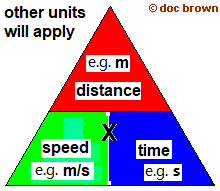
speed (metres/second, m/s) = distance travelled (metres, m) ๗ time (seconds, s)

distance (m) = average speed (m/s) x time (s)

time (s) = distance (m) ๗ average speed (m/s)

v = s t,  so  s = v x t  and  t = s v 

v = speed or velocity (m/s), s = distance (m), t = time (s)

sometimes distance is quoted as the variable d as well as s.

Changes in distance might be called Δd (or Δs) and changes in time Δt - the actual time taken for the distance of actual moved in that time.

Make sure you are good at doing equation rearrangements, this one is easy, but some are not! It is better to be able to rearrange a formula than use a formula triangle.

Beware! it is common in motion topics to represent distance by the letter s, don't confuse with the time unit second!

If the speed of an object is variable, average speed is simply the total distance travelled divided by the total time taken.

e.g. a sprinter completing a 200 m race in 25 seconds has an average speed of 200 / 25 = 8 m/s, but quite plainly the speed is variable as the athlete starts from 0 m/s to perhaps a maximum speed of over10 m/s since 100 m sprinters complete their distance in ~10 s giving an average speed of ~10 m/s.

For v to be a velocity, then direction of motion should be specified.


Example of speed calculation questions

Q1.1 A train was timed to take 2.5 seconds when passing between two posts 100 m apart.

(a) What is the speed of the train in m/s?

(b) What is the speed of the train in km/hour?

(I'm just deliberately asking a more arithmetically awkward question of a sort you may have to deal with)

Worked out ANSWERS for these speed calculation questions


Q1.2 How far will a car travel in 15 seconds at a speed of 20 m/s?

Worked out ANSWERS for these speed calculation questions


Q1.3 A sprinter runs 400 m at an average speed of 8.4 m/s. To the nearest 0.1 s, how long did the sprint run take?

Worked out ANSWERS for these speed calculation questions


Q1.4 A car travels at a constant speed of 40.0 mph.

(a) If 1 mile = 1.61 km, calculate the speed of the car in m/s.

(b) How far will the car travel in 45.0 seconds?

(c) If the car speeds up and travels 5.2 km in 3 minutes, what is the car's speed?

Worked out ANSWERS for these speed calculation questions


Q1.5 A car travels from motorway Junction 26 to Junction 27 with an average speed of 30 m/s (~67 mph).

It took 150 s to go from Junction 26 to Junction 27.

Due to road works speed restrictions the car moved on to Junction 28 at average speed of 20 m/s.

Junctions 27 and 28 are 15 km apart.

(a) Calculate how far apart Junctions 26 and 27 are.

(b) Calculate how long it took to travel between Junctions 27 and 28.

(c) What is the average speed of the car from Junction 26 to Junction 28?

Worked out ANSWERS for these speed calculation questions


INDEX physics notes: Speed calculations and distance-time graphs


Key points about speed and velocity - calculations of speed and velocity

Information sources for Doc Brown's key points: IGCSE-GCSE physics are based on textbooks & syllabus-specifications for students taking the UK AQA, Edexcel, OCR 21st Century Science, OCR Gateway science suite, WJEC, CCEA and CIE GCSE physics 9-1 level science examinations

A structured set of summary revision notes on speed and velocity calculations, tailored to the GCSE/IGCSE physics specifications across major UK exam boards: WJEC, CCEA, CIE, AQA, Edexcel, and OCR.


Speed and Velocity Calculations

Core Definitions

Term Description
Speed Rate at which distance is covered; scalar quantity (no direction)
Velocity Rate of change of displacement; vector quantity (includes direction)
Displacement Distance in a specific direction; vector quantity
Distance Total path travelled; scalar quantity

Key Equations for speed and velocity

  • Speed:
    Speed = Distance / Time
    (Scalar)
  • Velocity:
    Velocity = Distance displaced / Time
    (Vector)
  • Average Speed:
    Average Speed = Total Distance moved / Total Time taken
  • Average Velocity:
    Average Velocity = Total Distance displaced / Total Time taken

Graphical Interpretation


Typical Exam Board Syllabus Content

Specification Focus

Motion – scalar versus vector, speed/velocity calculations, graphs
Motion – average speed, displacement, vector/scalar distinction
Motion – speed, velocity, displacement, graphical analysis
Forces – speed/velocity equations, average speed, direction
Describing Motion – scalar/vector, speed/velocity, graphs
Motion – speed/velocity, average speed, graphical methods

Student Exam Tips

  • Check units: Convert km/h to m/s when needed (1 km/h = 0.278 m/s).
  • Use formula triangles to rearrange equations confidently.
  • Distinguish scalar versus vector: Speed is scalar, velocity is vector.
  • Label direction in velocity answers (e.g. “east” or “–5 m/s”).
  • Practice graph interpretation: gradients and areas give key motion data.
  • Use worked examples to reinforce concepts — especially with changing motion.

Keywords, phrases and learning objectives for speed, motion and graphs

Know the formula for speed and be able to do various examples of speed, distance and time calculations.


WHAT NEXT?

TOP of page

INDEX for physics notes on speed calculations and constructing and interpreting distance-time graphs

INDEX of all my physics notes on FORCES and MOTION

INDEX of all my physics notes on FORCES

INDEX of all my PHYSICS NOTES

email doc brown - comments - query?

BIG website, using the [SEARCH BOX] below, maybe quicker than navigating the many sub-indexes


Basic Science Quizzes for UK KS3 science students aged ~12-14, ~US grades 6-8

BiologyChemistryPhysics for UK GCSE level students aged ~14-16, ~US grades 9-10

Advanced Level Chemistry for pre-university age ~16-18 ~US grades 11-12, K12 Honors

Find your GCSE/IGCSE science course for more help links to all science revision notes


importance of speed & velocity formula calculations in GCSE level physics, What you need to know about speed & velocity formula calculations for GCSE level physics, Explaining the use of speed & velocity formula calculations knowledge in GCSE level physics, Examples of speed & velocity formula calculations explained when studying GCSE level physics, What is significant about speed & velocity formula calculations, describing the theory of speed & velocity formula calculations when studying GCSE level physics, revision notes for speed & velocity formula calculations in exams, online exam help for speed & velocity formula calculations, revision notes about speed & velocity formula calculations, what do I need to learn about speed & velocity formula calculations for by GCSE physics exam? help to understand the speed & velocity formula calculations topic in preparation for GCSE physics exam question, how to prepare for questions involving speed & velocity formula calculations in a GCSE physics examination? Revision notes on speed & velocity formula calculations based on the syllabus-specifications for students taking IGCSE/GCSE level physics examinations, summary revision notes and key points on speed & velocity formula calculations for students taking the AQA igcse/gcse physics notes on speed & velocity formula calculations, Edexcel gcse physics notes on speed & velocity formula calculations,  OCR 21st century GCSE physics notes on speed & velocity formula calculations, OCR gateway GCSE physics notes on speed & velocity formula calculations, WJEC gcse physics notes on speed & velocity formula calculations, CCEA gcse physics notes on speed & velocity formula calculations for students taking CIE Cambridge igcse physics, exam revision notes on speed & velocity formula calculations, useful for US grade 9-10 physics courses


SITEMAP Website content ฉ Dr Phil Brown 2000+. All copyrights reserved on Doc Brown's physics revision notes, images, quizzes, worksheets etc. Copying of website material is NOT permitted. Exam revision summaries and references to GCSE science course specifications are unofficial.

INDEX physics notes: Speed calculations and distance-time graphs

Worked out ANSWERS to the speed calculation questions

Q1.1 A train was timed to take 2.5 seconds when passing between two posts 100 m apart.

(a) What is the speed of the train in m/s?

v = s t = 100/2.5 = 40 m/s

(b) What is the speed of the train in km/hour?

(I'm just deliberately asking a more arithmetically awkward question of a sort you may have to deal with)

100 m = 100/1000 = 0.1 km

v = s t = 0.1/2.5 = 0.04 km/s

Since 1 hour equates to 60 x 60 = 3600 seconds

In 1 hour the train will travel 0.04 x 3600 km,  so speed = 144 km/hour


Q1.2 How far will a car travel in 15 seconds at a speed of 20 m/s?

v = s ๗ t  ,  so  s = vt = 20 x 15 = 300 m


Q1.3 A sprinter runs 400 m at an average speed of 8.4 m/s. To the nearest 0.1 s, how long did the sprint run take?

v = s ๗ t,  so t = s v  = 400/8.4 = 47.6 s


Q1.4 A car travels at a constant speed of 40.0 mph.

(a) If 1 mile = 1.61 km, calculate the speed of the car in m/s.

speed = 40 x 1.61 = 64.4 km/hour

64.4 m = 66400 m, 1 hour = 60 x 60 = 3600 s

speed of car = 66400/3600 = 17.9 m/s (3sf)

(b) How far will the car travel in 45.0 seconds?

speed = distance/time

distance = speed x time = 17.9 x 45 = 806 m (3sf)

(c) If the car speeds up and travels 5.2 km in 3 minutes, what is the car's speed?

3 minutes = 3 x 60 = 180 s, 5.2 km = 5200 m

speed = distance/time = 5200/180 = 29 m/s (2sf)


Q1.5 A car travels from motorway Junction 26 to Junction 27 with an average speed of 30 m/s (~67 mph).

It took 150 s to go from Junction 26 to Junction 27.

Due to road works speed restrictions the car moved on to Junction 28 at average speed of 20 m/s.

Junctions 27 and 28 are 15 km apart.

(a) Calculate how far apart Junctions 26 and 27 are.

v = Δd / Δt,    Δd = v x Δt = distance

Distance between Junction 26 and 27 = 30 x 150 = 4500 m (4.5 km)

(b) Calculate how long it took to travel between Junctions 27 and 28.

v = Δd / Δt,   Δt = Δd / v  = time taken, don't forget to change from km to m (x 1000)

Time from Junction 27 to 28 = (15 x 1000) / 20 = 750 s.

(c) What is the average speed of the car from Junction 26 to Junction 28?

The total distance is 4500 + 15000 = 19500 m

The total time = 150 + 750 = 900 s

Average speed = total distance / total time

= 19500 / 900 = 22 m/s (2 sf, 21.7 to 3 sf)

INDEX physics notes: Speed calculations and distance-time graphs

TOP OF PAGE