4.1
Newton's First Law of Motion, inertia and resultant forces
See also 4.4
More on the concept of
inertia, inertial mass and gravitational mass
What is Newton's first law of motion?
Newton's three laws of motion are some of
the earliest proposed laws of physics - indeed of science itself.
His imagination, insight and mathematical
brilliance have stood the test of time since 1686 when he first proposed
them - but they could not be assumed to be true i.e. valid in 1686 -
repeated experimental verification is required.
BUT, countless experiments over
the past few hundred years have shown them to be true and form the basis of
innumerable calculations in applied physics and engineering.
Newton's First Law of Motion
BUT 1st, knowing what inertia
is helps
Inertia is not a force - it’s a
fundamental property of matter and refers to an object's
resistance to changes in its motion.
The greater the mass,
of an object, the greater its inertia
(harder to change its motion).
Newton's First Law of Motion states that a
resultant force is needed to change the motion of any object.
e.g. starting a body moving, increasing
its speed (acceleration), slowing it down (deceleration), stopping it
moving, changing the direction of movement (the latter is a change in
velocity).
A resultant force must be an
unbalanced net force of >zero on an object.
If the resultant force on a stationary
body is zero, the body will remain stationary.
If the resultant force on a moving
object is zero, the velocity remains unchanged, in other words the
object will continue moving at the same speed and in the same
direction, therefore moving with the same velocity.
If a body such as a road vehicle or an aeroplane is
moving at a constant velocity (constant speed without changing direction)
the driving force from the engine and the resistive forces of friction
(moving parts, air resistance etc.) must be balanced i.e. the resultant force
is zero.
The velocity can only be changed if a
resultant non-zero force acts on the object.
A non-zero resultant force will always
initially produce an acceleration or deceleration in the direction of the force
(see cyclist example below).
There are five situations that you will
come across when dealing with a non-zero resultant force that results in a
change in velocity.
This change in velocity may involve
a moving object speeding up (acceleration) or slowing down (deceleration).
The acceleration might be a stationary object being forced to
move or a moving object made to stop.
These first four situations involve
change in speed, and not necessarily a change in direction, but change
in direction is also a 5th result of the effect on an object of a
non-zero resultant force, and therefore a change in velocity.
See also Forces and motion
section 3.
Calculating resultant forces using vector
diagrams, also includes work done calculations
Some of these ideas are illustrated using a cyclist
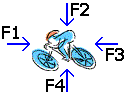 On the left is a 'free body force diagram' of a cyclist showing all the forces acting on the
body.
On the left is a 'free body force diagram' of a cyclist showing all the forces acting on the
body.
If the cyclist is moving with a constant velocity then we are dealing with uniform
or constant speed and
no change in direction.
There is no resultant force i.e.
F1 = F3 and F2 = F4,
so the cyclist continues in the same direction at the same speed.
Note the relative size and direction of the arrows and think of Newton's First
Law of Motion.
F1 is the air resistance due to
friction between the surface of the bike and cyclist and the air,
also friction between the wheels and road, and, friction in moving parts of the
bike.
All three combined oppose the forward motion of the bike and rider.
F2 is the weight of the bike +
cyclist combination due to gravity, weight of object acting on the road with the normal contact
force
F3 is the thrust or push of the
bike from the power generated by the cyclist.
F4 is the normal contact force of the
atoms of the road surface pushing back up on the bike.
 If the cyclist applies more power (left free body diagram), forces F1 and F2 are
unbalanced, giving a resultant force of greater than zero from right to left.
If the cyclist applies more power (left free body diagram), forces F1 and F2 are
unbalanced, giving a resultant force of greater than zero from right to left.
Therefore the cyclist will accelerate and
increase in speed. This action does not affect forces F2 and F4 which remain
balanced.
The resultant force
causes the acceleration.

If the cyclist applies the brakes (left
free body diagram), in
doing so he will stop pedalling, reducing force F3 AND the increased friction
from the brake pads acting on the wheel rim will increase force F1 (left
diagram).
Again, the arrows for forces F1 and F3 should be shown as unequal.
The forces are now unbalanced and the bike
and rider slow down (deceleration).
Neither of these two actions affects forces
F2 and F4 which remain balanced.
The
resultant force causes the deceleration.
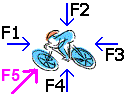 If another force is introduced like a sudden gust of a side wind
(F5), then the cyclist and bike will change direction in the direction of the
wind i.e. forced to the right since the diagram indicates a gust of wind from
the left.
If another force is introduced like a sudden gust of a side wind
(F5), then the cyclist and bike will change direction in the direction of the
wind i.e. forced to the right since the diagram indicates a gust of wind from
the left.
The cyclist will then apply a correcting 'balancing' force by
turning the handle bars to adjust for the extra force F5 to try to maintain the same speed
and direction of the cycle.
You can analyse the descent of a
parachutist
This is an interesting case because it
involves an acceleration, a deceleration and two terminal velocities!
1.
 2.
2.  3.
3. 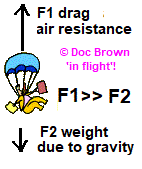
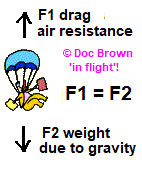
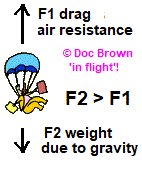
The three possible 'force' situations as
the parachuting person is descending after jumping out of an aeroplane.
Note the relative size and direction of
the arrows and think of Newton's First Law of Motion.
1. When drag force F1 is less than the
weight force F2, the parachutist is accelerating.
2. When drag force F1 equals the weight
force F2, the parachutist is descending at a steady speed - a terminal
velocity.
3. When drag force F1 is more than the
weight force F2, the parachutist will decelerate (to another terminal
velocity).
This situation is fully analysed on
Forces and Motion Part 3.5
Complex behaviour
of a falling parachutist: forces & velocities
Any stationary object standing on a
surface
The weight of an object, due to gravity,
acts on the surface - normal contact force.
The atoms of the surface are compressed
and push back up with an equal normal contact force.
The resultant force is zero.
Therefore from Newton's First Law of
Motion, the object should stay stationary.
If there was any difference in the two
forces, the object would accelerate and rise or fall.
Some examples
involving circular motion
(i) Suppose you whirl an object around
tied to the end of a string.
If you supply kinetic energy at a
constant rate the object will whirl around with a constant speed in the
same repeating circular path.
The object is held in a constant
orbit by the tension in the string - the centripetal force, acting
towards the centre of rotation, and balancing out the acceleration.
The forces are balanced, a zero
resultant force, but what if the string breaks!?
The tension in the string has gone,
so there is no balancing centripetal force, but the object is still
moving and shoots off at a constant velocity in a linear direction at a
tangent to the original orbit.
(ii) The Earth orbiting the Sun
A thought experiment! Suppose you
could switch off gravity, what would happen to the Earth.
(OR imagine if the Sun suddenly
disappeared, its the same effect, the Earth is NOT in a gravitational
field.)
The centripetal gravitational force
has gone, so I'm afraid the Earth would fly off at a tangent to its
original planetary orbit and fly off in a straight line at a constant
velocity.
Unless it hit or was hit, by another
object, it would continue in a straight line at constant speed for ever!
The
reluctance or property of an object to change its motion is called inertia.
See also 4.4
More on the concept of
inertia, inertial mass and gravitational mass
INDEX for physics notes on
Newton's Laws of Motion
Key points
on
Newton's laws of motion:
Newton's First Law of Motion and inertia
Information
sources for Doc Brown's key points: IGCSE-GCSE physics are based on
textbooks & syllabus-specifications for students taking the UK AQA, Edexcel,
OCR 21st Century Science, OCR Gateway science suite, WJEC, CCEA and CIE GCSE
physics 9-1 level science examinations
A structured set of summary revision notes
on Newton’s First Law of Motion, tailored to the GCSE/IGCSE Physics specifications across major UK exam boards: WJEC,
CCEA, CIE, AQA, Edexcel, and OCR.
Newton’s First Law of Motion – Summary Revision Notes
Definition (Universal Across All Boards)
An object will remain at rest or move at a constant velocity
unless acted upon by a resultant (net) force.
This law is also known as the Law of Inertia.
Key Concepts related to Newton's First Law of
Motion
- Inertia: The tendency of an object to resist changes in
its motion.
- Balanced Forces: No resultant force → object stays at
rest or continues at constant velocity.
- Unbalanced Forces: Resultant force ≠ 0 → object
accelerates (change in speed or direction).
- Constant Velocity means:
- No change in speed
- No change in direction
Real-World Examples of Newton's First Law of
Motion
| Scenario |
Newton’s First Law in Action |
| A book on a table |
Stays at rest unless pushed |
| A car cruising at 60 mph |
Continues unless brakes or engine force changes |
| A spacecraft in deep space |
Moves indefinitely unless acted on by gravity or collision |
Typical Exam Board Syllabus contents related
to Newton's First Law of Motion
|
Specific Requirements |
| Higher tier students must recall the law verbatim; all students must
apply it to real-world scenarios |
| Emphasis on inertia and balanced/unbalanced forces; apply to motion
graphs and everyday examples |
| Must define and apply the law to constant velocity and resultant
force scenarios |
| Apply the law to explain motion changes; understand balanced
versus
unbalanced forces |
| Use the law to explain constant velocity and resultant force
effects; apply to motion examples |
| Apply the law to uniform motion and changing velocity; use vector
diagrams and free-body diagrams (HT) |
Common Misconceptions relating to Newton's
First Law of Motion
- “If something is moving, there must be a force acting on it.”
Not true if it’s moving at constant velocity with balanced forces.
- “Objects naturally come to rest.”
Only happens due to friction or other forces counteracting the motion.
Student Tips relating to Newton's First Law of
Motion
- Memorise the definition
- especially for higher-tier
papers.
- Use diagrams to show balanced
versus unbalanced forces.
- Think beyond Earth
- space examples help clarify
inertia.
- Link to other topics like resultant force,
acceleration, and Newton’s Second Law.
- Practice with scenarios: cars, skydivers, trolleys,
and space probes.
Newton’s First Law and Inertia – How They're Intertwined
Newton’s First Law Recap
“An object will remain at rest or continue to move at a constant velocity
unless acted upon by a resultant force.”
This law describes how motion changes only when there's a
net force involved.
What Is Inertia?
- Inertia is not a force - it’s a property of matter.
- It refers to an object's resistance to changes in its motion.
- The greater the mass, the greater the inertia
(harder to change its motion).
The Relationship between inertia and Newton's
First Law of Motion
| Concept |
Connection to Newton’s First Law |
| Inertia |
Explains why objects obey the First Law: they naturally
resist changes in motion |
| Balanced forces |
Result in no motion change → inertia keeps object still or moving
steadily |
| Unbalanced forces |
Required to overcome inertia → change in speed or direction occurs |
| Mass |
Directly affects inertia → heavier objects need more force to change
motion |
In essence:
Newton’s First Law describes the behavior of objects.
Inertia explains the reason behind that behavior.
Example Scenario relating to Newton's First
Law of Motion
- A passenger in a moving car lurches forward when the brakes are slammed.
- That forward motion is due to inertia
- the passenger’s
body resists the sudden change in velocity.
More
on INERTIA
Inertia pops up all around us - once you start spotting it,
you’ll see it everywhere. Here’s a list of real-life examples
that beautifully demonstrate how objects resist changes to their motion:
Everyday Examples of Inertia
Inertia and vehicles
- Seatbelt Safety: If a car stops suddenly, your body
keeps moving forward due to inertia. That’s why seatbelts are essential - they
apply a force to stop you.
- Starting a Train: A heavy train takes a long time to
start and stop because its large mass gives it more inertia.
Inertia and objects at Rest
- Books on a Table: They don’t move unless someone
applies a force - classic inertia in action.
- Furniture: Large sofas are harder to push because they
have more mass → more inertia.
Inertia While Moving
- A Ball Rolling on Grass: It eventually stops, not
because inertia ends, but because friction and air resistance apply a force
to overcome it.
- Shopping Trolley: Push it, and it moves. Let go, and it
gradually stops due to friction - but inertia keeps it going initially.
Inertia of objects in space
- Satellites: Once launched, they keep orbiting without
further propulsion, unless acted upon (e.g., gravitational pull).
- Astronauts Floating: In zero gravity, if they push off,
they keep drifting - nothing slows them unless they bump into something.
In school experiments you see inertia, without
realising it?
- Pendulum Motion: A swinging pendulum continues until
air resistance and gravity act on it.
- Ticker Timer Tape: Shows constant spacing when an
object moves at constant speed → inertia preserves the motion.
Keywords, phrases and learning objectives for Newton's 1st Law of Motion
Know and be able to
Newton's First Law of Motion and resultant forces.
Know that a resultant force of >0 is
needed to change the motion of any object.
Know what is meant by the inertia of an
object and its relationship with Newton's 1st law of motion.
importance of Newton's
First Law of Motion, inertia & resultant force
in GCSE level physics, What you need to know about Newton's First Law of
Motion, inertia & resultant force for
GCSE level
physics,
Explaining the use of Newton's First Law of Motion, inertia & resultant
force knowledge in GCSE level physics, Examples of Newton's First Law of
Motion, inertia & resultant force explained
when studying GCSE level physics, What is
significant about Newton's First Law of Motion, inertia & resultant
force, describing the theory of Newton's First Law of Motion,
inertia & resultant force when studying
GCSE level physics, revision notes for Newton's First Law of Motion,
inertia & resultant force in exams, online exam help
for Newton's First Law of Motion, inertia & resultant force, revision notes about
Newton's First Law of Motion, inertia & resultant force, what do I need to learn about
Newton's First Law of Motion, inertia & resultant force for
by GCSE physics exam?
help to understand the Newton's First Law of Motion, inertia & resultant
force topic in preparation for GCSE physics exam
question, how to
prepare for questions involving Newton's First Law of Motion, inertia &
resultant force in a GCSE physics examination?
Revision notes on Newton's First Law of Motion, inertia & resultant
force b
ased on the syllabus-specifications
for students taking IGCSE/GCSE level physics examinations, summary
revision notes and key points on Newton's First Law of Motion, inertia &
resultant force for students taking the AQA
igcse/gcse physics notes on Newton's First Law of Motion, inertia & resultant
force, Edexcel gcse
physics notes on Newton's First Law of Motion, inertia & resultant
force, OCR 21st century GCSE
physics notes on Newton's First Law of Motion, inertia & resultant
force, OCR gateway
GCSE physics notes on Newton's First Law of Motion, inertia &
resultant force, WJEC gcse physics notes on Newton's First Law of
Motion, inertia & resultant force, CCEA
gcse physics notes on Newton's First Law of Motion, inertia & resultant
force for students taking CIE Cambridge igcse
physics, exam revision notes on
Newton's First Law of Motion, inertia & resultant force, useful for US grade 9-10 physics courses
SITEMAP
Website content © Dr
Phil Brown 2000+. All copyrights reserved on Doc Brown's physics revision notes, images,
quizzes, worksheets etc. Copying of website material is NOT
permitted. Exam revision summaries and references to GCSE science course specifications
are unofficial.
INDEX for physics notes on
Newton's Laws of Motion
