|
 KINETICS
7.6 Acid catalyzed
iodination of propanone KINETICS
7.6 Acid catalyzed
iodination of propanone
CH3COCH3(aq)
+ I2(aq) ==> CH3COCH2I(aq)
+ HI(aq) [Author
©
Dr
Phil Brown PhD: Doc
Brown's exam revision notes suitable
for students of advanced pre-university/college level theoretical-physical chemistry courses:
rates of reaction factors:
KINETICS iodine-propanone reaction
[kinetics page updated Mar
13th 2026 *]
Advanced Level Chemical Kinetics Notes
Index
[email doc
b: comment? query?]
*
[privacy-policies-disclaimer] * ]SEARCH doc b's
website]
Case
study 4.6 Acid catalyzed iodination of propanone
Explanation and derivation of orders of
reactants and how to write the rate expression
-
CAN A MECHANISM BE VERY COMPLICATED, AND YET
HAVE A SIMPLE RATE EXPRESSION?
-
 Propanone readily forms
1–iodopropanone on reaction with acidified iodine solution, as do all 2–ones
('methyl ketones') I assume? Propanone readily forms
1–iodopropanone on reaction with acidified iodine solution, as do all 2–ones
('methyl ketones') I assume?
-
However, the rate
expression is: rate = k2[CH3COCH3(aq)][H+(aq)]
-
This suggests there is
a slow rate determining step involving the ketone and the hydrogen ion in
the mechanism and what ever happens next e.g. involving the iodine, is
much faster. A proposed mechanism is shown below, where R = CH3 if it was
propanone. Note that very little can be
absolutely proved in mechanistic detail and you will find variations of this
diagram on the web.
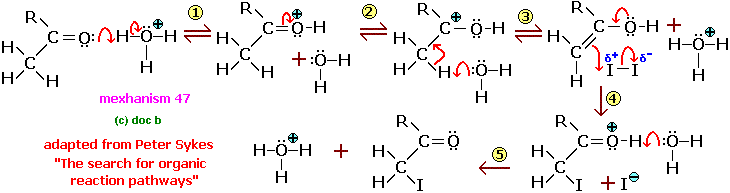
Note:
-
The reaction can be followed by
calorimetry, since the decline in iodine colour matches the reduction of
the propanone concentration.
-
The same
reaction is catalysed by bases and proceeds by a different mechanism and
gives different products ultimately. Multiple substitution takes place,
initially forming 1–iodopropanone, then 1,1–diidopropanone, and then
1,1,1–triiodopropanone. Finally, the carbon chain splits to give
triiodomethane, CHI3, i.e. its the 'iodoform' reaction
given by ethanol, ethanal, and all 2–ones ('methyl ketones').
-
The individual
products are almost impossible to isolate in the base catalysed
reaction, but in the acid catalysed reaction, the rate of halogenation
decreases with successive halogen atom substitution, so it is possible
to isolate e.g. 1–iodopropanone, 1,1–diiodopropanone and
1,1,1–triiodopropanone and presumably? molecules such as
1,3–diiodopropanone may be formed, but I'm not sure on this one?
This mechanism is
often presented, and not unreasonably at UK A level, as a three step
mechanism, with Step (1)
as the rds and clearly showing the proton's role in this acid catalysed
reaction.
-
Step
(1) (CH3)2C=O + H+
 (CH3)2C=O+H
-
Step
(2)
(CH3)2C=O+H
CH3C(OH)=CH2
+ H+
Step
(3)
CH3C(OH)=CH2 + I2
 CH3COCH2I + HI
(see also organic mechanisms
iodination of ketones)
Website content © Dr Phil Brown 2000+.
All copyrights reserved on Doc Brown's Advanced Level Chemistry revision
notes, images, quizzes, worksheets etc. on chemical kinetics. Copying of
website material is NOT permitted. Exam revision summaries & references
to chemistry course specifications are unofficial. Doc Brown's
Chemistry Advanced Level Pre-University Chemistry Revision Study Notes
explaining
the importance of kinetics of acid catalysed iodination of propanone -
iodine reaction for theoretical chemistry exam questions, What you need to know about
kinetics of acid catalysed iodination of propanone - iodine reaction for theoretical chemistry, Explaining the use of
kinetics of acid catalysed iodination of propanone - iodine reaction knowledge in
theoretical chemistry exam questions, Examples of kinetics of acid
catalysed iodination of propanone - iodine reaction explained when studying
theoretical chemistry, What is the significance and use of kinetics of
acid catalysed iodination of propanone - iodine reaction in theoretical
chemistry, describing and explaining the theory behind the study of
kinetics of acid catalysed iodination of propanone - iodine reaction,
exam revision notes on kinetics of acid catalysed iodination of
propanone - iodine reaction for exams, online help for the kinetics of
acid catalysed iodination of propanone - iodine reaction topic,
revision notes for kinetics of acid catalysed iodination of propanone -
iodine reaction, what do I need to learn for kinetics of acid catalysed
iodination of propanone - iodine reaction in exams?
revision summary for kinetics of acid catalysed iodination of propanone
- iodine reaction, help in teaching kinetics of acid catalysed
iodination of propanone - iodine reaction, learning notes for kinetics
of acid catalysed iodination of propanone - iodine reaction,
help to pass exam questions involving kinetics of acid catalysed
iodination of propanone - iodine reaction, help to prepare for examination questions on
kinetics of acid catalysed iodination of propanone - iodine reaction?
These revision notes are suitable for AQA A level chemistry,
Edexcel A level chemistry, OCR A level chemistry, Salters A level
chemistry, CIE A level chemistry WJEC & CCEA A level chemistry, US grade
11-12 K12 AP Honors
All
my advanced Level Chemical Kinetics Notes Index
(for students aged ~17-18)
All
my advanced Level Physical-Theoretical revision notes
(for ages ~17-18) All
my advanced Level UK (~US grades 11-12) pre-university
Chemistry Notes
(ages ~17-18)
All
my GCSE
Level (~US grades 8-10) Rates of Reaction Notes
(for students aged ~14-16)
All
my GCSE
Level (~US grades 8-10) School Chemistry Notes
(for students age ~14-16)
Email doc
brown - comment? query? |
|
