|
Organic chemistry Part 10: Reactivity and
reaction mechanisms
10.6.4
The
iodination of ketones (substitution reaction
mechanism)
[Author
© Dr
Phil Brown PhD: Doc
Brown's exam revision notes suitable
for A level chemistry students of advanced pre-university/college advanced level organic chemistry courses:
mechanism of iodination of ketones
[mechanism updated April 14th 2026 *]
email doc
brown - comments - query?
*
[privacy, cookies and disclaimer]
Index of
organic chemistry technical terms and mechanism pages
All my revision notes on the chemistry of
aldehydes and ketones
All my advanced A level organic
chemistry notes
10.6.4
The
iodination of ketones
(substitution reaction, not a nucleophilic addition)
The organic synthesis of iodoketones from the reaction of ketones with
iodine
-
What is the mechanism for the
iodine substitution reaction of ketones?
-
Propanone readily forms
1-iodopropanone on reaction with acidified iodine solution, as do all 2–ones
('methyl ketones') I assume?
-
However, from experimental
observations, the rate
expression is:
-
rate = k [ketone/propane] [acid
hydrogen ion]
-
rate = k2[CH3COCH3(aq)][H+(aq)]
-
and iodine is not in
the rate expression but one of the products is!
-
Therefore the
reaction is zero order for iodine and it also zero order for bromine in
the similar bromination reaction.
-
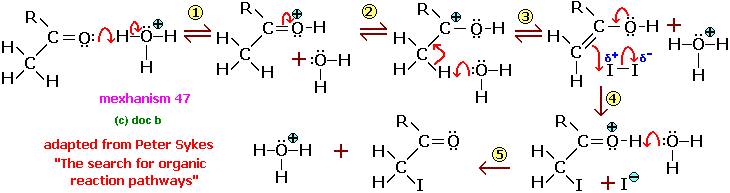
This suggests there
is a slow rate determining step involving the ketone and the hydrogen ion in
the mechanism and what ever happens next e.g. involving the iodine, is
much faster. A proposed mechanism is shown below, where R = CH3
if it was propanone. Note that very little can be absolutely proved in
mechanistic detail and you will find variations of this diagram on the web.
-
Other examples of
iodine reacting with ketones (specifically '2-ones')
-
So, what is the
reaction mechanism for propanone reacting with iodine under acidic
conditions.

APPENDIX -
COMPLETE MECHANISM
and Organic Synthesis INDEX
(so far!)
Website content © Dr
Phil Brown 2000+. All copyrights reserved on
Doc Brown's Chemistry revision notes organic reaction
mechanisms. Copying of website material is NOT
permitted.
Website content © Dr Phil Brown 2000+. All
copyrights reserved on revision notes, images, quizzes, worksheets etc. Copying
of website material is NOT permitted. Exam revision summaries & references to
science course specifications are unofficial.
Website content © Dr Phil Brown 2000+. All
copyrights reserved on these organic chemistry exam revision
notes on mechanism of iodination of ketones, these A level chemistry revision notes are suitable for use of pre-university students studying AQA advanced level
organic chemistry revision notes on mechanism of iodination of
ketones, Edexcel advanced level
organic chemistry revision notes on mechanism of iodination of
ketones, OCR advanced level
organic chemistry revision notes on mechanism of iodination of
ketones, IB advanced level
organic chemistry revision notes on mechanism of iodination of
ketones, WJEC (Eduqas) advanced level
organic chemistry revision notes on mechanism of iodination of
ketones, CIE Cambridge advanced level
organic chemistry revision notes on mechanism of iodination of
ketones, CCEA advanced level
organic chemistry revision notes on mechanism of iodination of
ketones, and useful for US grade 11 grade 12 AP honors organic chemistry courses
involving mechanism of iodination of ketones, keywords phrases: reaction conditions formula
intermediates organic chemistry reaction mechanisms
reaction of propanone and iodineCH3COCH3(aq) + I2(aq) ==> CH3COCH2I(aq) + H+(aq) + I–(aq) (CH3)2C=O + H3O+ <=>
(CH3)2C=O+H + H2O (CH3)2C=O+H <=> (CH3)2C+–OH (CH3)2C+–OH + H2O <=> CH3C(OH)=CH2
+ H3O+ CH3C(OH)=CH2 + I2 CH3C(=O+H)–CH2I + I– CH3C(=O+H)–CH2I + H2O <=>
CH3COCH2I + H3O+ (CH3)2C=O + H+ <=> (CH3)2C=O+H (CH3)2C=O+H <=> CH3C(OH)=CH2 +
I2 CH3COCH2ICH3C <=> (OH)=CH2 + H+
Website content © Dr Phil Brown 2000+. All
copyrights reserved on revision notes, images, quizzes, worksheets etc. Copying
of website material is NOT permitted. Exam revision summaries & references to
science course specifications are unofficial.
Website content © Dr Phil Brown 2000+. All
copyrights reserved on these organic chemistry exam revision
notes on reaction between iodine and methyl ketones, these A level chemistry revision notes are suitable for use of pre-university students studying AQA advanced level
organic chemistry revision notes on reaction between iodine and
methyl ketones, Edexcel advanced level
organic chemistry revision notes on reaction between iodine and
methyl ketones, OCR advanced level
organic chemistry revision notes on reaction between iodine and
methyl ketones, IB advanced level
organic chemistry revision notes on reaction between iodine and
methyl ketones, WJEC (Eduqas) advanced level
organic chemistry revision notes on reaction between iodine and
methyl ketones, CIE Cambridge advanced level
organic chemistry revision notes on reaction between iodine and
methyl ketones, CCEA advanced level
organic chemistry revision notes on reaction between iodine and
methyl ketones, and useful for US grade 11 grade 12 AP honors organic chemistry
courses involving reaction between iodine and methyl ketones,
Explaining the importance of synthesis of
iodo-ketones
in organic chemistry, What you need to know about synthesis of
iodo-ketones for organic
chemistry,
Explaining the use of synthesis of iodo-ketones knowledge in organic chemistry, Examples of
synthesis of iodo-ketones explained
when studying organic chemistry, What is
the significance of synthesis of iodo-ketones in organic chemistry, What is the use of
synthesis of iodo-ketones
in organic chemistry Describing and
explaining the theory of synthesis of iodo-ketones when studying organic chemistry, exam revision
notes for synthesis of iodo-ketones in exams, online help for synthesis
of iodo-ketones, revision notes for synthesis of iodo-ketones,
what do I need to learn for synthesis of iodo-ketones in exams? revision summary for
synthesis of iodo-ketones, help in
teaching synthesis of iodo-ketones, learning notes for synthesis of
iodo-ketones, help to pass the synthesis of iodo-ketones exam, how to
prepare for examination questions on synthesis of iodo-ketones?
[SEARCH
BOX]
pre-university/college advanced chemistry links
My advanced level organic
mechanism index
All my advanced level organic
chemistry notes
All my advanced level
inorganic chemistry notes
All my advanced level
theoretical chemistry notes |
|
 + I2 ==>
 + HI
+ HI + I2 ==>
 + HI
+ HI (CH3)2C=O+H + H2O
  CH3C(OH)=CH2 + H3O+
