|
Organic chemistry Part 10: Reactivity and
reaction mechanisms
10.7 Reaction mechanism for the reaction of acid/acyl chlorides
with alcohols
to yield esters
[Author
©
Dr
Phil Brown PhD: Doc
Brown's exam revision notes suitable
for A level chemistry students of advanced pre-university/college advanced level organic chemistry courses:
mechanism of esterification via an acyl/acid chloride
[mechanism updated April 14th 2026 *]
email doc
brown - comments - query?
*
[privacy, cookies and disclaimer]
Index of
organic chemistry technical terms and mechanism pages
All my revision notes on the chemistry of
alcohols
All
my revision notes on the chemistry of carboxylic acid & derivatives
All my advanced A level organic
chemistry notes
10.7 Reaction of acid/acyl chlorides
with alcohols
Examples are explained of the organic
chemistry mechanisms for acid/acyl
chlorides undergoing nucleophilic addition
and elimination reactions.
They are described with diagrams and full
explanation revision notes.
Esterification with alcohols to give an ester.
The revision
notes
include full diagrams and explanation of the mechanisms and the 'molecular' equation and reaction conditions are also explained.
10.7 CARBOXYLIC ACIDS and DERIVATIVES – Acyl/acid
chlorides
10.7.1 Introduction to acid chloride/acyl
chloride activity
Only acid chloride reactions
are considered at the moment and the high reactivity of acyl chlorides is
towards nucleophilic attack is due to the highly polarised situation of the
carbon–oxygen/chlorine bonds i.e.
δ–Cl–Cδ+=Oδ–
The ensuing mechanism is
called a nucleophilic addition elimination (because of the two
principal stages of the mechanism i.e. an addition followed by an
elimination), but overall it amounts to a nucleophilic substitution
mechanism (see further comments).
The initial point of attack
in this esterification process is via the addition of the nucleophile alcohol.
10.7.3 Acid/acyl chloride esterification
of an alcohol by
a nucleophilic addition–elimination substitution reaction mechanism
The organic synthesis of esters from the reaction of acid/acyl chloride
with alcohols
-
Examples of
nucleophilic addition of an alcohol to acid/acyl chlorides,
followed by elimination to give the ester and
hydrogen chloride.
-
What is the mechanism
for the formation of an ester from an alcohol and an acid chloride?
-
e.g.
R–COCl + R'OH ==> R–COOR' + HCl
[see mechanism
15 below]
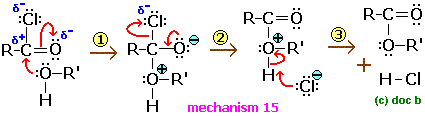
mechanism 15 –
nucleophilic addition–elimination reaction for the esterification of an
acyl chloride
 APPENDIX
COMPLETE MECHANISM
and Organic Synthesis INDEX
(so far!)
Website content © Dr
Phil Brown 2000+. All copyrights reserved on
Doc Brown's Chemistry revision notes organic reaction
mechanisms. Copying of website material is NOT
permitted.
Website content © Dr Phil Brown 2000+. All
copyrights reserved on revision notes, images, quizzes, worksheets etc. Copying
of website material is NOT permitted. Exam revision summaries & references to
science course specifications are unofficial.
Website content © Dr Phil Brown 2000+. All
copyrights reserved on these organic chemistry exam revision
notes on Acid/acyl chloride esterification of alcohol by nucleophilic
addition–elimination mechanism, these A level chemistry revision notes are suitable for use of pre-university students studying AQA advanced level
organic chemistry revision notes on Acid/acyl chloride
esterification of alcohol by nucleophilic addition–elimination mechanism, Edexcel advanced level
organic chemistry revision notes on Acid/acyl chloride
esterification of alcohol by nucleophilic addition–elimination mechanism, OCR advanced level
organic chemistry revision notes on Acid/acyl chloride
esterification of alcohol by nucleophilic addition–elimination mechanism, IB advanced level
organic chemistry revision notes on Acid/acyl chloride
esterification of alcohol by nucleophilic addition–elimination mechanism, WJEC (Eduqas) advanced level
organic chemistry revision notes on Acid/acyl chloride
esterification of alcohol by nucleophilic addition–elimination mechanism, CIE Cambridge advanced level
organic chemistry revision notes on Acid/acyl chloride
esterification of alcohol by nucleophilic addition–elimination mechanism, CCEA advanced level
organic chemistry revision notes on Acid/acyl chloride
esterification of alcohol by nucleophilic addition–elimination mechanism,
and useful for US grade 11 grade 12 AP honors organic chemistry courses
involving Acid/acyl chloride esterification of alcohol by nucleophilic
addition–elimination mechanism keywords phrases: reaction conditions formula
intermediates organic chemistry reaction mechanisms nucleophilic addition elimination HCl R–COCl + R'OH ==> R–COOR' + HCl,
Website content © Dr Phil Brown 2000+. All
copyrights reserved on revision notes, images, quizzes, worksheets etc. Copying
of website material is NOT permitted. Exam revision summaries & references to
science course specifications are unofficial.
Website content © Dr Phil Brown 2000+. All
copyrights reserved on these organic chemistry exam revision
notes on Why do alcohols readily react with acid/acyl chlorides to form esters?, these A level chemistry revision notes are suitable for use of pre-university students studying AQA advanced level
organic chemistry revision notes on Why do alcohols readily react
with acid/acyl chlorides to form esters?, Edexcel advanced level
organic chemistry revision notes on Why do alcohols readily react
with acid/acyl chlorides to form esters?, OCR advanced level
organic chemistry revision notes on Why do alcohols readily react
with acid/acyl chlorides to form esters?, IB advanced level
organic chemistry revision notes on Why do alcohols readily react
with acid/acyl chlorides to form esters?, WJEC (Eduqas) advanced level
organic chemistry revision notes on Why do alcohols readily react
with acid/acyl chlorides to form esters?, CIE Cambridge advanced level
organic chemistry revision notes on Why do alcohols readily react
with acid/acyl chlorides to form esters?, CCEA advanced level
organic chemistry revision notes on Why do alcohols readily react
with acid/acyl chlorides to form esters?, and useful for US
grade 11 grade 12 AP honors organic chemistry courses
involving Why do alcohols readily react with acid/acyl
chlorides to form esters?
Explaining the importance of
mechanism of ester synthesis from acid/acyl chlorides &
alcohols
in organic chemistry, What you need to know about mechanism of ester
synthesis from acid/acyl chlorides & alcohols for organic
chemistry,
Explaining the use of mechanism of ester synthesis from acid/acyl
chlorides & alcohols knowledge in organic chemistry, Examples of
mechanism of ester synthesis from acid/acyl chlorides &
alcohols explained
when studying organic chemistry, What is
the significance of mechanism of ester synthesis from acid/acyl
chlorides & alcohols in organic chemistry, What is the use of
mechanism of ester synthesis from acid/acyl chlorides &
alcohols
in organic chemistry Describing and
explaining the theory of mechanism of ester synthesis from acid/acyl
chlorides & alcohols when studying organic chemistry, exam revision
notes for mechanism of ester synthesis from acid/acyl chlorides &
alcohols in exams, online help for mechanism of ester
synthesis from acid/acyl chlorides & alcohols, revision notes for
mechanism of ester synthesis from acid/acyl chlorides &
alcohols,
what do I need to learn for mechanism of ester synthesis from acid/acyl
chlorides & alcohols in exams? revision summary for
mechanism of ester synthesis from acid/acyl chlorides &
alcohols, help in
teaching mechanism of ester synthesis from acid/acyl chlorides &
alcohols, learning notes for mechanism of ester synthesis
from acid/acyl chlorides & alcohols, help to pass the
mechanism of ester synthesis from acid/acyl chlorides &
alcohols exam, how to
prepare for examination questions on mechanism of ester synthesis from
acid/acyl chlorides & alcohols?
[SEARCH
BOX]
pre-university/college advanced chemistry links
My advanced level organic
mechanism index
All my advanced level organic
chemistry notes
All my advanced level
inorganic chemistry notes
All my advanced level
theoretical chemistry notes |
|
 + CH3-CH2-OH ===>
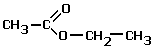 + HCl
+ HCl ===>
===>
 + HCl
+ HCl