|
Organic chemistry Part 10: Reactivity and
reaction mechanisms
10.5.2 The substitution reaction mechanism of alcohols with hydrogen halides
to give haloalkanes
ROH + HX ==> RX + H2O
[Author
© Dr
Phil Brown PhD: Doc
Brown's exam revision notes suitable
for A level chemistry students of advanced pre-university/college advanced level organic chemistry courses:
mechanism of haloalkane formation from alcohols
[mechanism updated April 14th 2026 *]
email doc
brown - comments - query?
*
[privacy, cookies and disclaimer]
Index of
organic chemistry technical terms and mechanism pages
All my revision notes on the chemistry of
alcohols
All
my revision notes on the chemistry of haloalkanes
10.5.2 Reaction of alcohols with hydrogen halides
Examples are explained of the organic
chemistry mechanisms for alcohols - substitution mechanism for the conversion of an alcohol to a halogenoalkane
and the mechanism of alcohol dehydration to form an alkene
Part
10.5 ALCOHOLS - 10.5.1 Introduction
-
The reaction
mechanism described involves acid catalysis and the initial step in
each case involves the protonation of the alcohol, this enables a
subsequent nucleophilic substitution to take place.
-
IMPORTANT NOTE on
structure classification
-
In the mechanism
diagrams you will see part of the molecular structure shown as R3C
-
PLEASE do not
assume this means a tertiary (tert) alcohol.
-
R3C–
is used repeatedly to minimise the number of graphic images
needed.
-
In general an
aliphatic alcohol has the structure R3C–OH where R =
H, alkyl or aryl.
-
A primary
aliphatic alcohol can be shown as RCH2–OH where R =
H, alkyl or aryl.
-
A secondary (sec)
alcohol can shown as R2CH–OH where R = alkyl or aryl.
-
A tertiary (tert)
alcohol can be shown as R3C–OH where R = alkyl or
aryl.
10.5.2 The acid catalysed conversion of alcohol to haloalkane
The organic synthesis of halogenoalkanes from alcohols and aqueous
hydrogen halides
-
Examples of alcohol
to halogenoalkane conversions
-
What is the mechanism
for the acid catalysis of making a halogenoalkane from an alcohol?
-
e.g.
R3C–OH + HX ===> R3C–X + H2O
[see mechanisms
12
and 13 below]
-
or more
correctly: R3C–OH + H3O+
+ X– ===> R3C–X + 2H2O
-
because
hydrogen halides are fully ionised in water,
-
HX(g/aq)
+ H2O(l) ===> H3O+(aq)
+ X–(aq)
-
For tertiary
halogenoalkanes the reaction is reversible.
-
You can use
conc. hydrochloric acid to make a chloroalkane or conc.
hydrobromic acid to make a bromoalkane.

mechanism 13
– substitution of the OH group of an alcohol by a halide ion
('unimolecular' via carbocation)

mechanism 12
– substitution of the OH group of an alcohol by a halide ion
(bimolecular)
10.5.3 The
acid catalysed elimination of water from an alcohol on
separate page now
10.6 Carbonyl compounds – nucleophilic addition to ALDEHYDES
and KETONES
on separate page now
10.6.3 Nucleophilic addition of a hydride ion in the
reduction of aldehydes/ketones to primary/secondary alcohols
on separate page now
10.6.4
The iodination of ketones (substitution reaction, not a nucleophilic addition)
on separate page now
10.7 CARBOXYLIC ACIDS and DERIVATIVES – Acyl/acid
chlorides - hydrolysis on
separate page now
10.7.3 Acyl chloride esterification by
nucleophilic addition–elimination
on separate page now
10.7.4 Amide
formation via acyl chloride by nucleophilic addition–elimination
on separate page now
 APPENDIX
COMPLETE MECHANISM and Organic
Synthesis INDEX (so far!)
Website content © Dr
Phil Brown 2000+. All copyrights reserved on
Doc Brown's Chemistry revision notes organic reaction
mechanisms. Copying of website material is NOT
permitted.
Website content © Dr Phil Brown 2000+. All
copyrights reserved on revision notes, images, quizzes, worksheets etc. Copying
of website material is NOT permitted. Exam revision summaries & references to
science course specifications are unofficial.
Website content © Dr Phil Brown 2000+. All
copyrights reserved on these organic chemistry exam revision
notes on mechanism of acid catalysed conversion of an alcohol to a haloalkane, these A level chemistry revision notes are suitable for use of pre-university students studying AQA advanced level
organic chemistry revision notes on mechanism of acid catalysed
conversion of an alcohol to a haloalkane, Edexcel advanced level
organic chemistry revision notes on mechanism of acid catalysed
conversion of an alcohol to a haloalkane, OCR advanced level
organic chemistry revision notes on mechanism of acid catalysed
conversion of an alcohol to a haloalkane, IB advanced level
organic chemistry revision notes on mechanism of acid catalysed
conversion of an alcohol to a haloalkane, WJEC (Eduqas) advanced level
organic chemistry revision notes on mechanism of acid catalysed
conversion of an alcohol to a haloalkane, CIE Cambridge advanced level
organic chemistry revision notes on mechanism of acid catalysed
conversion of an alcohol to a haloalkane, CCEA advanced level
organic chemistry revision notes on mechanism of acid catalysed
conversion of an alcohol to a haloalkane, and useful for US grade 11
grade 12 AP honors
organic chemistry courses involving mechanism of acid catalysed
conversion of an alcohol to a haloalkane
keywords phrases: reaction conditions formula
intermediates organic chemistry reaction mechanisms substitution reaction R3C–OH + HX ==> R3C–X + H2O R3C–OH + H3O+ + X– ==>
R3C–X + 2H2O HX(g/aq) + H2O(l) => H3O+(aq) + X– (aq) (CH3)3C–OH + HCl (CH3)3C–Cl
+ H2O,
Explaining the importance of
mechanism of how to convert an alcohol to a haloalkane
in organic chemistry, What you need to know about mechanism of how to
convert an alcohol to a haloalkane for organic
chemistry,
Explaining the use of mechanism of how to convert an alcohol to a
haloalkane knowledge in organic chemistry, Examples of
mechanism of how to convert an alcohol to a haloalkane explained
when studying organic chemistry, What is
the significance of mechanism of how to convert an alcohol to a
haloalkane in organic chemistry, What is the use of
mechanism of how to convert an alcohol to a haloalkane
in organic chemistry Describing and
explaining the theory of mechanism of how to convert an alcohol to a
haloalkane when studying organic chemistry, exam revision
notes for mechanism of how to convert an alcohol to a haloalkane in exams, online help for
mechanism of how to convert an alcohol to a haloalkane, revision notes for
mechanism of how to convert an alcohol to a haloalkane,
what do I need to learn for mechanism of how to convert an alcohol to a
haloalkane in exams? revision summary for mechanism of how
to convert an alcohol to a haloalkane, help in
teaching mechanism of how to convert an alcohol to a haloalkane, learning notes for
mechanism of how to convert an alcohol to a haloalkane, help to pass the
mechanism of how to convert an alcohol to a haloalkane exam, how to
prepare for examination questions on mechanism of how to convert an
alcohol to a haloalkane? Explaining the importance of how to
convert an alcohol into a haloalkane
in organic chemistry, What you need to know about how to convert an
alcohol into a haloalkane for organic
chemistry,
Explaining the use of how to convert an alcohol into a haloalkane knowledge in organic chemistry, Examples of
how to convert an alcohol into a haloalkane explained
when studying organic chemistry, What is
the significance of how to convert an alcohol into a haloalkane in organic chemistry, What is the use of
how to convert an alcohol into a haloalkane
in organic chemistry Describing and
explaining the theory of how to convert an alcohol into a haloalkane when studying organic chemistry, exam revision
notes for how to convert an alcohol into a haloalkane in exams, online help for
how to convert an alcohol into a haloalkane, revision notes for
how to convert an alcohol into a haloalkane,
what do I need to learn for how to convert an alcohol into a haloalkane in exams? revision summary for
how to convert an alcohol into a haloalkane, help in
teaching how to convert an alcohol into a haloalkane, learning notes for
how to convert an alcohol into a haloalkane, help to pass the
how to convert an alcohol into a haloalkane exam, how to
prepare for examination questions on how to convert an alcohol into a
haloalkane?
[SEARCH
BOX]
pre-university/college advanced chemistry links
My advanced level organic
mechanism index
All my advanced level organic
chemistry notes
All my advanced level
inorganic chemistry notes
All my advanced level
theoretical chemistry notes |
|

 + H2O
+ H2O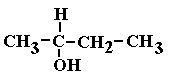


 To SEARCH
▲ENTER▲
chemistry words e.g. topic, module, formula, compound, reaction,
structure, concept, equation, 'phrase', homework question! anything
of chemical interest! This is a very comprehensive Google
generated search of my website.
All website content © Dr Phil Brown 2000+ of
Doc Brown's Advanced Level pre-university Organic Chemistry of haloalkane
halogenoalkane compounds
To SEARCH
▲ENTER▲
chemistry words e.g. topic, module, formula, compound, reaction,
structure, concept, equation, 'phrase', homework question! anything
of chemical interest! This is a very comprehensive Google
generated search of my website.
All website content © Dr Phil Brown 2000+ of
Doc Brown's Advanced Level pre-university Organic Chemistry of haloalkane
halogenoalkane compounds