|
GCSE level organic chemistry exam revision notes: INDEX of all my OIL PRODUCTS and ORGANIC CHEMISTRY NOTES [Author © Dr Phil Brown PhD: Doc Brown's chemistry exam revision notes on oil products & organic chemistry, suitable for students of UK GCSE Science level AQA, Edexcel, OCR, WJEC and CCEA GCSE chemistry courses, ~US grades 9-10 chemistry [page updated Mar 16th 2026 *]
All my GCSE level chemistry revision notes All my advanced A level organic chemistry notes email doc brown - comments - query? * [privacy policy, cookies and disclaimer] Index of Oil and Organic Chemistry Pages (for GCSE, IGCSE and O Level students)
1.
FOSSIL FUELS,
coal, oil, natural gas and peat and the Carbon Cycle
2.
Fractional distillation of crude
OIL and the uses of refined fractions,
what is a good fuel?
3.
ALKANES: saturated hydrocarbons, structure, names, combustion,
reacts with chlorine
5. ALKENES - unsaturated hydrocarbons
-
reaction with bromine & hydrogen
6. CRACKING
- a problem of supply and demand, other products
7A-G. Addition polymers: poly(ethene), poly(propene), polystyrene, PVC, PTFE, structure & uses
7H-J.
More on the
uses of plastics, issues with using plastics, solutions & recycling
methods
8. Why so many series of organic compounds?
- homologous series
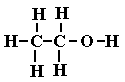
9a. Alcohols, Ethanol, manufacture,
physical properties & chemical reactions
AND 9b.
Biofuels & alternative fuels,
hydrogen, biogas, biodiesel
10a. Carboxylic acids - molecular
structure, chemistry and
uses
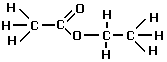
AND 10b. Esters, chemistry and uses
including perfumes, solvents
11. Condensation polymers, Nylon, Terylene/PET, comparing thermoplastics, fibres, thermosets
12. Natural molecules - carbohydrates
- sugars - polymers - starch and DNA
13. Amino
acids, proteins, polypeptides, enzymes & chromatography
14. Natural vegetable oils,
fats, margarine, emulsions and soaps
15. Vitamins,
drugs, medicines, E numbers, food additives, cooking
chemistry!
16. Ozone depletion,
CFC's and free radicals
O3
'Easy' Oil and Organic Chemistry gap-fill worksheets (originally written for previous GCSE courses, but still useful) Word-fill quiz "Origin of Crude Oil" Word-fill quiz "Crude Oil and its Fractional distillation" Word-fill quiz "Getting products from crude oil" Word-fill quiz "The Uses of the Fractions from Crude Oil" Word-fill quiz "More on hydrocarbon molecules" Word-fill quiz "The uses of the fractions from crude oil and pollution problems" Word-fill quiz "The chemistry of burning fossil fuels" Word-fill quiz "Air pollution chemistry and burning fossil fuels" Word-fill quiz "Reducing air pollution from power stations" Word-fill quiz "Reducing air pollution from cars" Word-fill quiz "Burning Fossil Fuels and Environmental Problems" Word-fill quiz "Making Alcohol and Uses of Alcohol" Word-fill quiz "Useful Products - Food Additives" Word-fill quiz "Cracking Oil to make Alkanes and Alkenes" Word-fill quiz "Cracking oil fractions and uses of products" Word-fill quiz "Cracking, fuels and polymers" Word-fill quiz "More on uses of products from cracking" Word-fill quiz "Examples of alkanes and alkenes and a test for alkenes" Word-fill quiz "Introduction to Polymers and Plastics" Word-fill quiz "Making and using polymers" Word-fill quiz "Vegetable Oils" Word-fill quiz "Hydrogenated vegetable oil and food additives" AND a BIG crossword puzzle on our oil based economy! (Crossword puzzle answers) Some sections of material science that may overlap with organic chemistry Part 1. General introduction to nanoscience and commonly used terms explained Part 2. NANOCHEMISTRY - an introduction and potential applications Part 3. Uses of Nanoparticles of titanium(IV) oxide, fat and silver Part 4. From fullerenes & bucky balls to carbon nanotubes Part 5. Graphene and Fluorographene Part 6. Cubic and hexagonal boron nitride BN Part 7. Problems, issues and implications associated with using nanomaterials Part 1 CHROMOGENIC MATERIALS - Thermochromic, Photochromic & Electrochromic Materials Part 2 SHAPE MEMORY ALLOYS e.g. Nitinol & Magnetic Shape Memory Alloys Part 3 SHAPE MEMORY POLYMERS, pH and temperature sensitive-responsive polymers, self-healing materials Part 4 LYCRA-SPANDEX Part 5 High performance polymers like KEVLAR Part 6 GORETEX, THINSULATE and TEFLON-PTFE Part 7 PIEZOELECTRIC EFFECT (PIEZOELECTRIC MATERIALS) & PHOTOMECHANICAL MATERIALS Part 8 CARBON FIBRES
Multiple Choice Quizzes and Worksheets
and
ALSO gap-fill ('word-fill') exercises originally written for ...
... AQA GCSE Science
AND
... OCR 21st C GCSE Science
... Edexcel 360 GCSE Science
... each set are interlinked, so clicking on one of the above leads to a sequence of several quizzes
oil products chemistry for syllabus-specifications for students taking the IGCSE/GCSE level chemistry examinations, summary revision notes key points on oil products chemistry for students studying AQA igcse/gcse chemistry notes on oil products chemistry, Edexcel gcse chemistry notes on oil products chemistry, OCR 21st century GCSE chemistry notes on oil products chemistry, OCR gateway GCSE chemistry notes on oil products chemistry, WJEC gcse chemistry notes on oil products chemistry, CCEA gcse chemistry notes on oil products chemistry, CIE Cambridge igcse chemistry, notes on oil products chemistry useful for US grade 9-10 chemistry student courses, Explaining importance of organic chemistry in GCSE level chemistry, What you need to know about organic chemistry for GCSE level chemistry, Explaining use of organic chemistry knowledge in GCSE level chemistry, Examples of organic chemistry explained when studying GCSE level chemistry, What is the significance of organic chemistry in GCSE level chemistry, describing explaining theory of organic chemistry when studying GCSE level chemistry, exam revision notes for organic chemistry, online help for understanding organic chemistry in GCSE chemistry, what do I need to learn about organic chemistry? what do I need to know about organic chemistry for GCSE chemistry exams, how to prepare for questions on organic chemistry in GCSE chemistry examination? |










 GCSE level m/c QUIZ on oil products & organic chemistry
(easier-foundation-level)
GCSE level m/c QUIZ on oil products & organic chemistry
(easier-foundation-level) ALL
my advanced
A Level Organic Chemistry revision notes
ALL
my advanced
A Level Organic Chemistry revision notes


 3 linked easy Oil Products gap-fill quiz worksheets
 Crude Oil and its Fractional distillation
 For searching