|
A-Level organic chemistry exam revision notes on
alcohols
Part 4.
The chemistry of ALCOHOLS - chemical tests described for
primary, secondary
and tertiary alcohols - reagents, methods and observations
[Author
©
Dr Phil Brown PhD:
Doc Brown's advanced level organic chemistry exam revision notes
suitable for students of UK A level chemistry courses & US K12 grade
11, grade 12 and AP honors chemistry courses: The chemistry of
alcohols - chemical tests for alcohols
[alcohols
page updated
April 7th 2026 *]
Email doc
brown query? comment?
*
[privacy policy, cookies
and disclaimer]
All advanced A level organic
chemistry notes
All revision
notes on the chemistry of alcohols
Index of GCSE level Oil - Useful Products
Chemistry Revision Notes
Chemical tests
for primary, secondary and tertiary alcohols
Adapted
from All the tests for
organic functional groups
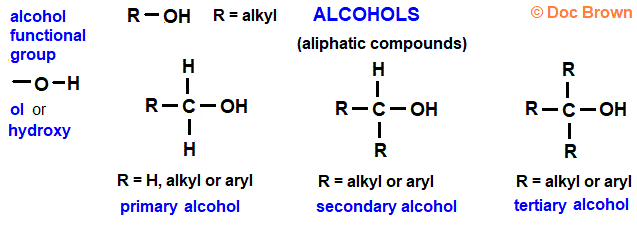 Aliphatic alcohols
Reminders:
You need to know the structures of the sub-classes of alcohols - primary,
secondary and tertiary.
There is no simple test that defines the presence of an alcohol or its sub-class
i.e. primary, secondary or tertiary alcohol.
You need to do several
tests and match the observations with an alcohol and its sub-class.
 Hydroxyl
group R–OH chemical test
in alcohols and phenols
(in 'dry'
conditions*) Hydroxyl
group R–OH chemical test
in alcohols and phenols
(in 'dry'
conditions*)
The first 3 tests (i) – (iii)
given on the right are quite general for most alcohols AND other
substances too!
|
(i)
Mix the dry sample with a few drops of ethanoyl chloride, test fumes with litmus and silver
nitrate (* note ethanoyl chloride reacts with water, phenols and amines too!).
(ii)
Mix the dry sample with a little phosphorus(V)
chloride and test as above.
(iii) Warm with a little
ethanoic acid and a few drops of conc. sulphuric acid. Pour into water
and stir gently.
|
(i)
Fumes
turn litmus red, and a white precipitate with silver nitrate(aq)
(drop on end of glass rod), ammonia fumes give a white cloud of ammonium
chloride, if the mixture is poured into water you may
detect a 'pleasant' ester odour, can test for HCl but water and amines
produce HCl too!
(ii) as for (i) but no ester smell!
(iii) You should get a
'pleasant' characteristic smell of an ester. |
(i)
R–OH
+ CH3COCl ==> CH3COOR +
HCl
An ester and hydrogen chloride are
formed
(ii) R–OH + PCl5 ==> R–Cl +
POCl3 + HCl
a chloro compound and hydrogen chloride
are formed.
(i) and (ii)
Ag+(aq) + Cl–(aq)
==> AgCl(s) from
the hydrogen chloride fumes dissolved in water.
(iii) CH3COOH +
ROH ==> CH3COOR + H2O
Note: Alcohols are distinguished from
carboxylic acids (pH < 7) by being neutral pH 7 - alcohols do not change
blue litmus red, or create effervescence with a pinch of sodium
hydrogencarbonate.
|
|
Primary
alcohol chemical tests
RCH2OH,
R = H, alkyl or aryl (NOT a phenol).
(ii) is not a good test on its own, since so
many other readily oxidisable organic compounds will give the
same reaction, though following it up by testing for an aldehyde gives
it much more validity. |
(i) Lucas test
– shake a few drops with cold zinc chloride in conc. HCl(aq)
(ii) Distil with potassium
dichromate(VI) and mod. conc. H2SO4(aq)
Not very convenient !!! |
(i)
Solution remains
clear.
(ii) If product distilled off
immediately an
aldehyde odour can be detected
and the solution colour changes from orange
to green. |
(i)
Not usually reactive enough to form a primary halogenoalkane
(ii)
R–CH2OH
+ [O] => R–CHO + H2O
or the full works!
3R–CH2OH
+ Cr2O72– + 8H+ ==>
2Cr3+ + 3R–CHO + 7H2O
The orange
dichromate(VI) ion is reduced to the green
chromium(III) ion. If the organic product is collected you could
test for an aldehyde. |
|
Secondary
alcohol chemical tests
R2CHOH,
R = alkyl or aryl.
(ii) is not a good test on its own, since so many other reducible
organic compounds will give the same reaction, though following it up by
testing for a ketone gives it much more validity. |
(i) Lucas test.
(ii) Distil with K2Cr2O7/H2SO4(aq)
Not very convenient !!! |
(i)
Solution may cloud very slowly or remains clear (hit and miss)
(ii) If product distilled off
immediately a
ketone odour can be detected
and the solution colour changes from orange
to green. |
(i)
May be reactive enough to slowly form an insoluble secondary
halogenoalkane:
R2CHOH
+ HCl => R2CHCl + H2O
(ii)
R2CHOH
+
[O] => R–CO–R + H2O
or the full works!
3R2CHOH
+ Cr2O72– + 8H+ ==>
2Cr3+ + 3R–CO–R + 7H2O
The orange dichromate(VI) ion is reduced to
the green chromium(III) ion. If the organic
product is collected you could test for an aldehyde. |
|
Tertiary
alcohol chemical tests
R3COH,
R = alkyl or aryl. |
(i)
Lucas test.
(ii) Distil with K2Cr2O7/H2SO4(aq) Not
very convenient !!! |
(i)
Goes cloudy very quickly.
(ii) No aldehyde or ketone
readily formed, no change from orange to green. |
(i)
Reactive enough to immediately form an
insoluble
tertiary halogenoalkane
R3COH + HCl => R3CCl
+ H2O
(iii)
Stable to modest oxidation.
|
|
Iodoform
test The formation
of CHI3, triiodomethane (or old name 'iodoform'. |
NaOH(aq)
is added to a solution of iodine in potassium iodide solution until most
of the colour has gone. The organic compound is warmed with this
solution. |
A
yellow solid is formed with the smell of an antiseptic, CHI3,
triiodomethane, melting point
119oC. |
This
reaction is given by the primary alcohol ethanol CH3CH2OH
and all secondary alcohols with the 2–ol structure
–CHOH–CH3
BUT, it is also given by the aldehyde ethanal CH3CHO
and all ketones with the 2–one
structure R–CO–CH3 ('methyl ketones')
Its a combination of halogenation and oxidation
and is not a definitive test for anything, it just indicates a possible
part of a molecules structure. |
There is no simple
test that defines the presence of an alcohol or its sub-class i.e. primary,
secondary or tertiary alcohol.
You need to do several
tests and match the observations with an alcohol and its sub-class
In the
iodoform test the primary alcohol first is oxidised to an aldehyde and secondary
alcohols to a ketone
See my
Organic
Chemistry Part 5.7 for more on the chemistry of the iodoform test
All the tests for
organic functional groups
Website content © Dr Phil Brown 2000+. All
copyrights reserved on revision notes, images, quizzes, worksheets etc. Copying
of website material is NOT permitted. Exam revision summaries & references to
A level chemistry course specifications are unofficial.
Website content © Dr Phil Brown 2000+. All
copyrights reserved on these organic chemistry exam revision
notes on chemical tests for alcohols, reagents & equations, these A level chemistry revision notes are suitable for use of pre-university students studying AQA advanced level
organic chemistry revision notes on chemical tests for alcohols,
reagents & equations, Edexcel advanced level
organic chemistry revision notes on chemical tests for alcohols,
reagents & equations, OCR advanced level
organic chemistry revision notes on chemical tests for alcohols,
reagents & equations, IB advanced level
organic chemistry revision notes on chemical tests for alcohols,
reagents & equations, WJEC (Eduqas) advanced level
organic chemistry revision notes on chemical tests for alcohols,
reagents & equations, CIE Cambridge advanced level
organic chemistry revision notes on chemical tests for alcohols,
reagents & equations, CCEA advanced level
organic chemistry revision notes on chemical tests for alcohols,
reagents & equations, and useful for US grade 11 grade 12 AP honors organic
chemistry courses involving chemical tests for alcohols, reagents & equations
Explaining the importance of chemical tests for
alcohols, reagents & equations
in organic chemistry, What you need to know about chemical tests for
alcohols, reagents & equations for organic
chemistry,
Explaining the use of chemical tests for alcohols, reagents & equations knowledge in organic chemistry, Examples of
chemical tests for alcohols, reagents & equations explained
when studying organic chemistry, What is
the significance of chemical tests for alcohols, reagents & equations in organic chemistry, What is the use of
chemical tests for alcohols, reagents & equations
in organic chemistry Describing and
explaining the theory of chemical tests for alcohols, reagents &
equations when studying organic chemistry, exam revision
notes for chemical tests for alcohols, reagents & equations in exams, online help for
chemical tests for alcohols, reagents & equations, revision notes for chemical
tests for alcohols, reagents & equations,
what do I need to learn for chemical tests for alcohols, reagents &
equations in exams? revision summary for chemical tests for alcohols, reagents &
equations, help in
teaching chemical tests for alcohols, reagents & equations, learning notes for
chemical tests for alcohols, reagents & equations, help to pass the chemical
tests for alcohols, reagents & equations exam, how to
prepare for examination questions on chemical tests for alcohols,
reagents & equations?
|
