|
Part 2.
The chemistry of
ALKENES -
USES of these unsaturated hydrocarbons as a chemical
feedstock for many products
[Author
© Dr
Phil Brown PhD: Doc
Brown's exam revision notes suitable
for A level chemistry students of advanced pre-university/college advanced level organic chemistry courses:
alkenes revision
notes on their uses and occurrence of C=C bond in biological
molecules
[alkenes page updated April
2nd 2026 *]
email doc
brown
*
[privacy, cookies and
disclaimer]
ALL my advanced A
level organic
chemistry revision notes
My advanced A level organic
chemistry index of notes on alkenes
Index of GCSE level Oil - Useful Products
Chemistry Revision Notes
2.9
The uses of alkenes (an important
chemical feedstock) and the occurrence of the alkene functional group in 'biological' molecules
and their uses
Alkenes from the petrochemical oil industry
are rarely used directly, but they are important starting materials
to make lots of useful chemicals in the chemical and pharmaceutical
industries.
2.9A
EXAMPLES of the industrial
importance of alkenes (many already described on other
pages)
Apart from
industrial manufacturing processes, a direct use of
ethene gas itself
The only one I can think of is the
use of ethene gas to control the ripening of fruit.
It gets a mention in
Hormone control of plant growth and uses of plant hormones
(school biology notes)
Manufacture of addition polymers - poly(alkenes)
Already dealt with on three other
of my web pages.
Addition polymers - plastics e.g.
poly(ethene) and PVC, manufacture and uses
Problems
with using polymers, recycling, biodegradable plastics
The
polymerisation of alkenes to
form addition polymers - structure, properties, uses of
poly(alkene) polymers (extra notes for advanced level
chemistry students)
Stereoregular polymers -
isotactic/atactic/syndiotactic poly(propene) (extra
advanced notes)
Alkenes are used
as the monomer unit from which addition polymers are manufactured e.g.
Ethene makes poly(ethene).
Ethene is converted to phenylethene (styrene) to
make poly(phenylethene), polystyrene.
Ethene is converted to
chloroethene (vinyl chloride) to make poly(chloroethene) PVC.
Chloroethene, the monomer for producing
poly(chloroethene), PVC, is made in two stages from ethene, which
originates from cracking oil fractions. In this case the haloalkane is
an intermediate compound.
ethene + chlorine == (1) =>
1,2-dichloroethane == (2) ==> chloroethene +
hydrogen chloride
H2C=CH2 + Cl2
===> ClH2CCH2Cl ===> H2C=CHCl
+ HCl
Stage (1) This addition
reaction catalysed by iron(III) chloride (FeCl3) and
is exothermic.
Stage (2) Is
a thermal decomposition and elimination reaction, 500oC
and at high pressure (1.5 to 3.0 MPa (15 - 30 atm) and is a very
endothermic reaction.
The
anhydrous hydrogen chloride formed can be used to make other
chloroalkanes or chloroalkenes, or dissolved in water to make
hydrochloric acid.
Ethane-1,2-diol (see below - antifreeze
manufacture) is also used to manufacture Terylene, a
polyester and a condensation polymer.
For details see
The manufacture, molecular structure, properties and uses of
polyesters
Manufacture of alcohols
See Part 2.6
The reaction of alkenes with steam synthesis of alcohols
Alcohols: including ethanol production and uses of alcohols
Ethanol as a fuels
Alcohols are used solvents and
manufacturing esters - the latter uses range from flavourings, odours
and drugs in the pharmaceutical industry.
Antifreeze
Anti-freeze liquid for motor vehicles contains
ethane-1,2-diol (ethylene glycol) which is made via a two
stage synthesis from ethene.
 ===>
===>
 ===>
===>

Stage 1: Ethene is mixed with air or oxygen and
passed over a catalyst (finely divided silver on an inert support such
as alumina) at 520-550 K and under 15-20 atmospheres pressure to make
epoxyethane
Note another example of a
transition metal catalyst, silver is in the 4d block below copper.
Stage 2: Epoxyethane is catalytically hydrolysed with
water to give ethane-1,2-diol
Ethane-1,2-diol is also used to manufacture
Terylene, a polyester and a condensation polymer.
For details see
The manufacture, molecular structure, properties and uses of
polyesters
Solvents
Many chloroalkanes are used as
solvents.
e.g. 1,2-dichloroethane is used as a
degreaser and paint remover.
Other miscellaneous examples of the uses of
specific alkenes.
Ethene H2C=CH2 is the starting molecule for
the manufacture of ethanoic acid, used in vinegar and many
organic syntheses e.g. making ethanoate esters.
2-methylbut-1-ene
CH3CH2C(CH3)=CH2 is
2-methylbut-2-ene
(2-methyl-2-butene)
(CH3)2C=CHCH3
is
3-methylbut-1-ene
(3-methyl-1-butene) is
9B Alkenes or the alkene functional group in biological molecules.
The C=C double bond occurs in many naturally occurring molecules - many of
great use to us!
A few
EXAMPLES from thousands of organic molecules in living organisms
 Terpenes Terpenes
Some
alkene hydrocarbons such as limonene smell good are used to give
pleasant aromas to such
things as candles and cleaning products.
Limonene
belongs to a group of unsaturated hydrocarbons called terpenes (terpenoids).
They are found
in plants producing natural oils with a variety of odours, some pleasant,
others not so pleasant.
One form of limonene can
be extracted from citrus fruits by steam distillation.
It has two
C=C double bonds and will add two bromine molecules per limonene
molecule.
It exhibits
R/S stereoisomerism - the bottom
carbon of the hexagon ring is chiral - four different groups attached to it.
Carotenes
- naturally synthesised in plants
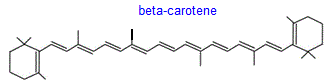

Now this is what you call a 'real'
unsaturated hydrocarbon molecule with 11 C=C double bonds!
Beta-carotene (C40H56) is synthesised in
plants from eight 2-methylbuta-1,3-diene (2-methyl-1,3-butadiene,
isoprene) units C5H8.
The middle 9 C=C bonds are
connected in the E E/Z stereoisomerism conformation (trans positions).
Beta-carotene is a
red-orange pigment found in plants and fruits, especially carrots and
colourful vegetables.
The name beta-carotene comes from the Greek “beta”
and Latin “carota” (carrot).
Beta-carotene is the yellow/orange pigment that gives
vegetables and fruits some of their rich colours.
The human body
converts beta-carotene into vitamin A (retinol), so beta carotene is a
precursor of vitamin A.
We all need vitamin A for healthy skin and mucus
membranes, our immune system, and good eye health and vision
- but it doesn't mean you can see in the dark!.
TOP OF PAGE
Unsaturated oils
and fats - hydrogenation and margarine

The term 'unsaturated' when applied to
oils and fats tells you the molecule contains at least one C=C double bond.
Unsaturated vegetable oils and more saturated fats (e.g.
butter or lard) are important sources of energy in our diet.

In the two diagrams above, you can see the basic difference between
an unsaturated vegetable oil and a saturated fat molecule, due to the presence or
absence of C=C double bonds.
They illustrate the general structure
for all naturally occurring triglyceride esters.
The manufacture of margarine
Margarine is manufactured as a butter
substitute and is made from animal or vegetable fats mixed with skimmed
milk and salt.
Animal fats and vegetable oils a
re primarily made up of triglyceride molecules illustrated above
with different degrees of unsaturation due to the presence one or
more C=C double bonds in the long chains of the glycerol ester
molecules.
Margarine has become more popular
because it is supposed to be more healthy than the animal fats in butter
which is much higher in saturated fats.
Margarine has high content of
mono and polyunsaturated fats which are supposed to be more healthy
than saturated fats, and they are often obtained from olive,
rapeseed and sunflower oils
However, unsaturated vegetable oils
are liquid at room temperature and not very spreadable on foods such as
bread. Using hydrogenation
and a nickel catalyst, adding hydrogen across a C=C double bond,
unsaturated oils/fats can be converted to more saturated molecules that
are soft and spreadable solid at room temperature.
The hydrogenation produces more saturated
molecules between which the intermolecular forces are slightly increased
- sufficient to increase the softening point by a few degrees.
By varying the degree of hydrogenation, varying the
number of C=C bonds remaining, you can produce a range of margarines
with different softening points - the point at which the margarine
hardens and solidifies.
However, in the process of hydrogenation, some of the cis/Z linkages are
'isomerised' into trans/E linkages as a by-product and 'trans-fats' are
supposed to be less healthy in our diet (see the first triglyceride
diagram).
For more on oils, fats and hydrogenation see
alkenes section 2.5
Test for unsaturation in fats and oils
If you shake a vegetable oil or saturated animal fat
with bromine water or bromine in a solvent like hexane, the unsaturated vegetable oil will decolourise the
bromine water and a saturated fat will not.
For more details of this
reaction see section 2.4)
 Cholesterol Cholesterol
Chemically, cholesterol,
which contains the
alcohol group –OH, is classed as a sterol, a sub–group of organic molecules called
steroids.
Cholesterol is an essential steroid–sterol to humans but if
too much is produced or ingested in food, it can cause heart disease e.g.
hardening of arteries.
The image on the left gives the skeletal formula structure of cholesterol
and shows it to contain one C=C alkene double bond as well as the hydroxy group.
[Cholesterol
image from NIST]
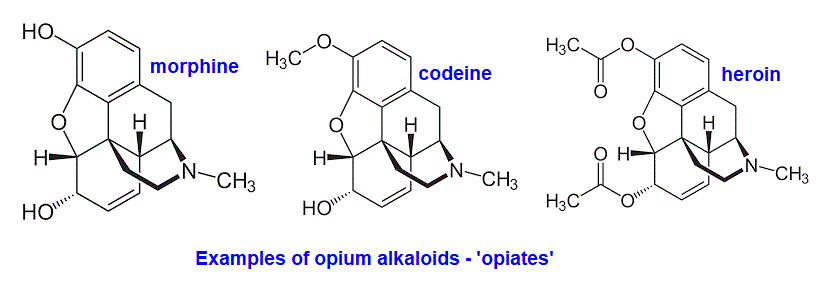
The opiate drugs morphine, codeine and heroin
contain an alkene group to the bottom of the molecule.
Don't confuse with the presence of the benzene ring
(written in Kekule style) at the top of the molecule with the alkene
functional group.
|
Website content © Dr
Phil Brown 2000+. All copyrights reserved on Doc Brown's Chemistry, revision notes, images,
quizzes, worksheets etc. Copying of website material is NOT
permitted. Doc Brown's organic chemistry of alkenes exam
Explaining the importance of alkenes as a chemical
feedstock for synthesising compounds
in organic chemistry, What you need to know about alkenes as a chemical
feedstock for synthesising compounds for organic
chemistry,
Explaining the use of alkenes as a chemical feedstock for synthesising
compounds knowledge in organic chemistry, Examples of alkenes as a chemical
feedstock for synthesising compounds explained
when studying organic chemistry, What is
the significance of alkenes as a chemical feedstock for synthesising
compounds in organic chemistry, What is the use of alkenes as a chemical
feedstock for synthesising compounds
in organic chemistry Describing and
explaining the theory of alkenes as a chemical feedstock for
synthesising compounds when studying organic chemistry, exam revision
notes for alkenes as a chemical feedstock for synthesising compounds in exams, online help for
alkenes as a chemical feedstock for synthesising compounds, revision notes for
alkenes as a chemical feedstock for synthesising compounds,
what do I need to learn for alkenes as a chemical feedstock for
synthesising compounds in exams? revision summary for alkenes as a chemical
feedstock for synthesising compounds, help in
teaching alkenes as a chemical feedstock for synthesising compounds, learning notes for
alkenes as a chemical feedstock for synthesising compounds, help to pass the
alkenes as a chemical feedstock for synthesising compounds exam, how to
prepare for examination questions on alkenes as a chemical feedstock for
synthesising compounds?
Website content © Dr Phil Brown 2000+. All
copyrights reserved on revision notes, images, quizzes, worksheets etc. Copying
of website material is NOT permitted. Exam revision summaries & references to
science course specifications are unofficial.
Website content © Dr Phil Brown 2000+. All
copyrights reserved on these organic chemistry exam revision
notes on uses of alkenes, these A level chemistry revision notes are suitable for use of pre-university students studying AQA advanced level
organic chemistry revision notes on uses of alkenes, Edexcel advanced level
organic chemistry revision notes on uses of alkenes, OCR advanced level
organic chemistry revision notes on uses of alkenes, IB advanced level
organic chemistry revision notes on uses of alkenes, WJEC (Eduqas) advanced level
organic chemistry revision notes on uses of alkenes, CIE Cambridge advanced level
organic chemistry revision notes on uses of alkenes, CCEA advanced level
organic chemistry revision notes on uses of alkenes, and useful for
US grade 11 grade 12 AP honors organic chemistry courses involving uses of
alkenes
index of
advanced notes on alkenes
|
|
