|
Part 7.13
The chemistry of
AROMATIC COMPOUNDS:
Examples of
naturally occurring or manufactured by
the pharmaceutical industry
[Author
© Dr
Phil Brown PhD: Doc
Brown's exam revision notes suitable
for A level chemistry students of advanced pre-university/college advanced level organic chemistry courses:
aromatic
chemistry revision notes on aromatic compounds in nature or produced by the
pharmaceutical industry
[aromatic page updated Mar 7th 2026 *]
email doc
brown - comments - query?
*
[privacy, cookies and disclaimer]
All my advanced level
aromatic chemistry notes
All my advanced A level organic
chemistry notes
Part 7.13
Examples of aromatic compounds from the pharmaceutical industry and
examples of aromatic compounds found in natural
products
Examples of synthetic
aromatic compounds from the pharmaceutical industry

Examples of analgesics -
pain-killers - anti-inflammatory drugs
Acetylsalicylic acid is one
chemical name for the brand
Aspirin.
N-(4-hydroxyphenyl)ethanamide is the IUPAC name for
the brand Paracetamol.
2-(4-(2-methylpropyl)phenyl)propanoic acid is the
IUPAC name for the brand Ibuprofen.

 Phenol is manufactured from benzene by several different processes.
(The details not
required, but you should know the last three reactions in
the synthesis route.)
C6H6
== [O] ==> C6H5OH
 Phenol is nitrated with nitric acid to give mainly 4-nitrophenol
(desired product) and some 2-nitrophenol.
Phenol is nitrated with nitric acid to give mainly 4-nitrophenol
(desired product) and some 2-nitrophenol.
C6H5OH
+ HNO3 ===> O2NC6H4OH
+ H2O
The 2-nitrophenol is removed
by steam distillation to leave mainly 4-nitrophenol.
Note the desired orientation
of the intermediates so that the final product's orientation is
correct.
 The 4-nitrophenol is reduced with hydrogen (Ni catalyst ?) to
4-aminophenol.
The 4-nitrophenol is reduced with hydrogen (Ni catalyst ?) to
4-aminophenol.
O2NC6H4OH
+ 6[H] ===> H2NC6H4OH
+ 2H2O
 4-aminophenol is ethanoylated with ethanoic anhydride to yield
N-(4-hydroxyphenyl)ethanamide aka 'Paracetamol'
4-aminophenol is ethanoylated with ethanoic anhydride to yield
N-(4-hydroxyphenyl)ethanamide aka 'Paracetamol'
H2NC6H4OH
+ (CH3CO)2O ===> CH3CONHC6H4OH
+ CH3COOH
TOP OF PAGE
and sub-index
Examples of naturally occurring aromatic compounds -
the natural occurrence of the benzene ring!
Use of the term 'aromatic' derives from the smell of oil from natural
products - usually 'aromatic' plants.
Today the term refers to compounds containing a benzene ring, fused benzene
rings or other ringed compounds that chemically behave as an aromatic
compound.
Aromatic compounds from the natural world often have a strong pleasing smell
and are naturally found in wine, spices, perfumes, fragrance oils, and
essential oils extracted from plants.
 The
simplest aromatic aldehyde, benzaldehyde (right) smell's of almonds and is a
naturally occurring compound found in bitter almond oil. It is synthesised
by the chemical industry for use in food flavourings and fragrances in the
perfume industry. The
simplest aromatic aldehyde, benzaldehyde (right) smell's of almonds and is a
naturally occurring compound found in bitter almond oil. It is synthesised
by the chemical industry for use in food flavourings and fragrances in the
perfume industry.
Salicin (below) is a naturally found in the bark of willow
and poplar trees. For thousands of years it was known to have a pain-killing
action when ingested, it is an anti-inflammatory agent. The Salicin molecule
consists of a phenol attached by an ether linkage to hexose sugar molecule.

The search for molecules having a similar effect.
Salicylic acid (2-hydroxybenzoic acid) is derived from the metabolism of
Salicin and is used in medical treatment. However, synthetic acetylsalicylic
acid (Aspirin) was found to be a more effective painkiller. Soluble Aspirin
is absorbed more quickly minimising irritating the stomach.
An 'aspirin' related aromatic acid derived molecule is
C8H8O3,
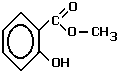 or
or  , methyl
2-hydroxybenzoate. , methyl
2-hydroxybenzoate.
Commonly known as methyl salicylate or 'oil of
wintergreen', a molecule that has mild pain killing properties. This
methyl ester of salicylic acid is a colourless, viscous liquid
with a sweet, fruity minty odour and used in mint candies. It is
produced by many species of plants, particularly wintergreens, from
which it can be obtained by distillation. These days it is mostly
manufactured synthetically, by esterifying 2-hydroxybenzoic acid with
methanol, and used as a fragrance and flavouring agent.
Many plants produce methyl salicylate in small quantities, often in
response to biotic stress e.g. infection by pathogens, where it plays a
role in the induction of resistance. Methyl 2-hydroxybenzoate is also
released in some plants when they are damaged by herbivorous insects,
where they may function as a cue aiding in the recruitment of predators.
Some plants produce methyl salicylate in larger quantities to aid direct
defence against predators or pathogens

Incidentally, methyl 2-hydroxybenzoate can exhibit both
intermolecular and intramolecular hydrogen bonding.
The same for 2-hydroxybenzoic acid?
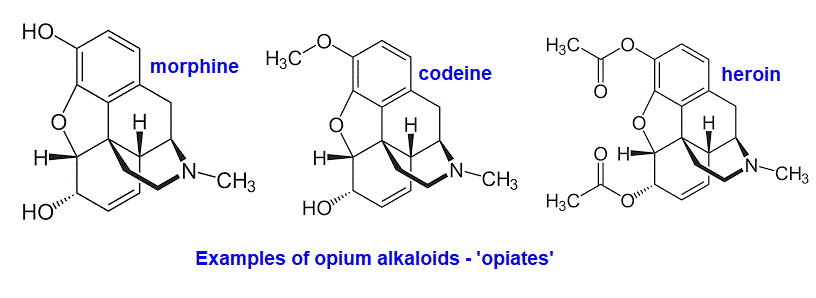
The benzene ring even turns up opiates (a type of alkaloids)
such as naturally occurring morphine, codeine and heroin, but these are not
classed as aromatic compounds.
For
more on uses see my organic chemistry notes Parts:
7.5
Electrophilic substitution -
ring nitration of benzene and methylbenzene, properties and uses of
nitro-aromatics
7.7
Electrophilic substitution -
ring sulfonation of arenes, properties & uses of
alkylbenzenesulfonic acids
7.9
The physical and chemical
properties of phenol and some of its derivatives and their uses
7.10
Physical & chemical
properties of phenylamine, selected derivatives including diazonium
ions and dyes
7.12
The structure, properties and uses of
polyesters and polyamides involving aromatic monomers
Website content © Dr
Phil Brown 2000+. All copyrights reserved on Doc Brown's Chemistry revision notes, images,
quizzes, worksheets etc. Copying of website material is NOT
permitted. Doc Brown's chemistry of aromatic compounds exam revision notes,
Website content © Dr Phil Brown 2000+. All
copyrights reserved on revision notes, images, quizzes, worksheets etc. Copying
of website material is NOT permitted. Exam revision summaries & references to
science course specifications are unofficial.
Website content © Dr Phil Brown 2000+. All
copyrights reserved on these organic chemistry exam revision
notes on naturally occurring aromatic compounds with a benzene ring, these A level chemistry revision notes are suitable for use of pre-university students studying AQA advanced level
organic chemistry revision notes on naturally occurring aromatic
compounds with a benzene ring, Edexcel advanced level
organic chemistry revision notes on naturally occurring aromatic
compounds with a benzene ring, OCR advanced level
organic chemistry revision notes on naturally occurring aromatic
compounds with a benzene ring, IB advanced level
organic chemistry revision notes on naturally occurring aromatic
compounds with a benzene ring, WJEC (Eduqas) advanced level
organic chemistry revision notes on naturally occurring aromatic
compounds with a benzene ring, CIE Cambridge advanced level
organic chemistry revision notes on naturally occurring aromatic
compounds with a benzene ring, CCEA advanced level
organic chemistry revision notes on naturally occurring aromatic
compounds with a benzene ring, and useful for US grade 11
grade 12 AP honors organic chemistry courses involving
naturally occurring aromatic compounds with a benzene ring
Explaining the importance of
pharmaceutical aromatic compounds with a benzene ring
in organic chemistry, What you need to know about pharmaceutical
aromatic compounds with a benzene ring for organic
chemistry,
Explaining the use of pharmaceutical aromatic compounds with a benzene
ring knowledge in organic chemistry, Examples of
pharmaceutical aromatic compounds with a benzene ring explained
when studying organic chemistry, What is
the significance of pharmaceutical aromatic compounds with a benzene
ring in organic chemistry, What is the use of pharmaceutical
aromatic compounds with a benzene ring
in organic chemistry Describing and
explaining the theory of pharmaceutical aromatic compounds with a
benzene ring when studying organic chemistry, exam revision
notes for pharmaceutical aromatic compounds with a benzene ring in exams, online help for
pharmaceutical aromatic compounds with a benzene ring, revision notes for
pharmaceutical aromatic compounds with a benzene ring,
what do I need to learn for pharmaceutical aromatic compounds with a
benzene ring in exams? revision summary for pharmaceutical
aromatic compounds with a benzene ring, help in
teaching pharmaceutical aromatic compounds with a benzene ring, learning notes for
pharmaceutical aromatic compounds with a benzene ring, help to pass the
pharmaceutical aromatic compounds with a benzene ring exam, how to
prepare for examination questions on pharmaceutical aromatic compounds
with a benzene ring?
[SEARCH
BOX]
All my advanced level
aromatic chemistry revision notes
All my advanced A level organic
chemistry notes |
|
