|
Part 3.
The chemistry of HALOGENOALKANES - reaction of haloalkanes with cyanide ion -
nucleophilic substitution
[Author
© Dr
Phil Brown PhD: Doc
Brown's exam revision notes suitable
for A level chemistry students of advanced pre-university/college level organic chemistry courses:
revision notes on
haloalkanes - reaction with cyanide ion
[haloalkane page updated Mar 23rd 2026 *]
3.5 The reaction
between halogenoalkanes and potassium cyanide - another nucleophilic
substitution reaction to produce a nitrile
Sub-index for this page
3.5.1
The reaction between potassium cyanide and
halogenoalkanes to give a nitrile product
3.5.2
The hydrolysis of nitriles to give carboxylic
acids
3.5.3
The SN1 nucleophilic
substitution mechanism of halogenoalkanes and cyanide ion
3.5.4
The SN2
nucleophilic substitution mechanism of halogenoalkanes and cyanide ion
See also
Nucleophilic
substitution by cyanide ion to give a nitrile
[SN1 or SN2]
(written before the above pages)
email
doc brown - comments - query?
*
[privacy, cookies and disclaimer]
All
my advanced A level organic chemistry notes
All
my advanced A level HALOALKANE chemistry notes
Index
of GCSE level oil and basic organic chemistry notes
3.5.1 The nucleophilic substitution reaction between potassium cyanide and
halogenoalkanes to synthesise nitriles
Halogenoalkanes were once known
as 'haloalkanes' or 'alkyl halides', but the correct IUPAC
nomenclature is based on calling halogenated alkanes
halogenoalkanes.
However, it seems ok to refer to
chloroalkanes, bromoalkanes and iodoalkanes.
I've written the
equations for the reactions showing the formation of nitriles from
the halogenoalkane in multiple styles and added the nucleophilic
substitution mechanisms where appropriate.
I've often added the boiling point (bpt) so can see
what is a liquid and could be hydrolysed in a school/college
laboratory.
Strictly speaking all the reactants and products
should be suffixed by (aq) apart fro water (l).

You must know the structures of
primary, secondary and tertiary halogenoalkanes (haloalkanes)
 This
is an important reaction for extending a carbon chain and a method of
synthesising carboxylic acids. This
is an important reaction for extending a carbon chain and a method of
synthesising carboxylic acids.
A nitrile
functional group replaces the halogen atom in the halogenoalkane:
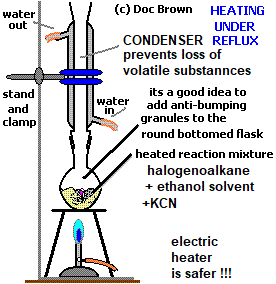
The halogenoalkane is refluxed with an ethanolic
solution of potassium cyanide.
The cold water cooled Liebig vertical condenser
prevents the loss of volatile molecules e.g. solvent or product.
It is better to use ethanol as the solvent rather than
water to avoid hydrolysis to an alcohol i.e. -X replaced with -OH.
R-X +
KCN ===> R-CN + KX
(R = alkyl, X =
halogen)
R-X +
CN- ===> R-CN + X-
(ionic equation)
The cyanide ion is a nucleophile,
an electron pair donor,
N≡C:-
(a)
The reaction between potassium cyanide and
bromoethane
Strictly speaking all the reactants and products
should be suffixed by (aq)
bromoethane + potassium cyanide
===> propanenitrile + potassium bromide
 + KCN
+ KCN

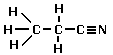 + KBr (displayed formula
equation)
+ KBr (displayed formula
equation)
Since the cyanide and bromide are free ions,
the equations are better written as ...
bromoethane + cyanide ion ===>
propanenitrile + bromide ion
+ CN–
+ Br–
(displayed formula equation)
 + CN–
+ CN–
 + Br–
+ Br–
(structured formula equation)
 + CN–
+ CN–
 + Br–
+ Br–
(abbreviated structured formula equation)
 + CN–
+ CN–
 + Br–
+ Br–
(skeletal formula equation)
This is an important synthesis reaction
because it is one of the few methods of increasing the length of the carbon
chain
(b)
The reaction between 2-bromopropane
(bpt 59oC) and potassium cyanide
2-bromopropane + cyanide ion
===> 2-methylpropanenitrile + bromide ion
CH3CHBrCH3
+ CN–
(CH3)2CHC≡N
+ Br-
TOP OF PAGE
and sub-index
3.5.2 The hydrolysis of nitriles to give carboxylic acids
The
hydrolysis of the resulting nitriles e.g. propane nitrile
If the nitrile is refluxed with dilute
hydrochloric/sulfuric acid or sodium hydroxide (strong base - alkali) the
corresponding carboxylic acid or its sodium salt is formed.
The hydrolysis with pure water is to
slow, but the reaction is speeded up by a strong acid or strong alkali.
Strictly speaking all the reactants and products
should be suffixed by (aq)
(i) Equations for the dilute mineral acid hydrolysis of a nitrile to give the
free (weaker) acid
In this case converting
propanenitrile to propanoic acid or its salt, sodium propanoate
+ 2H2O + H+
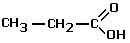 + NH4+
Here the free acid and an ammonium
ion are formed.
(more detailed structured formula hydrolysis equation)
+ 2H2O + H+
 + NH4+
(less detailed structured formula hydrolysis equation)
 + 2H2O + H+
 + NH4+
(skeletal formula hydrolysis equation)
(ii) Equations for the alkaline hydrolysis of a nitrile to give the sodium salt
(if aqueous sodium hydroxide is used), in the equations you write out the
product as the carboxylate anion.
In this case converting
propanenitrile to its salt, e.g. sodium propanoate
+ H2O + OH-
 + NH3
+ NH3
Here the carboxylate anion
(propanoate ion) and free ammonia are formed.
(structured formula hydrolysis equation)
+ H2O + OH-
 + NH3
+ NH3
(abbreviated structured formula hydrolysis equation)
+ H2O + OH-
 + NH3
+ NH3
(skeletal formula hydrolysis equation)
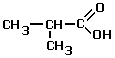  The
hydrolysis of 2-methylpropanenitrile The
hydrolysis of 2-methylpropanenitrile
2-methylpropanenitrile
=== hydrolysis ===> free 2-methylpropanoic acid (shown on right) or its salt
(CH3)2CHC≡N
+ 2H2O + H+
(CH3)2CHCOOH + NH4+
(acid hydrolysis, free acid)
(CH3)2CHC≡N
+ H2O + OH-
(CH3)2CHCOO- + NH3
(alkaline hydrolysis, salt of acid)
TOP OF PAGE
and sub-index
3.5.3 The SN1 nucleophilic
substitution mechanism of halogenoalkanes and cyanide ion
Remember:
A neutral or negative
nucleophile, Nuc: or Nuc:-, is an
electron pair donor that can attack an electron deficient partially/wholly
positive carbon atom to form a new C-Nuc bond.

Mechanism diagram 36 shows the general
pathway for the SN1 unimolecular nucleophilic substitution
reaction of halogenoalkanes where a cyanide ion (the nucleophile, electron
pair donor) displaces a halide ion via a carbocation.
chlorine and iodine
The SN1 unimolecular
mechanism is favoured by tertiary halogenoalkanes.
SN1
unimolecular, a
two step ionic mechanism via
carbocation formation
[mechanism
1 above]
In step
(1) the
Cδ+-Xδ-
polar bond
of the halogenoalkane splits heterolytically to form a carbocation and a free halide ion (X-, e.g. chloride or
bromide) and this is a reversible reaction.
The C-Br bond is most
likely to break because it is a weaker bond than the C-C or
C-H bond AND breaks heterolytically because of the
difference in electronegativity between carbon (2.5) and bromine
(2.8) giving a polar Cδ+-Brδ-
bond.
So the C-Br bonding pair of
electrons leaves with the Br atom as the Br- ion.
In step
(2) the cyanide ion is a negative electron pair donor
and rapidly combines with the carbocation, forming the C-O bond in the
alcohol product. The cyanide ion is the nucleophile.
Step
(1)
is the rate determining step with the much larger activation energy
(see reaction profile diagram 45
below)
This mechanism
is most likely with tertiary halogenoalkanes.
i.e. the mechanism is the same for
tertiary chloroalkanes or iodoalkanes.
Primary halogenoalkanes tend to react by the SN2 mechanism
NOT involving a carbocation.
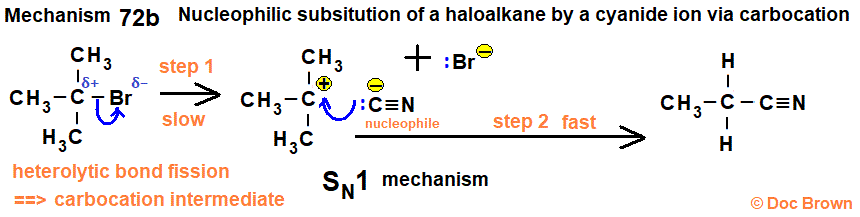
Mechanism diagram 72b shows the SN1
unimolecular nucleophilic substitution reaction of 2-bromo-2-methylpropane
where a cyanide ion displaces a bromide ion via a carbocation.
2-bromo-2-methylpropane +
cyanide ion ===> 2,2-dimethylpropanenitrile +
bromide ion
(CH3)3C-Br
+ :C≡N-
===> (CH3)3C-C≡N
+ :Br-
The unimolecular SN1
mechanism is favoured by tertiary halogenoalkanes like
2-bromo-2-methylpropane.
Secondary
halogenoalkanes react with cyanide ions by both SN1 and SN2
mechanisms.
Secondary
halogenoalkanes react with cyanide ions by both SN1 and SN2
mechanisms.
See also
Nucleophilic
substitution by cyanide ion to give a nitrile
[SN1 or SN2]
(written before the above pages)
AND See
Organic mechanisms Appendix 1 for a detailed discussion on
The
structure, relative stability and theory of carbocations
(separate page)
TOP OF PAGE
and sub-index
3.5.4 The SN2 nucleophilic substitution
mechanism of halogenoalkanes and cyanide ion
Remember:
A neutral or negative
nucleophile, Nuc: or Nuc:-, is an
electron pair donor that can attack an electron deficient partially/wholly
positive carbon atom to form a new C-Nuc bond.

SN2
'bimolecular', a
one step bimolecular collision mechanism
[mechanisms 34]
The Cδ+-Brδ-
bond is polar
because of the difference in electronegativity between carbon (2.5)
and bromine (3.0), so the electron rich nucleophile, the
cyanide ion, attacks the slightly positive carbon.
The nucleophile
acts as an electron pair donor (Lewis base) to bond with the
Cδ+
carbon to make the C-O bond in the newly formed C-CN nitrile group.
Simultaneously
the bromine atom is ejected,
taking with it the C-Br bond pair, so forming the bromide ion on
expulsion.
This mechanism
is most likely with primary halogenoalkanes.
i.e. the mechanism is the same for
primary chloroalkanes or iodoalkanes.
Tertiary halogenoalkanes tend to react by the SN1 mechanism
involving a carbocation, secondary halogenoalkanes react via both
mechanisms.

Mechanism diagram 72a shows the
bimolecular SN2 nucleophilic substitution of bromoethane by the
cyanide ion.
Note the 'transition
state' or 'activated complex' carries a negative sign because of the
negative charge of the cyanide ion.
The SN2 bimolecular mechanism is favoured by
primary halogenoalkanes such as bromoethane.
Secondary
halogenoalkanes react with cyanide ions by both SN1 and SN2
mechanisms.
See also
Nucleophilic
substitution by cyanide ion to give a nitrile
[SN1 or SN2]
(written before this page)
AND See
Organic mechanisms Appendix 1 for a detailed discussion on
The
structure, relative stability and theory of carbocations
(separate page)
Website content © Dr
Phil Brown 2000+. All copyrights reserved on Doc Brown's Chemistry revision notes, images,
quizzes, worksheets etc. Copying of website material is NOT
permitted.
Website content © Dr Phil Brown 2000+. All
copyrights reserved on revision notes, images, quizzes, worksheets etc. Copying
of website material is NOT permitted. Exam revision summaries & references to
science course specifications are unofficial.
Website content © Dr Phil Brown 2000+. All
copyrights reserved on these organic chemistry exam revision
notes on reaction between potassium cyanide and haloalkanes to synthesise
nitriles, these A level chemistry revision notes are suitable for use of pre-university students studying AQA advanced level
organic chemistry revision notes on reaction between potassium
cyanide and haloalkanes to synthesise nitriles, Edexcel advanced level
organic chemistry revision notes on reaction between potassium
cyanide and haloalkanes to synthesise nitriles, OCR advanced level
organic chemistry revision notes on reaction between potassium
cyanide and haloalkanes to synthesise nitriles, IB advanced level
organic chemistry revision notes on reaction between potassium
cyanide and haloalkanes to synthesise nitriles, WJEC (Eduqas) advanced level
organic chemistry revision notes on reaction between potassium
cyanide and haloalkanes to synthesise nitriles, CIE Cambridge advanced level
organic chemistry revision notes on reaction between potassium
cyanide and haloalkanes to synthesise nitriles, CCEA advanced level
organic chemistry revision notes on reaction between potassium
cyanide and haloalkanes to synthesise nitriles, and useful for US grade 11 grade
12 AP honors organic chemistry courses involving reaction between potassium
cyanide and haloalkanes to synthesise nitriles.
Explaining the importance of mechanism of
nucleophilic substitution of haloalkanes by cyanide ion
in organic chemistry, What you need to know about mechanism of
nucleophilic substitution of haloalkanes by cyanide ion for organic
chemistry,
Explaining the use of mechanism of nucleophilic substitution of
haloalkanes by cyanide ion knowledge in organic chemistry, Examples of mechanism
of nucleophilic substitution of haloalkanes by cyanide ion explained
when studying organic chemistry, What is
the significance of mechanism of nucleophilic substitution of
haloalkanes by cyanide ion in organic chemistry, What is the use of mechanism of
nucleophilic substitution of haloalkanes by cyanide ion
in organic chemistry Describing and
explaining the theory of mechanism of nucleophilic substitution of
haloalkanes by cyanide ion when studying organic chemistry, exam revision
notes for mechanism of nucleophilic substitution of haloalkanes by
cyanide ion in exams, online help for mechanism of nucleophilic substitution of
haloalkanes by cyanide ion, revision notes for mechanism of nucleophilic
substitution of haloalkanes by cyanide ion,
what do I need to learn for mechanism of nucleophilic substitution of
haloalkanes by cyanide ion in exams? revision summary for mechanism of
nucleophilic substitution of haloalkanes by cyanide ion, help in
teaching mechanism of nucleophilic substitution of haloalkanes by
cyanide ion, learning notes for mechanism of nucleophilic substitution of
haloalkanes by cyanide ion, help to pass the mechanism of nucleophilic
substitution of haloalkanes by cyanide ion exam, how to
prepare for examination questions on mechanism of nucleophilic
substitution of haloalkanes by cyanide ion?
|
 To SEARCH ENTER
chemistry words e.g. topic, module, formula, compound, reaction,
structure, concept, equation, 'phrase', homework question! anything
of chemical interest! This is a very comprehensive Google
generated search of my website.
All website content © Dr Phil Brown 2000+ of
Doc Brown's Advanced Level pre-university Organic Chemistry of haloalkane
halogenoalkane compounds
To SEARCH ENTER
chemistry words e.g. topic, module, formula, compound, reaction,
structure, concept, equation, 'phrase', homework question! anything
of chemical interest! This is a very comprehensive Google
generated search of my website.
All website content © Dr Phil Brown 2000+ of
Doc Brown's Advanced Level pre-university Organic Chemistry of haloalkane
halogenoalkane compounds