|
Part 3.7
The chemistry of HALOGENOALKANES - ELIMINATION REACTIONS of haloalkanes
[Author
© Dr
Phil Brown PhD: Doc
Brown's exam revision notes suitable
for A level chemistry students of advanced pre-university/college level organic chemistry courses:
revision notes on
elimination reactions of haloalkanes
[haloalkane page updated Mar 23rd 2026 *]
3.7 Elimination reactions of halogenoalkanes
(haloalkanes)
Sub-index for this page on
the hydrogen halide elimination reaction of haloalkanes
3.7.1
The hydrogen halide elimination reactions of halogenoalkanes
(haloalkanes)
3.7.2 Factors favouring a particular product where
isomers are possible and the method procedure
3.7.3
Examples of
elimination reactions of halogenoalkanes using potassium
hydroxide and mechanisms
email
doc brown - comments - query?
*
[privacy, cookies and disclaimer]
All
my advanced A level organic chemistry notes
All
my advanced A level HALOALKANE chemistry notes
Index
of GCSE level oil and basic organic chemistry notes
3.7.1 The hydrogen halide elimination reactions of halogenoalkanes
(haloalkanes)
The formation of alkenes by the
strong base action on haloalkanes - dehydrohalogenation and
comparing the reactivity trends with the unavoidable concurrent
nucleophilic substitution reaction
I've often added the boiling point (bpt) so can see
what is a liquid and could be hydrolysed in a school/college
laboratory.
Strictly speaking the reactants and products
should be suffixed by (aq) apart from water (l).

You must know the structures of
primary, secondary and tertiary halogenoalkanes (haloalkanes)
Introduction
An elimination reaction is when two
atoms, or one atom and a small group, are removed from adjacent carbon atoms
to form an unsaturated compound like an alkene.
In this case you must have a
hydrogen atom on one carbon atom adjacent to another carbon to which a
halogen atoms is attached to get elimination of
HX.
R2CH-CXR2,
X = halogen atom, and you are more likely to get elimination
when X is bromine or iodine, much less likely with chlorine and very
unlikely for fluorine.
For halogenoalkanes the general reaction is:
R2CX-CHR2
+ MOH ===> R2C=CR2 + MX
+ H2O
ionically with state symbols:
R2CX-CHR2
+ OH- ===> R2C=CR2
+ X-
+ H2O
X = halogen, R = H, alkyl or
aryl, M = Na, K etc. The elimination change is highlighted in blue.
This reaction is also known as the dehydrohalogenation of
haloalkanes.
This can
theoretically happen with any halogenoalkane apart from the methyl
haloalkanes (CH3X),
but, the yields are often very low, depending on
the reaction conditions and sub-class of haloalkane.
Don't forget about the con-current
substitution reaction:
R2CX-CHR2
+ OH- ===> R2COH-CHR2
+ X-
In this reaction, the action of the
strong
base, e.g. the
hydroxide ion OH-,
is to remove a proton forming water and a halide ion is released at the same time
from an adjacent carbon atom -
Note in this mechanism three
bond pairs shift simultaneously.
The C-H bond pair shifts to create the C=C pi
bond.
A lone pair on the
oxygen atom of the hydroxide ion is donated to the proton.
The C-Br bond pair are transferred to the bromine
atom on the expulsion of a bromide ion.
See the mechanism diagram 26 below
indicating the electron shifts that take place in the formation of an
alkene from a bromoalkane, similar for an equivalent iodoalkane.
(there is an alternative
carbocation mechanism).

This reaction is con-current with the
nucleophilic substitution reaction forming an alcohol.
RCH2X +
OH- ===> RCH2OH + X-
X = halogen e.g. Cl, Br, I and R = H,
alkyl This reaction is fully
described in Halogenoalkanes Part 3.4
Substitution reaction of halogenoalkanes (haloalkanes) with sodium hydroxide to
give alcohols
Which reaction dominates depends on reaction conditions,
reagents and structure of the halogenoalkane.
You need to know these trends
(i.e. likely product)
for the concurrent substitution and elimination reactions
(a) Substitution - the hydroxide ion acting as a
nucleophile
Substitution is favoured by (i)
lower temperature, (ii) dilute aqueous sodium hydroxide and primary
> secondary > tertiary haloalkane.
For (iii) the trend for the 4 isomers of C4H9Br
is below shown e.g. (prim ~ prim > sec > tert)
Likely substitution: CH3CH2CH2CH2-Br
~ (CH3)2CHCH2-Br >
CH3CH2CHBrCH3 > (CH3)3C-Br
(b) Elimination - the hydroxide ion acting as a
strong base
Elimination is favoured by
(i) higher temperature, (ii) concentrated ethanolic (H2O/C2H5OH
mixture) potassium hydroxide and (iii) tertiary >
secondary > primary haloalkane
For (iii) the trend for the 4
isomers of C4H9Br is shown below
e.g. (tert > sec > prim ~ prim)
Likely elimination: (CH3)3C-Br
> CH3CH2CHBrCH3 > (CH3)2CHCH2-Br
~ CH3CH2CH2CH2-Br
TOP OF PAGE
and sub-index
 3.7.2
Factors favouring the orientation of the product where isomers
are possible and the method procedure 3.7.2
Factors favouring the orientation of the product where isomers
are possible and the method procedure
Four factors favouring an
elimination reaction ...
tertiary >
secondary > primary halogenoalkane
Using pure ethanol as
solvent, not water or aqueous ethanol.
Using potassium
hydroxide, the strongest common base.
High concentration
of the strong base.
Reverse these factors to favour substitution !
Reaction conditions:
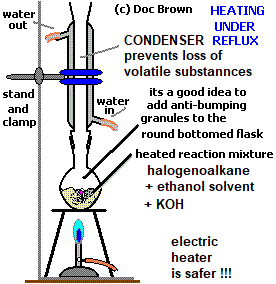
Reflux the
halogenoalkane with potassium hydroxide dissolved in ethanol (ethanolic
potassium hydroxide).
The cold water cooled Liebig vertical
condenser prevents the loss of volatile molecules e.g. solvent
or product.
The elimination reaction is concurrent
with the hydrolysis nucleophilic substitution reaction producing an alcohol.
The percentages of alkene
varies with the four factors mentioned above.
The diagram is common to many
textbooks, but they never say how you can conveniently separate
the alkene! and I don't know either!
TOP OF PAGE
and sub-index
3.7.3
Examples of
elimination reactions of halogenoalkanes using potassium
hydroxide and mechanisms
(1) The elimination reaction between
bromoethane (bpt 36oC) and ethanolic potassium hydroxide
bromoethane + potassium
hydroxide ===> ethene + potassium bromide +
water
 + KOH ===>
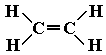 + KBr + H2O
CH3CH2Br + OH-
===> H2C=CH2 + Br-
+ H2O
but even with ethanolic KOH, the yield of ethene is
only 1%, 99% is substitution to give ethanol.
The main reaction is
nucleophilic substitution to give ethanol.
CH3CH2Br + OH-
===> CH3CH2OH + Br-
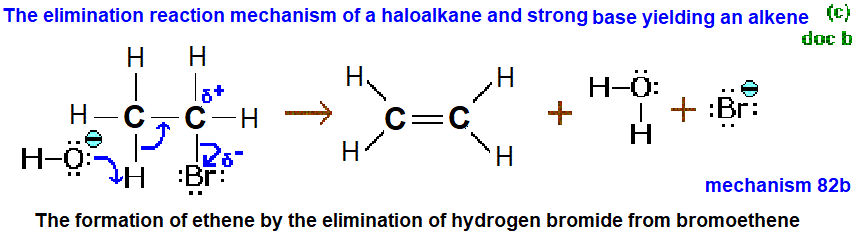
Mechanism 82b:
The reaction mechanism for the
elimination of hydrogen bromide from bromoethane to give ethene.
(2) The elimination reaction between
1-bromopropane (bpt 71oC) or 2-bromopropane (bpt 59oC)
and ethanolic potassium hydroxide
1-bromopropane/2-bromopropane +
potassium hydroxide ===> propene + potassium bromide
+ water
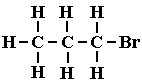 or
or
 + KOH ===>
 + KBr + H2O
CH3CH2CH2Br
or CH3CHBrCH3 + OH-
===> CH3CH=CH2 + Br- + H2O
You get the same product in each case,
but not the same yield of alkene.
Using ethanolic KOH the yields of
alkene are:
1-bromopropane gives
<<80% propene (equation above)
The main reaction being the
con-current nucleophilic substitution to give propan-1-ol
CH3CH2CH2Br + OH-
===> CH3CH2CH2OH + Br-
2-bromopropane gives 80% propene
(equation above)
2-bromo-2-methylpropane gives nearly 100% of methylpropene
(equation below)
(CH3)3CBr
+ OH- ==> (CH3)2C=CH2
+ Br-
As a general rule the yield of alkene
increases: tertiary > secondary > primary
haloalkanes

Mechanism 82b:
The reaction mechanism for the
elimination of hydrogen bromide from 1-bromopropane or 2-bromopropane to give
propene.
(3) The elimination reaction between
1-iodobutane (bpt 130oC) or 2-iodobutane (bpt
118oC)
and ethanolic potassium hydroxide
(i) 1-iodobutane or 2-iodobutane
+ potassium hydroxide ===> but-1-ene +
potassium iodide + water
CH3CH2CH2CH2I
or
CH3CH2CHICH3 +
KOH ===> CH3CH2CH=CH2 +
KI + H2O
CH3CH2CH2CH2I
or CH3CH2CHICH3 + OH-
===> CH3CH2CH=CH2 + I-
+ H2O
You get the same product in
the two above cases, BUT with 2-iodobutane (below) you can get
another isomeric product , which you cannot get with the 1-iodobutane
elimination
reaction ...
(ii) 2-iodobutane + potassium hydroxide
===> but-2-ene + potassium iodide + water
CH3CH2CHICH3
+ KOH ===> CH3CH=CHCH3 +
KI + H2O
CH3CH2CHICH3
+ OH- ===> CH3CH=CHCH3 +
I- + H2O
For 2-iodobutane, the two reactions (i) and (ii) run con-currently, but (ii) dominates.
For but-2-ene there are two possible E/Z
stereoisomers:
E-but-2-ene
(trans)
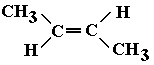
 and Z-but-2-ene


You also get hydrolysis to give butan-1-ol from
1-iodobutane and butan-2-ol from 2-iodobutane (See
Part 3.4)
Examples of producing
branched alkenes from branched halogenoalkanes
(i) conversion: 1- or
2-bromo-2-methylpropane ===> methylpropene (2-methylpropene, but
2 isn't necessary)
(CH3)2CHCH2Br
or (CH3)2CBrCH3 +
OH- ===> (CH3)2C=CH2
+ Br- + H2O
(ii) conversion: 2-bromo-3-methylbutane
===> 3-methylbut-1-ene or 2-methylbut-2-ene
(CH3)2CHCHBrCH3
+ OH- ===> (CH3)2CHCH=CH2
or (CH3)2C=CHCH3 + Br-
+ H2O
For
more details of the mechanism of elimination of hydrogen halides from halogenoalkanes
see ...
See also
Elimination of
hydrogen bromide to form alkenes [E1 and E2 mechanisms]
Website content © Dr
Phil Brown 2000+. All copyrights reserved on Doc Brown's Chemistry revision notes, images,
quizzes, worksheets etc. Copying of website material is NOT
permitted.
Website content © Dr Phil Brown 2000+. All
copyrights reserved on revision notes, images, quizzes, worksheets etc. Copying
of website material is NOT permitted. Exam revision summaries & references to
science course specifications are unofficial.
Website content © Dr Phil Brown 2000+. All
copyrights reserved on these organic chemistry exam revision
notes on elimination reaction between haloalkanes & ethanolic potassium
hydroxide to give alkenes, these A level chemistry revision notes are suitable for use of pre-university students studying AQA advanced level
organic chemistry revision notes on elimination reaction between
haloalkanes & ethanolic potassium hydroxide to give alkenes, Edexcel advanced level
organic chemistry revision notes on elimination reaction between
haloalkanes & ethanolic potassium hydroxide to give alkenes, OCR advanced level
organic chemistry revision notes on elimination reaction between
haloalkanes & ethanolic potassium hydroxide to give alkenes, IB advanced level
organic chemistry revision notes on elimination reaction between
haloalkanes & ethanolic potassium hydroxide to give alkenes, WJEC (Eduqas) advanced level
organic chemistry revision notes on elimination reaction between
haloalkanes & ethanolic potassium hydroxide to give alkenes, CIE Cambridge advanced level
organic chemistry revision notes on elimination reaction between
haloalkanes & ethanolic potassium hydroxide to give alkenes, CCEA advanced level
organic chemistry revision notes on elimination reaction between
haloalkanes & ethanolic potassium hydroxide to give alkenes, and useful for US
grade 11 grade 12 AP honors organic chemistry courses involving elimination
reaction between haloalkanes & ethanolic potassium hydroxide to give alkenes,
Explaining the importance of mechanism of
elimination reaction between haloalkanes & hydroxide ion
in organic chemistry, What you need to know about mechanism of
elimination reaction between haloalkanes & hydroxide ion for organic
chemistry,
Explaining the use of mechanism of elimination reaction between
haloalkanes & hydroxide ion knowledge in organic chemistry, Examples of
mechanism of elimination reaction between haloalkanes & hydroxide ion explained
when studying organic chemistry, What is
the significance of mechanism of elimination reaction between
haloalkanes & hydroxide ion in organic chemistry, What is the use of
mechanism of elimination reaction between haloalkanes & hydroxide ion
in organic chemistry Describing and
explaining the theory of mechanism of elimination reaction between
haloalkanes & hydroxide ion when studying organic chemistry, exam revision
notes for mechanism of elimination reaction between haloalkanes &
hydroxide ion in exams, online help for mechanism of elimination reaction
between haloalkanes & hydroxide ion, revision notes for mechanism of
elimination reaction between haloalkanes & hydroxide ion,
what do I need to learn for mechanism of elimination reaction between
haloalkanes & hydroxide ion in exams? revision summary for mechanism of
elimination reaction between haloalkanes & hydroxide ion, help in
teaching mechanism of elimination reaction between haloalkanes &
hydroxide ion, learning notes for mechanism of elimination reaction between
haloalkanes & hydroxide ion, help to pass the mechanism of elimination
reaction between haloalkanes & hydroxide ion exam, how to
prepare for examination questions on mechanism of elimination reaction
between haloalkanes & hydroxide ion?
|
