|
Part 6.
The Chemistry of Carboxylic Acids and their Derivatives
6.12
NITRILES -
molecular structure, preparation and reactions
[Author
© Dr
Phil Brown PhD: Doc
Brown's exam revision notes suitable
for A level chemistry students of advanced pre-university/college advanced level organic chemistry courses:
carboxylic acid
& derivatives
chemistry revision notes on nitriles
[updated April 15th 2026 *]
email doc
brown - comments - query?
*
[privacy, cookies and disclaimer]
All my revision notes on the
chemistry of carboxylic acids and derivatives
All my advanced A level organic
chemistry revision notes
Index of GCSE level oil and basic organic chemistry notes
6.12
Nitriles -
molecular structure, preparation, reactions
Sub-index for nitriles
The preparation
of nitriles and their
reactions and use in organic synthesis
6.12.1
Structure and physical properties of nitriles
6.12.2
The preparation of nitriles from halogenoalkanes
6.12.3
The preparation of nitriles from carbonyl compounds -
aldehydes and ketones
6.12.4
Use of nitriles in synthesis:
Reduction of nitriles to primary
aliphatic amines
6.12.5
Use of nitriles in
synthesis: Hydrolysis to prepare carboxylic acids
6.12.1 Structure and physical properties of nitriles
The nitrile functional group
consists of a carbon to nitrogen triple bond
C≡N

The aliphatic name is based on the longest
carbon chain, including the C of the nitrile group.
Nitriles are colourless and liquid at room temperature and all poisonous
compounds.
| Name |
Formula |
Mpt/oC |
Bpt/oC |
Comments including solubility in water |
| Methanenitrile |
HC≡N |
-14 |
26 |
Very soluble in water, also called hydrogen cyanide |
| Ethanenitrile |
CH3CN |
-46 |
82 |
Very soluble in water. |
| Propanenitrile |
CH3CH2CN |
-92 |
97 |
Very soluble in water. |
| Butanenitrile |
CH3CH2CH2CN |
|
|
|
| |
|
|
|
|
| Benzonitrile |
C6H5CN |
13 |
191 |
An aromatic nitrile, -C≡N directly
attached to the benzene ring. |
TOP OF PAGE
and sub-index
6.12.2
The preparation of nitriles from halogenoalkanes
The reaction between potassium cyanide and
halogenoalkanes

You must know the structures of
primary, secondary and tertiary halogenoalkanes (haloalkanes)
 This
is an important reaction for extending a carbon chain and a method of
synthesising carboxylic acids. This
is an important reaction for extending a carbon chain and a method of
synthesising carboxylic acids.
A nitrile
functional group replaces the halogen atom in the halogenoalkane:
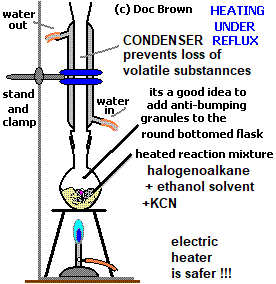
The halogenoalkane is refluxed with an ethanolic
solution of potassium cyanide.
The cold water cooled Liebig vertical condenser
prevents the loss of volatile molecules e.g. solvent or product.
It is better to use ethanol as the solvent rather than
water to avoid hydrolysis to an alcohol i.e. -X replaced with -OH.
R-X +
KCN ===> R-CN + KX (R = alkyl, X =
halogen)
R-X +
CN- ===> R-CN + X-
(ionic equation)
The cyanide ion is a nucleophile (electron pair donor,
N≡C:-)
(a)
The reaction between potassium cyanide and
bromoethane Strictly speaking all the reactants and products
should be suffixed by (aq)
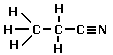
bromoethane + potassium cyanide
===> propanenitrile + potassium bromide
 + KCN
+ KCN

 + KBr
+ KBr
(displayed formula
equation)
Since the cyanide and bromide are free ions,
the equations are better written as ...
bromoethane + cyanide ion ===>
propanenitrile + bromide ion
+ CN–
+ Br–
(displayed formula equation)
 + CN–
+ CN–
 + Br–
+ Br–
(structured formula equation)
 + CN–
+ CN–
 + Br–
+ Br–
(abbreviated structured formula equation)
 + CN–
+ CN–
 + Br–
+ Br–
(skeletal formula equation)
This is an important synthesis reaction
because it is one of the few methods of increasing the length of the carbon
chain
(b)
The reaction between 2-bromopropane
(bpt 59oC) and potassium cyanide
2-bromopropane + cyanide ion
===> 2-methylpropanenitrile + bromide ion
CH3CHBrCH3 + CN- ===>
CH3CH(CN)CH3 + Br-
CH3CH(CH3)CN = CH3CH(CN)CH3
TOP OF PAGE
and sub-index
6.12.3 Preparation of nitriles from carbonyl compounds -
aldehydes and ketones
The reaction between
hydrogen cyanide and aldehydes or ketones
The
product of the nucleophilic addition of hydrogen cyanide is a hydroxynitrile (a
cyanohydrin).
The reaction is equivalent to adding H-CN
across the C=O bond, to give a N-C-O-H bonding situation.
The addition begins with the initial addition of a
cyanide ion (see details of mechanism in
section
6.4.3). So, the reagent and reaction conditions must be just
right. Hydrogen cyanide is a very weak acid (Ka = 5 x 10⁻¹⁰
mol dm-3), and, on its own at equilibrium, it produces very few
cyanide ions:
(i) HCN + H2O
 H3O+ + :CN-
Therefore a base (alkali) must be present to raise the pH
>7. The presence of a strong base (e.g. hydroxide ion)
generates a sufficiently high concentration of cyanide ions to allow the
addition of HCN to proceed efficiently.
(ii) HCN + OH-
 H2O + :CN-
If the pH is too low, there are insufficient cyanide ions
for the reaction to proceed quickly.
In practice, a solution of potassium cyanide (KCN) is
used, buffered to about pH ~8.
KCN is the salt of a strong base and
a very weak acid, and is naturally alkaline by hydrolysis (the reverse
of reaction (ii) above), so providing a higher concentration of cyanide
ions than hydrogen cyanide.
To
get the right pH, a little dilute sulfuric acid is added to a solution
of sodium/potassium cyanide.
Using pure HCN solution, the reaction takes weeks, add a drop of NaOH
and it goes in hours, so the base (alkali) has quite a catalytic effect.
Examples of
nucleophilic addition of hydrogen cyanide to aldehydes and ketones
to give hydroxynitriles
(a)
 + HCN ===>

ethanal + hydrogen
cyanide ===> 2-hydroxypropanenitrile
(b)
 + HCN ===>

propanone + hydrogen
cyanide ===> 2-hydroxy-2-methylpropanenitrile
(c)
 + HCN ===>

butanone + hydrogen
cyanide ===> 2-hydroxy-2-methylbutanenitrile
Need some bigger skeletal formulae equations?
TOP OF PAGE
and sub-index
6.10.4 Use of nitriles in synthesis:
Reduction of nitriles to primary
aliphatic amines
Sodium tetrahydridoborate(III), NaBH4 (sodium borohydride),
is not a powerful enough reducing agent to reduce nitriles to primary
amines.
LiAlH4
is a more powerful reducing agent than NaBH4 and reacts
violently with water (and reacts with ethanol too), so the reaction must be carried out in an inert
non-aqueous solvent
like dry ethoxyethane ('ether').
(a) The reduction reaction of nitriles can be summarised
as:
RC N + 4[H]
===> RCH2NH2 (R = H, alkyl or aryl) N + 4[H]
===> RCH2NH2 (R = H, alkyl or aryl)
e.g. propanenitrile to
propylamine:
CH3CH2C≡N + 4[H] ===> CH3CH2CH2NH2
The initial product is hydrolysed by
dilute sulphuric acid and the amine then freed by adding strong alkali like
sodium hydroxide.
(b) The reduction of hydroxy-nitriles
e.g.
RCH(OH)C≡N + 4[H]
==> RCH(OH)CH2NH2 (R = H, alkyl or aryl)
The product is an amino alcohol (or hydroxy-amine).
This is an example of the reduction of a polar C-N pi
bond via the hydride ion (H-) acting as a nucleophile
generated by the tetrahydridoaluminate(III) ion, which does not reduce
the non-polar pi bond C=C you find in alkenes.
Tin and hydrochloric acid, Sn(s)/HCl(aq), is not a
powerful enough reducing agent to reduce nitriles to amines.
H2(g)/150oC/Ni(s)
catalyst conditions will allow hydrogen gas to reduce nitriles to primary aliphatic amines
in the chemical industry.
RCN
+ 2H2 ==> RCH2NH2 (R = H,
alkyl or aryl)
TOP OF PAGE
and sub-index
6.12.5
Use of nitriles in
synthesis:
Hydrolysis to prepare carboxylic acids
The hydrolysis of nitriles to give carboxylic acids
The
hydrolysis of the resulting nitriles e.g. propane nitrile
If the nitrile is refluxed with dilute
hydrochloric/sulfuric acid or sodium hydroxide (strong base - alkali) the
corresponding carboxylic acid or its sodium salt is formed.
The hydrolysis with pure water is to
slow, but the reaction is speeded up by a strong acid or strong alkali.
Strictly speaking all the reactants and products
should be suffixed by (aq)
(i) Equations for the dilute mineral acid hydrolysis of a nitrile to give the
free (weaker) acid
In this case converting
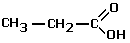
propanenitrile to propanoic acid or its salt, sodium propanoate
+ 2H2O + H+
 + NH4+
Here the free acid and an ammonium
ion are formed. (more detailed structured formula hydrolysis equation)
+ 2H2O + H+
 + NH4+
(less detailed structured formula hydrolysis equation)
 + 2H2O + H+
 + NH4+
(skeletal formula hydrolysis equation)
(ii) Equations for the alkaline hydrolysis of a nitrile to give the sodium salt
(if aqueous sodium hydroxide is used), in the equations you write out the
product as the carboxylate anion.
In this case converting
propanenitrile to its salt, e.g. sodium propanoate
+ H2O + OH-
 + NH3
+ NH3
Here the carboxylate anion
(propanoate ion) and free ammonia are formed.
(structured formula hydrolysis equation)
+ H2O + OH-
 + NH3
+ NH3
(abbreviated structured formula hydrolysis equation)
+ H2O + OH-
 + NH3
+ NH3
(skeletal formula hydrolysis equation)
The
hydrolysis of 2-methylpropanenitrile
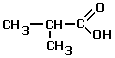
2-methylpropanenitrile
=== hydrolysis ===> free 2-methylpropanoic acid or its salt
 or
or
(CH3)2CHC≡N
+ 2H2O + H+
(CH3)2CHCOOH + NH4+
(acid hydrolysis, free acid)
(CH3)2CHC≡N
+ H2O + OH-
(CH3)2CHCOO- + NH3
(alkaline hydrolysis, salt of acid)
|
Website content © Dr
Phil Brown 2000+. All copyrights reserved on
Doc Brown's Chemistry revision notes carboxylic acids and
derivatives. Copying of website material is NOT
permitted.
Website content © Dr Phil Brown 2000+. All
copyrights reserved on revision notes, images, quizzes, worksheets etc. Copying
of website material is NOT permitted. Exam revision summaries & references to
science course specifications are unofficial.
Website content © Dr Phil Brown 2000+. All
copyrights reserved on these organic chemistry exam revision
notes on structure, properties, synthesis & uses of nitriles, these A level chemistry revision notes are suitable for use of pre-university students studying AQA advanced level
organic chemistry revision notes on structure, properties, synthesis
& uses of nitriles, Edexcel advanced level
organic chemistry revision notes on structure, properties, synthesis
& uses of nitriles, OCR advanced level
organic chemistry revision notes on structure, properties, synthesis
& uses of nitriles, IB advanced level
organic chemistry revision notes on structure, properties, synthesis
& uses of nitriles, WJEC (Eduqas) advanced level
organic chemistry revision notes on structure, properties, synthesis
& uses of nitriles, CIE Cambridge advanced level
organic chemistry revision notes on structure, properties, synthesis
& uses of nitriles, CCEA advanced level
organic chemistry revision notes on structure, properties, synthesis
& uses of nitriles, and useful for US grade 11 grade 12 AP
honors organic chemistry courses involving structure,
properties, synthesis & uses of nitriles,
Explaining the importance of
equation & reagents for the reduction & hydrolysis of
nitriles
in organic chemistry, What you need to know about equation & reagents
for the reduction & hydrolysis of nitriles for organic
chemistry,
Explaining the use of equation & reagents for the reduction & hydrolysis
of nitriles knowledge in organic chemistry, Examples of
equation & reagents for the reduction & hydrolysis of
nitriles explained
when studying organic chemistry, What is
the significance of equation & reagents for the reduction & hydrolysis
of nitriles in organic chemistry, What is the use of
equation & reagents for the reduction & hydrolysis of
nitriles
in organic chemistry Describing and
explaining the theory of equation & reagents for the reduction &
hydrolysis of nitriles when studying organic chemistry, exam revision
notes for equation & reagents for the reduction & hydrolysis of nitriles in exams, online help for
equation & reagents for the reduction & hydrolysis of
nitriles, revision notes for equation & reagents for the
reduction & hydrolysis of nitriles,
what do I need to learn for equation & reagents for the reduction &
hydrolysis of nitriles in exams? revision summary for
equation & reagents for the reduction & hydrolysis of
nitriles, help in
teaching equation & reagents for the reduction & hydrolysis of nitriles, learning notes for
equation & reagents for the reduction & hydrolysis of
nitriles, help to pass the equation & reagents for the
reduction & hydrolysis of nitriles exam, how to
prepare for examination questions on equation & reagents for the
reduction & hydrolysis of nitriles?
[SEARCH
BOX]
advanced pre-university/college chemistry links
My advanced level carboxylic acid
notes index
All my advanced level organic
chemistry notes
All my advanced level
inorganic chemistry notes
All my advanced level
theoretical chemistry notes |
|
