|
Part 6.
The Chemistry of Carboxylic Acids and their Derivatives
Part 6.6
The chlorination and bromination of
aliphatic/aromatic carboxylic acids and use of the products in organic synthesis
[Author
© Dr
Phil Brown PhD: Doc
Brown's exam revision notes suitable
for A level chemistry students of advanced pre-university/college advanced level organic chemistry courses:
chemistry revision
notes on the halogen substitution reactions of carboxylic acids
[updated April 15th 2026 *]
email doc
brown - comments - query?
* [privacy, cookies and disclaimer]
All my revision notes on the
chemistry of carboxylic acids and derivatives
All my advanced A level organic
chemistry revision notes
Index of GCSE level oil and basic organic chemistry notes
Part 6.6
The chlorination and bromination of
aliphatic/aromatic carboxylic acids and use of the products in organic synthesis
Sub-index for this page
(some overlap with
section 6.3)
6.6.1
The chlorination/bromination of aliphatic carboxylic acids
6.6.2
The chlorination of aromatic carboxylic acids -
substitution in the benzene ring
6.6.3
The use of chlorinated aliphatic
carboxylic acids in organic synthesis reactions
6.6.1 The chlorination and bromination of aliphatic carboxylic
acids
The alkyl hydrocarbon sections of
aliphatic carboxylic acid can be chlorinated using chlorine and uv light.
You can prepare chlorinated aliphatic monocarboxylic
acids by bubbling chlorine gas into the liquid acid in the presence of uv
light or bright sunlight.
You can
carry out the same reaction using liquid bromine to make bromocarboxylic
acids.
For ethanoic acid, you can replace all three hydrogen
atoms of the alkyl methyl group.
(i)
CH3COOH +
Cl2 ===> ClCH2COOH + HCl
(chloroethanoic acid)
(ii)
ClCH2COOH
+ Cl2 ===> Cl2CHCOOH +
HCl (dichloroethanoic acid)
(iii)
Cl2CHCOOH +
Cl2 ===> Cl3CCOOH + HCl
(trichloroethanoic acid)
The chlorination of
an aliphatic carboxylic acid is a
free
radical chain reaction mechanism
(just like the chlorination of methane:
Free radical
chlorination/bromination to give halogenoalkanes
Initiation
Cl2 ===> 2Cl•
(note the •
denotes the unpaired electron on
the free radical)
Propagation steps
(i) for the 1st
substitution product
Cl• + CH3COOH
===> •CH2COOH + HCl
•CH2COOH + Cl2
===> ClCH2COOH + Cl•
(ii) for the 2nd substitution product
ClCH2COOH +
Cl• ===> •CHClCOOH + HCl
•CHClCOOH + Cl2 ===>
Cl2CHCOOH + Cl•
(iii) for the 3rd substitution product
Cl2CHCOOH + Cl•
===> •CCl2COOH + HCl
•CCl2COOH + Cl2
===> Cl3CCOOH + Cl•
Termination
Any two of all the radicals
mentioned above e.g.
Cl• +
Cl• ===> Cl2
R• + Cl• ===> RCl
R• + R'• ===> R-R'
Chlorinating/brominating higher members of the aliphatic carboxylic acids
e.g. (i)
Chlorinating propanoic acid with Cl2/uv gives mainly 2-chloropropanoic acid.
CH3CH2COOH +
Cl2 ===> H3CCHClCOOH + HCl
The product will be a racemic mixture of the two R/S
stereoisomers of  , ,  because the middle carbon (known as the alpha carbon) is chiral - 4
different groups attached to it.
because the middle carbon (known as the alpha carbon) is chiral - 4
different groups attached to it.
(ii) Bromination of propanoic acid ('propionic acid')
with bromine and phosphorus(III) bromide gives 2-bromopropanoic acid.
CH3CH2COOH +
Br2 ===> H3CHBrCOOH + HBr
Structures as above, but Br instead of Cl and will
also exhibit R/S stereoisomerism.
TOP OF PAGE
and sub-index
6.6.2 The chlorination of aromatic carboxylic acids
- substitution in the benzene ring
The benzene ring is very stable and you
cannot get controlled chlorination of it using chlorine and uv light.
However, you can replace the hydrogen
atoms in the benzene ring using chlorine and a catalyst such as aluminium
chloride (AlCl3) or iron(III) chloride (FeCl3).
 + Cl2 ===>
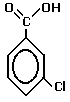 + HCl
+ HCl
The principal product is 3-chlorobenzoic
acid, shown above, and with smaller amounts of 2-chlorobenzoic acid and 4-chlorobenzoic acid.
You can brominate i.e. substitute bromine
into the benzene ring using bromine and a catalyst of aluminium bromide
(AlBr3) or iron(III) bromide (FeBr3).
These are electrophilic substitution
Friedel-Crafts catalysed reaction mechanisms
See section 7.6
Electrophilic substitution - ring halogenation of benzene &
methylbenzene
Aromatic halogen compounds, where the
halogen atom is directly attached to the ring, do not hydrolyse easily to a
phenol group with alkali like ethanolic or aqueous potassium/sodium
hydroxide.
It is not easy to hydrolyse
3-chlorobenzoic acid to 3-hydroxybenzoic acid by simply refluxing it
with aqueous sodium hydroxide.
You do not get the same
Cδ+-Clδ-
polarising effect because of the benzene ring,
The carbon - chlorine bond is less
polar because of the interaction of chlorine's orbitals with the pi
electron cloud of the benzene ring and this same 'resonance' interaction
increases the strength of the C-Cl bond (increases the C-Cl bond order
to > 1.0).
TOP OF PAGE
and sub-index
6.6.3 The use of chlorinated aliphatic
carboxylic acids in organic synthesis
A monochlorinated aliphatic
carboxylic acid has two functional groups.
The -COOH is dealt with on
other pages, so we can concentrate on the other functional
group, the chlorine atom -Cl.
This gives the molecule the
chemistry of halogenoalkanes.
We'll illustrate the
possibilities starting with ethanoic acid.
(a)
Amine preparation -
amino acid
Reacting chloroethanoic
acid with ammonia
ClCH2COOH
+ 2NH3 ===> H2NCH2COOH
+ NH4Cl
The product is
aminoethanoic acid, the simplest alpha amino acid.
This molecule has now
also got the functional group chemistry of an amine.
2-chloropropanoic acid
gives 2-aminopropanoic acid.
+ 2NH3 ===>
 + NH4Cl
+ 2NH3 ===>
 + NH4Cl
For more mechanistic details
of this reaction see
Part 3.6
Nucleophilic substitution reaction between halogenoalkanes (haloalkanes) and ammonia
(b)
Hydroxy acid preparation
Refluxing chloroethanoic
acid with ethanolic sodium hydroxide
ClCH2COOH
+ NaOH ===> HOCH2COOH +
NaCl
The product is
hydroxyethanoic acid, the simplest alpha amino acid.
This molecule has now
also got the functional group chemistry of a primary
alcohol.
This is a nucleophilic
substitution reaction.
2-chloropropanoic acid
gives 2-hydroxypropanoic acid.
+ OH- ===>
 + Cl-
+ Cl-
+ OH- ===>
 + Cl-
+ Cl-
For more mechanistic details
for this reaction see
Part 3.4
Nucleophilic
substitution of halogenoalkanes (haloalkanes) with sodium hydroxide
(c)
Nitrile preparation and
hydrolysis to a dicarboxylic acid
Refluxing chloroethanoic
acid with ethanolic potassium cyanide
ClCH2COOH
+ NaC≡N
===> N≡CCH2COOH
+ NaCl
This molecule has now
also got the functional group chemistry of a nitrile.
This is a nucleophilic
substitution reaction, Cl- exchanged (displaced)
with a CN- ion.
Therefore it can be
hydrolysed to a dicarboxylic acid by refluxing with dilute
aqueous alkali (NaOH) or dilute aqueous acid (HCl, H2SO4).
The equation for acid catalysed hydrolysis is ...
N≡CCH2COOH
+
2H2O + H+
===> HOOCCH2COOH + NH4+
The hydrolysis product is
propanedioic acid.
For more details see
Part 3.5
The
nucleophilic substitution reaction between halogenoalkanes (haloalkanes) and potassium cyanide
and hydrolysis of nitriles to carboxylic acids
|
Website content © Dr
Phil Brown 2000+. All copyrights reserved on
Doc Brown's Chemistry revision notes carboxylic acids and
derivatives. Copying of website material is NOT
permitted.
Website content © Dr Phil Brown 2000+. All
copyrights reserved on revision notes, images, quizzes, worksheets etc. Copying
of website material is NOT permitted. Exam revision summaries & references to
science course specifications are unofficial.
Website content © Dr Phil Brown 2000+. All
copyrights reserved on these organic chemistry exam revision
notes on methods of halogen substitution reactions of carboxylic acids, these A level chemistry revision notes are suitable for use of pre-university students studying AQA advanced level
organic chemistry revision notes on methods of halogen substitution
reactions of carboxylic acids, Edexcel advanced level
organic chemistry revision notes on methods of halogen substitution
reactions of carboxylic acids, OCR advanced level
organic chemistry revision notes on methods of halogen substitution
reactions of carboxylic acids, IB advanced level
organic chemistry revision notes on methods of halogen substitution
reactions of carboxylic acids, WJEC (Eduqas) advanced level
organic chemistry revision notes on methods of halogen substitution
reactions of carboxylic acids, CIE Cambridge advanced level
organic chemistry revision notes on methods of halogen substitution
reactions of carboxylic acids, CCEA advanced level
organic chemistry revision notes on methods of halogen substitution
reactions of carboxylic acids, and useful for US grade 11
grade 12 AP honors organic chemistry courses involving
methods of halogen substitution reactions of carboxylic
acids,
Explaining the importance of
substitution reactions of carboxylic acids with chlorine &
bromine
in organic chemistry, What you need to know about substitution reactions
of carboxylic acids with chlorine & bromine for organic
chemistry,
Explaining the use of substitution reactions of carboxylic acids with
chlorine & bromine knowledge in organic chemistry, Examples of
substitution reactions of carboxylic acids with chlorine &
bromine explained
when studying organic chemistry, What is
the significance of substitution reactions of carboxylic acids with
chlorine & bromine in organic chemistry, What is the use of
substitution reactions of carboxylic acids with chlorine &
bromine
in organic chemistry Describing and
explaining the theory of substitution reactions of carboxylic acids with
chlorine & bromine when studying organic chemistry, exam revision
notes for substitution reactions of carboxylic acids with chlorine &
bromine in exams, online help for substitution reactions of
carboxylic acids with chlorine & bromine, revision notes for
substitution reactions of carboxylic acids with chlorine &
bromine,
what do I need to learn for substitution reactions of carboxylic acids
with chlorine & bromine in exams? revision summary for
substitution reactions of carboxylic acids with chlorine &
bromine, help in
teaching substitution reactions of carboxylic acids with chlorine &
bromine, learning notes for substitution reactions of
carboxylic acids with chlorine & bromine, help to pass the
substitution reactions of carboxylic acids with chlorine &
bromine exam, how to
prepare for examination questions on substitution reactions of
carboxylic acids with chlorine & bromine?
[SEARCH
BOX]
advanced pre-university/college chemistry links
My advanced level carboxylic acid
notes index
All my advanced level organic
chemistry notes
All my advanced level
inorganic chemistry notes
All my advanced level
theoretical chemistry notes |
|
