Advanced Organic Chemistry: Infrared spectrum of 2-methylpropan-2-ol (CH3)3COH

HOME PAGE * SEARCH * GCSE Level Chemistry age ~14-16 * Advanced Level Chemistry age ~16-19

Interpreting the infrared spectrum of 2-methylpropan-2-ol (tert-butyl alcohol)

[Author ©  Dr WP Brown PhD: Doc Brown's advanced level organic chemistry exam revision notes suitable for students of UK A level chemistry courses & US K12 grade 11, grade 12 and AP honors chemistry courses: Molecular spectroscopy - analysing the infrared spectrum of 2-methylpropan-2-ol [updated October 24th 2025]

 email doc brown  Re-edit (CH3)3COH

 Links associated with 2-methylpropan-2-ol

 The chemistry of ALCOHOLS

 This is a BIG website, you need to take time to explore it

Infrared spectroscopy - spectra index


Introductory note on the infrared spectrum of 2-methylpropan-2-ol

Students and teachers please note my explanation of the infrared spectrum of 2-methylpropan-2-ol is designed for advanced, but pre-university, chemistry courses.

Based in the infrared spectrum diagram for 2-methylpropan-2-ol, only some of the most prominent peaks for particular bond vibrations are discussed, particularly if 2-methylpropan-2-ol has a functional group with a particular characteristic wavenumber peak.

The infrared spectrum of 2-methylpropan-2-ol is unique and the whole, or selected wavenumbers, can be used to fingerprint its identity, sometimes analysing a mixture containing 2-methylpropan-2-ol or following its change of concentration in a reaction.

C4H10O (CH3)3COH infrared spectrum of 2-methylpropan-2-ol wavenumbers cm-1 functional group detection fingerprint pattern identification of tert-butyl alcohol doc brown's advanced organic chemistry revision notes 

Spectra obtained from a liquid film of 2-methylpropan-2-ol. The right-hand part of the of the infrared spectrum of 2-methylpropan-2-ol, wavenumbers ~1500 to 400 cm-1 is considered the fingerprint region for the identification of 2-methylpropan-2-ol and most organic compounds. It is due to a unique set of complex overlapping vibrations of the atoms of the molecule of 2-methylpropan-2-ol.

2-methylpropan-2-ol   C4H10alcohols and ether structure and naming (c) doc b  alcohols and ether structure and naming (c) doc b  alcohols and ether structure and naming (c) doc b

The molecular structure and naming of aliphatic alcohols and ethers

Interpretation of the infrared spectrum of 2-methylpropan-2-ol

The most prominent infrared absorption lines of 2-methylpropan-2-ol

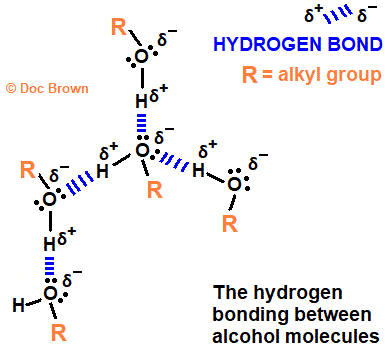
The most characteristic absorption is the broad O-H stretching vibration band at wavenumbers ~3500 to 3230 cm-1, the breadth is caused by hydrogen bonding interactions, common to all hydrogen bonded molecules with a hydroxyl group e.g. alcohols and carboxylic acids.

infrared spectrum of ethanol diagram of intermolecular hydrogen bonding forces between liquid alcohol molecules doc brown A level organic chemistry revision notes R-O–Hδ+llll:Oδ-R ... etc.

C-H stretching vibration absorption occurs ~2900 cm-1, wavenumbers common to any molecule with alkyl groups.

C-C-C skeletal vibrations show absorptions at wavenumbers ~1255 to 1200 cm-1 and 750 to 720 cm-1 for a -C(CH3)3 grouping.

There are C-O stretching vibration and C-H deformation vibration absorption bands of wavenumbers ~1350 to 1030 cm-1, common to aliphatic alcohols

The absence of other specific functional group bands will show that a particular functional group is absent from the 2-methylpropan-2-ol molecular structure.


Key points about the infrared spectrum of 2-methylpropan-2-ol

2-Methylpropan-2-ol shows a broad O–H stretch around 3200–3600 cm⁻¹ and strong C–H stretches near 2950 cm⁻¹; absence of C=O confirms it's not a ketone or acid.


Key IR Spectrum Features of 2-Methylpropan-2-ol

2-Methylpropan-2-ol (tert-butanol) is a tertiary alcohol with the formula (CH3)3COH.

Its IR spectrum reflects characteristic functional group vibrations:

Wavenumber (cm⁻¹) Bond / Vibration Description
3200–3600 O–H stretch (alcohol) Broad, strong peak due to hydrogen bonding; hallmark of alcohols
~2950 C–H stretch (alkyl) Sharp peaks from methyl C–H stretching vibrations
~1450–1375 C–H bending (methyl groups) Medium intensity; confirms presence of multiple CH3 groups
~1050–1150 C–O stretch (alcohol) Strong, sharp peak; confirms alcohol functionality
<1500 Fingerprint region Complex pattern; useful for compound identification but not functional groups

Sources: NIST Chemistry WebBook


Common Misconceptions in Exams

  • Mistaking the O–H stretch for N–H or carboxylic acid: Alcohol O–H is broad but not as broad or intense as carboxylic acids.
  • Assuming all alcohols show identical O–H peaks: Tertiary alcohols like 2-methylpropan-2-ol may show less hydrogen bonding, slightly narrowing the peak.
  • Overinterpreting the fingerprint region: Students often try to assign peaks <1500 cm⁻¹ without sufficient data—this region is best used for comparison, not deduction.
  • Missing the absence of C=O: A key diagnostic feature—no peak near 1700 cm⁻¹ confirms it's not a ketone, aldehyde, or acid.

Exam Revision Tips

  • Use IR to confirm or eliminate functional groups: For example, absence of C=O rules out ketones and acids.
  • Compare spectra to known standards: Practice with spectra of ethanol, propan-2-ol, and carboxylic acids to distinguish O–H types.
  • Label spectra in mock exams: Annotate key peaks with bond types and wavenumbers—this builds pattern recognition.
  • Watch for distractors in MCQs: Some exams include spectra with overlapping features—focus on the most diagnostic peaks.
  • Practice with real spectra: Use NIST or exam board resources to interpret actual IR plots, not just tables.

Would you like a printable overlay comparing IR spectra of primary, secondary, and tertiary alcohols for revision?


Key words & phrases: C4H10O (CH3)3COH image and diagram explaining the infrared spectrum of 2-methylpropan-2-ol, complete infrared absorption spectrum of 2-methylpropan-2-ol, comparative spectra of 2-methylpropan-2-ol, prominent peaks/troughs for identifying functional groups in the infrared spectrum of 2-methylpropan-2-ol, important wavenumber values in cm-1 for peaks/troughs in the infrared spectrum of 2-methylpropan-2-ol, revision of infrared spectroscopy of 2-methylpropan-2-ol, fingerprint region analysis of 2-methylpropan-2-ol, how to identify 2-methylpropan-2-ol from its infrared spectrum, identifying organic compounds like 2-methylpropan-2-ol from their infrared spectrum, how to analyse the absorption bands in the infrared spectrum of 2-methylpropan-2-ol detection of hydroxyl functional groups in the 2-methylpropan-2-ol molecule example of the infrared spectrum of a molecule like 2-methylpropan-2-ol with a hydroxyl functional group  interpreting interpretation of the infrared spectrum of 2-methylpropan-2-ol shows presence of hydroxyl functional group hydroxy group in tert-butyl alcohol How do you interpret the infrared absorption spectrum of 2-methylpropan-2-ol How to interpret the infrared spectrum of 2-methylpropan-2-ol Explanatory diagram of the infrared spectrum of the 2-methylpropan-2-ol molecule in terms of its molecular structure. Listing data of the prominent main wavenumber peaks troughs in the infrared spectrum of 2-methylpropan-2-ol. How to explain the infrared spectrum of 2-methylpropan-2-ol. Use of the infrared spectrum of 2-methylpropan-2-ol, identification of 2-methylpropan-2-ol from its infrared spectrum - fingerprint wavenumber pattern to identify the 2-methylpropan-2-ol molecule. The uses of the infrared spectrum of the 2-methylpropan-2-ol molecule. The distinctive features of the infrared spectrum of the 2-methylpropan-2-ol molecule explained. explaining the peaks-trough of the transmittance of the infrared spectrum of 2-methylpropan-2-ol what does the infrared spectrum tell you about the structure and properties of the 2-methylpropan-2-ol molecule? How is infrared spectrum of 2-methylpropan-2-ol used to identify 2-methylpropan-2-ol?


Links associated with 2-methylpropan-2-ol

The mass spectrum of 2-methylpropan-2-ol

The H-1 NMR spectrum of 2-methylpropan-2-ol

The C-13 NMR spectrum of 2-methylpropan-2-ol

The chemistry of ALCOHOLS revision notes INDEX

Infrared spectroscopy index

ALL SPECTROSCOPY INDEXES

All Advanced Organic Chemistry Notes

Use My Google search site box

Email doc b: chem55555@hotmail.com


Website content © Dr Phil Brown 2000+. All copyrights reserved on revision notes, images, quizzes, worksheets etc. Copying of Doc Brown's pre-university advanced level chemistry website material is NOT permitted. Exam revision summaries & references to science course specifications are unofficial. These organic chemistry revision notes on spectroscopy are suitable for use of pre-university students studying AQA advanced level chemistry, Edexcel advanced level chemistry, OCR advanced level chemistry, IB advanced level chemistry, WJEC (Eduqas) advanced level chemistry, CIE advanced level chemistry, US grade 11-12 AP honors chemistry courses and they will also prove useful to 1st year undergraduate students of chemistry.

TOP OF PAGE