|
Interpreting the
Carbon-13 NMR spectrum of propan-1-ol
CH3CH2CH2OH
[Author
©
Dr Phil Brown PhD:
Doc Brown's advanced level organic chemistry exam revision notes
suitable for students of UK A level chemistry courses & US K12 grade
11, grade 12 and AP honors chemistry courses:
Molecular
spectroscopy analysis of
propan-1-ol
[spectra page
updated Mar 26th 2026 *]
Email
doc brown re-edit 13C NMR spectrum of
CH3CH2CH2OH
This is a BIG chemistry website, PLEASE take time to explore it
Links associated with propan-1-ol
* [privacy policy, cookies
and disclaimer]
C-13
NMR spectroscopy - spectra index
See also
comparing the infrared, mass, 1H NMR and 13C NMR
spectra of the 3 isomers of C3H8O
Introductory note on the 13C NMR spectrum of propan-1-ol
(1-propanol)
Students and teachers please note that my explanation of the
carbon-13 NMR spectrum of propan-1-ol is designed for advanced, but
pre-university, chemistry courses.
The description does not involve
the chemical shift δ
spin-spin coupling effects for propan-1-ol and the relative size of the carbon-13
NMR shifts does not give the ratio of the carbon atoms in the
different non-equivalent chemical environments of the propan-1-ol molecule.
The most common solvent used for investigating the C13 NMR
spectrum of compounds like propan-1-ol, is CDCl3 and other
deuterated solvents.
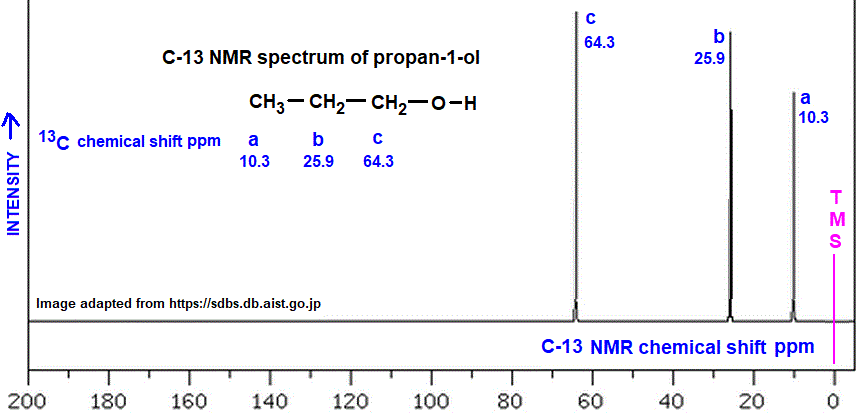
TMS is the acronym for tetramethylsilane, formula Si(CH3)4,
whose 13C atoms are arbitrarily given a chemical shift of 0.0
ppm. This is the 'standard' in 13C NMR spectroscopy and all other
13C shifts, called chemical shifts, depend on the
individual (electronic) chemical environment of the 13C atoms in
an organic molecule - propan-1-ol here.
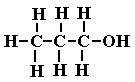
Propan-1-ol C3H8O,
 ,
,
 ,
,
 ,
,

primary alcohol
The molecular structure and naming of aliphatic
alcohols and ethers
Interpreting the C-13 NMR spectrum of propan-1-ol
As you can see from the diagram above there are
3 different 13C chemical shift lines
(a) to (c) in the C-13 NMR spectrum of
propan-1-ol
indicating 3 different chemical environments of the carbon atoms.
CH3CH2CH2OH
(Note the 3 colours indicating the
3 different chemical environment of the carbon atoms in propan-1-ol).
Note the decreasing effect on the chemical shift as the
carbon atom is further from the highly electronegative oxygen atom of propan-1-ol.
The carbon-13 NMR spectra a provides direct evidence of
3 different carbon atom environments in the propan-1-ol molecule from 3
different 13C chemical shifts (ppm) and fits in with the structural
formula of propan-1-ol.
Key points about the 13C NMR spectrum of
opan-1-ol and practice
questions
Key ¹³C NMR
Features of Propan-1-ol
Important note:
At A-level and IB/AP level, spectra are usually presented as
proton-decoupled ¹³C NMR spectra.
This means each carbon environment appears
as a single peak (singlet), regardless of attached protons.
Splitting patterns are not normally shown.
|
Chemical shift (δ, ppm) |
Carbon type |
Origin |
Notes |
| ~10–15
ppm, 10.3 |
CH3
(terminal methyl) |
End of
chain |
Slightly
shielded, typical alkyl CH₃ |
| ~20–30
ppm, 25.9 |
Middle
CH2 |
Central
methylene |
More
deshielded than CH₃ |
| ~60 ppm,
64.3 |
CH2OH
group |
Carbon
bonded to OH |
Strongly
deshielded due to electronegative oxygen |
Number of signals = 3 distinct carbons
(CH3, CH2, CH2OH).
Decoupled spectrum → all 13C chemical shifts appear as
singlets.
Spectra data source
https://sdbs.db.aist.go.jp/Disclaimer.aspx for
13C δ
ppm
Common
Misconceptions
- Expecting splitting in ¹³C NMR
→ In decoupled spectra, carbons appear as singlets.
- Thinking OH gives a carbon signal
→ OH has no carbon, so no peak.
- Assuming integration is used in
¹³C NMR → Unlike ¹H NMR, peak
areas are not reliable for carbon counts.
- Forgetting isomer differences
→ Propan-2-ol has different chemical shifts (isopropyl pattern).
Exam Revision Tips
- Remember only three signals
for propan-1-ol.
- Compare isomers:
propan-2-ol has three signals but different chemical shift distribution.
- Distinguish alcohol vs. aldehyde
vs. ketone: aldehyde C=O ~190–200 ppm, alcohol CH₂OH ~60 ppm.
- Always state that ¹³C NMR spectra
are proton-decoupled in exam answers.
Practice Multiple
Choice Questions based on the 13C NMR spectrum of propan-1-ol
Each question has A–D options, model
answer, and feedback explaining distractors.
If you think there are any errors
email doc b
asap
Jot down your responses and check out the
ANSWERS!
Q1.
How many signals appear in the decoupled ¹³C NMR spectrum of propan-1-ol?
- 2
- 3
- 4
- 5
Q2.
Why do all signals appear as singlets in ¹³C NMR?
- Proton decoupling removes splitting
- Carbons have no protons
- Solvent effect
- Instrument resolution
Q3.
Which of the following only has two signals in its 13C NMR spectrum?
- Propan-2-ol
- Propanal
- Propanoic acid
- Propanone
Q4.
Why does OH not give a signal in
13C
NMR?
- It has no carbon atom
- It exchanges with solvent
- It is too broad
- It overlaps with CH3
Q5.
Which 13C signal would be absent in propanone compared to
propan-1-ol?
- ~60 ppm CH2OH
- ~20 ppm CH2
- ~10 ppm CH3
- ~200 ppm C=O
Q6.
Which statement about ¹³C NMR integration is correct?
- It gives proton ratios
- It gives carbon ratios
- It is not reliable for quantitative
analysis
- It always equals 1:1
If you think there are any errors
email doc b
asap
Jot down your responses and check out the
ANSWERS!
|
Comparing the infrared, mass, 1H NMR and 13C NMR
spectra of the 3 isomers of C3H8O
NOTE: The images are linked to their
original detailed spectral analysis pages AND can be doubled in
size with touch screens to
increase the definition to the original propan-1-ol,
propan-2-ol and methoxyethane image sizes. |
 |
 |
 |
I wasn't able to obtain an infrared
spectrum for methoxyethane, so I've added the infrared spectrum
of ethoxyethane to enable a few comparisons with two aliphatic
alcohols
Comparing the
infrared
spectra of
propan-1-ol,
propan-2-ol and
methoxyethane
Propan-1-ol,
propan-2-ol and methoxyethane
are structural isomers of molecular formula C3H8O
Propan-1-ol,
propan-2-ol and methoxyethane
exemplify infrared spectra of the lower members of the homologous series
of aliphatic alcohols and ethers |
|
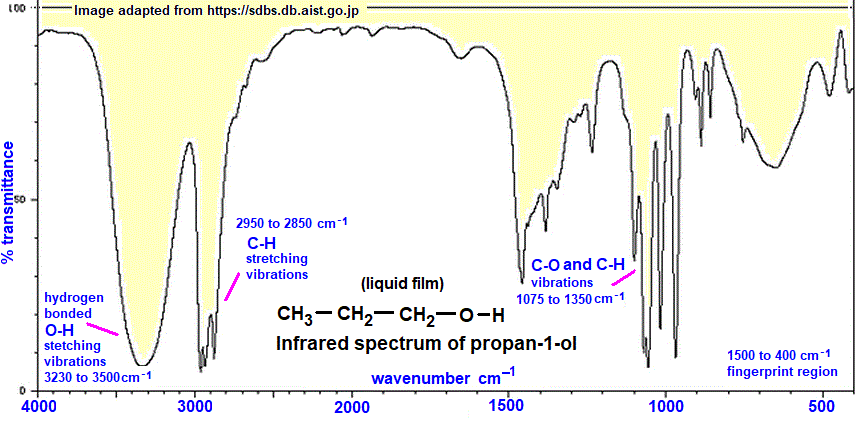
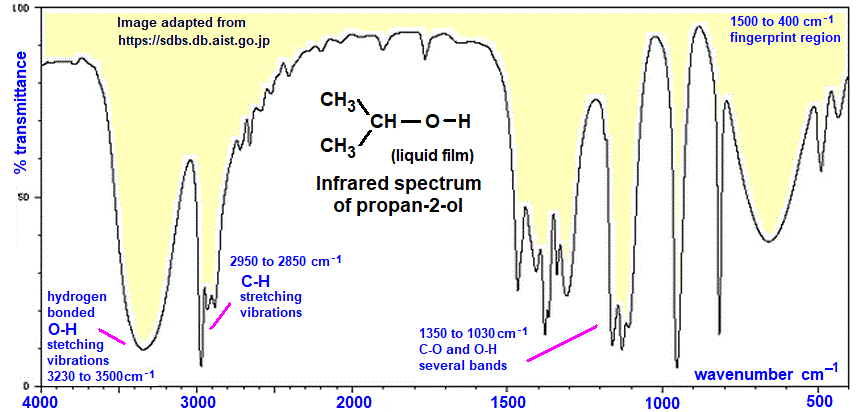
INFRARED SPECTRA
(above): There are, as expected, differences in the fingerprint region at
wavenumbers 1500 to 400 cm-1, but most absorptions
for all three molecules are the various C-O and the many C-H
vibrational modes. However, there is one characteristic distinguishing
absorption only present in the infrared spectra of alcohols, but
not in ethers, that is the broad O-H stretching vibration
peaking at ~3350 cm-1. There is also another broad
absorption band (origin?) peaking at ~650 cm-1 in the
alcohol spectra, but not in the ether spectra. |
 |
 |
 |
Comparing the
mass
spectra of
propan-1-ol,
propan-2-ol and
methoxyethane
Propan-1-ol,
propan-2-ol and methoxyethane
are structural isomers of molecular formula C3H8O
Propan-1-ol,
propan-2-ol and methoxyethane
exemplify the mass spectra of the lower members of the homologous series
of aliphatic alcohols and ethers |
|
MASS SPECTRA (above):
The base ion peaks are m/z 45 for propan-2-ol and methoxyethane,
but that of propan-1-ol is m/z 31. Many of the fragmentation
ions are common to all three spectra. The m/z 45 ion is peak is
much smaller in the propan-1-ol spectrum compared to the other
two. |
 |
 |
 |
Comparing the
1H proton NMR
spectra of
propan-1-ol,
propan-2-ol and
methoxyethane
Propan-1-ol,
propan-2-ol and methoxyethane
are structural isomers of molecular formula C3H8O
Propan-1-ol,
propan-2-ol and methoxyethane exemplify the 1H proton NMR spectra of
the lower members of the homologous series of aliphatic alcohols and
ethers |
|
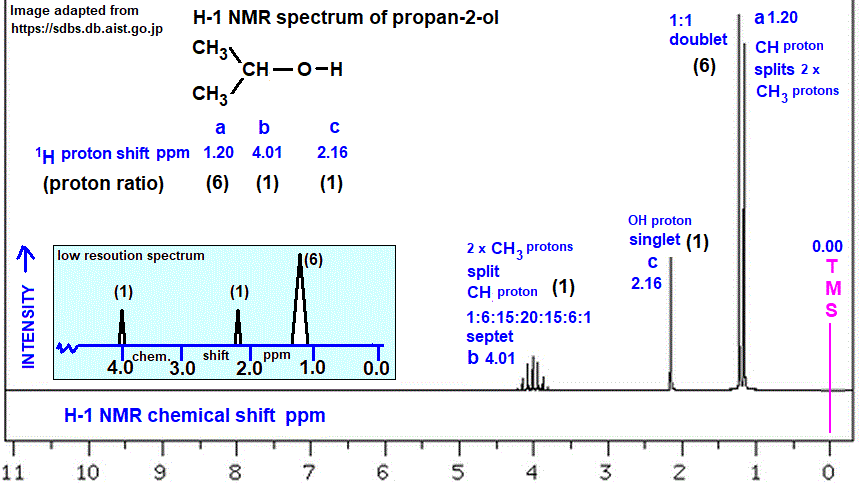
1H NMR SPECTRA (above): The 1H NMR spectra of
all three molecules give different integrated proton ratios for the
different 1H chemical environments i.e. the proton
ratios are as follows: propan-1-ol
3:2:2:1; propan-2-ol 6:1:1 and methoxyethane
3:2:3. Therefore, all three can be distinguished by their
1H NMR spectra. |
|
|
 |
 |
Comparing the
carbon-13 NMR
spectra of
propan-1-ol,
propan-2-ol and
methoxyethane
Propan-1-ol,
propan-2-ol and methoxyethane
are structural isomers of molecular formula C3H8O
Propan-1-ol,
propan-2-ol and methoxyethane exemplify the carbon-13 NMR spectra of
members of the lower members of the homologous series of aliphatic
alcohols and ethers |
|
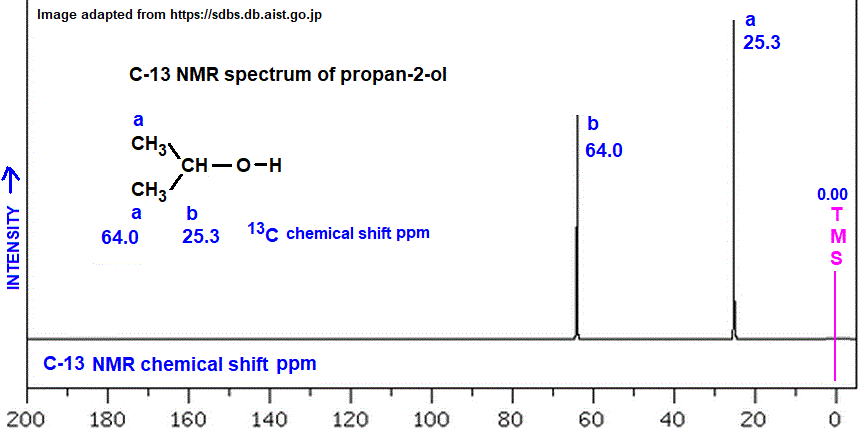
13C NMR SPECTRA
(above): The
13C NMR spectra of propan-1-ol and methoxyethane show
three different 13C NMR chemical shifts, but
propan-2-ol can be distinguished from the other two by
exhibiting only two chemical shift lines. You would need other
spectral data to distinguish propan-1-ol and methoxyethane. |
Key words & phrases: 1-propanol n-propyl
alcohol
Interpreting the C-13 NMR spectra of propan-1-ol, C-13 nmr spectrum of
propan-1-ol, understanding the
carbon-13 nmr spectrum of propan-1-ol, explaining the line pattern in the high
resolution C-13 nmr spectra of propan-1-ol, revising the C-13 nmr spectrum of
propan-1-ol, ppm
chemical shifts of the C-13 nmr spectrum of propan-1-ol, how to construct the diagram of
the C-13 nmr spectrum of propan-1-ol, how to analyse the chemical shifts in the
carbon-13 NMR spectrum of propan-1-ol deducing the chemical environment of all the
carbon atoms in propan-1-ol examining the c13 nmr spectrum of propan-1-ol analysing the
13-c nmr spectrum of propan-1-ol how do you sketch and interpret the C-13 NMR
spectrum of propan-1-ol 1-propanol n-propyl alcohol
isomer of molecular formula C3H8O Molecular structure diagram of the
carbon-13 NMR diagram for the 13C NMR spectrum of propan-1-ol 1-propanol. Deducing the number
of different chemical environments of the carbon atoms in the propan-1-ol
1-propanol molecule
from the 13C chemical shifts in the carbon-13 NMR spectrum of propan-1-ol
1-propanol. Revision
notes on the carbon-13 NMR spectrum of propan-1-ol 1-propanol. Matching and deducing the
structure of the propan-1-ol 1-propanol molecule from its 13C NMR spectrum.
Carbon-13 NMR spectroscopy of aliphatic alcohols
13C NMR spectra of propan-1-ol 1-propanol, an isomer of molecular formula
C3H8O Explanatory diagram of the 13C C-13 carbon-13 NMR spectrum of the 2-propanol propan-2-ol molecule in terms of its molecular structure. Listing data of all the chemical shift peaks in ppm in the carbon-13 NMR spectrum of 2-propanol propan-2-ol. How to explain the C-13 NMR spectrum of 2-propanol propan-2-ol. How to deduce the number of different carbon atom environments in the 2-propanol propan-2-ol molecule from its carbon-13 NMR spectrum to help work out the molecular structure of the 2-propanol propan-2-ol molecule. The uses and distinctive features of the carbon-13 NMR spectrum of the 2-propanol propan-2-ol molecule explained. What does the c-13 carbon-13 NMR spectrum tell us about the 2-propanol propan-2-ol molecule?
How do you interpret the chemical shifts of the C-13 NMR spectrum
of propan-1-ol How to interpret the C-13 NMR spectrum of propan-1-ol Explanatory diagram of the 13C C-13 carbon-13 NMR spectrum of the number of different carbon atom
environments in the propan-1-ol molecule from its carbon-13 NMR spectrum to
help work out the molecular structure of the propan-1-ol molecule? The uses
and distinctive features of the carbon-13 NMR spectrum of the
propan-1-ol
molecule explained. What do the number and values of the chemical
shifts from the c-13 carbon-13 NMR spectrum tell us about the
propan-1-ol
molecule? explaining the decoupled carbon-13 NMR spectrum of
propan-1-ol
with a detailed interpretation diagram of all the C-13 chemical shifts and
intensities
ANSWERS to the Practice Multiple
Choice Questions based on the 13C NMR spectrum of propan-1-ol
If you think there are any errors
email doc b
asap
Q1.
How many signals appear in the decoupled ¹³C NMR spectrum of propan-1-ol?
-
2
-
3
-
4
-
5
Answer: B.
Q2.
Why do all signals appear as singlets in ¹³C NMR?
-
Proton decoupling removes
splitting
-
Carbons have no protons
-
Solvent effect
-
Instrument resolution
Answer: A.
Q3.
Which of the following only has two signals in its 13C NMR spectrum?
-
Propan-2-ol
-
Propanal
-
Propanoic acid
-
Propanone
Answer: D.
Q4.
Why does OH not give a signal in
13C NMR?
-
It has no carbon atom
-
It exchanges with solvent
-
It is too broad
-
It overlaps with CH3
Answer: A.
Q5.
Which 13C signal would be absent in propanone compared to
propan-1-ol?
-
~60 ppm CH2OH
-
~20 ppm CH2
-
~10 ppm CH3
-
~200 ppm C=O
Answer: A.
Q6.
Which statement about ¹³C NMR integration is correct?
-
It gives proton ratios
-
It gives carbon ratios
-
It is not reliable for
quantitative analysis
-
It always equals 1:1
Answer: C.
If you think there are any errors
email doc b
asap
Links associated
with
propan-1-ol
(1-propanol)
The chemistry of ALCOHOLS
revision notes INDEX
The infrared spectrum of Propan-1-ol (1-propanol,
n-propyl alcohol)
The mass spectrum of Propan-1-ol (1-propanol,
n-propyl alcohol)
The H-1 NMR spectrum of Propan-1-ol (1-propanol,
n-propyl alcohol)
C-13
NMR spectroscopy index
Isomers of molecular formula C3H8O
(Mr = 60)
ALL SPECTROSCOPY INDEXES
All my pre-university Advanced Organic
Chemistry Notes
Use My Google search site box
Email doc b:
chem55555@hotmail.com
Website content © Dr Phil Brown
2000+. All copyrights reserved on revision notes, images, quizzes, worksheets
etc. Copying of Doc Brown's pre-university/college advanced level chemistry website
material is NOT permitted. Exam revision summaries & references to chemistry
course specifications are unofficial. These organic chemistry revision notes on
the spectroscopy of propan-1-ol (1-propanol) - its 13C NMR spectrum are
suitable for use of pre-university students studying AQA advanced level
chemistry, Edexcel advanced level chemistry, OCR advanced level chemistry, IB
advanced level chemistry, WJEC (Eduqas) advanced level chemistry, CIE Cambridge advanced level chemistry, US grade 11-12 AP honors
chemistry courses and they will also prove useful to
1st year undergraduate students of chemistry. |
