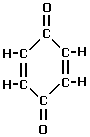
|
10. Other miscellaneous Organic Redox
Reactions
This is a
'collection' of reactions not dealt with in sections 8. and 9.
They
may/may not be useful reactions.
Section 10.
reaction sub–index
10.1 Cannizzaro reaction
10.2
aldehydes/ketones tests
10.3
Combustion
10.4 Fuel cells
10.5
Use of
1,4–dihydroxybenzene (quinol, hydroquinol) in photography
-
10.1 The Cannizzaro reaction
-
Aldehydes
which do not have a hydrogen atom on the carbon next to the carbon
of the carbonyl group (C=O) undergo the Cannizzaro reaction with
concentrated aqueous sodium hydroxide in which one molecule
of the aldehyde is reduced to a primary alcohol and another is
oxidised to the sodium salt of a carboxylic acid.
-
This is
an organic example of disproportionation in which the same
carbon atoms of the reactant molecule simultaneously increase and
decrease their oxidation state e.g.
-
10.2 Simple chemical tests to distinguish aldehydes from ketones
-
The tests
depend on the relative redox stability of ketones compared to the
much more readily oxidised aldehydes. These tests also give
positive results with many reducing sugars and some rather more
stable aromatic aldehydes e.g. benzaldehyde, may not give a positive
result at all.
-
In these tests, because
aldehydes are stronger reducing agents than ketones, they reduce the
metal ion and are oxidised in the process i.e. RCHO + [O] ==>
RCOOH, a change which is equivalent to a 2 electron loss by the
RCHO.
-
Tollens
reagent is a colourless solution of silver nitrate in aqueous
ammonia.
-
When an aldehyde is warmed with
Tollens reagent it is oxidised to a
carboxylic acid and the silver ion (in ammine complex form) is
reduced to silver, forming a silver mirror on the side of the test tube.
-
2[Ag(NH3)2]+(aq)
+ R–CHO(aq) + H2O(l) ==>
2Ag(s) + 4NH3(aq) + R–COOH(aq)
+ 2H+(aq)
-
simplified:
2Ag+(aq)
+ R–CHO(aq) + H2O(l) ==>
2Ag(s) + R–COOH(aq)
+ 2H+(aq)
-
or
2[Ag(NH3)2]+(aq)
+ R–CHO(aq) + 2OH–(aq) ==>
2Ag(s) + 4NH3(aq) + R–COOH(aq) +
H2O(l)
-
simplified:
2Ag+(aq)
+ R–CHO(aq) + 2OH–(aq) ==>
2Ag(s) + R–COOH(aq) +
H2O(l)
-
Fehlings or
Benedict's solution consists of a copper(II) ion complexed with
an organic carboxylic acid.
-
The deep blue copper(II) ion in the
complex is reduced to a red–brown precipitate of copper(I) oxide.
-
Ketones show no reaction
due to their greater oxidation stability.
-
2Cu2+(complex/aq)
+ R–CHO(aq) + 2H2O(l)
==> Cu2O(s) + R–COOH(aq) + 4H+(aq)
-
or
-
2Cu2+(complex/aq)
+ R–CHO(aq) + 4OH–(aq)
==> Cu2O(s) + R–COOH(aq) + 2H2O(l)
-
Ketones show no reaction because of their
greater reluctance to oxidation.
-
There are lots more
organic chemical tests described –
Chemical Identification Tests (with alphabetical index).
-
10.3 All
organic compound air/oxygen combustion reactions are oxidations
-
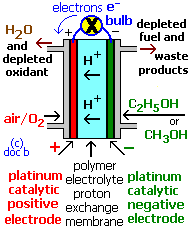 10.4
Organic Fuel Cells 10.4
Organic Fuel Cells
-
Many hydrocarbon
molecules are burned as fuels, but since it is a redox reaction,
theoretically it can be done as a combined half–cell oxidation/reduction electron transfer reaction.
-
In practice organic compounds can be oxidised by oxygen
in a way that can be used to generate electricity directly in a fuel cell
(right diagram) rather than release the energy as heat e.g.
-
In reaction 9.1(a)
ethanol was oxidised to ethanoic acid by acidified potassium
dichromate(VI). The same result can be
obtained by reaction of ethanol with oxygen in a fuel cell.
-
The reaction is very exothermic,
so ethanol is a good source of chemical potential energy.
-
Ethanol is used directly as a fuel in a direct ethanol fuel cell (a
DEFC fuel cell).
-
(i)
CH3CH2OH(aq)
+ O2(g) ==> CH3COOH(aq) + H2O(l)
(ΔHØ = –494 kJ mol–1)
-
The half–cell
reactions are:
-
(ii) Reduction,
+ve electrode:
-
O2(g) + 4H+(aq)
+ 4e– ==> 2H2O(l) (EØ
= +1.23V)
-
(iii) Oxidation,
–ve electrode:
-
CH3CH2OH(l)
+ H2O(l) ==> CH3COOH(aq)
+ 4H+(aq) + 4e– (EØ
= +0.06V)
-
Adding (ii)
+ (iii) = equation (i) so ...
-
The reactions must
take place on catalytic electrodes made of platinum and other
transition metals and here the inner 'electrolyte' is as a polymer
proton exchange membrane of the fuel cell (a PEFC fuel cell), though it can be a
concentrated phosphoric acid solution (in a PAFC fuel cell).
-
The electrons will
flow through the external circuit from the –ve electrode to the
+ve electrode.
-
Free energy
change: ΔGØ = –nEØF
-
= – 4 x 1.17 x 96500
= –451620 J mol–1 =
–451.6 kJ mol–1
-
n = number
of electrons transferred, EØ = cell voltage,
F
= Faraday constant in C mol–1 coulombs/mole
-
This sort of
chemistry is being developed to make reasonably efficient portable
fuel cells
-
Commercially developed fuel cells will
hopefully convert the ethanol completely into water and
carbon dioxide to give a greater and more efficient energy output, but
its still generates a
voltage of 1.0–1.2V per cell, in this case ...
-
(i) Oxidation,
–ve electrode: C2H5OH(l) +
3H2O(l) ==> 12H+(aq)
+ 2CO2(aq/g) + 12e–
-
(iii) Reduction,
+ve electrode: 3O2(aq/g) + 12H+(aq)
+ 12e– ==> 6H2O(l)
-
adding (i) + (iii)
gives: C2H5OH(l) + 3O2(aq/g)
==> 3H2O(l) + 2CO2(aq/g)
-
+ other organic
products as the reaction is not completely efficient.
-
The cells can
obviously be connected in series to give larger voltages.
-
The ethanol
('alcohol', C2H5OH) can be bio–sourced from
sugar beet, potatoes and cereal crops and other plant material that
can fermented with enzymes. The ethanol is fractionally distilled from
the fermented mixture and constitutes a renewable fuel.
-
However there seems to
have been more work done? on the Direct Methanol Fuel Cell (a DMFC
fuel cell),
though there are concerns over methanol's toxicity and the very costly
platinum catalytic electrodes required, but the DMFC is essentially like the DEFC described above and
the principles illustrated in the
diagram.
-
Methanol can be synthesised in the
reforming reaction:
CO(g) + 2H2(g)
==> CH3OH(l)
-
half–cell
reactions for the DMFC cell:
-
(i) Reduction, +ve electrode:
-
(ii) Oxidation,
–ve electrode:
-
so overall the
cell reaction is ... with a maximum output voltage of about 1.0V.
-
CH3OH(aq)
+
3/2O2(g) ==> CO2(aq/g)
+ 3H2O(l)
-
Hopefully,
efficient cells using ethanol can be developed because ethanol
compared to methanol has a higher energy density (e.g. kJ/kg), is less
toxic and can be bio–resourced as a renewable fuel.
-
There is a huge
amount of research going on in fuel cell development to try to use cheaper,
but equally effective tiny particle metal catalysts of Fe, Co and Ni
instead of costly platinum, but the most efficient metals are still
the most costly?
-
10.5 The
use of 1,4–dihydroxybenzene
(p–quinol, hydroquinol)
in photography
-
1,4–dihydroxybenzene (Quinol) is an ingredient in photographic
developing solutions. In the transparent plastic emulsion film of
the exposed film it will reduce the silver ions in silver halide
salts, (which have not already been decomposed by light to silver
and bromine), to silver as well. It would appear that these extra
silver atoms produced by the developer, cluster around the already
formed silver atoms (acting as 'nuclei') from the action of light,
to enhance the image in 'shades' and 'contrast' to give a more
clearly defined negative.
-
The relevant
half–cell reactions and their standard redox electrode potentials
are ...
-
AgBr(s) +
e– ==> Ag(s) + Br–(aq)
(EθAg/AgBr
= +0.073V at 298K)
-
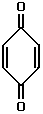 (aq)
+ 2H+(aq) + 2e– ==> (aq)
+ 2H+(aq) + 2e– ==>
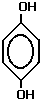 (aq)
(EθQ/QH2
= +0.059V (at 298K, pH 8.5) (aq)
(EθQ/QH2
= +0.059V (at 298K, pH 8.5)
-
These two
organic molecules are referred to by a variety of systematic and
trivial names, confusing when searching the web! e.g.
-
left (ref Q): 2,5–cyclohexadiene–1,4–dione, p–quinone, ('one' higher
ranking than 'ene')
-
right (ref QH2):
1,4–dihydroxybenzene, 1,4–benzenediol, benzene–1,4–diol,
p–quinol, p–hydroquinone, p–dihydroxybenzene
-
It is convention
to show the half–cell reactions as reductions when quoting them with
the half–cell potential.
-
In the reactions
the silver ions in the silver bromide salt are reduced to silver
atoms and 1,4–dihydroxybenzene (quinol) is oxidised to
2,5–cyclohexadiene–1,4–dione (quinone). The bromide ions 'dissolve'
and two hydrogen ions are released from the quinol. Therefore the
basic reaction via the alkaline developer is ....
-
(aq)
+ 2AgBr(s) ==>
(aq)
+ 2Ag(s) + 2Br–(aq) + 2H+(aq)
-
Sometimes more
simply written as ...
-
C6H4(OH)2(aq)
+ 2AgBr(s) ==> C6H4O2(aq)
+ 2Ag(s) + 2HBr(aq)
-
Eθreaction
= Eθred – Eθox = EθAgBr/Ag
– EθQ/QH2
-
Eθreaction
= (+0.073) – (+0.059) = +0.014V
-
The positive
value for Eθreaction shows the reaction is
feasible. In fact the EθQ/QH2 becomes less
positive as the pH is increased making the reaction more feasible,
but the EAgBr/Ag is theoretically independent of pH. The
hydrogen ions would be neutralised by the alkaline media.
-
Oxidation
number analysis for the molecules in question is shown below ...

-
Note: Not
all the silver bromide reacts in this way, so in the fixing process
the remaining silver bromide is removed by sodium thiosulfate to
produce the 'light stable' negative.
-
The
transition metal complex ion [Ag(S2O3)2]3–(aq)
is formed when sodium thiosulfate (Na2S2O3)
is used to remove unreacted silver bromide (AgBr) crystals in developing
photographic films.
-
AgBr(s) +
2S2O32–(aq)
==> [Ag(S2O3)2]3–(aq)
+ Br–(aq)
-
This is NOT a redox
reaction, Ag is +1 and Br is –1 throughout the reaction. The
thiosulfate ion is here acting as a ligand and not a
reducing agent e.g. like its reaction with iodine.
TOP OF PAGE and
sub-index
11. Oxidation state
of carbon in organic compounds
Usually the oxidation state
of hydrogen is +1, and oxygen –2 in organic compounds, but carbon's
oxidation state is variable.
This section should enable
you to answer questions such as 'what is the oxidation state of carbon
in methane?', 'what is the oxidation state of carbon in methanol?',
''what is the oxidation state of carbon in methanol?', 'what is the
oxidation state of carbon in methanoic acid?', ''what is the oxidation
state of carbon in ethane?', ''what are the oxidation states of carbon
in ethanol?', ''what are the oxidation states of carbon in ethanal?',
''what are the oxidation states of carbon in ethanoic acid?', ''what is
the oxidation state of carbon in ethene?', ''what are the oxidation
states of carbon in propene?',
(The quoted
Pauling electronegativities are C = 2.5, H = 2.2 and O
= 3.5 which gives the lead in assigning oxidation numbers in this
section i.e. the highest oxidation state is assigned to the least
electronegative atom and vice versa for hydrogen and oxygen BUT beware
for carbon, logical deduction can give some surprising, but correct
results!)
On this basis you can
achieve a useful oxidation number analysis of simple organic compounds
in an oxidation sequence e.g. the oxidation sequence below, with
oxidation state of
carbon in ()
with hydrogen
(+1) and oxygen (-2).
CH4
(–4) == ox'n ==> CH3OH
(–2) ==
ox'n ==> HCHO (0)
== ox'n ==> HCOOH (+2) ==> CO2
(+4)
The above
sequence can described in terms of the 'level of the functional group'
which is equal the number of bonds the carbon atom forms with more
electronegative atoms like oxygen.
Therefore in the above sequence:
alkane hydrocarbons are level zero
(carbon and hydrogen have virtually the same electronegativity
alcohols are level 1 (C–OH, as are halogenoalkanes/haloalkanes e.g. C–Cl)
carbonyl is
level 2 (e.g. C=O in aldehydes/ketones)
carboxylic acids are
level 3 (C=O and C–OH)
and finally the fully oxidised carbon in
carbon dioxide is level 4.
Note that these levels equate
with a 'functional group level' and applies
to a single carbon atom e.g. the carbon of the functional group, and
not the full molecule. (See
Appendix 1.)
Similarly for
the oxidation sequence from ethane to ethanoic acid ...
CH3CH3 (–3,–3)
= ox'n => CH3CH2OH (–3,–1) =
ox'n => CH3CHO (–3,+1)
= ox'n => CH3COOH (–3,+3)
In terms of oxidation
states, as far as I can tell, in most organic compounds, hydrogen always
seems to be +1 and oxygen –2 (except in e.g. organic peroxides
R-O-O-R, R = alkyl or aryl)
Note the rise of
carbon's oxidation state in increments of 2, see oxidation equations for
acidified potassium dichromate(VI) reaction with alcohols and aldehydes
in
section 9.1(a) where the half–cell
oxidation equations involve a 2 electron loss from the organic molecule.
Other organic molecules
and redox sequences can be similarly 'analysed'
ethene H2C=CH2
(–2,–2) + H2
(0) == reduction/Ni
==> ethane CH3–CH3 (–3,–3), (+1)
propene CH3–CH=CH2
(–3,–1,–2) + H2 == reduction/Ni ==> CH3–CH2–CH3
(–3,–2,–3)
ethanol CH3–CH2–OH
(–3,–1) == ox'n
==> ethanal CH3CHO (–3,+1)
== ox'n ==> CH3COOH (–3,+3)
TOP OF PAGE and
sub-index
Appendix 1. The Concept of Functional Group
Level
-
This concept of
functional group level has been introduced into some UK A level
pre–university courses.
-
It is
related to an increase in the oxidation state of carbon.
-
As the oxidation state of a carbon atom is increased by combining
with a more electronegative atom, so the functional group level is
increased.
-
In the explanation with
examples below assume R = a H, alkyl or aryl grouping.
-
The concept of
functional group level of a carbon atom is derived from counting
the number of bonds of an individual carbon atom to
electronegative atoms X,
i.e. C-X
-
If no such C–X bonds
exist the carbon is described as being at the hydrocarbon level.
-
With one C–X bond
the carbon atom is at the alcohol level e.g. alcohols (C–OH),
monohaloalkanes (R3C–Cl) and ethers (R3C–O–CR3)
where R is alkyl.
-
With two C–X bonds
the carbon atom is at the carbonyl level e.g. aldehydes and
ketones (R2C=O) and dihydroxy compounds with the >C(OH)2
grouping.
-
With three C–X bonds
the carbon atom is at the carboxylic acid level RCOOH (RO–C=O
grouping), esters RCOOR, amides RCONH2, nitrile RCN (RC≡N),
X is O or N.
-
Finally with four C–X
bonds we reach the carbon dioxide level e.g. carbon dioxide
itself CO2 or an ether such as C(OR)4
-
The concept of
functional group level often applies to a single carbon atom, not
the whole molecule e.g.
-
alcohol COH,
chloroalkane C–Cl, aldehyde CHO,
-
carboxylic acid
level: carboxylic acid COOH, amide CONH2,
-
but not exclusively
e.g. C=C in alkenes, but would this would be considered at the
hydrocarbon level despite being at a higher oxidation state than
a saturated alkane? (see
section 11).
-
If a reaction takes
place within a level you are swapping one heteroatom (non–carbon
atom) for another
-
In order to move a
carbon atom up a level requires an oxidizing agent (dealt with
on this page in
section 9).
-
e.g. the oxidation
of alcohols using acidified potassium dichromate(VI) solution
-
R–CH2OH == Cr2O72–/H+
==> RCHO == Cr2O72–/H+
==> RCOOH
-
alcohol level ==>
carbonyl level ==> carboxylic acid level
-
To move a carbon atom
down a level requires a reducing agent (dealt with in
section 8) or carbanion equivalent (not dealt
with yet)
-
e.g. the reduction
of carboxylic acids to primary alcohols with lithium
tetrahydridoaluminate(III)
-
RCOOH + 4[H]
==> RCH2OH + H2O
-
In this case the
carbon atom of the functional group is reduced two levels i.e.
from the carboxylic level to the alcohol level.
Learning objections for
redox reactions involving organic molecules
Know that organic synthesis can involve redox
reactions, that is synthesis routes employing oxidising agents and
reducing agents, often to change or form a different organic
functional group.
Know that reducing agents can be selective - don't
assume they can reduce any molecule capable of being reduced.
Know which reducing agents can be used for a
particular reduction synthesis reactions.
Know and be able to describe and explain the
reduction of alkenes to alkanes with hydrogen and nickel catalyst.
Know and be able to describe and explain that
aldehydes can be reduced to primary alcohols and ketones reduced to
secondary alcohols using sodium tetrahydridoborate(III), NaBH4 (sodium borohydride)
Know and be able to describe and explain that
carboxylic acids can be reduced to primary alcohols using lithium
tetrahydridoaluminate(III), LiAlH4, (lithium aluminium tetrahydride).
Know and be able to describe and explain that
nitriles can be reduced to primary aliphatic amines using lithium
tetrahydridoaluminate(III), LiAlH4, (lithium aluminium tetrahydride).
Know and be able to describe and explain that
nitroaromatic compounds can be reduced to primary aromatic amines
using tin/hydrochloric acid or lithium tetrahydridoaluminate(III),
LiAlH4, (lithium aluminium tetrahydride).
Know which oxidising agents can be used for a
particular oxidation synthesis reactions.
Know and be able to describe and explain the
oxidation of primary alcohols to aldehydes and carboxylic acids and
the oxidation of secondary alcohols to ketones and know that
tertiary alcohols resist oxidation until the carbon chain is broken.
Know and be able to describe and explain that alkyl
groups directly attached to a benzene ring are completely oxidised
to leave a carboxylic acid group i.e. an aromatic carboxylic acid is
formed.
Know and be able to describe and explain the tests
for aldehydes and ketones.
Know and be able to describe and explain the use of
organic molecules in fuel cells and appreciate the redox chemistry
involved.
Know and be able to appreciate that carbon exhibits
different oxidation states in organic compounds e.g. -4, -2, 0 and
+2.
Know and be able to describe, understand and explain
the concept of functional group level e.g.
hydrocarbon level ==> alcohol level ==>
carbonyl level (aldehydes/ketones) ==> carboxylic acid level
Know and be able to describe and explain the
Know and be able to describe and explain the
[SEARCH
BOX]
QUIZ on oxidation state
|
Website content © Dr Phil Brown
2000+. All copyrights reserved on revision notes, images, quizzes,
worksheets etc. Copying of website material is NOT permitted. Doc
Brown's Chemistry theoretical-physical chemistry revision notes for
pre-university level students on redox reactions and oxidation
states,
Doc
Brown's Chemistry
Advanced Level Theoretical-Physical-Organic Chemistry
revision notes on analysing organic molecule redox reactions, Explaining the
importance of oxidation & reduction reactions in organic chemistry for theoretical chemistry exam questions, What you need to know about
oxidation & reduction reactions in organic chemistry for theoretical chemistry, Explaining the use of
oxidation & reduction reactions in organic chemistry knowledge in
theoretical chemistry exam questions, Examples of oxidation & reduction
reactions in organic chemistry explained when studying
theoretical chemistry, What is the significance and use of oxidation &
reduction reactions in organic chemistry in theoretical
chemistry, describing and explaining the theory behind the study of
oxidation & reduction reactions in organic chemistry,
exam revision notes on oxidation & reduction reactions in organic
chemistry for exams, online help for the oxidation & reduction reactions
in organic chemistry topic,
revision notes for oxidation & reduction reactions in organic chemistry, what do I need to learn for
oxidation & reduction reactions in organic chemistry in exams?
revision summary for oxidation & reduction reactions in organic chemistry, help in teaching
oxidation & reduction reactions in organic chemistry, learning notes for
oxidation & reduction reactions in organic chemistry,
help to pass exam questions involving oxidation & reduction reactions in
organic chemistry, help to prepare for examination questions on
oxidation & reduction reactions in organic chemistry? Explaining the
importance of how to balance redox equations in organic chemistry for theoretical chemistry exam questions, What you need to know about
how to balance redox equations in organic chemistry for theoretical chemistry, Explaining the use of
how to balance redox equations in organic chemistry knowledge in
theoretical chemistry exam questions, Examples of how to balance redox
equations in organic chemistry explained when studying
theoretical chemistry, What is the significance and use of how to
balance redox equations in organic chemistry in theoretical
chemistry, describing and explaining the theory behind the study of how
to balance redox equations in organic chemistry,
exam revision notes on how to balance redox equations in organic
chemistry for exams, online help for the how to balance redox equations
in organic chemistry topic,
revision notes for how to balance redox equations in organic chemistry, what do I need to learn for
how to balance redox equations in organic chemistry in exams?
revision summary for how to balance redox equations in organic chemistry, help in teaching
how to balance redox equations in organic chemistry, learning notes for
how to balance redox equations in organic chemistry,
help to pass exam questions involving how to balance redox equations in
organic chemistry, help to prepare for examination questions on
how to balance redox equations in organic chemistry? Explaining the
importance of deducing oxidation state of carbon in organic compounds for theoretical chemistry exam questions, What you need to know about
deducing oxidation state of carbon in organic compounds for theoretical chemistry, Explaining the use of
deducing oxidation state of carbon in organic compounds knowledge in
theoretical chemistry exam questions, Examples of deducing oxidation
state of carbon in organic compounds explained when studying
theoretical chemistry, What is the significance and use of deducing
oxidation state of carbon in organic compounds in theoretical
chemistry, describing and explaining the theory behind the study of
deducing oxidation state of carbon in organic compounds,
exam revision notes on deducing oxidation state of carbon in organic
compounds for exams, online help for the deducing oxidation
state of carbon in organic compounds topic,
revision notes for deducing oxidation state of carbon in organic
compounds, what do I need to learn for deducing oxidation
state of carbon in organic compounds in exams?
revision summary for deducing oxidation state of carbon in organic
compounds, help in teaching deducing oxidation state of
carbon in organic compounds, learning notes for deducing
oxidation state of carbon in organic compounds,
help to pass exam questions involving deducing oxidation state of carbon
in organic compounds, help to prepare for examination questions on
deducing oxidation state of carbon in organic compounds? Explaining the
importance of explaining the functional group level concept in organic
chemistry in terms of the oxidation state of carbon for theoretical chemistry exam questions, What you need to know about
explaining the functional group level concept in organic
chemistry in terms of the oxidation state of carbon for theoretical chemistry, Explaining the use of
explaining the functional group level concept in organic
chemistry in terms of the oxidation state of carbon knowledge in
theoretical chemistry exam questions, Examples of explaining the
functional group level concept in organic chemistry in terms
of the oxidation state of carbon explained when studying
theoretical chemistry, What is the significance and use of explaining
the functional group level concept in organic chemistry in
terms of the oxidation state of carbon in theoretical
chemistry, describing and explaining the theory behind the study of
explaining the functional group level concept in organic
chemistry in terms of the oxidation state of carbon,
exam revision notes on explaining the functional group level concept in
organic chemistry in terms of the oxidation state of carbon for exams, online help for the
explaining the functional group level concept in organic
chemistry in terms of the oxidation state of carbon topic,
revision notes for explaining the functional group level concept in
organic chemistry in terms of the oxidation state of carbon, what do I need to learn for
explaining the functional group level concept in organic
chemistry in terms of the oxidation state of carbon in exams?
revision summary for explaining the functional group level concept in
organic chemistry in terms of the oxidation state of carbon, help in teaching
explaining the functional group level concept in organic
chemistry in terms of the oxidation state of carbon, learning notes for
explaining the functional group level concept in organic
chemistry in terms of the oxidation state of carbon,
help to pass exam questions involving explaining the functional group
level concept in organic chemistry in terms of the oxidation
state of carbon, help to prepare for examination questions on
explaining the functional group level concept in organic
chemistry in terms of the oxidation state of carbon? |
|


 On addition of conc.
sodium hydroxide (a strong soluble base) the amine separates out as an oily layer and the mixture is
heated with the steam input via the procedure known as steam distillation.
The addition of an alkali is necessary because the phenylamine base is
soluble in the excess acid.
On addition of conc.
sodium hydroxide (a strong soluble base) the amine separates out as an oily layer and the mixture is
heated with the steam input via the procedure known as steam distillation.
The addition of an alkali is necessary because the phenylamine base is
soluble in the excess acid.
 + 6[O] ==>
 + 2H2O
 and
and