|
10. Simple Cells and batteries
(A) Introduction to what
a simple battery does
How a simple cell can be
used as a battery is explained, using the different reactivities of two
metal strips.
How can you make a simple battery, how can you use a simple
cell to investigate the reactivity series of metals.
What is the
difference between rechargeable and non-rechargeable batteries, how to
make a simple copper-zinc cell, how to make a simple copper-magnesium
cell.
These revision notes on how simple cells and batteries
work
should prove useful for the new AQA chemistry, Edexcel chemistry & OCR
chemistry GCSE (9–1, 9-5 and 5-1) science courses.
-
In electrolysis,
electrical energy is taken in (endothermic) to enforce the oxidation and
reduction to produce the products at the electrodes.
-
The chemistry of simple
voltaic
cells or batteries is in principle the opposite of electrolysis.
-
Inside an electrochemical cell or battery are
chemicals
that react together to produce electricity.
-
The reactants constitute a
supply of chemical potential energy to be converted into electrical energy.
-
A cell will produce a
potential difference (p.d. voltage) until one
of the reactants is all used up, then, quite obviously, the reaction
cannot continue.
-
An oxidation-reduction (redox) reactions occurs
at electrodes to produce products and energy is given out because it is an exothermic
reaction,
-
 A
simple electrochemical cell can be
made by dipping two pieces of
different metals (must
be metals of different reactivity - different potential to produce an
electrical potential), connected by a wire, into
a solution of ions e.g. a salt or dilute acid which will act as an
electrolyte. A
simple electrochemical cell can be
made by dipping two pieces of
different metals (must
be metals of different reactivity - different potential to produce an
electrical potential), connected by a wire, into
a solution of ions e.g. a salt or dilute acid which will act as an
electrolyte.
-
The electrolyte is a solution of
charged particles - ions, that can carry an electric current - can be a
salt solution of dilute acid.
-
The external wire and voltmeter
completes the circuit - as in physics!
-
The two pieces of metal can be held in
crocodile clips and acts as electrodes - the electrical contacts with the
electrolyte solution - at least one must react, one may be inert, but they
both usually react as part of the electrochemical cell chemistry.
-
The arrangement is shown in the simple
diagram of simple cell (right)
-
If you connect several cells together in
series, the voltage is increased.
-
If the metals have different
reactivities, then an electrical current is generated as long as the circuit
is complete as illustrated above on the right.
-
You need is a
solution of charged positive and negative particles called ions e.g.
sodium Na+,
chloride Cl–, hydrogen H+, sulfate SO42–
in the electrolyte solution
etc.
-
The greater the difference in
reactivity of the two metals, the bigger the cell voltage produced.
-
If you use the same metal for
both strips, their chemical potentials 'cancel' each other out, so no potential difference (voltage
= 0 V)
so no current of electrical energy.
-
If you connect several cells together,
identical or different, you can add up the individual cell voltages
to give the total p.d. in volts AND
you might light up a bulb! having made a crude battery!
-
You can predict the potential difference (p.d. in volts) by
subtracting one metal potential from another to give the theoretical cell
voltage.
-
Examples of how
to think, i.e. predict the voltage of a very simple cell.
 Ignore the highly reactive metals like potassium, sodium
and calcium - impractical because they rapidly react with water, but lots of
other pairs can be used in simple school experiments e.g. Ignore the highly reactive metals like potassium, sodium
and calcium - impractical because they rapidly react with water, but lots of
other pairs can be used in simple school experiments e.g.
Pairing magnesium with copper will give a potential difference
of 2.69 V (from +0.34 - - 2.35 V theoretically!), one of the biggest voltages
possible from the list on the right.
Pairing iron and tin will give a theoretical p.d. of 0.30 V, one
of the lowest possible from the list (-0.15 - -0.45 V).
Note that you subtract
one electrode potential voltage from the other i.e. calculate the difference
between them. You get a + or - answer depending on which way round you do the
calculation. At this level, its the number that's important irrespective of the
sign.
See other pages for the
full chemistry of the reactivity series of metals
TOP OF PAGE
and sub-index
 (B) A simple cell experiment to investigate
the effects of using different pairs of metals (B) A simple cell experiment to investigate
the effects of using different pairs of metals
-
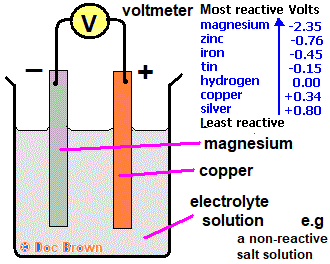
A simple
demonstration cell can be
made by e.g. dipping strips of magnesium and copper metals into an inert salt solution
(or dilute sulfuric acid) and connecting them via a voltmeter (e.g. as in diagram) and a voltage is
readily recorded.
-
The electrolyte here is a
non-reactive aqueous of a salt, but it will work with a very dilute
sulfuric acid solution.
-
(You can experiment with different
electrolytes and see which one gives the greatest p.d. in volts,)
-
The electrode
half-equations are:
-
at the (+)
electrode 2H+(aq) + 2e–
===>
H2(g)
-
(hydrogen ions
reduced on the surface
of the copper because there are no copper ions to be reduced)
-
above is the hydrogen ion -
hydrogen half-equation
-
here the
copper is inert and the hydrogen ions come from water/acid
and end up as bubbles of hydrogen.
-
You won't see a copper
deposit on the magnesium.
-
at the (–)
electrode Mg(s) – 2e–
===> Mg2+(aq)
-
(magnesium atoms
oxidised, the
electrons run round the wire to reduce the hydrogen ions from water
or acid)
-
above is the magnesium atom
- magnesium ion half-equation
-
the
magnesium dissolves into solution by the electrode chemical reaction
-
Each of the above
equations is called a half–cell reaction, because that's what it is
– half the chemical change.
-
It
is these electrode equations involving oxidation and reduction which
explain how the electrical current is generated.
-
So, overall the
overall redox
reaction is ...
-
and the
electrons from the oxidation of the magnesium move round through the
magnesium strip, along the external wire to the copper electrode.
-
In
this case the copper strip just acts as an electrical connection and
doesn't chemically change, but hydrogen ions from the water or
acid do.
-
Note the (+) and
(–) polarity of the electrodes in a cell, is the opposite of
electrolysis because the process is operating in the opposite
direction i.e.
-
in
electrolysis electrical energy induces chemical changes,
-
but in a
cell, chemical changes produce electricity.
-
The electrode potential of each
metal is a measure of its chemical reactivity - the more negative or
less positive, the more reactive the metal and the greater the
difference in the two metal strips, the larger the p.d. in volts
created.
-
Theoretically you can generate a
p.d. of 2.35 V, unlikely
to be that high, but it should work and give you a voltage!
-
I think this might work with just
a carbon rod instead of copper - check that out!
-
If so, you could establish a
reactivity series of metals based on voltages produced keeping the
carbon rod electrode constant and varying the metal electrode -
see end of section (D).
TOP OF PAGE
and sub-index
(C) An early practical battery cell
-
As we have seen above, the simplest cell to generate electricity can be made
by dipping two externally connected pieces of different metals into an
electrolyte solution of a non-reactive salt.
-
e.g. connecting strips of zinc and copper (plus
voltmeter) and placing in the electrolyte of zinc sulfate, .
-

-
This simple cell system 'sort of' works
for a few minutes and then the voltage drops away..
-
So this set-up is not practical
enough for any use!
-
It won't work effectively as a battery
with just one electrolyte.
-
SO, you do need something a bit more
sophisticated than this simple cell and the actual set-up in
principle for the Daniel Cell is shown below, one of the first simple, but effective,
batteries used in laboratories as a d.c. electrical supply for other experiments.
-
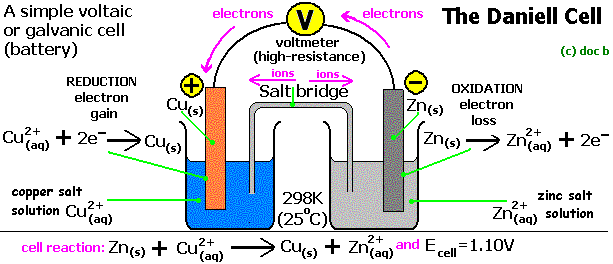
The diagram below explains the chemistry
behind one of the first practical battery systems.
-
-
The 'fuel' is effectively zinc metal and
copper(II) sulfate solution which get consumed when the battery is working
to generate a constant stream of d.c. electrical current.
-
This 'voltaic 'or
galvanic' electrochemical cell uses a half–cell
of copper metal dipped in copper(II) sulfate,
-
and in electrical
contact with another half–cell of zinc metal dipped in zinc sulfate solution.
-
The zinc is the more
reactive, and is the negative electrode, releasing electrons because
-
The
half-equation for the zinc electrode
-
on it zinc atoms
lose electrons to form zinc ions,
Zn(s) ===>
Zn2+(aq) + 2e–
-
The less reactive
metal copper, is the positive electrode, and acts as an inert electrode.
-
The
half-equation for the copper electrode
-
Instead copper(II) ions gain electrons
from the negative electrode through the external wire connection and are
reduced to copper metal atoms...
-
the copper
ions are reduced to copper atoms:
Cu2+(aq) + 2e–
===> Cu(s)
-
Overall the reactions is:
-
Zn(s) + CuSO4(aq)
===> ZnSO4(aq) + Cu(s)
-
or
ionically the full equation is:
-
Zn(s) + Cu2+(aq)
===> Zn2+(aq) + Cu(s)
-
It is an exothermic reaction,
BUT here, there is no temperature rise, because the energy is released
as electrical energy carried by the flow of electrons.
-
The theoretical p.d. created is 0.34
- (-0.76) = 1.10 V.
-
The electrode potential of each
metal is a measure of its chemical reactivity - the more negative or
less positive, the more reactive the metal.
-
The overall reaction
is therefore the same as displacement reaction, and it is a redox
reaction involving electron transfer and the movement of the electrons
through the external wire to the bulb or voltmeter etc. forms the
working electric current.
-
In a working Daniel cell two
salt solutions are separated by a porous barrier that ions can diffuse through to
complete the electrical circuit.
TOP OF PAGE
and sub-index
(D)
More on investigation experiments and how to predict the
simple electrochemical cell voltage
-
The positive cell voltage can
be predicted by subtracting the less positive voltage from the more
positive voltage (or the subtracting most negative from the least negative):
-
Technically, in more advanced chemistry, these individual electrode
voltages are called the half-cell potentials.
-
So, by referring to the list
of electrode potentials of voltages on the right and choosing two different metals
coupled together in the electrolyte solution ...
-
... a magnesium and
copper cell will produce a voltage of (+0.34) – (–2.35) = 2.69 volts if
the electrolyte used is copper sulfate solution.
-
or an iron and tin
cell will only produce a voltage of (–0.15) – (–0.45) = 0.30 V using
a tin chloride solution.
-
Note:
-
(i)
The bigger
the difference in reactivity, the bigger the cell voltage produced.
-
(ii) The 'half–cell'
voltages quoted in the diagram are measured against the hydrogen ion -
hydrogen gas potential H+(aq)/H2(g)
system which is given the arbitrary standard potential of zero volts (hydrogen/hydrogen
ion potential
= 0.00 V).
-
(iii) If you swap the metal
electrodes around, you reverse the sign of the cell voltage (p.d.) and
the current flows in the opposite direction - your digital meter
reading might change from + 0.30 V to -).30 V.
-
You should appreciate the
electrode potential is a measure of the chemical potential energy of
that metal to react by losing electrons
- remember the
theory behind the reactivity
series of metals!
-
-
A copper - zinc cell can be simply set up with strips of the two metals
dipped into a salt or dilute acid solution.
-
The predicted voltage would be copper
potential - zinc potential
-
V = +0.34 - (-0.76) =
1.10 V
-
Note in practice that the p.d. (V)
you measure for the initial minute might vary from electrolyte to electrolyte
because the chemistry is not quite as simple as the diagram suggests.
-
Also, without the presence of copper
ions you are more likely to measure a voltage of ~0.76 V because the
copper may act as an inert electrode and hydrogen forming on its surface
(0 - (-0.76) = 0.76 V.
-
The chemistry for this
electrochemical cell is described in
section (C)
above.
-
-
A copper - magnesium cell can be simply set up with strips of the two metals
dipped into non-reactive salt or dilute acid solution.
-
The predicted voltage would be copper
potential - magnesium potential
-
V = +0.34 - (-2.35) =
2.69 V
-
Again, without the presence of copper
ions you are more likely to measure a voltage of ~2.35 V b because the
copper may act as an inert electrode and hydrogen forming on its surface
(0 - (-2.35) = 2.35 V.
-
A case of setting up two cells in
series to produce a bigger voltage and increase current flow
-

-
The predicted cell voltages are 2.35
V
(copper not involve chemically) and 1.10 V for the two cells.
-
Theoretically this more complex
system should generate a total p.d of 2.35 + 1.10 =
3.45 V
-
BUT, you can put two
copper cells together in series two generate a p.d. of 4.70 V or two
zinc cells together to generate a p.d. of 2.20 V.
-
Practical re-chargeable batteries, like a car
battery, are made up several cells connected in series to
increase the working voltage.
-
In the lab, a class could put several
similar simple cells together, wired in series, and see what higher
voltages you could generate.
-
Before modern electricity supplies
were available, lots of Daniel Cells were linked together in series to
produce much higher voltages and were known as 'voltaic piles' see
https://en.wikipedia.org/wiki/Voltaic_pile
-
Extra note on the
reactivity
series of metals
-

-
A simple cell of a carbon rod and a metal strip.
-
This is a simple experiment to investigate
the reactivity series of metals - the more reactive the metal, the
greater the p.d. in volts, but make sure you always connect the
voltmeter the same way round and produce a positive value for e.g.
magnesium.
-
A carbon rod
(graphite) can be used as a bench mark chemically inert electrode and the
voltages measured for a series of other metals paired with it to get a
partial metal reactivity series.
-
This is the simplest experiment I know to use a
simple cell to determine a metal reactivity series.
-
It should work well enough with very dilute
sulfuric acid, with other metals like tin or nickel, readings can be
close and trend not clear, but it might show Al in its correct place
despite the inhibiting oxide layer.
-
You should obtain a series of increasing p.d
values (V) e.g. Mg > Zn > Fe >Cu, effectively a measure of the
reactivity of the metal.
-
but the actual values may depend on
the electrolyte used - you can try other electrolytes like aqueous
sodium sulfate solution.
-
This series of p.d. values
('voltages') for different metals is known as the electrochemical
series.
TOP OF PAGE
and sub-index
(E)
Practical batteries for commercial and domestic use - rechargeable and
non-rechargeable
-
The simple cells described above do not
make a
satisfactory 'battery' for producing even a small continuous d.c. current.
-
So the batteries you buy in shops are a
bit more complicated.
-
However,
once the chemicals are used up, it will stop working and the p.d. (voltage
generated) tends to decline towards the end of their useful life.
-
Cells or batteries
are useful and convenient portable sources of energy for torches,
radios, shavers and other gadgets BUT they are
expensive compared to what you pay for 'mains' electricity.
-
With rechargeable cells and batteries, it is
possible to input electrical energy (via a charger) and reverse the
chemistry that produced the electricity in the first place.
-
In non-rechargeable cells and batteries
the chemical reactions must stop when one of the reactants has been used up.
-
You can't produce electricity if one of
the reactants is no longer present!
-
Its all changed to the 'product' and
there is no longer any chemical potential energy to be transferred as useful
work - electrical energy.
-
The common zinc-carbon and acid paste
battery comes into this category, so don't try and recharge it!
-
AND most alkaline batteries are
non-rechargeable too.
-
These type of batteries can
only be used once.
-
It is possible to recycle
some of the materials from waste batteries like metals, chargeable or non-chargeable and
they should be disposed of safely to avoid pollution or waste of
valuable materials like metals that can be recycled.
-
See also 11.
Fuel Cells e.g. the hydrogen - oxygen fuel cell
-
Electrolysis and cell-battery theory-examples
for Advanced Level Chemistry Students
TOP OF PAGE
and sub-index
(F) Some quick question and answer exercise on simple
cells
GCSE / IGCSE Chemistry Quiz: Simple Cells and
the Reactivity Series (AI generated experiment)
Here is a 10-question multiple-choice quiz
designed specifically around practical exam specifications for GCSE and
IGCSE chemistry. These questions focus exclusively on simple chemical cells
made from two metal strips in a salt solution electrolyte, directly linking
the generated voltage to the reactivity series.
Jot down your responses and
Check out your answers
If you think there is an error email me
asap!
chem55555@hotmail.com
Question
1
A student sets up a simple cell
using a magnesium strip and a copper strip dipped into a sodium chloride
solution. The voltmeter records a reading of +2.7 V. If the student replaces
the magnesium strip with a zinc strip, what will happen to the voltage
reading?
A) It will increase because zinc is more dense than magnesium.
B) It will decrease because zinc is less reactive than magnesium.
C) It will remain at +2.7 V because the copper strip has not changed.
D) It will drop to 0.0 V because zinc cannot react with sodium chloride.
Question 2
Four simple cells are set up using
different pairs of metal electrodes dipped into the same electrolyte
solution. Which pair of metals will generate the smallest, non-zero voltage
reading on the voltmeter?
A) Magnesium and Copper
B) Iron and Copper
C) Zinc and Iron
D) Zinc and Copper
Question
3
Two identical strips of iron are placed
into a beaker containing a potassium nitrate electrolyte solution and
connected to a voltmeter. What voltage will be displayed, and why?
A) 0.0 V, because there is no difference in reactivity between the
electrodes.
B) 1.1 V, because iron is a moderately reactive transition metal.
C) 2.0 V, because potassium ions in the electrolyte boost the charge.
D) A negative voltage, because iron only releases electrons when paired with
copper.
Question 4
A student measures the voltage of a
cell containing Metal X and Copper. They repeat this with Metal Y and
Copper. The results are:
- Cell 1: Metal X and Copper = +1.1 V
- Cell 2: Metal Y and Copper = +0.5 V
Both X and Y are found to be more reactive than copper. What is the
correct order of reactivity for these three metals, from most reactive
to least reactive?
A) Copper, Metal Y, Metal X
B) Metal Y, Metal X, Copper
C) Metal X, Metal Y, Copper
D) Metal X, Copper, Metal Y
Question
5
In a simple cell consisting of a
zinc strip and a copper strip connected by wires to a voltmeter in a salt
solution, how do the electrons move through the circuit?
A) They travel through the salt solution from the copper strip to the zinc
strip.
B) They travel through the wires from the copper strip to the zinc strip.
C) They travel through the salt solution from the zinc strip to the copper
strip.
D) They travel through the wires from the zinc strip to the copper strip.
Question 6
An unknown metal, Z, is paired with
copper in a simple cell and produces a voltage of +1.9 V. When Z is paired
with magnesium, the voltmeter reads +0.8 V, and magnesium is found to be the
electrode losing electrons. What can be deduced about the position of metal
Z in the reactivity series?
A) Metal Z is more reactive than magnesium.
B) Metal Z is less reactive than copper.
C) Metal Z lies between magnesium and copper.
D) Metal Z is the least reactive metal known.
Question
7
When evaluating a practical setup
of a simple cell, which of the following variables must be kept constant
(controlled) to ensure a fair and valid comparison of voltages when changing
the metal pairs?
A) The surface area of the metal strips.
B) The distance between the two metal strips in the solution.
C) The type of metal used for the negative electrode.
D) The concentration and type of the salt solution electrolyte.
Question 8
A student uses the following metal
pairs in a simple cell experiment: Pair 1 (Mg/Cu) and Pair 2 (Mg/Zn). They
notice that both cells produce a voltage, but Pair 1 produces a
significantly higher voltage. What is the chemical reason for this
observation?
A) Zinc is a better electrical conductor than copper.
B) Zinc is closer to magnesium in the reactivity series than copper is.
C) Copper reacts vigorously with the salt solution, adding extra energy.
D) Magnesium is less stable when paired with zinc.
Question
9
In a simple chemical cell using a
magnesium strip and an iron strip in a sodium sulfate electrolyte, which
metal acts as the negative electrode, and what process occurs there?
A) Iron acts as the negative electrode because it undergoes reduction.
B) Magnesium acts as the negative electrode because it undergoes oxidation.
C) Iron acts as the negative electrode because it undergoes oxidation.
D) Magnesium acts as the negative electrode because it undergoes reduction.
Question 10
A student connects a cell with Zinc
and Copper electrodes and records a voltage of +1.1 V. They double the
concentration of the sodium chloride salt solution used as the electrolyte.
What is the most likely outcome on the measured voltage?
A) The voltage will double to +2.2 V because there are twice as many ions.
B) The voltage will drop to 0.0 V because the solution becomes too crowded.
C) The voltage will remain approximately +1.1 V because voltage depends on
the metals.
D) The voltage will flip to -1.1 V because the direction of the current
reverses.
Jot down your responses and
Check out your answers
If you think there is an error email me
asap!
chem55555@hotmail.com
(G)
Learning objectives for simple cells and batteries
(GCSE/IGCSE level, ~ US grade 9 or US grade 10
Know that a battery or cell converts chemical potential energy into
electrical energy.
Chemicals can be reacted together in oxidation-reduction reactions to
release this energy.
Know you can make a simple cell by connecting two different metal strips
or plates and dipping them into an electrolyte - a salt or acid solution.
Be able to write electrode equations to explain how the battery generates
the electrical current - the flow of electrons from the oxidation and
reduction reactions.
Know that the greater the difference in reactivity of the metals
increases the p.d. (voltage) produced.
Know that wiring more than one cell in series can increase the output
voltage (p.d.) to increase current flow.
Know that when the chemicals
are used the battery will stop working and the p.d. (voltage generated) will
decline towards the end of the batteries life.
Know that batteries can be
rechargeable (can be re-used) or non-rechargeable (used once).
Know that you can recycle
some of the materials from waste batteries e.g. valuable metals, chargeable or non-chargeable and
batteries should be disposed of safely to avoid land or water pollution or waste of
valuable materials like metals that can be recycled and re-used in batteries
again or other applications.
(H)
Key
revision
points - exam board
orientated
for GCSE/IGCSE chemistry specifications
across WJEC, CCEA, CIE, AQA, Edexcel, OCR Gateway, and OCR 21st Century.
It includes syllabus-aligned
content, examples of simple cell experiments,
how batteries work (excluding fuel cells), plus
exam tips and common misconceptions.
Revision Notes:
Simple Cells & Batteries
1. Core Concept:
Simple Cells
- Definition:
A simple cell is a device that converts chemical energy into electrical
energy using two different metals in an electrolyte.
- Basic setup:
- Two different metals (e.g., zinc and
copper).
- An electrolyte (e.g., dilute sulfuric
acid or sodium chloride solution).
- Wires and a voltmeter to measure
potential difference.
Example Experiment
- Place a strip of zinc and
a strip of copper into a beaker of dilute sulfuric
acid.
- Connect them with wires to a voltmeter.
- Observation: A voltage is produced because
zinc is more reactive than copper, so electrons flow from zinc → copper.
2. How Batteries
Work
- Batteries
are collections of cells connected together to provide a greater voltage.
- Rechargeable batteries
(e.g., lithium-ion) can be reversed by applying an external current.
- Non-rechargeable batteries
(e.g., alkaline batteries) rely on irreversible reactions.
Key points for exams:
- Voltage depends on difference in
reactivity between the two metals.
- Greater reactivity difference → higher
voltage.
- Electrolyte allows ions to move,
completing the circuit.
3. Typical Syllabus
Requirements about simple cells and batteries
| Required Knowledge |
| Simple cells, reactivity series
link, practical experiment with copper/zinc, role of electrolyte. |
| Energy changes in cells, batteries
as multiple cells, practical demonstration, importance of reactivity
difference. |
| Construction of simple cells,
explanation of electron flow, comparison of voltages with different
metals. |
| Simple cells, batteries,
rechargeable versus non-rechargeable, link to reactivity series. |
| Practical setup, voltage
measurement, explanation of chemical-to-electrical energy
conversion. |
| Simple cells, batteries, practical
experiments, evaluation of battery use. |
| Applications of batteries,
environmental impact, comparison of rechargeable versus
non-rechargeable. |
4. Exam Tips for
questions involving simple cells and batteries
- Always link to the reactivity
series: More reactive metal →
loses electrons → acts as negative electrode.
- Use correct terminology:
"Electrons flow through the wire" versus "Ions move in the electrolyte."
- Draw clear diagrams:
Label metals, electrolyte, voltmeter.
- Compare metals systematically:
If asked "Which pair produces the highest voltage?" → choose metals furthest
apart in reactivity series.
- Practice past-paper questions:
Many boards ask you to explain why voltage changes with different metals.
5. Typical
Misconceptions about simple cells and batteries
- Thinking the electrolyte produces
electrons → Correction: Electrolyte allows ions to move,
but electrons come from the more reactive metal.
- Believing both metals lose electrons
→ Correction: Only the more reactive metal loses electrons
(oxidation).
- Confusing fuel cells
with batteries → Correction: Fuel cells
continuously use external fuel; batteries store chemicals internally.
- Assuming voltage is fixed →
Correction: Voltage depends on the metals chosen and the
electrolyte used.
- Forgetting that batteries
are multiple cells → Correction: A single cell
produces a small voltage; batteries combine cells for higher voltage.
6. Quick Summary Table
| Concept |
Key Point |
Example |
| Simple Cell |
Two metals + electrolyte → voltage |
Zinc + Copper in dilute H₂SO₄ |
| Battery |
Multiple cells connected |
Alkaline battery, lithium-ion battery |
| Voltage |
Depends on reactivity difference |
Mg + Cu > Zn + Cu |
| Rechargeable |
Reactions reversible |
Lithium-ion |
| Non-rechargeable |
Reactions irreversible |
Alkaline battery |
TOP OF PAGE
and sub-index
ANSWERS AND DISTRACTOR EXPLANATIONS
I've repeated the
question for clarity on reading the feedback and answers
If you think there is an error email me
asap!
chem55555@hotmail.com
Question
1
A student sets up a simple cell
using a magnesium strip and a copper strip dipped into a sodium chloride
solution. The voltmeter records a reading of +2.7 V. If the student replaces
the magnesium strip with a zinc strip, what will happen to the voltage
reading?
A) It will increase because zinc is more dense than magnesium.
B) It will decrease because zinc is less reactive than magnesium.
C) It will remain at +2.7 V because the copper strip has not changed.
D) It will drop to 0.0 V because zinc cannot react with sodium chloride.
Answer 1: B
- Explanation: Magnesium is higher up
the reactivity series than zinc. The voltage of a cell is determined by
the difference in reactivity between the two metals. Replacing magnesium
with the less reactive zinc narrows the reactivity gap between the two
electrodes (Zinc and Copper), which decreases the voltage.
- Distractor A is wrong because density
does not dictate the electrical potential or voltage of a chemical cell.
- Distractor C is wrong because changing
one of the metals alters the reactivity gap, which alters the voltage.
- Distractor D is wrong because a
voltage will still be produced; zinc and copper still have a difference
in reactivity.
Question
2
Four simple cells are set up using
different pairs of metal electrodes dipped into the same electrolyte
solution. Which pair of metals will generate the smallest, non-zero voltage
reading on the voltmeter?
A) Magnesium and Copper
B) Iron and Copper
C) Zinc and Iron
D) Zinc and Copper
Answer 2: C
- Explanation: Looking at a standard
reactivity series (Magnesium > Zinc > Iron > Copper), Zinc and Iron are
located right next to each other. Because they have the smallest
difference in reactivity among the options provided, they will generate
the smallest non-zero voltage.
- Distractor A features the largest
reactivity gap, meaning it will create the largest voltage.
- Distractor B and D feature wider gaps
than the Zinc/Iron pair, thus yielding higher voltages.
Question
3
Two identical strips of iron are placed
into a beaker containing a potassium nitrate electrolyte solution and
connected to a voltmeter. What voltage will be displayed, and why?
A) 0.0 V, because there is no difference in reactivity between the
electrodes.
B) 1.1 V, because iron is a moderately reactive transition metal.
C) 2.0 V, because potassium ions in the electrolyte boost the charge.
D) A negative voltage, because iron only releases electrons when paired with
copper.
Answer 3: A
- Explanation: For a cell to generate a
voltage, there must be a potential difference driven by two metals with
differing tendencies to lose electrons. Because both strips are made of
iron, their tendency to lose electrons is identical, resulting in zero
potential difference (0.0 V).
- Distractor B is wrong because a single
metal cannot create a potential difference against itself, regardless of
its raw position on the series.
- Distractor C is wrong because the
identity or concentration of ions in the electrolyte does not generate a
baseline voltage if the electrodes are identical.
- Distractor D is wrong because no
current or voltage is produced at all.
Question
4
A student measures the voltage
of a cell containing Metal X and Copper. They repeat this with Metal Y
and Copper. The results are:
- Cell 1: Metal X and Copper = +1.1
V
- Cell 2: Metal Y and Copper = +0.5
V
Both X and Y are found to be more reactive than copper. What is the
correct order of reactivity for these three metals, from most
reactive to least reactive?
A) Copper, Metal Y, Metal X
B) Metal Y, Metal X, Copper
C) Metal X, Metal Y, Copper
D) Metal X, Copper, Metal Y
Answer 4: C
- Explanation: The voltage is directly
proportional to the difference in reactivity between the metal and the
reference electrode (Copper). Since Metal X produces a larger voltage
(+1.1 V) than Metal Y (+0.5 V) when paired with copper, Metal X must
have a larger reactivity gap from copper than Y does. Given both are
more reactive than copper, Metal X is the most reactive, followed by Y,
and Copper is the least reactive.
- Distractor A reverses the entire
series.
- Distractor B incorrectly ranks Y as
more reactive than X.
- Distractor D misplaces copper in the
middle of the two reactive metals.
Question
5
In a simple cell consisting of a
zinc strip and a copper strip connected by wires to a voltmeter in a salt
solution, how do the electrons move through the circuit?
A) They travel through the salt solution from the copper strip to the zinc
strip.
B) They travel through the wires from the copper strip to the zinc strip.
C) They travel through the salt solution from the zinc strip to the copper
strip.
D) They travel through the wires from the zinc strip to the copper strip.
Answer 5: D
- Explanation: Electrons are subatomic
particles that can only travel through metallic conductors (the wires
and voltmeter) in a simple cell circuit. They flow from the more
reactive metal (zinc, where oxidation occurs) to the less reactive metal
(copper).
- Distractors A and C are fundamentally
incorrect because free electrons cannot exist or travel through an
aqueous solution.
- Distractor B is wrong because
electrons flow away from the more reactive metal, not toward it.
Question
6
An unknown metal, Z, is paired with
copper in a simple cell and produces a voltage of +1.9 V. When Z is paired
with magnesium, the voltmeter reads +0.8 V, and magnesium is found to be the
electrode losing electrons. What can be deduced about the position of metal
Z in the reactivity series?
A) Metal Z is more reactive than magnesium.
B) Metal Z is less reactive than copper.
C) Metal Z lies between magnesium and copper.
D) Metal Z is the least reactive metal known.
Answer 6: C
- Explanation: Magnesium is more
reactive than Z because magnesium loses electrons when paired with it.
This puts Z below magnesium. However, Z produces a large voltage (+1.9
V) when paired with copper, meaning Z must be substantially more
reactive than copper. Therefore, Z sits between magnesium and copper.
- Distractor A is wrong because
magnesium loses electrons to Z, meaning magnesium is more reactive.
- Distractor B is wrong because Z is
more reactive than copper (indicated by the positive cell voltage where
Z acts as the more reactive partner).
- Distractor D is wrong because copper
is less reactive than Z.
Question
7
When evaluating a practical setup
of a simple cell, which of the following variables must be kept constant
(controlled) to ensure a fair and valid comparison of voltages when changing
the metal pairs?
A) The surface area of the metal strips.
B) The distance between the two metal strips in the solution.
C) The type of metal used for the negative electrode.
D) The concentration and type of the salt solution electrolyte.
Answer 7: D
- Explanation: To make a fair comparison
of how the metal identity affects voltage, the electrolyte type and
concentration must be controlled. Changes in the electrolyte can
slightly alter internal resistance and cell conditions, which impacts
the validity of the data.
- Distractors A and B are variables that
primarily affect the cell's current (amperage) and internal resistance
rather than its baseline chemical voltage.
- Distractor C is wrong because the
negative electrode must change if you are testing different metal
combinations.
Question
8
A student uses the following metal
pairs in a simple cell experiment: Pair 1 (Mg/Cu) and Pair 2 (Mg/Zn). They
notice that both cells produce a voltage, but Pair 1 produces a
significantly higher voltage. What is the chemical reason for this
observation?
A) Zinc is a better electrical conductor than copper.
B) Zinc is closer to magnesium in the reactivity series than copper is.
C) Copper reacts vigorously with the salt solution, adding extra energy.
D) Magnesium is less stable when paired with zinc.
Answer 8: B
- Explanation: The voltage depends
entirely on the distance between the two metals on the reactivity
series. Zinc is higher up the reactivity series than copper and sits
closer to magnesium. This smaller reactivity gap between Mg and Zn
results in a lower voltage than the wider gap between Mg and Cu.
- Distractor A is wrong because
electrical conductivity of the solid bulk metal does not dictate the
cell's chemical potential difference.
- Distractor C is a misconception;
copper is unreactive and does not react directly with the salt solution.
- Distractor D is scientifically
meaningless in the context of electrochemical cell potential.
Question
9
In a simple chemical cell using a
magnesium strip and an iron strip in a sodium sulfate electrolyte, which
metal acts as the negative electrode, and what process occurs there?
A) Iron acts as the negative electrode because it undergoes reduction.
B) Magnesium acts as the negative electrode because it undergoes oxidation.
C) Iron acts as the negative electrode because it undergoes oxidation.
D) Magnesium acts as the negative electrode because it undergoes reduction.
Answer 9: B
- Explanation: Magnesium is more
reactive than iron, meaning it has a greater tendency to lose electrons.
Loss of electrons is oxidation (OIL RIG). Because magnesium releases
electrons into the external circuit, it becomes the negative terminal
(electrode) of the cell.
- Distractor A is wrong because iron is
the less reactive metal and acts as the positive terminal.
- Distractor C is wrong because iron
does not undergo oxidation; magnesium does.
- Distractor D is wrong because
magnesium undergoes oxidation (loses electrons), not reduction.
Question
10
A student connects a cell with Zinc
and Copper electrodes and records a voltage of +1.1 V. They double the
concentration of the sodium chloride salt solution used as the electrolyte.
What is the most likely outcome on the measured voltage?
A) The voltage will double to +2.2 V because there are twice as many ions.
B) The voltage will drop to 0.0 V because the solution becomes too crowded.
C) The voltage will remain approximately +1.1 V because voltage depends on
the metals.
D) The voltage will flip to -1.1 V because the direction of the current
reverses.
Answer 10: C
- Explanation: The voltage (potential
difference) of a simple cell is fundamentally determined by the chemical
identities of the two metals and their positions in the reactivity
series. Altering the concentration of the electrolyte allows the
solution to conduct current better (lowering internal resistance), but
it does not change the chemical potential difference.
- Distractor A is a classic
misconception that changing concentration linearly scales the voltage.
- Distractors B and D are incorrect
because the fundamental chemistry driving the electron push remains
completely unchanged.
If you think there is an error email me
asap!
chem55555@hotmail.com
What next?
Associated Pages
ELECTROCHEMISTRY INDEX
ALL my GCSE Level (~US grade 8-10)
School Chemistry Notes
(ages ~14-16)
Find your GCSE
science course for more help links to revision notes
All my Advanced Level pre-university Chemistry
notes (~US grades 11-12)
This is a BIG
website, you need to take time to explore it [SEARCH
BOX]
 Simple Quiz on the basics of electrolysis
Electrolysis Quiz (GCSE 9-1 FT Foundation Level (easier)
Electrolysis Quiz (GCSE 9-1 HT Higher Level (harder)
Electrolysis Quiz including calculations (GCSE 9-1 HT Higher Level)
email doc
brown - comment - query?
|
Website content © Dr
Phil Brown 2000+. All copyrights reserved on Doc Brown's Chemistry revision notes, images,
quizzes, worksheets etc. on explaining electrolysis with lots of
diagrams, electrode equations and uses of electrolysis, revision
notes suitable for
IGCSE/GCSE level chemistry courses (US grades 8, 9, 10) Copying of website material is NOT
permitted. Exam revision summaries and references to science exam
board course exams and specifications
are unofficial.
keywords and phrases:
revision study notes for AQA Edexcel OCR
IGCSE/GCSE chemistry topics modules the Introduction to understanding
cells and batteries, how to do a simple cell experiment to investigate
the effects of using different pairs of metals dipped into an
electrolyte of a salt solution of dilute acid, describing an early
practical battery cell dhow to do investigation experiments in how to
predict the cell voltage, using a simple cell to investigate the
reactivity series of metals, description of practical batteries for
commercial and domestic use, explaining the difference between
chargeable and non-rechargeable what is a simple Voltaic Cells, how to
make simple cell batteries using strips of copper zinc magnesium dipped
in salt solution electrolyte investigation into the reactivity series of
metals using simple cell and voltmeter circuit, Explaining the importance of
simple cells & batteries
in GCSE level chemistry, What you need to know about simple cells &
batteries for
GCSE level
chemistry,
Explaining the use of simple cells & batteries knowledge in GCSE level chemistry, Examples of
simple cells & batteries explained
when studying GCSE level chemistry, What is
the significance of simple cells & batteries in GCSE level chemistry, describing and
explaining the theory of simple cells & batteries when studying GCSE level chemistry, revision
notes for simple cells & batteries in exams, online help for understanding
simple cells & batteries, exam revision
notes for simple cells & batteries, what do I need to learn about simple
cells & batteries? revision summary for simple cells & batteries, learning notes for
simple cells & batteries, help to pass the simple cells & batteries
topic in an exam question, how to prepare for questions on simple cells
& batteries in a GCSE
chemistry examination?
Based on the syllabus-specifications
for students taking the IGCSE/GCSE level chemistry examinations summary
revision notes and key points on simple cells & batteries for students taking the AQA
igcse/gcse chemistry notes on simple cells & batteries, Edexcel gcse
chemistry notes on simple cells & batteries, OCR 21st century GCSE
chemistry notes on simple cells & batteries, OCR gateway
GCSE chemistry notes on simple cells & batteries, WJEC gcse chemistry notes on
simple cells & batteries, CCEA
gcse chemistry notes on simple cells & batteries for students taking CIE Cambridge igcse
chemistry, or any other GCSE or IGCSE level chemistry exams notes on
simple cells & batteries, useful for US grade 9-10 chemistry courses
|
What next?
Associated Pages
|

 For searching