|
11. FUEL CELLS e.g. the
hydrogen-oxygen fuel electrical cell
(a) What is a fuel cell? How do fuel
cells
work?
The principles of fuel
cells are explained with particular attention to the hydrogen–oxygen
fuel cell. These revision notes on how fuels work and how fuel cells are
constructed
should prove useful for the new AQA chemistry, Edexcel chemistry & OCR
chemistry GCSE (9–1, 9-5 & 5-1) science courses.

(b)
How does a hydrogen-oxygen fuel cell work?
-
A
FUEL CELL is a device
to make electricity that functions like an electrical cell or battery that you supply
with a fuel (liquid or gas) and an oxidant (oxidising agent, usually oxygen gas)
which react together in a redox reaction (oxidation + reduction) to
release energy as a flow of electrons i.e. an electrical current
capable of doing useful work.
-
The oxidation of the
fuel and reduction of the oxidant reactions take place on
electrodes (see simplified diagram on right, all is fully explained further
down the page).
-
Anode
oxidation: 2H2(g)
==> 4H+(aq) + 4e–
(electron loss)
- Cathode reduction:
O2(g)
+ 4H+(aq) + 4e– ==> 2H2O(l)
(electron gain)
- Overall reaction:
2H2(g)
+ O2(g) ==>
2H2O(l)
(balanced reaction equation)
-
Fuel cells essentially a
device to release the chemical potential energy of combustible fuels
as electrical energy at a much lower temperature and without the
flame!
-
So, the idea of a
hydrogen–oxygen fuel cell
is to release the energy from hydrogen reacting with oxygen, not as
heat as in normal combustion in air, but as useful electrical
energy i.e. a practical electricity supply.
-
Hydrogen-oxygen fuel cells are much
efficient than conventional power stations or batteries (e.g.
zinc-carbon) because
the electrical energy is directly generated from the chemical
reaction between the oxidant and the fuel - there are no
complications with boilers, turbines and generators.
-
In fossil fuel power
stations, motor vehicles, coal/gas fires etc. quite a percentage of
energy is lost as waste heat.
-
With a fuel cell there
are fewer stages in producing the useful energy, so there is less
opportunity to lose potentially useful energy e.g. waste heat,
friction from moving parts etc.
-
A hydrogen–oxygen fuel cell is a
non–polluting clean fuel since the only combustion product is
water.
-
Fuel cells do not produce
pollutants like carbon monoxide, sulfur dioxide and nitrogen oxides -
gases you get from fossil fuel combustion in power stations or burnt
road vehicles..
-
Cars powered by fuel cells would be
quite an environmental advantage in cities, where electric cars are
already beginning to be significantly used in developed countries.
-
Fuel cells could replace larger
batteries which are not easily recycled and contain highly toxic metal
compounds.
-
It would be an ideal
fuel on this basis e.g. for motor vehicles, but that's not the only
factor to consider!
-
It would be ideal if
the hydrogen fuel could be manufactured by electrolysis of water e.g. using
excess electricity from solar cells or wind turbines.
-
 Hydrogen can be used
to power fuel cells. Hydrogen can be used
to power fuel cells.
-
It all sounds
wonderful BUT, still technological problems to solve for large scale
manufacture and distribution of 'clean' hydrogen gas or use in
generating electricity AND its rather an inflammable explosive gas!
-
See
fuel survey and
alternative fuels like biofuels
(c) A battery system! Useful, many positives, but there are
issues!
-
Fuel cells are 'battery
systems' in which two reactants can be continuously fed in.
-
They must undergo an
oxidation–reduction (redox) reaction.
-
The consequent redox
chemistry produces a working current e.g. hydrogen, ethanol and hydrocarbons
can be oxidised with oxygen in a fuel cell, rather than conventional
combustion.
-
Fuel cells have the big
advantage of not requiring charging up, as long as you keep on supplying the
fuel and oxidant.
-
The motor vehicle industry is
looking at fuel cell cars, but lately electric cars with better quality
modern battery technology and convenient charging facilities seem to be more
in the news.
-
Plus points in favour of
using fuel cells in cars and other road vehicles – advantages
-
Batteries are more expensive to make than
fuel cells.
-
Fuel cells do not produce the
usual pollutants like sulfur oxides (acid rain), nitrogen oxides and carbon
monoxide (harmful gases from traffic pollution).
-
Fuel cells don't involve any moving parts
like most power generators - no energy lost by friction.
-
Unless an organic fuel like a
hydrocarbon or an alcohol is used, there will be no greenhouses gases like
carbon dioxide, because hydrogen combustion only produces harmless water.
-
Neither do you produce harmful and
polluting gases like carbon monoxide, nitrogen oxides, sulfur oxides and hydrocarbon particulates
and the global warming gas carbon dioxide,.
-
Fuel cells could be used in
countries with little oil and make them less dependant on costly imported
oil.
-
Hydrogen-oxygen fuel cells
create water and since the hydrogen will have to be made from abundant water
supplies in the long run, it is effectively a renewable resource, unlike
fossil fuels like petrol or diesel.
-
Fuel cells are much more
efficient than fossil fuel power stations or costly chemical
batteries etc. because the electrical energy is generated directly
from the chemical reaction.
-
In fossil fuel power
stations, motor vehicles, coal/gas fires etc. too much energy is
lost as waste heat.
-
Fossil fuels are a finite supply,
whereas if we can get hydrogen from water, and the air has lots of
oxygen, there is effectively, if not practical at the moment, an
infinite supply of fuel.
-
With a fuel cell there
are fewer stages in producing the useful electrical energy, so there
is less chance of losing useful energy e.g. waste heat,
friction from moving parts etc.
-
Maybe in the long–run we
can get rid of polluting fossil fuelled road vehicles and batteries
containing harmful chemicals e.g. toxic metal compounds of cadmium.
-
Although current electric cars
are improving in the design, the batteries are very costly can only
be recharged a limiting number of times before requiring
replacement.
-
Batteries also store less energy than fuel cells (which
still have to be 're-fuelled').
-
Batteries are more expensive to
make than fuel cells.
-
AND
fuel cells have found use in
spacecraft (e.g. space shuttle), satellites and orbiting space stations
-
Fuel cells can provide a
convenient source of electrical power in the space industry.
-
Fuel cells can be made
reasonably lightweight and compact saving both space and weight.
-
Hydrogen and oxygen may be used
from the fuel tanks of spacecraft.
-
Fuel cells do not have moving
parts which could go wrong.
-
The final product is water,
which could be used as drinking water, reducing the initial payload in the
spacecraft.
-
Since water is the only product
from a hydrogen-oxygen fuel cell, there are no waste pollution products to
deal with.
-
BUT:
Issues over the use of fuel cells in
transport systems or as a major energy resource – disadvantages
-
There are always disadvantages in most
new technologies.
-
You need a large scale hydrogen
production system - not ready yet!
-
Hydrogen can be made from electrolysis,
but you need a lot renewable sourced electricity.
-
Fuel cells cannot be used for
large–scale energy production, so conventional fossil fuel or nuclear power
stations still have an important future.
-
Hydrogen is a gas and requires a
much larger storage volume compared to fossil fuels like petrol and at a
high pressure too - increasing engineering costs.
-
Safe storage is an issue,
especially as it would be stored under high pressure to decrease the storage
space required.
-
There is no efficient means of
mass producing hydrogen.
-
Efficient large scale technology
is not yet developed to produce hydrogen on a large scale e.g. from
electrolysis using solar power electricity – photovoltaic power system, wind
turbines or hydroelectric power.
-
Although water is cheap and
plentiful, it requires expensive electrical energy to electrolyse water to
split it into hydrogen and oxygen.
-
Electrolysis of acidified water
is expensive because electricity is expensive and much is still made from
fossil fuels - though this is now decreasing as more solar and wind farms
con stream as renewable sources of electricity.
-
You would need large scale electrolysis plants and then devise
safe means of storing and delivering the hydrogen gas to where its needed.
-
Not only that, most electricity
in the world is still generated from burning fossil fuels!
-
AND most hydrogen used in industry
is made from fossil fuel hydrocarbons, which won't last forever. (see making hydrogen for the
Haber Synthesis of ammonia).
-
Other disadvantages:
(d) More about the potential of fuel cells and their design
-
More on hydrogen's potential use in fuel and energy applications
-
This
includes powering vehicles, running turbines or fuel cells to produce electricity, and generating heat and electricity for
buildings and very convenient for remote and compact situations like the space
shuttle.
-
Fuel cells were developed in the
1960s as part of the USA NASA's space exploration programme to provide
electrical power.
-
Fuel cells were/are used in
lunar landing vehicles, space stations orbiting the Earth etc.
-
They are more practical and
robust than solar cell panels and definitely safer than small nuclear power
units.
-
When hydrogen is the
fuel, the product of its oxidation is water, so this is potentially a clean
non–polluting and non–greenhouse gas? fuel.
-
Most fuel cells use
hydrogen, but alcohols and hydrocarbons can be used.
-
A fuel cell works like a battery but does not run down or need
recharging as long as the 'fuel' supply is there.
-
It will produce electricity and heat as long as fuel (hydrogen) is supplied.
-
Notes
based on the DIAGRAMS and the CHEMISTRY
of a hydrogen–oxygen fuel cell
-
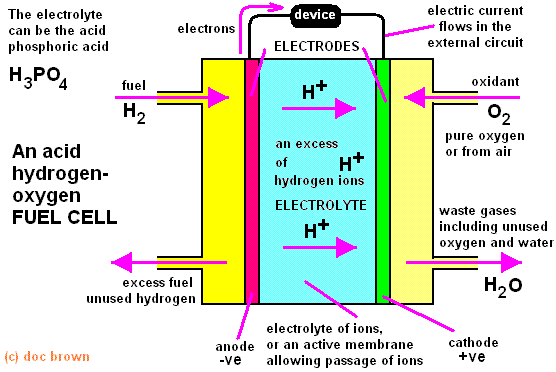
An acid based fuel cell (phosphoric acid effectively acts as a catalyst)
-
-
A typical acid fuel cell (above) consists of two electrodes consisting of a negative electrode (or anode) and a positive electrode (or cathode)
which are sandwiched around an electrolyte (conducting salt/acid/alkali
solution of free ions).
-
Hydrogen (or other fuel) is fed to the
(–) anode, and oxygen is fed to the (+) cathode.
-
The platinum catalyst
activates the hydrogen atoms/molecules to separate into protons (H+)
and electrons (e–), which take different paths to the (+) cathode.
-
The electrons go through an external circuit, creating a flow of
electricity e.g. to light a bulb.
-
The protons (H+) migrate through the electrolyte
and pass through the semi–permeable membrane to the cathode, where they
and electrons reduce the oxygen to water.
-
In both acid or alkaline
hydrogen–oxygen fuel cells, oxygen is the oxidising agent (oxidant, gets
reduced) and hydrogen (fuel, gets oxidised) is the reducing agent.
-
The hydrogen is fed into the
anode compartment and the oxygen into the cathode compartment.
-
The oxidation of the fuel
(hydrogen) at the anode electrode provides electrons that flow round (via
some device e.g. bulb, motor etc.) to the cathode electrode to effect the
reduction of the oxygen.
-
So you have simultaneous
oxidation and a reduction, therefore overall a redox reaction.
-
Anode
oxidation: 2H2(g)
==> 4H+(aq) + 4e–
(electron loss)
- Cathode reduction:
O2(g)
+ 4H+(aq) + 4e– ==> 2H2O(l)
(electron gain)
- Overall reaction:
2H2(g)
+ O2(g) ==>
2H2O(l)
(balanced reaction equation)
-
An alkali based fuel cell
-

-
In an alkaline hydrogen–oxygen
fuel cell, the construction is quite similar, but it is hydroxide ions (OH–)
that migrate in the potassium hydroxide solution electrolyte.
-
Each cell only
produces a small voltage (typically 0.4 to 1.0V) so many cells have to be put together in
series to give a bigger working voltage.
-
Note on reverse reaction
water ==> hydrogen + oxygen
-
If there is spare
electricity from another source available, you can run the fuel cell in
reverse and electrolyse the water to make hydrogen and oxygen (acting as
an electrolyser).
-
The two gases are
stored, and when extra electricity or heat needed, the fuel cell can then be
re–run using the stored gaseous fuel.
-
This is called a
regenerative fuel cell system.
-
You can use solar
energy from external panels on the space shuttle to do this, and use the
fuel during the 'darkness of night'.
(e) A more detailed chemical
description of fuel cells - electrode half-reactions
The half reactions - electrode equations for hydrogen oxygen cells
The chemistry of fuel cells
- half equations to describe the chemical processes at the electrodes
Example 1 Acid hydrogen - oxygen fuel
cell
In the electrode equations I have included the
'subscripted' state symbols (aq), (g) and (l) where appropriate.
This acid hydrogen–oxygen fuel cell uses porous carbon
and costly platinum electrode catalysts.
The
electrolyte solution here is phosphoric acid, H3PO4
Remember: half equations = electrode equation
The electrode
half equations for an acid
hydrogen – oxygen fuel cell are for 4 electrons worth of current are ...
1. Oxidation electrode half–equation,
hydrogen atoms/molecules lose electrons
The hydrogen goes into the anode compartment
2H2(g)
==> 4H+(aq) + 4e–
(half
cell equation for
the negative
anode electrode*)
or
2H2(g) – 4e– ==> 4H+(aq)
electrode equation 1. has been doubled up to balance
the electrons involved and so that equations 1. plus 2. equals the overall 'normal'
molecular equation for the hydrogen fuel consumption.
2. Reduction electrode half–equation,
oxygen atoms/molecules gain electrons
The oxygen goes into the cathode compartment
O2(g)
+ 4H+(aq) + 4e– ==> 2H2O(l)
(half cell equation for the positive cathode electrode*)
3. The electrons generated by reaction 1. flow through
the external circuit from the anode to the cathode to facilitate reaction 2.
Adding the two electrode
equations 1 + 2 gives the overall
equation, which is the same as the normal combustion equation, in a
way its a
sort of 'cooler' combustion without the flame!
2H2(g)
+ O2(g) ==>
2H2O(l)
*
Note the +ve and –ve electrode charges are reversed compared to
electrolysis, because the system is operating in the opposite direction. But, as
in electrolysis, you still get reduction at the cathode and oxidation at the
anode.
Example 2 Alkaline hydrogen - oxygen
fuel cells
You can also run a hydrogen–oxygen fuel cell with
an alkaline electrolyte [e.g. potassium hydroxide solution, KOH(aq)], but still with costly electrodes
In the case of the alkaline hydrogen–oxygen fuel
cell the different electrode equations are ...
1. oxidation electrode half–equation,
hydrogen atoms/molecules lose electrons, to give hydrogen ions which
immediately combine with the hydroxide ions to form water.
2H2(g) + 4OH–(aq) –
4e–
==> 4H2O(l)
(oxidation at the anode)
or
2H2(g) +
4OH–(aq)
==> 4H2O(l) + 4e–
2. reduction electrode half–equation,
oxygen atoms/molecules gain electrons and in combination with water
molecules are reduced to hydroxide ions.
O2(g)
+ 2H2O(l) + 4e–
==> 4OH–(aq)
(reduction at the cathode)
Again,
the overall equation is same as the normal combustion equation by
adding equations 1. and 2. together.
2H2(g)
+ O2(g) ==> 2H2O(l)
 Example
3 Organic fuel - oxygen fuel cells Example
3 Organic fuel - oxygen fuel cells
For more advanced level chemistry students
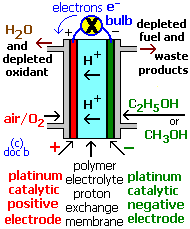
The diagram on the right shows the
same arrangement for a fuel cell, as for hydrogen, but you can use an organic
fuel like an alcohol e.g. ethanol (C2H5OH) or
methanol (CH3OH), which burn exothermally if ignited, but here
made to release their chemical potential energy as electrical energy.
The overall cell reactions are ...
C2H5OH + 3O2
==> 2CO2 + 3H2O
+ electrical energy
CH3OH +
3/2O2
==> CO2 + 2H2O
+ electrical energy
These are the same equations as if the organic compound
(alcohol) was burned in air/oxygen.
For more details click on the Redox 3 link below for
advanced level students only.
(f) Learning objectives
for fuel cells e.g. hydrogen-oxygen or alcohol-oxygen fuel cells
Know that fuels convert chemical potential energy directly
into electrical energy.
Be able to describe and explain how a simple hydrogen-oxygen
fuel cells works.
Be able to write and explain the electrode equations
involved in a hydrogen-oxygen fuel cell.
Know that hydrogen is a 'green' fuel because only water is
formed from the reactions and no carbon dioxide, so reducing our carbon
footprint.
Be able to write and equation
in words and symbols for hydrogen combining with oxygen to give water.
Know that organic compounds
like alcohols can be used as fuels in fuel cells.
(g)
Key points about fuel cells
Quick Summary:
Fuel cells are electrochemical devices that convert chemical energy (often
hydrogen + oxygen) directly into electrical energy, and in the case of
hydrogen fuel, producing water as the
only by-product.
You should know and understand the
half-reactions that occur on the surface of the two electrodes, the anode
and cathode.
Across GCSE/IGCSE boards (WJEC, CCEA, CIE,
AQA, Edexcel, OCR Gateway, OCR 21st Century), students must understand their
structure, reactions, advantages/disadvantages, and exam-style applications.
Fuel Cells – Core
Academic Content
How They Work
- Definition:
A fuel cell is an electrochemical cell where a fuel (commonly hydrogen) is
oxidised at the anode, and oxygen is reduced at the cathode, generating
electricity.
- Hydrogen-Oxygen Fuel Cell Example:
- Anode reaction:
2H2 ==> 4H+ + 4e-
(oxidation, electron loss)
- Cathode reaction:
O2 + 4H+ + 4e- ==> 2H2
(reduction, electron gain
- Overall reaction:
2H2 + O2 ==> 2H2O
- Electrolyte:
Often potassium hydroxide or proton-exchange membranes.
- Electrodes:
Porous carbon with catalysts (e.g., platinum).
Typical Exam Board
Requirements for the hydrogen-oxygen fuel cell
|
Key Requirements |
| Describe hydrogen-oxygen fuel
cells, pros/cons versus combustion. |
| Half-equations, environmental
benefits, practical applications. |
| Structure, reactions, comparison
with rechargeable batteries. |
| Hydrogen fuel cells,
half-equations, evaluation of advantages/disadvantages. |
| Fuel cells, half-equations,
sustainability. |
| Applications in transport,
environmental impact, equations. |
Advantages of Fuel
Cells
- High efficiency compared to combustion
engines.
- Produce only water (no CO2
if hydrogen is pure).
- Continuous supply of electricity as long
as fuel is provided.
Disadvantages of
fuel cells
- Hydrogen storage is difficult (low
density, explosive risk).
- Production of hydrogen often requires
fossil fuels.
- Expensive catalysts (platinum).
Exam Tips for
questions involving the hydrogen-oxygen fuel cell
- Always write half-equations
clearly: Examiners often award
marks for correct balancing.
- Compare fuel cells versus
rechargeable batteries: Fuel
cells provide continuous energy; batteries need recharging.
- State environmental benefits:
“Only water produced” is a key mark point.
- Use keywords:
“Electrochemical cell,” “oxidation at anode,” “reduction at cathode.”
Common
Misconceptions about the hydrogen-oxygen fuel cell
- “Fuel cells store energy like
batteries” → Correction: They generate electricity
continuously while fuel is supplied.
- “Hydrogen fuel cells produce CO2”
→ Correction: They produce water only, unless hydrogen is
sourced from hydrocarbons.
- “The electrolyte is hydrogen”
→ Correction: Hydrogen is the fuel, not the electrolyte.
- “Fuel cells are the same as
combustion engines” → Correction: Fuel cells are
electrochemical, not thermal.
Revision Strategy
about the hydrogen-oxygen fuel cell
- Create annotated diagrams
of hydrogen-oxygen fuel cells.
- Practice half-equation balancing.
- Use comparative tables
(fuel cells versus batteries versus combustion).
- Review exam board-specific command
words (e.g., “evaluate,” “compare,” “describe”).
What next?
Associated Pages
See also 10.
Simple cells (batteries)
 Simple Quiz on the basics of electrolysis
Electrolysis Quiz (GCSE 9-1 FT Foundation Level (easier)
Electrolysis Quiz (GCSE 9-1 HT Higher Level (harder)
Electrolysis Quiz including calculations (GCSE 9-1 HT Higher Level)
ELECTROCHEMISTRY INDEX
ALL my GCSE Level (~US grade 8-10) Chemistry Notes
(ages ~14-16)
Find your GCSE
science course for more help links to revision notes
This is a BIG
website, you need to take time to explore it [SEARCH
BOX]
email doc
brown - comment - query?
Other notes on ADVANCED
level chemistry pages:
Alkaline hydrogen–oxygen fuel cell is described in
 Equilibria Part 7 Redox Chemistry
and
organic fuel cells are described in Redox Chemistry Part 3. |
 It burns with a pale
blue flame in air reacting with oxygen to be oxidised to form water.
It burns with a pale
blue flame in air reacting with oxygen to be oxidised to form water.

