|
A-Level organic chemistry exam revision notes on
alcohols
Part 4.
The chemistry of ALCOHOLS
4.2
Synthesis methods and manufacture of alcohols - conditions, reagents and
equations
[Author
©
Dr Phil Brown PhD:
Doc Brown's advanced level organic chemistry exam revision notes
suitable for students of UK A level chemistry courses & US K12 grade
11, grade 12 and AP honors chemistry courses: The chemistry of
alcohols - naming and structure
[updated
Feb 27th 206 *]
Part 4.
2 The Laboratory Synthesis and
Industrial Manufacture of
Alcohols
Sub-index for this
alcohol chemistry page 4.2
on the synthesis and manufacture of alcohols
4.2.1
Hydrolysis of
halogenoalkanes - a laboratory synthesis
4.2.2
The acid
catalysed hydration of alkenes
4.2.3
Industrial
manufacture of alcohols
Email doc
brown query? comment?
*
[privacy policy, cookies
and disclaimer]
All advanced A level organic
chemistry notes
All revision
notes on the chemistry of alcohols
Index of GCSE level Oil - Useful Products
Chemistry Revision Notes
4.2.1 The hydrolysis of
halogenoalkanes to alcohols

You must know the structures of
primary, secondary and tertiary halogenoalkanes (haloalkanes)
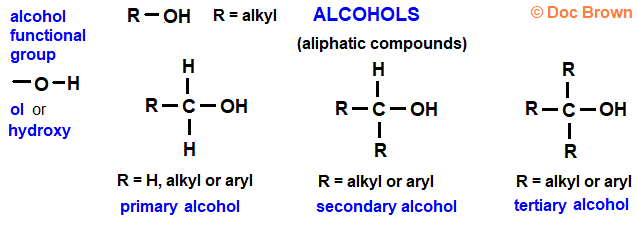
You must know the structures of
primary, secondary and tertiary alcohols
(a) The reaction between a halogenoalkane
and the hydroxide ion and reagents and method
Both these soluble strong bases
(alkalis) are source of a powerful nucleophile, the hydroxide ion (OH–).
This is a nucleophilic substitution reaction
because the attacking reagent is a nucleophile and the halogen
functional group/atom is replaced by the hydroxyl functional group
(alcohol):
RX +
OH- ===> ROH + X-
(R = alkyl, X = Cl, Br or I)
The hydrolysis usually takes faster with an
alkali than pure water because water is a weaker nucleophile than
the hydroxide ion.
See Part 3.4
The
substitution reaction of halogenoalkanes (haloalkanes) with sodium/potassium hydroxide to
give alcohols
Strictly speaking all the reactants and products
should be suffixed by (aq) apart from water (l).
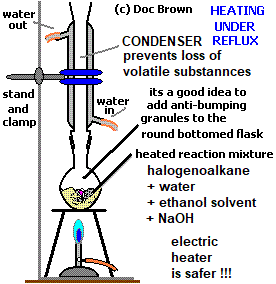

The reaction
is usually carried out by refluxing the halogenoalkane with aqueous sodium
hydroxide (NaOH) and potassium hydroxide (KOH) (left diagram above)
The cold water cooled Liebig vertical condenser
prevents the loss of volatile molecules e.g. solvent or product.
The alcohol can be distilled from the mixture using
fractional distillation (right diagram above).
When an organic compounds like
halogenoalkanes are not very soluble in water, the reaction with an aqueous reagent is very
slow because of a much reduced chance of reactant particle
interactions e.g. compared to a homogenous mixture where the
haloalkane dissolves in the reagent solvent.
So, even under reflux, the hydrolysis reaction can
be quite slow because halogenoalkanes are insoluble in water, but
using aqueous ethanol solvent increases their solubility and speed
of the reaction, BUT ...
... NaOH, and in particular KOH, are very strong bases, and if pure ethanol is used as the solvent, you can get
significant quantities of an alkene via an elimination reaction.
See
Part 3.7
The elimination reactions of
halogenoalkanes (haloalkanes) with potassium hydroxide to give alkenes
(b) bromoethane +
sodium hydroxide ===> ethanol + sodium
bromide
 + NaOH

 + NaBr
since hydroxide
and bromide are free ions the equations are better written as ...
bromoethane + hydroxide ion ===>
ethanol + bromide ion
+ OH–
+ Br–
(displayed formula equation)
 + OH–
+ OH–
 + Br–
(structured formula ionic equation)
+ Br–
(structured formula ionic equation)
 + OH–
+ OH–
 + Br–
(skeletal formula equation)
+ Br–
(skeletal formula equation)
An
example of primary alcohol formation.
(c) 1-bromopropane + sodium hydroxide
===> propan-1-ol + sodium bromide
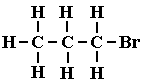 + NaOH
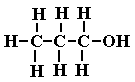 + NaBr
since hydroxide
and bromide are free ions the equations are better written as ...
1-bromopropane + hydroxide ion ===>
propan-1-ol + bromide ion
+ OH–
+ Br–
 + OH–
+ OH–
 + Br–
+ Br–
Another example of primary alcohol formation.
(d) bromocyclohexane + hydroxide ion
===> cyclohexanol + bromide ion
 + OH–
+ OH–
 + Br–
+ Br–
An example of secondary alcohol formation.
(e) 2-bromopropane + sodium
hydroxide ===> propan-2-ol + sodium bromide
CH3CHBrCH3
+ OH- ===> CH3CH(OH)CH3
+ Br-
Another example of secondary alcohol
formation.
(f)
2-chloro-2-methylpropane + sodium hydroxide ===> 2-methylpropan-2-ol + sodium chloride
(CH3)3CCl
+ OH- ===> (CH3)3COH
+ Cl-
Another example of tertiary alcohol formation.
(g) 1,3-dichlorobutane + sodium
hydroxide ===> butane-1,3-diol + sodium bromide
 + 2OH- ===>
 + 2Cl-
The diol product is both a primary and secondary
alcohol (reverse one of the images to match up!)
See also Parts 3.3
and 3.4
Reactivity trends of halogenoalkanes - introduction to their nucleophilic
substitution reactions
The
substitution reaction of halogenoalkanes (haloalkanes) with sodium/potassium hydroxide to
give alcohols
and in the
mechanism sections
Nucleophilic substitution by water/hydroxide ion
[SN1 or SN2
mechanisms, hydrolysis to
give alcohols]
TOP OF PAGE and
indexes
4.2.2
The acid catalysed hydration of alkenes to alcohols
Concentrated sulfuric acid adds to an
alkene to produce an alkyl hydrogensulfate salt (i), which is hydrolysed on
warming with water to give the alcohol (ii) e.g.
(a) (i) ethene + sulfuric acid
===> ethyl hydrogensulfate
H2C=CH2
+ H2SO4 ===> CH3CH2OSO2OH
(ii) ethyl hydrogensulfate +
water ===> ethanol + sulfuric acid
CH3CH2OSO2OH
+ H2O ===> CH3CH2OH
+ H2SO4
There is only one product with a
symmetrical alkene
(b) (i) propene + sulfuric acid
===> propyl hydrogensulfates
H2C=CH2CH3
+ H2SO4 ===> CH3CH2CH2OSO2OH
or CH3CH(OSO2OH)CH3
(ii) propyl hydrogensulfates +
water ===> propanol alcohols + sulfuric acid
There are two isomeric alcohols
from an unsymmetrical alkene, because there are two possible
alkylhydrogensulfates derived from propene.
CH3CH2CH2OSO2OH
+ H2O ===> CH3CH2CH2OH
+ H2SO4
giving the primary
alcohol propan-1-ol
CH3CH(OSO2OH)CH3
+ H2O ===> CH3CH(OH)CH3
+ H2SO4
giving the isomeric
secondary alcohol
propan-2-ol
For (b)(ii), propan-2-ol is the major
product, which you can work out from the Markownikoff (Markownikov)
Rule.
There will always be two isomeric
alcohol products with
an unsymmetrical alkene
For details see Part 2.6
The reaction of alkenes with steam -
addition of water - synthesis of alcohols and the reaction of
alkenes with concentrated sulfuric acid
TOP OF PAGE and
indexes
4.2.3
Industrial manufacture of alcohols
Examples of how alcohols are
manufactured and synthesised on a large scale.
(a)
The industrial
manufacture of methanol
Methanol can be manufactured by
mixing hydrogen and carbon monoxide gases and passing them over a zinc
oxide and chromium oxide catalyst.
2H2(g) +
CO(g) ===> CH3OH(g)
The methanol can be condensed and purified by
fractional distillation.
(b)
Methods of manufacturing ethanol ('alcohol')
The production of ethanol (i) from sugar
fermentation or (ii) synthesis from ethene:
(i)
C6H12O6(aq)
====> 2C2H5OH(aq) + 2CO2(g)
(in the brewing and wine industry)
All
the manufacturing processes are fully described on the
Ethanol manufacture page
(ii)


 ===>
===>
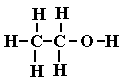
(acid catalysed hydration of alkene synthesis
of alcohols in the chemical industry)
For details see Part 2.6
The reaction of alkenes with steam -
addition of water - synthesis of alcohols and the reaction of
alkenes with concentrated sulfuric acid
Electrophilic addition mechanism of
adding water to alkenes
[acid catalyst] to form alcohols
(c)
Other
alcohols and other methods
Most of the other alcohols are
manufacture by far more complex processes, often involving several
steps. e.g. the synthesis
of propan-1-ol can
be made in two stages using transition metal based catalysts.
(i) Ethene (from oil cracking) is
reacted with carbon monoxide and hydrogen using a rhodium or cobalt
compound catalyst to propanal.
H2C=CH2
+ CO + H2 ===> CH3CH2CHO
(ii) The propanal is hydrogenated
to make propan-1-ol (1-propanol) using an Ni/Pt catalyst.
CH3CH2CHO
+ H2 ===> CH3CH2CH2OH
Propanol
alcohols, as with many other compounds, can be manufactured from basic
carbohydrates like sugars in a fermenter. The microbe enzymes do the chemistry
- examples of biosynthetic pathways - considered more 'green' chemistry.
Website content © Dr Phil Brown 2000+. All
copyrights reserved on revision notes, images, quizzes, worksheets etc. Copying
of website material is NOT permitted. Exam revision summaries & references to
A level chemistry course specifications are unofficial.
Website content © Dr Phil Brown 2000+. All
copyrights reserved on these organic chemistry exam revision
notes on synthesis & manufacture of alcohols, these A level chemistry revision notes are suitable for use of pre-university students studying AQA advanced level
organic chemistry revision notes on synthesis & manufacture of
alcohols, Edexcel advanced level
organic chemistry revision notes on synthesis & manufacture of
alcohols, OCR advanced level
organic chemistry revision notes on synthesis & manufacture of
alcohols, IB advanced level
organic chemistry revision notes on synthesis & manufacture of
alcohols, WJEC (Eduqas) advanced level
organic chemistry revision notes on synthesis & manufacture of
alcohols, CIE Cambridge advanced level
organic chemistry revision notes on synthesis & manufacture of
alcohols, CCEA advanced level
organic chemistry revision notes on synthesis & manufacture of
alcohols, and useful for US grade 11 grade 12 AP honors organic chemistry
courses involving synthesis & manufacture of alcohols
Explaining the importance of synthesis &
manufacture of alcohols
in organic chemistry, What you need to know about synthesis &
manufacture of alcohols for organic
chemistry,
Explaining the use of synthesis & manufacture of alcohols knowledge in organic chemistry, Examples of
synthesis & manufacture of alcohols explained
when studying organic chemistry, What is
the significance of synthesis & manufacture of alcohols in organic chemistry, What is the use of
synthesis & manufacture of alcohols
in organic chemistry Describing and
explaining the theory of synthesis & manufacture of alcohols when studying organic chemistry, exam revision
notes for synthesis & manufacture of alcohols in exams, online help for
synthesis & manufacture of alcohols, revision notes for synthesis & manufacture
of alcohols,
what do I need to learn for synthesis & manufacture of alcohols in exams? revision summary for
synthesis & manufacture of alcohols, help in
teaching synthesis & manufacture of alcohols, learning notes for
synthesis & manufacture of alcohols, help to pass the synthesis & manufacture of
alcohols exam, how to
prepare for examination questions on synthesis & manufacture of
alcohols?
|
