|
Doc Brown's
Advanced Organic Chemistry: Part 14.7
Examples of
the constitutional structural isomers of molecular formula C6H10
and examples of stereoisomers
- structural formula and skeletal formula
[Author
©
Dr
Phil Brown GRIC, PhD: Doc
Brown's advanced level organic chemistry exam revision notes suitable
for students of UK advanced level chemistry courses, IB advanced
chemistry & US K12 grades 11-12 and AP honors chemistry courses: Molecular
spectroscopy and analysing the isomers of C6H10
[page updated
RE-EDIT]
Sub-index for
this page on selected isomers of molecular formula C6H10
(1)
Introduction to the isomers of C6H10
(2)
Details of
selected isomers of
C6H10
(3)
Key revision
points and extra information about selected isomers of
C6H10
(4) Learning objectives - questions to be answered?
(5)
Practice exam
questions based on the isomerism of
C6H10
with worked out
ANSWERS
Associated organic chemistry page links
Index of sets of isomers for a given
molecular formula
email doc
brown - comments - query?
*
[privacy policy, cookies
and disclaimer]
This is a big chemistry website, please allow time
to explore it
(1) Many examples of the structural isomers of molecular formula
C6H10 and E/Z and R/S isomers
Introduction to the constitutional isomers and stereoisomers of C6H10

Percent composition of
C6H10 based on atomic masses C= 12.01 H =
1.01 and Mr(C6H10) = 82.16
Element composition (two dp): carbon = 87.71%
hydrogen = 12.29%
Empirical formula = C3H5 and
molecular formula = C6H10
Structural isomerism
- isomers of the same specific molecular formula, based on different connectivity's of the constituent atoms
(the constitutional isomers), so
they cannot be spatially identical (but sometimes can be defined as having the same shape).
This includes (a)
carbon chain variation (usually need a minimum of 4 atoms),
(b) change in position of a substituent or functional group and
(c) functional group isomerism where the atoms have a different
connectivity configuration, usually with significant differences in
chemical and physical properties e.g.
In terms of isomers of
C6H10
there are
(a) chain variations based on the, open chain linear
or branched alkene or alkyne molecules and lots of unsaturated cyclic (alicyclic)
structures,
(b) positional isomers e.g. position of
alkene and alkyne groups in the open chain compounds and the alkene
groups in cyclic compounds.
(c) They are all functional group isomers of
each other
e.g. in terms e.g. aliphatic open chain alkene (dienes)
versus aliphatic alkyne molecules versus alicyclic cycloalkene
molecules.
Stereoisomerism - isomers
based on the same connectivity of the atoms (same constitutional
formula), but in some way, they are 2D or 3D spatially different
non-superimposable images (e.g. E/Z
'geometrical' isomers or mirror image R/S 'optical' isomers)
This is where
molecules have the same basic constitutional structural formula, but
isomers differ in the 2D/3D arrangement of the atoms.
For stereoisomers, the (CIP) abbreviation
means the
IUPAC Cahn-Ingold-Prelog priority order rule for assigning
E/Z (geometrical) and R/S (optical)
stereoisomers.
E/Z stereoisomerism
was called 'geometrical isomerism' e.g.
cis (= Z) and
trans (= E) isomers of alkenes
or disubstituted cyclic alkanes where there are 2D/3D spatial variations
that are not mirror images and not super imposable.
There are examples of E/Z geometrical isomers
e.g.
in open chain compounds via the C=C restricted rotation in the
dienes and substituted ring molecules based on cyclobutene.
R/S stereoisomerism
was called 'optical isomerism', the pairs of isomers are called
enantiomers, which are 3D non-superimposable mirror image forms of the
molecule (enantiomers).
The molecule must have a chiral centre
(a stereocentre), that is an asymmetric carbon atom with four different
atoms/groups attached to it.
There several examples of R/S optical isomers,
apart from an alkyne, usually involving some of the cyclic
molecules.
NOTE
There are at least 62 structural isomers of molecular
formula C6H10 I have identified, excluding E/Z and R/S
stereoisomers (of which there at least a dozen to add to the 61. There are
many I haven't found the name for yet, BUT, much of the naming of these
compounds is above UK/US K12 grade level, i.e. university level, so don't
worry! and I've left them anonymous, BUT you should be able to interpret their
structure.
Examples of functional group isomerism: (1-7) alkynes, (8-22)
open chain diene alkenes, (23-61)
cycloalkenes, cycloalkanes with an alkene group NOT part of the ring and three
saturated bicylcoalkanes (43-45).
| Spectroscopy |
C≡C stretch
~2100–2260 cm⁻¹ |
C=C stretch ~1640
cm⁻¹ |
IR shifts lower
with conjugation |
Good spectral analysis point about different
infrared wavenumbers.
|
(2)
Details of the selected constitutional isomers and stereoisomers of C6H10
(1-7) Alkynes -
open chain aliphatic compounds with a carbon-carbon
triple bond
C≡C
functional group.
(1) hex-1-yne,
CH3CH2CH2CH2C≡CH ,
1-hexyne, abbreviated structural formula
 skeletal formula of a 'doubly' unsaturated alkyne.
Terms that be used to
describe unsaturation:
Index of hydrogen
deficiency (IHD) = 4, four H atoms can be added to the
C≡C
bond.
Double bond equivalents
(DBE) = 2,
two C=C bonds in the molecule.
Degree of unsaturation
= 2, two C=C bonds
in the molecule.
No E/Z or R/S isomerism
possible for hex-1-yne.
Number of low resolution
NMR chemical shift
δ
signal peaks: 5 1H
and 6 13C
(email
if disagree?)
1H NMR ratio of peaks: 3 : 2 : 2 : 2
: 1 (for equivalent protons of the principal chemical shifts)
Index of 1H NMR spectra organic
compounds and
Index of 13C NMR spectra organic
compounds
(2) hex-2-yne,
CH3CH2CH2C≡CCH3 ,
2-hexyne, abbreviated structural formula
 skeletal formula of this alkyne
No E/Z or R/S
isomerism possible.
Number of low resolution
NMR chemical shift
δ
signal peaks: 4 1H
and 6 13C
(email
if disagree?)
1H NMR ratio of peaks: 3 : 2 : 2 : 3
(for equivalent protons of the principal chemical shifts)
(3) hex-3-yne,
CH3CH2C≡CCH2CH3 ,
3-hexyne,
abbreviated structural formula
 skeletal formula of this alkyne
No E/Z or R/S
isomerism possible.
Number of low resolution
NMR chemical shift
δ
signal peaks: 2 1H
and 3 13C
(email
if disagree?)
1H NMR ratio of peaks: 6
(3+3) : 4 (2+2) (for
equivalent protons of the principal chemical shifts)
Reduced number of peaks due to the symmetry of the
molecule.
(4) 3-methylpent-1-yne,
CH3CH2CH(CH3)C≡CH ,
3-methyl-1-pentyne,
abbreviated structural formula
 skeletal formula, R/S isomers possible of this alkyne, carbon atom 3 is chiral.
(R)-3-methylpent-1-yne,
(S)-3-methylpent-1-yne, (R)-3-methyl-1-pentyne,
(S)-3-methyl-1-pentyne
Number of low resolution
NMR chemical shift
δ
signal peaks: 5 1H
and 6 13C
(email
if disagree?)
1H NMR ratio of peaks: 3 : 2 : 1 : 3
: 1 (for equivalent protons of the principal chemical shifts)
(5) 4-methylpent-1-yne,
(CH3)2CHCH2C≡CH ,
4-methyl-1-pentyne,
abbreviated structural formula
 skeletal formula, No E/Z or R/S isomerism possible for this alkyne.
Number of low resolution
NMR chemical shift
δ
signal peaks: 4 1H
and 5 13C
(email
if disagree?)
1H NMR ratio of peaks: 6
(3+3) : 1 : 2 : 1 (for equivalent protons of the
principal chemical shifts)
(6) 4-methylpent-2-yne,
(CH3)2CHC≡CCH3 ,
4-methyl-2-pentyne, abbreviated structural formula
 skeletal formula, No E/Z or R/S isomerism possible for this alkyne.
Number of low resolution
NMR chemical shift
δ
signal peaks: 3 1H
and 5 13C
(email
if disagree?)
1H NMR ratio of peaks: 6
(3+3) : 1 : 3 (for equivalent protons of the principal
chemical shifts)
(7)
3,3-dimethylbut-1-yne, (CH3)3CC≡CH ,
3,3-dimethyl-1-butyne
 skeletal formula, No E/Z or R/S isomerism possible.
Number of low resolution
NMR chemical shift
δ
signal peaks: 2 1H
and 4 13C
(email
if disagree?)
1H NMR ratio of peaks: 9
(3x3) : 1 (for equivalent protons of the principal
chemical shifts)
(8-22) Dienes - carbon chain
and positional isomers
(8) hexa-1,2-diene,
CH3CH2CH2CH=C=CH2
, 1,2-hexadiene,
abbreviated structural formula
 skeletal formula, No E/Z or R/S isomerism possible for this diene.
Number of low resolution
NMR chemical shift
δ
signal peaks: 5 1H
and 6 13C
(email
if disagree?)
1H NMR ratio of peaks: 3 : 2 : 2 : 1
: 2 (for equivalent protons of the principal chemical shifts)
(9) hexa-1,3-diene,
CH3CH2CH=CHCH=CH2
, 1,3-hexadiene,
abbreviated structural formula
 skeletal formula
E/Z isomers based on carbon atoms >C=C< 3 and 4, E (trans) and Z (cis) isomer shown here.
CIP assignment priority rule for
E/Z isomers:
6C1H > 1H
CIP rule for the four atoms/groups around the >C=C< double bond
Other names:
(E)-hexa-1,3-diene, (Z)-hexa-1,3-diene, (E)-1,3-hexadiene,
(Z)-1,3-hexadiene, (3E)-hexa-1,3-diene, (3Z)-hexa-1,3-diene,
(3E)-1,3-hexadiene, (3Z)-1,3-hexadiene
Number of low resolution
NMR chemical shift
δ
signal peaks: 6 1H
and 6 13C
(email
if disagree?)
1H NMR ratio of peaks: 3 : 2 : 1 : 1
: 1 : 2 (for equivalent protons of the principal chemical shifts)
(10) hexa-1,4-diene,
CH3CH=CHCH2CH=CH2
, 1,4-hexadiene,
abbreviated structural formula
 skeletal formula
E/Z isomers based on carbon atoms 4 and 5, E (trans) and Z (cis) isomers shown here.
CIP assignment priority rule for
E/Z isomers:
6C1H > 1H
CIP rule for the four atoms/groups around the >C=C< double bond
Other names:
(E)-hexa-1,4-diene, (Z)-hexa-1,4-diene, (E)-1,4-hexadiene,
(Z)-1,4-hexadiene, (4E)-hexa-1,4-diene, (4Z)-hexa-1,4-diene,
(4E)-1,4-hexadiene, (4Z)-1,4-hexadiene
Number of low resolution
NMR chemical shift
δ
signal peaks: 6 1H
and 6 13C
(email
if disagree?)
1H NMR ratio of peaks: 3 : 1 : 1 : 2
: 1 : 2 (for equivalent protons of the principal chemical shifts)
(11) hexa-1,5-diene,
H2C=CHCH2CH2CH=CH2
, 1,5-hexadiene,
abbreviated structural formula
 skeletal formula, No E/Z or R/S isomerism possible.
Number of low resolution
NMR chemical shift
δ
signal peaks: 3 1H
and 3 13C
(email
if disagree?)
1H NMR ratio of peaks: 4
(2+2) : 2 (1+1) : 4
(2+2) (for equivalent protons of the principal chemical
shifts). Reduced number of NMR peaks due to the symmetry of this
diene molecule.
(12) hexa-2,3-diene,
CH3CH2CH=C=CHCH3,
2,3-hexadiene,
abbreviated structural formula
 skeletal formula,
This exhibits R/S
(optical) isomerism
because the pi orbitals of the adjacent C=C bonds are at 90o
to each other and allows the formation of non-superimposable mirror image forms
(a bit subtle at pre-university, but make the models yourself!). The R/S isomers
(pair of enantiomers) are best appreciated using ball and stick models
(university level analysis).
Number of low resolution
NMR chemical shift
δ
signal peaks: 5 1H
and 6 13C
(email
if disagree?)
1H NMR ratio of peaks: 3 : 2 : 1 : 1
: 3 (for equivalent protons of the principal chemical shifts)
(13) hexa-2,4-diene,
CH3CH=CHCH=CHCH3,
2,4-hexadiene,
abbreviated structural formula
 skeletal formula, symmetrical alkene
E/Z isomers based on carbon atoms 2 and 3, three possible E/Z isomers.
CIP assignment priority rule for
E/Z isomers:
6C6C >
6C1H > 1H
(a bit tricky!)
CIP rule for the four atoms/groups around each >C=C< double bond
(E,E)-hexa-2,4-diene, (E,Z)-hexa-2,4-diene,
(Z,Z)-hexa-2,4-diene, (E,E)-2,4-hexadiene, (E,Z)-2,4-hexadiene, (Z,Z)-2,4-hexadiene
Number of low resolution
NMR chemical shift
δ
signal peaks: 3 1H
and 3 13C
(email
if disagree?)
1H NMR ratio of peaks: 6
(3+3) : 2 (1+1) : 2
(1+1) (for equivalent protons, ignoring E/Z isomers)
(14)
3-methylpenta-1,2-diene, CH3CH2C(CH3)=C=CH2
, 3-methyl-1,2-pentadiene,
abbreviated structural formula
 skeletal formula, no E/Z or R/S isomerism possible for this diene.
Number of low resolution
NMR chemical shift
δ
signal peaks: 4 1H
and 6 13C
(email
if disagree?)
1H NMR ratio of peaks: 3 : 2 : 3 : 2
(for equivalent protons of the principal chemical shifts)
(15)
4-methylpenta-1,2-diene, (CH3)2CHCH=C=CH2 ,
4-methyl-1,2-pentadiene,
abbreviated structural formula
 skeletal formula, No E/Z or R/S isomerism possible.
Number of low resolution
NMR chemical shift
δ
signal peaks: 4 1H
and 5 13C
(email
if disagree?)
1H NMR ratio of peaks: 6
(3+3) : 1 : 1 : 2 (for equivalent protons of the
principal chemical shifts)
(16)
2-methylpenta-1,3-diene, CH3CH=CHC(CH3)=CH2 ,
2-methyl-1,3-pentadiene,
abbreviated structural formula
 skeletal formula, E/Z stereoisomers (cis and trans) for this diene
CIP assignment priority rule for
E/Z isomers:
6C6C >
6C1H > 1H
CIP rule for the four atoms/groups around the >C=C< double bond
(E)-2-methylpenta-1,4-diene, (Z)-2-methylpenta-1,4-diene,
(E)-2-methyl-1,3-pentadiene, (Z)-2-methyl-1,3-pentadiene
Number of low resolution
NMR chemical shift
δ
signal peaks: 5 1H
and 6 13C
(email
if disagree?)
1H NMR ratio of peaks: 3 : 1 : 1 : 3
: 2 (for equivalent protons)
(17)
3-methylpenta-1,3-diene, CH3CH=C(CH3)CH=CH2 ,
3-methyl-1,3-pentadiene,
abbreviated structural formula
 skeletal formula, E/Z isomerism possible.
Other names:
(E)-3-methylpenta-1,3-diene, (Z)-3-methylpenta-1,3-diene,
(E)-3-methyl-1,3-pentadiene, (Z)-3-methyl-1,3-pentadiene
CIP assignment priority rule for
E/Z isomers:
6C6C >
6C1H > 1H
CIP rule for the four atoms/groups around the >C=C< double bond
Number of low resolution
NMR chemical shift
δ
signal peaks: 5 1H
and 6 13C
(email
if disagree?)
1H NMR ratio of peaks: 3 : 1 : 3 : 1
: 2 (for equivalent protons of the principal chemical shifts)
(18)
4-methylpenta-1,3-diene, (CH3)2C=CHCH=CH2 ,
4-methyl-1,3-pentadiene,
abbreviated structural formula
 skeletal formula, No E/Z and R/S isomers possible.
Number of low resolution
NMR chemical shift
δ
signal peaks: 4 1H
and 5 13C
(email
if disagree?)
1H NMR ratio of peaks: 6
(3+3) : 1 : 1 : 2 (for equivalent protons of the
principal chemical shifts)
(19)
2-methylpenta-1,4-diene, H2C=CHCH2C(CH3)=CH2
, 2-methyl-1,4-pentadiene,
abbreviated structural formula
 skeletal formula, no E/Z or R/S isomers possible.
Number of low resolution
NMR chemical shift
δ
signal peaks: 5 1H
and 6 13C
(email
if disagree?)
1H NMR ratio of peaks: 2 : 1 : 2 : 3
: 2 (for equivalent protons of the principal chemical shifts)
(20)
3-methylpenta-1,4-diene, H2C=CHCH(CH3)CH=CH2 ,
3-methyl-1,4-pentadiene,
abbreviated structural formula
 skeletal formula, no E/Z or R/S isomers possible.
Number of low resolution
NMR chemical shift
δ
signal peaks: 4 1H
and 4 13C
(email
if disagree?)
1H NMR ratio of peaks: 4
(2+2) : 2 (1+1) : 1 : 3 (for
equivalent protons of the principal chemical shifts)
Four NMR peaks despite symmetry of this molecule.
(21)
2-methylpenta-2,3-diene, CH3CH=C=C(CH3)2 ,
2-methyl-2,3-pentadiene,
abbreviated structural formula
 skeletal formula, no E/Z or R/S isomers possible.
Number of low resolution
NMR chemical shift
δ
signal peaks: 3 1H
and 5 13C
(email
if disagree?)
1H NMR ratio of peaks: 3 : 1 : 6 (for equivalent protons)
(22)
2,3-dimethylbuta-1,3-diene, H2C=C(CH3)C(CH3)=CH2
, 2,3-dimethyl-1,3-butadiene,
abbreviated structural formula
 skeletal formula, no E/Z or R/S isomers possible.
Number of low resolution
NMR chemical shift
δ
signal peaks: 2 1H
and 3 13C
(email
if disagree?)
1H NMR ratio of peaks: 4
(2+2) : 6 (3+3) = 2 : 3 (for
equivalent protons of the principal chemical shifts), reduced
number of NMR peaks due to symmetry of molecule.
(23-61) Cycloalkenes
- aliphatic compounds with a C=C double bond in a ring (alicyclic)
(23)
cyclohexene,
 ,
skeletal formula, no E/Z or R/S isomers possible. ,
skeletal formula, no E/Z or R/S isomers possible.
Number of low resolution
NMR chemical shift
δ
signal peaks: 3 1H
and 3 13C
(email
if disagree?)
1H NMR ratio of peaks: 4
(2+2) : 4 (2+2) : 2
(1+1) (for equivalent protons of the principal chemical shifts),
reduced number of NMR peaks due to symmetry of molecule.
(24)
1-methylcyclopentene,
 , 1-methylcyclopent-1-ene, skeletal formula, , 1-methylcyclopent-1-ene, skeletal formula,
No E/Z or R/S isomers
possible.
Number of low resolution
NMR chemical shift
δ
signal peaks: 5 1H
and 6 13C
(email
if disagree?)
1H NMR ratio of peaks: 1 : 2 : 2 : 2 : 3
(clockwise for equivalent protons of the principal chemical shifts)
(25)
3-methylcyclopentene,
 , 3-methylcyclopent-1-ene, skeletal formula , 3-methylcyclopent-1-ene, skeletal formula
NOT
2-methylcyclopentene, because the carbon atoms of the C=C are preferentially
numbered 1,2.
No E/Z isomers, but R/S
isomers based on the right-hand carbon atom of the pentangle, C3, which is chiral.
Number of low resolution
NMR chemical shift
δ
signal peaks: 6 1H
and 6 13C
(email
if disagree?)
1H NMR ratio of peaks: 1 : 2 : 2 : 1 : 3 : 1
(clockwise for equivalent protons of the principal chemical shifts)
(26)
4-methylcyclopentene,
 , 4-methylcyclopent-1-ene, skeletal formula , 4-methylcyclopent-1-ene, skeletal formula
No E/Z or R/S isomers
possible.
NOT 3-methylcyclopropene,
because the carbon atoms of the C=C are preferentially numbered 1,2.
Number of low resolution
NMR chemical shift
δ
signal peaks: 4 1H
and 4 13C
(email
if disagree?)
1H NMR ratio of peaks: 2
(1+1) : 4 (2+2) : 1 : 3 (for equivalent
protons of the principal chemical shifts)
(27)
1-ethylcyclobutene,
 , 1-ethylcyclobut-1-ene, 1-ethyl-1-cyclbuttene,
The skeletal formula
and there are no E/Z or R/S isomers possible.
Number of low resolution
NMR chemical shift
δ
signal peaks: 5 1H
and 6 13C
(email
if disagree?)
1H NMR ratio of peaks: 2 : 2 : 1 : 2 : 3
(clockwise for equivalent protons of the principal chemical shifts)
(28)
3-ethylcyclobutene,
 , 3-ethylcyclobut-1-ene, skeletal formula
No E/Z isomers, but R/S
isomers based on the bottom left carbon atom of the
□, C3 is chiral.
NOT 2-ethylcyclopropene
because the C=C carbon atoms are preferentially numbered 1 and 2.
Number of low resolution
NMR chemical shift
δ
signal peaks: 6 1H
and 6 13C
(email
if disagree?)
1H NMR ratio of peaks: 3 : 2 : 1 : 2 : 1 : 1 (for equivalent protons)
(29)
1,2-dimethycyclobutene,
 ,
1,2-dimethylcyclobut-1-ene, skeletal formula. ,
1,2-dimethylcyclobut-1-ene, skeletal formula.
No E/Z or R/S isomerism
possible.
Number of low resolution
NMR chemical shift
δ
signal peaks: 2 1H
and 3 13C
(email
if disagree?)
1H NMR ratio of peaks: 4
(2+2) : 6 (3+3) (for equivalent protons
of the principal chemical shifts), reduced number of NMR peaks due to
symmetry.
(30a)
1,3-dimethylcyclobutene,
 ,
1,3-dimethylcyclobut-1-ene, skeletal formula. ,
1,3-dimethylcyclobut-1-ene, skeletal formula.
R/S isomerism possible
based on the top left carbon atom of the
□,
C3, which is chiral.
Number of low resolution
NMR chemical shift
δ
signal peaks: 5 1H
and 6 13C
(email
if disagree?)
1H NMR ratio of peaks: 2 : 1 : 3 : 1 : 3 (for
equivalent protons of the principal chemical shifts)
(30b)
2,3-dimethylcyclobutene ,
 ,
2,3-dimethylcyclobut-1-ene ,
2,3-dimethylcyclobut-1-ene
Also named as
1,4-dimethylcyclobutene or 1,4-dimethylcyclobut-1-ene
R/S isomerism possible
based on the bottom left carbon atom of the
□,
C3, which is chiral.
Number of low resolution
NMR chemical shift
δ
signal peaks: 5 1H
and 6 13C
(email
if disagree?)
1H NMR ratio of peaks: 3 : 1 : 2 : 1 : 3 (for equivalent protons)
(31)
3,3-dimethylcyclobutene,
 ,
3,3-dimethylcyclobut-1-ene, skeletal formula ,
3,3-dimethylcyclobut-1-ene, skeletal formula
No E/Z or R/S isomerism possible.
Number of low resolution
NMR chemical shift
δ
signal peaks: 4 1H
and 5 13C
(email
if disagree?)
1H NMR ratio of peaks: 2 : 6
(3+3) : 1 : 1 (for equivalent protons of the principal chemical
shifts)
(32)
3,4-dimethylcyclobutene,
 ,
3,4-dimethylcyclobut-1-ene, skeletal formula ,
3,4-dimethylcyclobut-1-ene, skeletal formula
E/Z (cis/trans) isomerism possible based on the two ring methyl groups,
but the left C atoms of the ring are both chiral so is R/S isomerism is possible?
Overlap of types of stereoisomerism (university level
analysis)
CIP assignment priority rule for
E/Z isomers:
6C6C >
6C1H > 1H
(Z)-3,4-dimethylcyclbutene (cis isomer),
 , a = a
= CH3 , a = a
= CH3
(E)-3,4-dimethylcyclbutene (trans isomer) ,
 , a = a
= CH3 , a = a
= CH3
Number of low resolution
NMR chemical shift
δ
signal peaks: 3 1H
and 3 13C
(email
if disagree?)
1H NMR ratio of peaks: 6
(3+3) : 2 (1+1) : 2
(1+1) = 3 : 1 : 1 (for equivalent protons)
(33)
1-propylcyclopropene,
 ,
1-propylcycloprop-1-ene, skeletal formula ,
1-propylcycloprop-1-ene, skeletal formula
No E/Z or R/S isomerism possible.
Number of low resolution
NMR chemical shift
δ
signal peaks: 5 1H
and 6 13C
(email
if disagree?)
1H NMR ratio of peaks: 1 : 2 : 2 : 2 : 3 (for equivalent protons)
(34)
3-propylcyclopropene,
 ,
3-propylcycloprop-1-ene, skeletal formula ,
3-propylcycloprop-1-ene, skeletal formula
NOT 2-propylcyclopropene
because the C=C carbon atoms are preferentially numbered 1 and 2.
No E/Z or R/S isomerism possible.
Number of low resolution
NMR chemical shift
δ
signal peaks: 5 1H
and 5 13C
(email
if disagree?)
1H NMR ratio of peaks: 2
(1+1) : 1 : 2 : 2 : 3 (for equivalent protons of the principal
chemical shifts)
(35)
1-(1-methylethyl)cyclopropene ?,
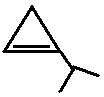 , skeletal formula
No E/Z or R/S isomerism possible.
Number of low resolution
NMR chemical shift
δ
signal peaks: 4 1H
and 5 13C
(email
if disagree?)
1H NMR ratio of peaks: 1 : 2 : 1 : 6
(3+3) (for equivalent protons of the principal chemical shifts)
(36)
3-(1-methylethyl)cyclopropene ?,
 , skeletal formula , skeletal formula
No E/Z or R/S isomerism possible.
Number of low resolution
NMR chemical shift
δ
signal peaks: 4 1H
and 4 13C
(email
if disagree?)
1H NMR ratio of peaks: 2
(1+1) : 1 : 1 : 6 (3+3) (for equivalent protons)
(37)
1-ethyl-2-methylcyclopropene,
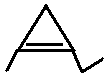 ,
1-ethyl-2-methylcycloprop-1-ene, skeletal formula ,
1-ethyl-2-methylcycloprop-1-ene, skeletal formula
No E/Z (?) or R/S isomerism possible.
Number of low resolution
NMR chemical shift
δ
signal peaks: 4 1H
and 6 13C
(email
if disagree?)
1H NMR ratio of peaks: 3 : 2 : 2 : 3 (for
equivalent protons of the principal chemical shifts)
(38)
1-ethyl-3-methylcyclopropene,
 ,
1-ethyl-3-methylcycloprop-1-ene, skeletal formula ,
1-ethyl-3-methylcycloprop-1-ene, skeletal formula
NOT
1-ethyl-2-methylcyclopropene because the C=C carbon atoms are preferentially
numbered 1 and 2.
R/S isomerism possible, based on top carbon atom of the
∆, which is chiral.
Number of low resolution
NMR chemical shift
δ
signal peaks: 5 1H
and 6 13C
(email
if disagree?)
1H NMR ratio of peaks: 1 : 1 : 3 : 2 : 3 (for equivalent protons)
(39)
3-ethyl-1-methylcyclopropene,
 ,
3-ethyl-1-methylcycloprop-1-ene, skeletal formula ,
3-ethyl-1-methylcycloprop-1-ene, skeletal formula
R/S isomerism possible, based on top carbon atom of the
∆, which is chiral.
Number of low resolution
NMR chemical shift
δ
signal peaks: 5 1H
and 6 13C
(email
if disagree?)
1H NMR ratio of peaks: 1 : 1 : 2 : 3 : 3 (for equivalent protons)
(40)
3-ethyl-3-methylcyclopropene,
 ,
3-ethyl-3-methylcycloprop-1-ene, skeletal formula ,
3-ethyl-3-methylcycloprop-1-ene, skeletal formula
NOT
2-ethyl-2-methylcyclopropene because the C=C carbon atoms are preferentially
numbered 1 and 2.
No E/Z or R/S isomers
possible of this cycloalkene.
Number of low resolution
NMR chemical shift
δ
signal peaks: 4 1H
and 5 13C
(email
if disagree?)
1H NMR ratio of peaks: 2
(1+1) : 3 : 2 : 3 (for equivalent protons)
(41)
1,2,3-ttrimethylcyclopropene,
 ,
1,2,3-trimethycycloprop-1-ene, skeletal formula ,
1,2,3-trimethycycloprop-1-ene, skeletal formula
No E/Z or R/S isomers
possible.
Number of low resolution
NMR chemical shift
δ
signal peaks: 3 1H
and 4 13C
(email
if disagree?)
1H NMR ratio of peaks: 6
(3+3) : 1 : 3 (for equivalent protons)
(42)
1,3,3-trimethylcyclopropene,
 ,
1,3,3-trimethylcycloprop-1-ene, skeletal formula ,
1,3,3-trimethylcycloprop-1-ene, skeletal formula
NOT
1,2,2-trimethylcyclopropene because the C=C carbon atoms are preferentially
numbered 1 and 2.
No E/Z or R/S isomers
possible.
Number of low resolution
NMR chemical shift
δ
signal peaks: 3 1H
and 5 13C
(email
if disagree?)
1H NMR ratio of peaks: 1 : 6
(3+3) : 3 (for equivalent protons)
(43)
bicyclo[2.2.0]hexane,
![bicyclo[2.2.0]hexane skeletal formula isomer of C6H10](../addhoc06/0isomc6h10-43.gif) ,
skeletal formula ,
skeletal formula
E/Z or R/S isomers
possible due to symmetry?
Number of low resolution
NMR chemical shift
δ
signal peaks: 2 1H
and 2 13C
(email
if disagree?)
1H NMR ratio of peaks: 8
(4x2) : 2 (1+1) = 4 : 1 (for equivalent protons)
Note that this isn't it's real shape!, it is 'crumpled' so that all the
C-C-C, C-C-H and H-C-H bond angles are ~109o.
(44)
bicyclo[3.1.0]hexane,
![bicyclo[3.1.0]hexane skeletal formula isomer of C6H10](../addhoc06/0isomc6h10-44.gif) ,
skeletal formula ,
skeletal formula
No E/Z isomers
possible?, but R/S isomers?
Number of low resolution
NMR chemical shift
δ
signal peaks: 4 1H
and 4 13C
(email
if disagree?)
1H NMR ratio of peaks: 2 : 4
(2+2) : 2 (1+1) : 2 (for equivalent protons)
(45)
2,4-dimethylbicyclo[1.1.0]butane,
![2,4-dimethylbicyclo[1.1.0]butane skeletal formula isomer of C6H10](../addhoc06/0isomc6h10-45.gif) ,
skeletal formula ,
skeletal formula
No E/Z or R/S isomers
possible.
Number of low resolution
NMR chemical shift
δ
signal peaks: 3 1H
and 3 13C
(email
if disagree?)
1H NMR ratio of peaks: 6
(3+3) : 2 (1+1) : 2
(1+1) (for equivalent protons of the principal chemical
shifts), reduced NMR peaks due to symmetry of molecule.
(46)
methylidenecyclopentene,
 ,
skeletal formula ,
skeletal formula
No E/Z or R/S isomers
possible.
Number of low resolution
NMR chemical shift
δ
signal peaks: 3 1H
and 4 13C
(email
if disagree?)
1H NMR ratio of peaks: 4
(2+2) : 4 (2+2) : 2 (for equivalent
protons of the principal chemical shifts)
(47)
ethylidenecyclobutane,
 ,
skeletal formula ,
skeletal formula
No E/Z or R/S isomers
possible.
Number of low resolution
NMR chemical shift
δ
signal peaks: 4 1H
and 5 13C
(email
if disagree?)
1H NMR ratio of peaks: 2 : 4
(2+2) : 1 : 3 (for equivalent protons)
(48)
ethenylcyclobutane,
 ,
skeletal formula, cyclobutylethene ? ,
skeletal formula, cyclobutylethene ?
No E/Z or R/S isomers
possible.
Number of low resolution
NMR chemical shift
δ
signal peaks: 5 1H
and 5 13C
(email
if disagree?)
1H NMR ratio of peaks: 2 : 4
(2+2) : 1 : 1 : 2 (for equivalent protons)
(49)
1-methyl-2-methylenecyclobutane,
 ,
skeletal formula ,
skeletal formula
R/S isomers possible based on the top left carbon atom,
which is chiral.
Number of low resolution
NMR chemical shift
δ
signal peaks: 5 1H
and 6 13C
(email
if disagree?)
1H NMR ratio of peaks: 2 : 1 : 3 : 2 : 2 (clockwise for equivalent protons)
(50)
1-methyl-3-methylenecyclobutane,
 ,
skeletal formula ,
skeletal formula
No E/Z or R/S isomers
possible.
Number of low resolution
NMR chemical shift
δ
signal peaks: 4 1H
and 5 13C
(email
if disagree?)
1H NMR ratio of peaks: 3 : 1 : 4
(2+2) : 2 (for equivalent protons)
(51) name ?,
 ,
skeletal formula ,
skeletal formula
No E/Z or R/S isomers
possible.
Number of low resolution
NMR chemical shift
δ
signal peaks: 4 1H
and 5 13C
(email
if disagree?)
1H NMR ratio of peaks: 4
(2+2) : 1 : 2 : 3 (for equivalent protons)
(52)
1-cyclopropylpropene,
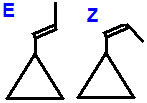 ,
skeletal formula ,
skeletal formula
Other names:
1-cyclopropylprop-1-ene, 1-cyclopropyl-1-propene, (E)-1-cyclopropylpropene,
(Z)-1-cyclopropylpropene, (E)-1-cyclopropylprop-1-ene, (E)-1-cyclopropyl-1-propene,
(Z)-1-cyclopropylprop-1-ene, (Z)-1-cyclopropyl-1-propene
E/Z geometrical isomers possible based on the C=C bond.
CIP assignment priority rule for
E/Z isomers:
6C6C >
6C1H > 1H
Number of low resolution
NMR chemical shift
δ
signal peaks: 5 1H
and 5 13C
(email
if disagree?)
1H NMR ratio of peaks: 4
(2+2) : 1 : 1 : 1 : 3 (for equivalent protons)
(53) name ?,
 ,
skeletal formula ,
skeletal formula
No E/Z or R/S isomers
possible.
Number of low resolution
NMR chemical shift
δ
signal peaks: 4 1H
and 5 13C
(email
if disagree?)
1H NMR ratio of peaks: 4
(2+2) : 1 : 3 : 2 (for equivalent protons)
(54)
3-cyclopropylpropene,
 ,
skeletal formula. ,
skeletal formula.
3-cyclopropylprop-1-ene, 3-cyclopropyl-1-propene
No E/Z or R/S isomers
possible.
Number of low resolution
NMR chemical shift
δ
signal peaks: 5 1H
and 5 13C
(email
if disagree?)
1H NMR ratio of peaks: 4
(2+2) : 1 : 2 : 1 : 2 (for equivalent protons)
(55) name ?,
 ,
skeletal formula ,
skeletal formula
No E/Z or R/S isomers
possible.
Number of low resolution
NMR chemical shift
δ
signal peaks: 2 1H
and 4 13C
(email
if disagree?)
1H NMR ratio of peaks: 4
(2+2) : 6 (3+3) (for equivalent protons
of the principal chemical shifts, reduced number due to high symmetry of
molecule)
(56)
1-ethylidene-2-methylcyclopropane,
 ,
skeletal formula ,
skeletal formula
(E)-1-ethylidene-2-methylcyclopropane, (Z)-1-ethylidene-2-methylcyclopropane
CIP assignment priority rule for
E/Z isomers:
6C6C >
6C1H > 1H
Both E/Z isomers based on the alkene bond and R/S
stereoisomers based on the bottom right
carbon atom of the
∆,
which is chiral - complicated situation - university level.
Number of low resolution
NMR chemical shift
δ
signal peaks: 5 1H
and 6 13C
(email
if disagree?)
1H NMR ratio of peaks: 2 : 1 : 3 : 1 : 3 (clockwise for equivalent protons)
(57)
1-ethenyl-1-methylcyclopropane,
 ,
skeletal formula ,
skeletal formula
No E/Z or R/S isomers possible.
Number of low resolution
NMR chemical shift
δ
signal peaks: 4 1H
and 5 13C
(email
if disagree?)
1H NMR ratio of peaks: 4
(2+2) : 3 : 1 : 2 (for equivalent protons)
(58)
1-ethenyl-2-methylcyclopropane,
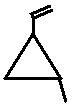 ,
skeletal formula ,
skeletal formula
E/Z (geometrical) isomers based on the two substituents in
the cyclopropane ring and R/S stereoisomers based on the bottom right
carbon atom of the
∆, which is chiral.
This is complicated stereoisomerism - university level
analysis.
Number of low resolution
NMR chemical shift
δ
signal peaks: 6 1H
and 6 13C
(email
if disagree?)
1H NMR ratio of peaks: 2 : 1 : 1 : 2 : 1 : 3 (clockwise for equivalent protons)
(59)
1-ethyl-2-methylenecyclopropane ?,
 ,
skeletal formula ,
skeletal formula
2-ethyl-1-methylenecyclopropane ?
R/S isomers based on the bottom right
carbon atom of the
∆, which is chiral.
This is complicated stereoisomerism!
Number of low resolution
NMR chemical shift
δ
signal peaks: 5 1H
and 6 13C
(email
if disagree?)
1H NMR ratio of peaks: 2 : 2 : 1 : 2 : 3 (for equivalent protons)
(60)
1,1-dimethyl-2-methylenecyclopropane ?,
 ,
skeletal formula ,
skeletal formula
2,2-dimethyl-2-methylenecyclopropane ?
No E/Z or R/S isomers possible.
Number of low resolution
NMR chemical shift
δ
signal peaks: 3 1H
and 5 13C
(email
if disagree?)
1H NMR ratio of peaks: 2 : 2 : 6
(3+3) (for equivalent protons)
(61)
1,2-dimethyl-3-methylenecyclopropane,
 ,
skeletal formula ,
skeletal formula
Based on the two bottom carbon atoms of the
∆, both E/Z and R/S
stereoisomerism possible, very complicated, university level.
Number of low resolution
NMR chemical shift
δ
signal peaks: 3 1H
and 4 13C
(email
if disagree?)
1H NMR ratio of peaks: 6
(3+3) : 2 (1+1) : 2 (for equivalent protons)
(62-?) I'm sure there are other isomers possible for C6H10,
but I think I've illustrated enough examples?
(3) EXTRA NOTES
on the isomers of
Molecular Formula: C6H10
Types
of Isomerism in C6H10
| Type of Isomerism |
Description |
| Constitutional |
Different connectivity: e.g.
hex-1-yne versus 1,3-cyclohexadiene |
| Positional |
Triple or double bond in different
locations (e.g. hex-1-yne versus hex-2-yne) |
| Chain (skeletal) |
Straight versus branched carbon
skeletons (e.g. 3-methylpent-1-yne) |
| Geometric (E/Z) |
For alkenes with two different
groups on each C=C (e.g. hex-2-ene) |
| Ring versus acyclic |
Cycloalkenes versus open-chain
alkynes/dienes |
| Conformational |
Chair/boat forms in cyclohexenes;
rotamers in branched chains |
Representative Constitutional Isomers of C6H10
Alkyne Isomers
-
Hex-1-yne
-
Hex-2-yne
-
3-Methylpent-1-yne
-
3-Methylpent-2-yne
-
2-Methylpent-1-yne
Cycloalkene Isomers
Diene Isomers
-
Hexa-1,3-diene (conjugated)
-
Hexa-1,4-diene (non-conjugated)
-
2-Methylpenta-1,3-diene
Differences in Physical Properties of selected isomers of C6H10
| Property |
Alkyne Isomers |
Cycloalkenes |
Dienes |
| Boiling Point |
Lower for terminal alkynes |
Higher due to ring strain relief |
Conjugated dienes slightly lower |
| Polarity |
Terminal alkynes more polar |
Cycloalkenes less polar overall |
Conjugation affects dipole moment |
| Spectroscopy |
C≡C stretch ~2100–2260 cm⁻¹ |
C=C stretch ~1640 cm⁻¹ |
IR shifts lower with conjugation |
Good point about different
infrared wavenumbers.
Differences in Chemical Reactivity of selected isomers of C6H10
| Reaction Type |
Alkyne Isomers |
Cycloalkenes |
Dienes |
| Electrophilic Addition |
Terminal alkynes undergo Markovnikov |
Cyclohexene reacts like typical alkene |
Conjugated dienes show 1,2 & 1,4
addition |
| Hydrogenation |
Converts to alkene then alkane |
Converts to cyclohexane |
Conjugated dienes hydrogenate
selectively |
| Diels–Alder |
Not applicable |
Rare unless conjugated |
Conjugated dienes are reactive
partners |
| Acidity |
Terminal alkynes are weakly acidic |
Not acidic |
Dienes not acidic but reactive |
Uses
and Applications of selected isomers of C6H10
-
Alkynes: Precursors in organic synthesis
(e.g. Sonogashira coupling), fuel additives, welding gases (ethyne).
-
Cycloalkenes: Used in polymer synthesis,
fragrance intermediates, and as models for ring strain.
-
Dienes: Key monomers in synthetic rubber
(e.g. 1,3-butadiene), Diels–Alder chemistry, and fine chemical synthesis.
Student Misconceptions about selected isomers of C6H10
-
“Alkynes are just like alkenes” — No! Alkynes have linear
geometry and different reactivity (e.g. acidity, triple bond additions).
-
“Conjugated dienes react the same as isolated ones” — False.
Conjugation stabilizes intermediates and changes regioselectivity.
-
“Cyclohexene is aromatic” — Incorrect. It lacks full
conjugation and planarity needed for aromaticity.
Exam
Revision Tips for questions involving selected isomers of C6H10
-
Draw and name all major isomers: practice
IUPAC naming and skeletal structures.
-
Compare reactivity: use mechanisms to
explain why conjugated dienes undergo 1,4-addition.
-
Spectroscopy practice: identify IR
stretches for C≡C and C=C; predict NMR shifts for vinylic and allylic
protons.
-
Mechanism mastery: show electrophilic
addition to alkynes and dienes with regioselectivity.
-
Use energy profiles: explain why conjugated
systems are more stable and react differently.
(4)
Learning objectives - questions to be answered?
How do you work out the structure of
the isomers of molecular formula C6H10?
How do you draw the structural formula
and skeletal formula of the isomers of molecular formula C6H10?
How many aliphatic structural isomers
are there of molecular formula C6H10?
How many aliphatic carbon chain isomers
are there of molecular formula C6H10?
How many positional isomers are there
of molecular formula C6H10?
How many E/Z (geometrical) isomers are
there of molecular formula C6H10?
How many R/S (optical) isomers
(enantiomers) of molecular formula C6H10?
Are there any aliphatic open chain
alkene isomers of molecular formula C6H10?
Are there any diene isomers of
molecular formula C6H10?
Are there any alkyne isomers of
molecular formula C6H10?
Are there any alicyclic cycloalkane
isomers of molecular formula C6H10?
Are there any alicyclic cycloalkene
isomers of molecular formula C6H10?
Are there any functional group isomers
with a molecular formula C6H10?
Are there any E/Z (geometrical) isomers
with a molecular formula C6H10?
Are there any R/S (optical) isomers
(enantiomers) with a molecular formula C6H10?
Does C6H10 have any stereoisomers?
This
page will answer these questions for molecular formula C6H10
|
(5)
QUESTIONS
Practise exam questions
based on isomers of molecular formula C6H10
Jot
down your responses and check out the answers
ANSWERS
to the questions based on the isomers of
C6H10
If you think there are
any errors, please email me asap at
chem55555@hotmail.com
I don't mind if students/teachers do a selected printout
of these questions and answers.
Give the
seven selected isomers of molecular formula C6H10
...
Q1 Which
isomer(s) of C6H10 will readily
add a maximum of one bromine molecule per molecule?
Q2 Which
isomer(s) of C6H10 can exhibit E/Z
(geometrical) isomerism?
Q3 Which
isomer(s) of C6H10 will not
readily accept a bromine molecule in an addition
reaction?
Q4 Which
isomer(s) of C6H10 can add two
molecules of hydrogen in a hydrogenation reaction?
Q5 Which
isomer(s) of C6H10 can exhibit R/S
(optical) isomerism?
Q6 Which
isomer(s) of C6H10 are alkynes?
Q7 (a)
Using abbreviated structural formula, write equations
for B and D reacting with excess bromine
(b) IUPAC
name the products in each case, and, what if any, do the
products exhibit any type of isomerism?
If you think there are
any errors, please email me asap at
chem55555@hotmail.com
|
Associated organic chemistry links
Index of sets of isomers for a given
molecular formula
The molecular structure and
naming of ALKANES (how
to name and draw alkane structures)
The molecular structure and naming
of ALKENES
(how to name and draw alkene structures)
Index of revision notes
on the chemistry of ALKANES and the petrochemical
industry
INDEX of
ALL revision notes on the chemistry ALKENES
including reactions and polymersFor isomerism in organic chemistry, see also the
notes
Isomerism: introduction, structural isomerism - chain,
positional, functional group, tautomerism
Stereoisomerism:
introduction, definition,
priority rules, E/Z isomerism (cis/trans isomerism)
Stereoisomerism - R/S isomerism (optical
isomerism) -
definition - examples explained
This is a big chemistry website, please allow time
to explore it
Index of my advanced
(pre-college/university) organic
chemistry revision notes
Index
of all my spectroscopy pages
Index
of all my isomerism pages
The chemistry of
alkanes and the petrochemical
industry
The
chemistry of alkenes
The
chemistry of haloalkanes
The
chemistry of
alcohols
The chemistry of aldehydes
and ketones
The
chemistry of carboxylic acids and derivatives
The chemistry of organo-nitrogen compounds
The chemistry of
aromatic compounds

|
Website content © Dr Phil Brown 2000+. All copyrights reserved on revision
notes, images, quizzes, worksheets etc. Copying of Doc Brown's pre-university
advanced level chemistry website material is NOT permitted. Exam revision
summaries & references to science course specifications are unofficial. These
organic chemistry revision notes on isomerism are suitable for use of
pre-university students studying AQA advanced level chemistry, Edexcel advanced
level chemistry, OCR advanced level chemistry, IB advanced level chemistry, WJEC
(Eduqas) advanced level chemistry, CIE advanced level chemistry, US grade 11-12
AP honors chemistry courses and they will also prove useful to 1st year
undergraduate students of chemistry.
The isomerism of molecules of formulae
C6H10,
structural constitutional isomers, E/Z geometrical isomers and R/S
optical stereoisomers |
selected constitutional isomers of molecular formula C6H10, names of C6H10 isomers, structural isomers, skeletal formula of C6H10 isomers, carbon chain isomers C6H10
isomers, E/Z geometrical isomers of C6H10, R/S optical stereoisomers of C6H10, structural formula, positional isomers, alkyne isomers of C6H10, cycloalkene isomers of C6H10, diene isomers of C6H10, cycloalkene isomers of C6H10, exam questions on isomers of C6H10, Doc Brown's advanced level chemistry revision notes for AQA Edexcel OCR Salters IB US honors chemistry courses
Keywords or phrases: how many isomers are
there of molecular formula C6H10? how do you name the isomers of
molecular formula C6H10? what is the molecular structure of the
isomers of C6H10, what type of isomerism is exhibited by molecules
of formula C6H10, how do you work out the isomers of cycloalkenes
and alkynes of molecular
formula C6H10, what are the structural isomers of C6H10, the carbon chain
isomers of C6H10 in the homologous series of alkanes, comparing
the spectra of isomers of molecular formula C6H10 how many structural isomers of
C6H10 can you draw? how many structural isomers does C6H10 have?
what are the possible isomers of C6H10? revision notes on
isomerism of C6H10 molecules, isomerism in
alkane, alkene and alkane
isomers of C6H10, ester isomers of C6H10, the molecular structure of
the isomers of C6H10 how to draw the
structural formula of isomers of C6H10, how to draw the displayed
formula of isomers of C6H10, how to draw the skeletal formula of
isomers of C6H10 cycloalkenes and alkynes, how to name the isomers of molecular formula
C6H10,
isomers of C6H10 of molecular mass ? R/S optical isomers
enantiomers of C6H10 cycloalkenes and alkynes E/Z isomers cis
trans stereoisomers of C6H10
E/Z isomers of molecular formula C6H10 (geometric cis/trans
isomers) alkene molecules isomeric of molecular formula C6H10,
molecules isomeric with molecular formula C6H10, structural isomers of molecular
formula C6H10, optical isomers R/S enantiomers isomeric with molecular
formula C6H10, positional isomers isomeric with cycloalkenes and
alkynes of molecular formula C6H10,
which types of isomerism are exhibited by molecules isomeric with
molecular formula C6H10 alkyl positional isomers of C6H10 branched
carbon chain alkene isomers of C6H10 cycloalkanes of molecular formula
C6H10 which are isomeric with alkenes of molecular formula C6H10
stereoisomers of molecular formula C6H10
cycloalkene molecules isomeric of molecular formula C6H10,
cycloalkenes and alkynes molecules isomeric with molecular formula
C6H10, structural isomers of molecular
formula C6H10, optical isomers R/S enantiomers isomeric with molecular
formula C6H10, positional isomers isomeric with molecular formula
C6H10,
which types of isomerism are exhibited by molecules isomeric with
molecular formula C6H10 alkyl positional isomers of C6H10
cycloalkenes and alkynes branched carbon chain cycloalkene
isomers of molecular formula C6H10
cyclic alkanes of formula C6H10 E/Z isomers of molecular formula
C6H10 (geometric cis/trans
isomers) alkene molecules isomeric of molecular formula C6H10,
molecules isomeric with molecular formula C6H10, structural isomers of molecular
formula C6H10, optical isomers R/S enantiomers isomeric with molecular
formula C6H10, positional isomers isomeric with molecular formula
C6H10,
alicyclic alkanes of formula C6H10 which types of isomerism are exhibited by molecules isomeric with
molecular formula C6H10 alkyl positional isomers of C6H10 branched
carbon chain alkene isomers of C6H10 cycloalkanes of molecular formula
C6H10 which are isomeric with alkenes of molecular formula C6H10
stereoisomers of molecular formula C6H10 cycloalkane functional
group isomers of C6H10 are there alkyne isomers of C6H10? are
there cycloalkanes of formula C6H10? are there cycloalkenes of
formula C6H10 chain isomers of C6H10 functional group isomers of
C6H10 substituent and functional group positional isomers of
C6H10 cyclic alkanes of formula C6H10 E/Z isomers of molecular formula
C6H10 (geometric cis/trans
isomers) alkene molecules isomeric of molecular formula C6H10,
molecules isomeric with molecular formula C6H10, structural isomers of molecular
formula C6H10, optical isomers R/S enantiomers isomeric with molecular
formula C6H10, positional isomers isomeric with molecular formula
C6H10,
alicyclic alkanes of formula C6H10 which types of isomerism are exhibited by molecules isomeric with
molecular formula C6H10 alkyl positional isomers of C6H10 branched
carbon chain alkene isomers of C6H10 cycloalkanes of molecular formula
C6H10 which are isomeric with alkenes of molecular formula C6H10
stereoisomers of molecular formula C6H10 cycloalkane functional
group isomers of C6H10 are there alkyne isomers of C6H10? are
there cycloalkanes of formula C6H10? are there cycloalkenes of
formula C6H10 chain isomers of C6H10 functional group isomers of
C6H10 substituent and functional group positional isomers of
C6H10
|
(5)
ANSWERS
Practise exam questions
based on isomers of molecular formula C6H10
If you think there are
any errors, please email me asap at
chem55555@hotmail.com
I don't mind if students/teachers do a selected printout
of these questions and answers.
Give the
seven selected isomers of molecular formula C6H10
...
Q1 Which
isomer(s) of C6H10 will readily
add a maximum of one bromine molecule per molecule?
ANSWERS A, C
and E, each molecule has a single C=C bond,
albeit in a cycloalkene ring.
Q2 Which
isomer(s) of C6H10 can exhibit E/Z
(geometrical) isomerism?
ANSWER only B
(which is an E (trans) isomer, based on the C=C
bond of atoms C3 and C4).
Q3 Which
isomer(s) of C6H10 will not
readily accept a bromine molecule in an addition
reaction?
ANSWER G only,
all the others have an unsaturated C=C or
C≡C bond. Note that G isn't that shape, it is 'crumpled'
so that all bond angles are ~109o.
Q4 Which
isomer(s) of C6H10 can add two
molecules of hydrogen in a hydrogenation reaction?
ANSWERS B, D
and F, these molecules have two C=C bonds or
a single C ≡C
bond.
Q5 Which
isomer(s) of C6H10 can exhibit R/S
(optical) isomerism?
ANSWERS A and
C, both have an asymmetric carbon atom, C3 in
both cases (C1 and C2 form the C=C bond).
Q6 Which
isomer(s) of C6H10 are alkynes?
ANSWER only D
has a
C≡C triple bond.
Q7 (a)
Using abbreviated structural formula, write equations
for B and D reacting with excess bromine
With two C=C double bonds, they will add two bromine
molecules. For isomer B:
CH3CH2CH=CHCH=CH2
+ 2Br2 ===> CH3CH2CHBrCHBrCHCH2Br
For isomer D:
CH3CH2CH2CH2C≡CH
+ 2Br2 ===>
CH3CH2CH2CH2CBr2CHBr2
(b) IUPAC
name the products in each case, and, what if any, do the
products exhibit any type of isomerism?
Product from B is
1,2,3,4-tetrabromohexane, positional
isomerism of the bromine atoms, chain isomerism, R/S ('optical')
isomerism (C2, C3 and C4 are chiral). Note that the
product cannot now exhibit E/Z (geometrical) isomerism.
Product from D is
1,1,2,2-tetrabromohexane, positional
isomerism of the bromine atoms, chain isomerism.
If you think there are
any errors, please email me asap at
chem55555@hotmail.com
|
|

