|
Doc Brown's
Advanced Chemistry: Part 14.7
Isomers of a given molecular formula
The 35
constitutional-structural
carbon chain isomers of molecular formula C9H20
and those that exhibit R/S ('optical') stereoisomerism
[Author
©
Dr
Phil Brown GRIC, PhD:
Doc Brown's advanced level organic chemistry exam revision notes
suitable for students of UK advanced level chemistry courses, IB advanced
chemistry & US K12 grades
11-12 and AP honors chemistry courses: NMR molecular
spectroscopy and analysing the isomers of C9H20
[page updated
RE-EDIT]
Sub-index for
this page on the isomers of molecular formula C9H20
(A)
Introduction to the isomers of C9H20
(B)
Details of the 35 structural isomers of C9H20
(C)
Extra data on C9H20 isomers
including examples of physical properties, octane numbers and uses
(D)
Typical expected learning objectives for C9H20
isomers
(E)
Practice exam questions based on the isomers of C9H20
email doc
brown - comments - query?
*
[privacy policy, cookies
and disclaimer]
Associated organic chemistry page links
Index of sets of isomers for a given
molecular formula
This is a big chemistry website, please allow time
to explore it
(A)
Introduction to 35 alkane carbon chain constitutional-structural isomers of molecular formula C9H20

R/S means molecule
is capable of forming R/S 'optical' isomers (enantiomer pairs of
non-superimposable mirror images) i.e. has a chiral
carbon atom, more details below
Percent composition based on
atomic masses C= 12.01 H = 1.01 and Mr(C9H20)
= 128.29
Element composition (to two
dp): carbon = 84.25% hydrogen = 15.75%
Empirical formula = C9H20
= molecular formula =
C9H20
Structural isomerism
includes carbon chain variation (usually need a minimum of 4 C atoms), change in
position of a substituent or functional group and functional group isomerism
where the atoms have a different configuration, usually with significant
differences in chemical and physical properties.
Only carbon chain isomerism
applies to the isomers of C9H20.
Stereoisomerism is where
molecules have the same basic constitutional structural formula, but isomers
differ in the 2D/3D arrangement of the atoms.
E/Z
stereoisomerism was called 'geometrical isomerism' e.g. cis
and trans isomers of alkenes or disubstituted cyclic alkanes
where there are 3D spatial variations due to restricted bond rotation that are not mirror images and not super
imposable.
Does NOT apply to the isomers of
C9H20.
R/S
stereoisomerism was called 'optical isomerism', the pairs of
isomers are called enantiomers which are 3D non-superimposable
mirror image forms of the molecule. The molecule must have a chiral centre
(a stereocentre), that is an asymmetric carbon atom with four
different atoms/groups attached to it.
There are several
examples of R/S 'optical' isomerism in the isomers of C9H20.
NOTE
All 35 constitutional isomers of C9H20 are examples of carbon chain isomerism,
but a number of them, theoretically, will exhibit R/S isomerism
(non-superimposable mirror images, optical isomers known as enantiomers).
The side
chains are the methyl and ethyl groups.
There are quite a few stereoisomers, 15 isomers
exhibit R/S isomerism and three have two chiral carbon atoms, so things
get complicated - university level analysis required.
This means there are at least 33 stereoisomers for
C9H20.
(B) Details of
35 constitutional isomers of C9H20
(and accompanying R/S 'optical' isomers indicated)
(1)
nonane, CH3CH2CH2CH2CH2CH2CH2CH2CH3
or
CH3(CH2)7CH3
skeletal formula,
 A linear alkane hydrocarbon molecule A linear alkane hydrocarbon molecule
Number of low resolution
NMR chemical shift
δ
signal peaks: 5 1H
and 5 13C
(email
if disagree?)
1H NMR ratio of peaks: 6(3+3) :
4(2+2) :
4(2+2) :
4(2+2)
: 2 (central C5) (for equivalent protons)
Reduced number of chemical shift peaks due to the symmetry
of the molecule.
These 1H and 13C NMR resonances
are likely to be close together requiring high resolution spectroscopy.
This applies to most of the isomers of C9H20.
Detail s of isomers based on a carbon chain of
eight
(substituted
octanes)
(2)
2-methyloctane,
CH3CH2CH2CH2CH2CH2CH(CH3)2
skeletal formula
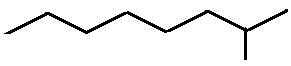
Number of low resolution
NMR chemical shift
δ
signal peaks: 8 1H
and 8 13C
(email
if disagree?)
1H NMR ratio of peaks: 3 : 2 : 2 : 2
: 2 : 1 : 2 : 6(3+3) (central
C5) (for equivalent protons)
Many chemical shifts due to lack of symmetry.
(3)
3-methyloctane,
CH3CH2CH2CH2CH2CH(CH3)CH2CH3
skeletal formula
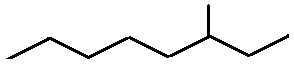
R/S 'optical' isomers
(enantiomers), 3rd C3 is chiral
Number of low resolution
NMR chemical shift
δ
signal peaks: 9 1H
and 9 13C
(email
if disagree?)
1H NMR ratio of peaks: 3 : 2 : 2 : 2
: 2 : 1 : (3) : 2 : 3 (for equivalent protons)
Maximum number of possible chemical shifts due to zero symmetry.
(4)
4-methyloctane,
CH3CH2CH2CH2CH(CH3)CH2CH2CH3
skeletal formula
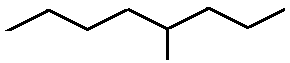
R/S 'optical' isomers (enantiomers), 4th C4 is chiral
Number of low resolution
NMR chemical shift
δ
signal peaks: 9 1H
and 9 13C
(email
if disagree?)
1H NMR ratio of peaks: 3 : 2 : 2 : 2
: 1 : (3) : 2 : 2 : 3 (for equivalent protons)
Maximum number of possible chemical shifts due to zero
symmetry.
There are lots of more highly branched structural isomers of
C9H20 (31 more in fact !!!)
Details of isomers based on a carbon chain of
seven
(substituted
heptanes)
(5) 3-ethylheptane, skeletal formula
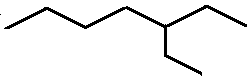
Number of low resolution
NMR chemical shift
δ
signal peaks: 7 1H
and 7 13C
(email
if disagree?)
1H NMR ratio of peaks: 3 : 2 : 2 : 2
: 1 : 4(2+2) : 6(3+3) (for equivalent protons)
(6) 4-ethylheptane, skeletal formula
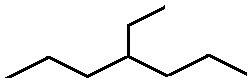
Number of low resolution
NMR chemical shift
δ
signal peaks: 6 1H
and 6 13C
(email
if disagree?)
1H NMR ratio of peaks: 6(3+3)
: 4(2+2)
: 4(2+2)
: 1 : 2 : 3 (for equivalent protons)
Some symmetry in the molecule.
(7) 2,2-dimethylheptane, skeletal formula
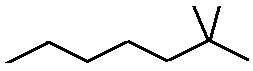
Number of low resolution
NMR chemical shift
δ
signal peaks: 6 1H
and 7 13C
(email
if disagree?)
1H NMR ratio of peaks: 3 : 2 : 2 : 2
: 2 : 9(3x3) (for equivalent protons)
(8) 2,3-dimethylheptane, skeletal formula

R/S 'optical' isomers (enantiomers), carbon atom C3 is chiral
Number of low resolution
NMR chemical shift
δ
signal peaks: 8 1H
and 8 13C
(email
if disagree?)
1H NMR ratio of peaks: 3 : 2 : 2 : 2
: 1 : (3) : 1 : 6(3+3) (for equivalent protons)
(9) 2,4-dimethylheptane, skeletal formula
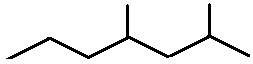
R/S 'optical' isomers (enantiomers), carbon atom C4 is chiral
Number of low resolution
NMR chemical shift
δ
signal peaks: 8 1H
and 8 13C
(email
if disagree?)
1H NMR ratio of peaks: 3 : 2 : 2 : 1
: (3) : 2 : 1 : 6(3+3) (for equivalent protons)
(10) 2,5-dimethylheptane, skeletal formula
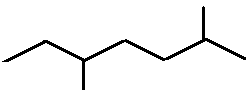
R/S 'optical' isomers (enantiomers), carbon atom C5 is chiral.
Number of low resolution
NMR chemical shift
δ
signal peaks: 8 1H
and 8 13C
(email
if disagree?)
1H NMR ratio of peaks: 3 : 2 : 1 :
(3) : 2 : 2 : 1 : 6(3+3) (for equivalent protons)
(11) 2,6-dimethylheptane, skeletal formula
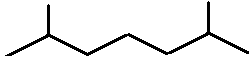
Number of low resolution
NMR chemical shift
δ
signal peaks: 4 1H
and 4 13C
(email
if disagree?)
1H NMR ratio of peaks: 12(3x4)
: 2(1+1) : 4(2+2)
: 2 (for equivalent protons)
Reduced number of chemical shift peaks due to the
symmetry of the molecule.
(12) 3,3-dimethylheptane, skeletal formula
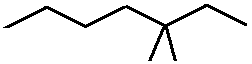
Number of low resolution
NMR chemical shift
δ
signal peaks: 7 1H
and 8 13C
(email
if disagree?)
1H NMR ratio of peaks: 3 : 2 : 2 : 2
: (6(3+3))
: 2 : 3 (for equivalent protons)
(13) 3,4-dimethylheptane, skeletal formula
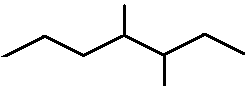
R/S 'optical' isomers (enantiomers), carbon atoms C3 and
C4 are
two chiral centres - complicated, university level analysis - no plane of
symmetry in the molecule, so four permutations of stereoisomers possible: RR', RS', SR' and SS'
Number of low resolution
NMR chemical shift
δ
signal peaks: 9 1H
and 9 13C
(email
if disagree?)
1H NMR ratio of peaks: 3 : 2 : 2 : 1
: (3) : 1: (3) : 2 : 3 (for equivalent protons)
Maximum number of chemical shifts possible due to zero
symmetry.
(14) 3,5-dimethylheptane, skeletal formula
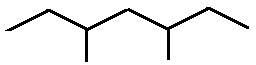
R/S isomers, carbon atoms C3 and C5 are chiral (two
stereocentres), but there is a plane of symmetry, pair of R/S enantiomers and a
3rd optically
inactive meso isomer - university level analysis.
Number of low resolution
NMR chemical shift
δ
signal peaks: 5 1H
and 5 13C
(email
if disagree?)
1H NMR ratio of peaks: 6(3+3)
: 4(2+2) : 2(1+1)
: 6(3+3) : 2 (for equivalent protons)
Reduced number of chemical shift peaks due to the
symmetry of the molecule.
(15) 4,4-dimethylheptane, skeletal formula
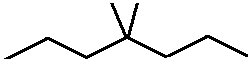
Number of low resolution
NMR chemical shift
δ
signal peaks: 4 1H
and 5 13C
(email
if disagree?)
1H NMR ratio of peaks: 6(3+3)
: 4(2+2) : 4(2+2)
: 6(3+3) (for equivalent protons)
Reduced number of chemical shift peaks due to the
symmetry of the molecule.
Details of isomers based on a carbon chain of
six
(substituted
hexanes)
The images (16)
to (19) were originally done for my
learning alkanes nomenclature page,
now redone.
(16)
3-ethyl-2-methylhexane ,
 , ,

skeletal formula
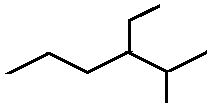 R/S 'optical' isomers (enantiomers), the molecule has a chiral (asymmetric) carbon atom (3rd C) - example of
stereoisomerism -
R/S (optical) isomers
R/S 'optical' isomers (enantiomers), the molecule has a chiral (asymmetric) carbon atom (3rd C) - example of
stereoisomerism -
R/S (optical) isomers
Number of low resolution
NMR chemical shift
δ
signal peaks: 8 1H
and 8 13C
(email
if disagree?)
1H NMR ratio of peaks: 3 : 2 : 2 : 1 : (2 : 3) :
1 : 6(3+3) (for equivalent protons)
(17)
3-ethyl-3-methylhexane ,
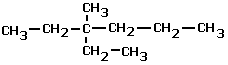 , ,

skeletal
formula

Number of low resolution
NMR chemical shift
δ
signal peaks: 6 1H
and 7 13C
(email
if disagree?)
1H NMR ratio of peaks: 3 : 2 : 2
: 4(2+2) : 3 : 6(3+3) (for equivalent protons)
(18)
3-ethyl-4-methylhexane ,
 , ,

skeletal formula

R/S 'optical' isomers (enantiomers), it has a chiral (asymmetric) carbon atom (4th C) - example of
stereoisomerism.
Number of low resolution
NMR chemical shift
δ
signal peaks: 7 1H
and 7 13C
(email
if disagree?)
1H NMR ratio of peaks: 3 : 2 : 1 : (3) : 1 : 4(2+2)
: 6(3+3) (for equivalent protons)
(19)
4-ethyl-2-methylhexane ,
 , ,

skeletal formula
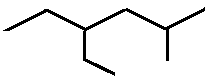
Number of low resolution
NMR chemical shift
δ
signal peaks: 6 1H
and 6 13C
(email
if disagree?)
1H NMR ratio of peaks:
6(3+3)
: 4(2+2) : 1 : 2 : 1 : 6(3+3) (for equivalent protons)
(20) 2,2,3-trimethylhexane, skeletal formula
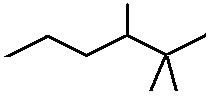
R/S 'optical' isomers (enantiomers), it has a chiral (asymmetric)
carbon atom (3rd C) - example of
stereoisomerism.
Number of low resolution
NMR chemical shift
δ
signal peaks: 6 1H
and 7 13C
(email
if disagree?)
1H NMR ratio of peaks: 3 : 2 : 2 : 1 : (3) : 9(3x3) (for equivalent protons)
(21) 2,2,4-trimethylhexane, skeletal formula
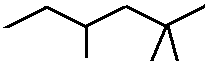
R/S 'optical' isomers (enantiomers), it has a chiral (asymmetric) carbon atom (4th C) - example of
stereoisomerism.
Number of low resolution
NMR chemical shift
δ
signal peaks: 6 1H
and 7 13C
(email
if disagree?)
1H NMR ratio of peaks: 3 : 2 : 1 : (3) : 2 : 9(3x3) (for equivalent protons)
(22) 2,2,5-trimethylhexane, skeletal formula

Number of low resolution
NMR chemical shift
δ
signal peaks: 5 1H
and 6 13C
(email
if disagree?)
1H NMR ratio of peaks: 6(3+3)
: 1 : 2 : 2 : 9(3x3) (for equivalent protons)
(23) 2,3,3-trimethylhexane, skeletal formula
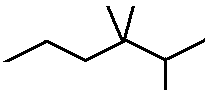
Number of low resolution
NMR chemical shift
δ
signal peaks: 6 1H
and 7 13C
(email
if disagree?)
1H NMR ratio of peaks: 3 : 2 : 2 : (6(3+3))
: 1 : 6(3+3) (for equivalent protons)
(24) 2,3,4-trimethylhexane, skeletal formula
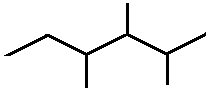
R/S 'optical' isomers (two pairs of enantiomers), carbon atoms
C3 and C4 are
two chiral centres - complicated, university level analysis - molecule has
no plane of symmetry, so four possible permutations of
the stereoisomers: RR', RS', SR' and SS'.
Number of low resolution
NMR chemical shift
δ
signal peaks: 8 1H
and 8 13C
(email
if disagree?)
1H NMR ratio of peaks: 3 : 2 : 1 : (3) : 1 : (3)
: 1 : 6(3+3) (for equivalent protons)
(25) 2,3,5-trimethylhexane, skeletal formula
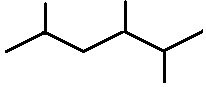
R/S 'optical' isomers (enantiomers), carbon atom C3 is chiral.
Number of low resolution
NMR chemical shift
δ
signal peaks: 7 1H
and 7 13C
(email
if disagree?)
1H NMR ratio of peaks:
6(3+3)
: 1 : 2 : 1 : (3) : 1 : 6(3+3) (for equivalent protons)
(26) 2,4,4-trimethylhexane, skeletal formula
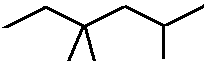
Number of low resolution
NMR chemical shift
δ
signal peaks: 6 1H
and 7 13C
(email
if disagree?)
1H NMR ratio of peaks: 3 : 2 : 6(3+3)
: 2 : 1 :
6(3+3)
(for equivalent protons)
(27) 3,3,4-trimethylhexane, skeletal formula
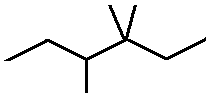
R/S 'optical' isomers (enantiomers), carbon atom 4 is chiral.
Number of low resolution
NMR chemical shift
δ
signal peaks: 7 1H
and 8 13C
(email
if disagree?)
1H NMR ratio of peaks: 3 : 2 : 1 : 3 : 6(3+3)
: 2 : 3 (for equivalent protons)
Details of isomers based on a carbon chain of
five (substituted
pentanes)
(28)
3,3-diethylpentane,
skeletal formula

Number of low resolution
NMR chemical shift
δ
signal peaks: 2 1H
and 3 13C
(email
if disagree?)
1H NMR ratio of peaks: 12(4x3) :
8 (4x2) (for equivalent protons)
Greatly reduced number of chemical shift peaks due to
the very high symmetry of the molecule.
(29)
3-ethyl-2,2-dimethylpentane,
 , ,

skeletal formula

Number of low resolution
NMR chemical shift
δ
signal peaks: 4 1H
and 5 13C
(email
if disagree?)
1H NMR ratio of peaks:
6(3+3) : 4(2+2)
: 1 : 9(3x3) (for equivalent protons)
(30)
3-ethyl-2,3-dimethylpentane,
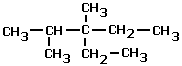 , ,

skeletal formula
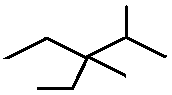
Number of low resolution
NMR chemical shift
δ
signal peaks: 5 1H
and 6 13C
(email
if disagree?)
1H NMR ratio of peaks:
6(3+3) : 4(2+2)
: 3 : 1 : 6(2+2) (for equivalent protons)
(31)
3-ethyl-2,4-dimethylpentane,
 , ,

skeletal formula

Number of low resolution
NMR chemical shift
δ
signal peaks: 5 1H
and 5 13C
(email
if disagree?)
1H NMR ratio of peaks: 12(4x3)
: 2(1+1) : 1 :
2 : 3
(for equivalent protons)
(32) 2,2,3,3-tetramethylpentane,
skeletal formula
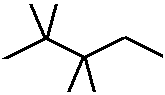
Number of low resolution
NMR chemical shift
δ
signal peaks: 4 1H
and 6 13C
(email
if disagree?)
1H NMR ratio of peaks: 9(3x3)
: 6(3+3) :
2 : 3
(for equivalent protons)
(33)
2,2,3,4-tetramethylpentane,
skeletal formula

R/S 'optical' isomers (enantiomers), carbon atom C3 is chiral.
Number of low resolution
NMR chemical shift
δ
signal peaks: 5 1H
and 6 13C
(email
if disagree?)
1H NMR ratio of peaks: 6(3+3)
: 1 : 1 : 3 : 9(3x3) (for equivalent protons)
(34)
2,3,3,4-tetramethylpentane,
skeletal formula
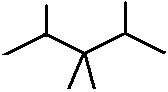
Number of low resolution
NMR chemical shift
δ
signal peaks: 3 1H
and 4 13C
(email
if disagree?)
1H NMR ratio of peaks: 12(4x3):
2(1+1) : 6(3+3) (for equivalent protons)
Greatly reduced number of chemical shift peaks due
to the high symmetry of the molecule.
(35)
2,2,4,4-tetramethylpentane,
skeletal formula

Number of low resolution
NMR chemical shift
δ
signal peaks: 2 1H
and 3 13C
(email
if disagree?)
1H NMR ratio of peaks: 18(6x3):
2 (for equivalent protons)
Greatly reduced number of chemical shift peaks due to the very
high symmetry of the molecule.
(C)
EXTRA NOTES on isomers of
C9H20
Alkane isomers with
molecular formula
C9H20
(nonane and its branched variants) are primarily used as fuels, solvents,
and chemical feedstocks, with differences in volatility and combustion
efficiency influencing their specific applications.
Overview of
C9H20
Alkane Isomers
These isomers differ in carbon branching, which
affects boiling point, flash point, and combustion characteristics.
Uses and Applications
of isomers of C9H20
|
Isomer
Type |
Key
Properties |
Common
Uses |
|
n-Nonane |
High boiling point
(~151 °C), low volatility |
- Jet fuel and diesel
blending
- Organic solvent
- Calibration standard |
|
Branched
isomers |
Lower boiling points,
higher octane ratings |
- Petrol additives
(e.g., 2,2,4-trimethylpentane = isooctane)
- Cleaner combustion fuels |
Sources:
Comparative Analysis
of isomers of C9H20
|
Feature |
n-Nonane |
Branched
Isomers |
|
Boiling point |
Higher |
Lower due to compact
structure |
|
Octane rating |
Lower (poor anti-knock
quality) |
Higher (better for
internal combustion engines) |
|
Combustion
efficiency |
Slower, more complete |
Faster, cleaner burn |
|
Industrial
preference |
Jet fuels, solvents |
Petrol additives,
performance fuels |
Summary of Applications
of isomers of C9H20
-
Fuel blending: Branched isomers are
preferred in gasoline due to high octane ratings.
-
Solvent use: n-Nonane is used in
analytical chemistry and industrial cleaning.
-
Chemical synthesis: All isomers can serve
as feedstocks for cracking and reforming processes.
-
Environmental considerations: Branched
isomers tend to produce fewer pollutants during combustion.
Boiling
points and octane numbers of C9H20 isomers
(generated by Microsoft Co-pilot)
Key notes
-
Straight‑chain nonane has the highest boiling point
and lowest octane number.
-
More
branching → lower boiling point → higher octane number
(better fuel behaviour).
-
Highly
branched isomers (e.g., trimethylhexanes, tetramethylpentanes) have
very high octane numbers.
(D)
Learning objectives - questions to be answered?
Can you IUPAC name the
isomers of C9H20?
Can you work out the number of
distinct 1H NMR chemical shifts for an isomer of C9H20?
Can you work out the
number of distinct 13H NMR chemical shifts for an isomer of C9H20?
How many constitutional isomers are there of
molecular formula C9H20?
How do you work out the structure
of the isomers of molecular formula C9H20?
How do you draw the constitutional-structural
formula of the isomers of molecular formula
C9H20?
How do you draw the skeletal formula of the isomers of molecular formula
C9H20?
How do you name the isomers of molecular formula
C9H20?
How many aliphatic structural
isomers are there of molecular formula C9H20?
How many aliphatic carbon chain
isomers are there of molecular formula C9H20?
How many positional isomers are
there of molecular formula C9H20?
Does C9H20 have any stereoisomers?
Are there any E/Z (geometrical) or
RS (optical) stereoisomers (enantiomers) of C9H20?
Are there any aliphatic open chain
alkene isomers of molecular formula C9H20?
Are there any alkane/cycloalkane isomers of
molecular formula C9H20?
Are there any alkene/cycloalkene/diene/alkyne isomers of
molecular formula C9H20?
Are there any alicyclic cycloalkane
isomers of molecular formula C9H20?
Are there any functional group
isomers with a molecular formula C9H20?
For isomers of
molecular formula C9H20, be able to
correlate intermolecular bonding forces, boiling points and octane numbers and
explain theoretically explain their connection.
This page will answer these questions for molecular formula C9H20
(E) QUESTIONS
Practise exam questions
based on isomers of molecular formula C9H20
Jot
down your responses and check out the answers
ANSWERS
to the questions based on the isomers of
C9H20
If you think there are
any errors, please email me asap at
chem55555@hotmail.com
I don't mind if students/teachers do a selected printout
of these questions and answers.
Given six selected isomers of molecular formula C9H20
...
In answering the questions,
give as much reasoning as
possible!
Q1
Assign
IUPAC names
to isomers
A to F
Q2 (a) Which isomer will give the most 1H and
13C NMR resonances
(b) Which isomer will give the least 1H and
13C NMR resonances
Q3 Which isomers can exhibit R/S ('optical')
isomerism?
Q4 Which of the isomers might you expect to have the
highest octane number and which isomer the lowest octane
number?
Q5 Which of the isomers might you expect to exhibit the
strongest intermolecular bonding forces and which isomer
the weakest?
Q6 Which of the isomers might you expect to have the
lowest boiling point and which isomer the highest
boiling point?
Q7 Which isomer can only give a maximum of two isomers
on mono-chlorination with Cl2/uv?
Write skeletal formula equations to show their formation
ANSWERS
to the questions based on the isomers of
C9H20
If you think there are
any errors, please email me asap at
chem55555@hotmail.com
I don't mind if students/teachers do a selected printout
of these questions and answers.
|
Associated organic chemistry links
Advanced Level pre-university
organic chemistry notes
IR, mass and H-1 & C-13 NMR
spectra of organic compounds
Examples of effects of isomerism: The similarity or difference
in the physical & chemical properties of structural isomers
Index of sets of isomers for a given
molecular formula
The molecular structure and
naming of ALKANES
Index of revision notes
on the chemistry of ALKANES and the petrochemical
industry
Isomerism: introduction, structural isomerism - chain,
positional, functional group, tautomerism
Stereoisomerism:
introduction, definition,
priority rules, E/Z isomerism (cis/trans isomerism)
Stereoisomerism - R/S isomerism (optical
isomerism) -
definition - examples explained
This is a big chemistry website, please allow time
to explore it
Index of advanced
(pre-university) organic
chemistry revision notes
The chemistry of
alkanes and the petrochemical
industry
The
chemistry of alkenes
The
chemistry of organic halogen compounds
The
chemistry of
alcohols
The chemistry of
aldehydes
and ketones The
chemistry of carboxylic acids and derivatives
The chemistry of
organo-nitrogen compounds
The chemistry of
aromatic compounds

|
Website content © Dr
Phil Brown 2000+. All copyrights reserved on revision notes, images,
quizzes, worksheets etc. Copying of Doc Brown's pre-university
advanced level chemistry website material is NOT
permitted. Exam revision summaries & references to science course specifications
are unofficial. These organic chemistry revision notes on
isomerism are
suitable for use of pre-university students studying AQA advanced level
chemistry, Edexcel advanced level chemistry, OCR advanced level
chemistry, IB advanced level chemistry, WJEC (Eduqas) advanced level
chemistry, CIE advanced level chemistry, US grade 11-12 AP honors
chemistry courses and they will also prove useful to
1st year undergraduate students of chemistry.
The isomerism of molecules of formulae
C9H20,
structural constitutional isomers and R/S optical stereoisomers |
Keywords or phrases: how many isomers are
there of molecular formula C9H20? how do you name the isomers of
molecular formula C9H20? what is the molecular structure of the
isomers of C9H20, what type of isomerism is exhibited by molecules
of formula C9H20, how do you work out the isomers of molecular
formula C9H20, what are the structural isomers of
C9H20, the carbon chain
isomers of C9H20 in the homologous series of alkanes, comparing
the spectra of isomers of molecular formula C9H20 how many structural isomers of
C9H20 can you draw? how many structural isomers does C9H20 have?
what are the possible isomers of C9H20? revision notes on
isomerism of C9H20 molecules R/S
optical isomers enantiomers of C9H20,
isomers of C9H20 of molecular mass 128
open carbon chain aliphatic alkane molecules isomeric of molecular formula
C9H20,
hydrocarbon molecules isomeric with molecular formula C9H20, structural isomers of molecular
formula C9H20, optical isomers R/S enantiomers isomeric with molecular
formula C9H20, positional isomers isomeric with molecular formula
C9H20,
which types of isomerism are exhibited by molecules isomeric with
molecular formula C9H20 alkyl positional isomers of C9H20 branched
carbon chain alkane isomers of C9H20
open carbon chain aliphatic alkane molecules isomeric of molecular formula C9H20,
hydrocarbon molecules isomeric with molecular formula C9H20, structural isomers of molecular
formula C9H20, optical isomers R/S enantiomers isomeric with molecular
formula C9H20, positional isomers isomeric with molecular formula
C9H20,
which types of isomerism are exhibited by molecules isomeric with
molecular formula C9H20 alkyl positional isomers of C9H20 branched
carbon chain alkane isomers of C9H20
cycloalkane molecules isomeric of molecular formula C9H20,
cycloalkane molecules isomeric with molecular formula C9H20, structural isomers of molecular
formula C9H20, optical isomers R/S enantiomers isomeric with molecular
formula C9H20, positional isomers isomeric with molecular formula
C9H20,
which types of isomerism are exhibited by molecules isomeric with
molecular formula C9H20 alkyl positional isomers of C9H20 branched
carbon chain cycloalkane isomers of molecular formula C9H20
cycloalkene molecules isomeric of molecular formula C9H20,
cycloalkene molecules isomeric with molecular formula C9H20, structural isomers of molecular
formula C9H20, optical isomers R/S enantiomers isomeric with molecular
formula C9H20, positional isomers isomeric with molecular formula
C9H20,
which types of isomerism are exhibited by molecules isomeric with
molecular formula C9H20 alkyl positional isomers of C9H20
cycloalkenes branched carbon chain cycloalkene isomers of molecular formula
C9H20
ANSWERS
|
Practise exam questions
based on isomers of molecular formula C9H20
If you think there are
any errors, please email me asap at
chem55555@hotmail.com
I don't mind if students/teachers do a selected printout
of these questions and answers.
Given six selected isomers of molecular formula
C9H20
...
answers the question plus as much reasoning as
possible!
Q1
Assign
IUPAC names
to isomers
A to F
ANSWERS A
2-methyloctane, B 4-ethylheptane, C
2,4-dimethylheptane
D 3,4-dimethylheptane,
E 4-ethyl-2-methylhexane, F
2,2,4,4-tetramethylpentane
Q2 (a) Which isomer will give the most 1H and
13C NMR resonances
(b) Which isomer will give the least 1H and
13C NMR resonances
ANSWERS
(a) isomer
D,
no symmetry in the molecule, maximum possible 9 1H
and 9 13C NMR chemical shifts.
(b) isomer
F,
most symmetry in the molecule, only 2 1H and
3 13C NMR peaks, the most symmetrical of
these six isomers.
Q3 Which isomers can exhibit R/S ('optical')
isomerism?
ANSWERS
C, C4
is chiral, 4 different groups attached to C4.
D, has two chiral centres,
4 different groups
attached to C3 and also C4.
Q4 Which of the isomers might you expect to have the
highest octane number and which isomer the lowest octane
number?
ANSWERS (refer
to data table)
F
likely to have the highest octane number, most branched,
probably RON ~95
A
likely to have the lowest octane number, least branched,
probably RON ~45
Q5 Which of the isomers might you expect to exhibit the
strongest intermolecular bonding forces and which isomer
the weakest?
ANSWERS (refer
to data table)
A
likely to exhibit the strongest intermolecular forces,
least branched, least compact molecule, most
polarizable.
F
likely to exhibit the weakest intermolecular forces,
most branched, most compact molecule, least polarizable.
Q6 Which of the isomers might you expect to have the
lowest boiling point and which isomer the highest
boiling point?
ANSWERS
(refer
to data table) These answers follow on from
Q5
F
likely to have the lowest boiling point, most branched,
most compact, least ploarizable, weakest intermolecular
forces, molecules need least kinetic energy to escape
from the liquid and vaporise, bpt. probably ~133oC.
A
likely to have the highest boiling point, least
branched, most compact, most polarizable, strongest
intermolecular forces, bpt probably ~143oC.
Q7 Which isomer can only give a maximum of two isomers
on mono-chlorination with Cl2/uv?
Write skeletal formula equations to show their formation
ANSWER
isomer F,
the haloalkane isomers will have the molecular formula C9H19Cl
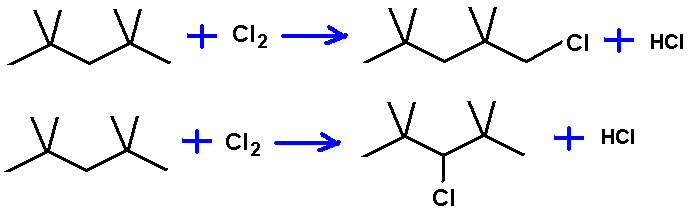
1-chloro-2,2,4,4-tetramethylpentane and
3-chloro-2,2,4,4-tetramethylpentane
Note that you can't
have 2-chloro-2,2,4,4-tetramethylpentane, no H at carbon
C2.
If you think there are
any errors, please email me asap at
chem55555@hotmail.com
|
|
