|
Doc Brown's
Advanced Chemistry Part 14.7:
Isomers and extra notes on their properties and uses
The 5
constitutional structural
carbon chain, positional isomers and stereoisomers of molecular formula C4H8
[Author
©
Dr
Phil Brown PhD:
Doc Brown's advanced level organic chemistry exam revision notes
suitable for students of UK advanced A level chemistry courses, IB
advanced chemistry & US K12 grades
11-12 and AP honors chemistry courses: Molecular
spectroscopy and analysing the isomers of C4H8
[page updated
RE-EDIT]
Sub-index for this page
on isomers of C4H8
Introduction to
Details
Key points and extra notes about the isomers of C4H8
Practise exam questions based on (with answers)
ANSWERS to the practise exam questions
Associated organic chemistry page links
Index of sets of isomers for a given
molecular formula
email doc
brown - comments - query?
*
[privacy policy, cookies
and disclaimer]
This is a big chemistry website, please allow time
to explore it
The 5
non-cyclic alkene or cycloalkane constitutional structural isomers of molecular
formula C4H8
(Mr = 56)
Percent composition of
C4H8 based on atomic masses C= 12.01 H =
1.01 and Mr(C4H8) = 56.12
Element composition (to two dp): carbon = 85.60%
hydrogen = 14.40%
Empirical formula =
CH2 and
molecular formula = C4H8
Introduction
to isomerism for molecular formula
C4H 8
(see also summary
diagram)
 details below
Structural isomerism
- There are 5 constitutional isomers based on different connectivity's of the constituent atoms, so cannot
be spatially identical (but some can be described as having a similar shape).
This includes (a)
carbon chain variation (usually need a minimum of 4 atoms),
(b) change in position of a substituent or functional group and
(c) functional group
isomerism where the atoms have a different connectivity configuration, usually with
significant differences in chemical and physical properties.
All three are applicable to
the 5 constitutional isomers of C4H8
(a) Linear and branched carbon chain, linear versus
cyclic carbon chain.
(b) Position of C=C in alkenes
(c) Open chain aliphatic unsaturated alkenes versus
saturated alicyclic cycloalkanes.
Stereoisomerism - isomers
based on the same connectivity of the atoms, but 2D or 3D spatially different,
non-superimposable images (e.g. E/Z isomers or mirror image R/S optical isomers)
This is
where molecules have the same basic constitutional structural formula, but
isomers differ in the 2D/3D arrangement of the atoms.
For stereoisomers, the (CIP) abbreviation means the IUPAC Cahn-Ingold-Prelog priority
order rule for assigning E/Z (geometrical) and R/S (optical) stereoisomers.
E/Z
stereoisomerism was called 'geometrical isomerism' e.g. cis
and trans isomers of alkenes or disubstituted cyclic alkanes
where there are 2D/3D spatial variations that are not mirror images and not
super imposable.
This applies to one of the
alkene isomers of C4H8,
making a total of 6 distinct isomer structures.
R/S
stereoisomerism was called 'optical isomerism', the pairs of
isomers are called enantiomers which are 3D non-superimposable
mirror image forms of the molecule (enantiomers). The molecule must have a chiral centre
(a stereocentre), that is an asymmetric carbon atom with four
different atoms/groups attached to it.
This does not apply to
any isomers of C4H8.
Note
There are 5
constitutional isomers of molecular formula C4H8,
excluding E/Z and R/S isomers,
3 alkene isomers of C4H8 and 2
cycloalkane isomers of C4H8.
Including the E/Z isomers there are a total of
6 distinct isomers
of C4H8.
There are carbon chain isomers and positional isomers of the C=C
double bond.
There are two sets
of functional group isomers of
alkenes (1-3) and cycloalkanes (4-5), also one
pair of E/Z isomers (cis/trans
geometric), stereoisomers of but-2-ene.
Details of the
constitutional isomers of molecular formula
C4H8
with additional
notes on the stereoisomers
(1)
but-1-ene (1-butene),
CH3CH2CH=CH2
,
 ,
,

Structural
formula and skeletal formula of but-1-ene, an alkene
functional group
that cannot exhibit E/Z
or R/S isomerism. It is a functional group isomer of the
cycloalkanes.
A positional isomer of the
>C=C< alkene functional group.
(1)-(3) are unsaturated
hydrocarbon compounds.
Number of low resolution
NMR
chemical shift
δ
signal peaks: 4
1H and
4 13C
(email
if disagree?)
1H NMR ratio of peaks: 3 : 2 : 1
: 2
(for equivalent protons)
BUT, for the 'end' =CH2 alkene protons,
you can get two chemical shifts close together, if there are two
different groups attached to the other carbon of the C=C bond i.e. R"R'C=CH2 where
R" and R' are different. This causes the
two =CH2 protons to experience slightly different fields.
See also spectra that can distinguish one C4H8 isomer
from another
The infrared spectrum of
but-1-ene
The mass spectrum of but-1-ene
1H NMR spectra of
but-1-ene
The C-13 NMR spectrum of
but-1-ene
Index of
1H NMR spectra organic
compounds and
Index of
13C NMR spectra organic
compounds
See also
a comparison of the infrared spectra of the
isomers of C4H8
(2) The structural formula of
but-2-ene
(2-butene)

but E/Z
(geometric) isomers exist (stereoisomers) for this molecule, their
structural formulae and skeletal formulae are shown below.
It is a functional group positional isomer of but-1-ene (the
position numbers are necessary here).
It is a functional group isomer of the cycloalkanes.
(Z)-but-2-ene
 or or

(Z)-but-2-ene, (cis-2-butene, cis-but-2-ene, Z-2-butene)
(E)-but-2-ene, 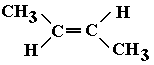 or or

(trans-2-butene, trans-but-2-ene, (E)-2-butene).
Note that 6C has a higher priority than 1H,
s0 E/Z isomer assignment is easy.
From the CIP assignment priority rule for E/Z
isomers:
6C > 1H on either
side o C=C.
The CIP rule about the >C=C< double bond, E/Z or
cis/trans is easy to assign here.
A positional isomer of the
>C=C< alkene functional group.
Number of low resolution
NMR
chemical shift
δ
signal peaks: 2
1H and
2 13C
(email
if disagree?)
High symmetry leads to lower number of NMR chemical
shift resonance.
1H NMR ratio of peaks: 6 : 2
(for equivalent protons)
But-2-ene is
a case of
E/Z stereoisomerism, but not R/S isomerism.
See also spectra that can distinguish one C4H8 isomer
from another
The infrared spectra of E/Z
isomers of but-2-ene (cis and trans isomers)
The mass spectra of E/Z
isomers of but-2-ene
(cis and trans isomers)
The H-1 NMR spectrum of E/Z
but-2-ene (cis and trans isomers)
The
C-13 NMR spectra of E/Z
isomers of but-2-ene (cis and trans isomers)
See also
a comparison of the infrared spectra of the isomers of C4H8
(3)
Methylpropene or
2-methylpropene, but 2- is not really needed here,
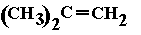 , ,
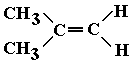 , structural formulae,
and the skeletal formula is
 and methylpropene cannot exhibit E/Z or R/S isomerism.
It is a chain structural isomer of the linear alkenes above and a
functional group isomer of the cycloalkanes.
and methylpropene cannot exhibit E/Z or R/S isomerism.
It is a chain structural isomer of the linear alkenes above and a
functional group isomer of the cycloalkanes.
Number of low resolution
NMR
chemical shift
δ
signal peaks: 2
1H and
3 13C
(email
if disagree?)
1H NMR ratio of peaks: 6 : 2
(for equivalent protons)
See also spectra that can distinguish one C4H8 isomer
from another
The infrared spectrum of
2-methylpropene
The mass spectrum of 2-methylpropene
The H-1 NMR spectrum of
2-methylpropene
The C-13 NMR spectrum of
2-methylpropene
See also
a comparison of the infrared spectra of the
isomers of C4H8
(1) to (3) are unsaturated
open chain alkenes (aliphatic) and (4) to (5) are saturated cycloalkanes
(alicyclic).
(4)
cyclobutane ,
 , ,
 ,
structural formula and skeletal formula of cyclobutane.
,
structural formula and skeletal formula of cyclobutane.
 Cyclobutane cannot exhibit E/Z or R/S isomerism, though the ring is slightly
bent so the bond angles tend to be ~109o to minimise bond strain in the ring. Cyclobutane cannot exhibit E/Z or R/S isomerism, though the ring is slightly
bent so the bond angles tend to be ~109o to minimise bond strain in the ring.
This is a saturated alkane
molecule, albeit a cycloalkane (alicyclic).
It is a functional group
isomer of the alkenes (1)-(3) above, but does not have a functional
group itself..
Number of low resolution
NMR
chemical shift
δ
signal peaks: 1
1H and
1 13C
(email
if disagree?)
Very high symmetry leads to the least possible NMR
chemical shifts,
See also spectra that can distinguish one C4H8 isomer
from another
The
infrared spectrum of cyclobutane
The
mass spectrum of cyclobutane
The H-1 NMR spectrum of cyclobutane
The C-13 NMR spectrum of cyclobutane
See also
a comparison of the infrared spectra of the
isomers of C4H8
(5)
methylcyclopropane,
 , ,
 ,
structural formula and skeletal
formula.
,
structural formula and skeletal
formula.
Methylcyclopropane cannot exhibit E/Z or R/S isomerism.
This is also a saturated alkane molecule,
again a cycloalkane (alicyclic).
It is a functional group
isomer of the alkenes (1)-(3) above,
but does not have a functional group itself..
Number of low resolution
NMR
chemical shift
δ
signal peaks: 3
1H and
3 13C
(email
if disagree?)
1H NMR ratio of peaks: 4
(2+2) : 1 : 3
(for equivalent protons)
See also
a comparison of the infrared spectra of the
isomers of C4H8
These two sets of molecules, (1-3) and (4-5),
are an example of functional group isomerism (albeit all
acyclic constitutional structural isomers of C4H8), open chain
unsaturated aliphatic alkenes and saturated aliphatic cycloalkanes (alicyclic), each
having a significant different chemistry as members of their own
homologous series.
and check out an example of
the differences in chemistry between
an alkene and cycloalkane
The chemistry of ALKANES
(detailed notes on all aspects of alkane chemistry)
The chemistry
of ALKENES
(detailed notes on all aspects of alkene chemistry)
Summary of key points and extra notes on the isomers of molecular
formulae C4H8
The molecular formula
C4H8 lends itself to a rich array of
isomeric forms due to its unsaturation (double bonds or rings), so below is
a methodical breakdown of the types of isomers:
Types
of Isomerism in
C4H8
Compounds
|
Type of
Isomerism |
Isomer
example(s) |
Explanation |
|
Chain Isomerism |
But-1-ene versus
2-methylpropene |
Variation in carbon chain
branching. |
|
Positional Isomerism |
But-1-ene versus But-2-ene |
Position of the C=C double
bond changes. |
|
Functional Group
Isomerism |
Cyclobutane or
methylcyclopropane versus Butenes |
Ring structure (alkane)
versus double bond (alkene). |
|
Geometrical (E/Z)
Isomerism |
But-2-ene: E-But-2-ene
and Z-But-2-ene |
Restricted rotation around
C=C; depends on groups attached. |
Physical Property Differences between the isomers of
C4H8
|
Isomer |
Boiling Point (approx.) |
Reason |
|
But-1-ene |
~6.3 °C |
Straight-chain,
more surface area than branched chains. |
|
2-Methylpropene |
~-6.9 °C |
More branched →
weaker Van der Waals forces. |
|
But-2-ene (E/Z
forms) |
~3.7,–1.0 °C |
Z-form is more
polar → higher b.p. than E-form. |
|
Cyclobutane |
~12.5 °C |
Compact ring
structure → stronger intermolecular forces. |
Chemical Property Differences between the isomers of
C4H8
Some
uses of the isomers of
C4H8
|
Isomer |
Typical Use/Application |
|
Butenes |
Used as
intermediates for polybutene or butyl rubber. |
|
2-Methylpropene |
Used to make
polyisobutylene → chewing gum base, fuel additives. |
|
Cyclobutane |
Niche use, mostly
academic interest or model compound in ring strain studies. |
Common
Misconceptions about the isomers of
C4H8
(see also below)
-
Z ≠ cis / E ≠ trans: These terms match
only if identical groups are present. Exam boards love this trap! (the
terms cis/trans are used more widely, but get the E/Z notation correct and
you can't go wrong in an exam!).
-
Cyclobutane is not an alkene: Despite the
same molecular formula, its bonding and reactivity differ dramatically.
-
Not all butenes exhibit E/Z isomerism: Only
but-2-ene does—check for two different groups on each C of
the double bond.
Exam
Tips for questions involving the isomers of
C4H8
(see also above)
-
Always identify the carbon skeleton first before worrying
about function groups.
-
For E/Z questions, draw structures with clear priority
groups (Cahn-Ingold-Prelog rules).
-
Bromine water test is a classic for identifying alkenes—know
which isomers respond!
-
Tabulate boiling points for comparison, especially between
branched and unbranched forms.
-
Use IUPAC naming with stereochemical prefixes where needed:
E-but-2-ene not just “trans-butene”.
A comparison of the
infrared spectra of the isomers of C4H8
A structured comparison of the prominent IR diagnostic
wavenumbers for the major isomers of molecular formula C4H8,
along with common misconceptions and exam tips to help clarify and reinforce
understanding.
Overview of C4H8 Isomers with respect to their infrared
spectra
C4H8 has several structural isomers,
broadly classified into:
|
Type |
Examples |
Key
Features |
|
Alkenes (1 double
bond) |
But-1-ene,
But-2-ene (cis/trans), 2-methylpropene |
C=C stretch, sp²
C–H stretch |
|
Cycloalkanes (1
ring) |
Cyclobutane,
methylcyclopropane |
No C=C; only sp³
C–H and ring strain |
Diagnostic IR Wavenumbers of the infrared spectra
of the isomers of C4H8
|
Functional Group / Bond |
Wavenumber (cm⁻¹) |
Isomer
Type |
Notes |
|
C=C stretch
(alkene) |
~1640–1680 |
Alkenes |
Medium intensity;
confirms unsaturation |
|
sp² C–H stretch |
~3020–3100 |
Alkenes |
Sharp peaks;
distinguishes from sp³ C–H |
|
sp³ C–H stretch |
~2850–2960 |
All isomers |
Present in both
alkenes and cycloalkanes |
|
CH2
bend (scissoring) |
~1450 |
All isomers |
Often overlaps;
not diagnostic alone |
|
CH3
bend (umbrella mode) |
~1370 |
Branched alkenes |
Indicates methyl
groups (e.g. 2-methylpropene) |
|
Ring strain
indicators |
~1000–1300
(complex) |
Cycloalkanes |
Broad, less
defined; fingerprint region |
Common
Misconceptions about the infrared spectra of the isomers of C4H8
(see also below)
-
Misconception 1: All C4H8
isomers show a C=C stretch.
-
Misconception 2: The fingerprint region is
useless.
-
Misconception 3: sp² and sp³ C–H stretches
are interchangeable.
Exam
Tips for questions that may involve the infrared spectra of the isomers of C4H8
(see also above)
-
Memorize key wavenumber ranges: Especially
for C=C (~1650 cm⁻¹) and sp² C–H (~3050 cm⁻¹).
-
Compare spectra side-by-side: Look for
presence/absence of alkene signals to distinguish between cyclic and acyclic
isomers.
-
Use methyl bending (~1370 cm⁻¹) to identify
branching in alkenes like 2-methylpropene.
-
Don't ignore weak bands: Even
medium-intensity C=C stretches can be diagnostic.
-
Practice with spectra overlays: Helps
reinforce pattern recognition and functional group identification.
Learning objectives - questions to be answered?
How do you work out the isomers of
molecular formula C4H8?
How do you draw the structural formula
and skeletal formula of the isomers of molecular formula C4H8?
How many aliphatic structural isomers
are there of molecular formula C4H8?
How many aliphatic carbon chain isomers
are there of molecular formula C4H8?
How many positional isomers are there
of molecular formula C4H8?
How many E/Z (geometrical) isomers are
there of molecular formula C4H8?
How many R/S (optical) isomers
(enantiomers) of molecular formula C4H8?
Are there any aliphatic open chain
alkene isomers of molecular formula C4H8?
Are there any diene isomers of
molecular formula C4H8?
Are there any alkyne isomers of
molecular formula C4H8?
Are there any alicyclic cycloalkane
isomers of molecular formula C4H8?
Are there any alicyclic cycloalkene
isomers of molecular formula C4H8?
Are there any functional group isomers
with a molecular formula C4H8?
Are there any E/Z (geometrical) isomers
with a molecular formula C4H8?
Are there any R/S (optical) isomers
(enantiomers) with a molecular formula C4H8?
Does C4H8 have any stereoisomers?
This page
will answer these questions for molecular formula C4H8.
Practise exam questions based on
the isomers of C4H8
I don't mind if teachers/students want to do a selected printout
of these questions
|
Given the five
skeletal formulae
answer the following question with full explanations!
Q1
Which isomer is a an E/Z (geometrical) isomer?
Q2
Which isomer(s) will readily add a bromine molecule at room
temperature?
Q3
Which isomer(s) can exhibit R/S (optical) isomerism?
Q4
In which isomer(s) are all the bond angles ~109o?
Q5
Which isomer(s) will NOT give a strong infrared absorption
signal of wavenumber ~1650 cm-1?
Q6
Ignoring any splitting effects, how many different 1H
and 13C NMR chemical shifts would be observed by each
isomer? |
ANSWERS
Associated organic chemistry links
Advanced Level pre-university
organic chemistry notes
IR, mass and H-1 & C-13 NMR
spectra of organic compounds
Index of sets of isomers for a given
molecular formula
The molecular structure and
naming of ALKANES
The molecular structure and naming
of ALKENES
Index of revision notes
on the chemistry of ALKANES and the petrochemical
industry
INDEX of
ALL revision notes on the chemistry ALKENES
including reactions and polymersFor isomerism in organic chemistry, see also the
notes
Isomerism: introduction, structural isomerism - chain,
positional, functional group, tautomerism
Stereoisomerism:
introduction, definition,
priority rules, E/Z isomerism (cis/trans isomerism)
Stereoisomerism - R/S isomerism (optical
isomerism) -
definition - examples explained
This is a big chemistry website, please allow time
to explore it
Index of advanced
(pre-university) organic
chemistry revision notes
The chemistry of
alkanes and the petrochemical
industry
The
chemistry of alkenes
The
chemistry of haloalkanes
The
chemistry of
alcohols
The chemistry of aldehydes
and ketones
The
chemistry of carboxylic acids and derivatives
The chemistry of organo-nitrogen compounds
The chemistry of
aromatic compounds
Summary diagram of isomerism which
links to details of the types of isomerism

|
Website content © Dr Phil Brown 2000+. All copyrights reserved
on revision notes, images, quizzes, worksheets etc. Copying of Doc Brown's
pre-university advanced level chemistry website material is NOT permitted. Exam
revision summaries & references to science course specifications are unofficial.
These organic chemistry revision notes on the isomers of C4H8
with names, structures, types of isomerism and a few spectroscopy details are
suitable for use of pre-university students studying AQA advanced level
chemistry, Edexcel advanced level chemistry, OCR advanced level
chemistry, IB advanced level chemistry, WJEC (Eduqas) advanced level
chemistry, CIE advanced level chemistry, CCEA advanced level chemistry, US grade 11-12 AP honors
chemistry courses and they will also prove useful to
1st year undergraduate students of chemistry. |
Keywords or phrases: how many isomers are
there of molecular formula C4H8? how do you name the isomers of
molecular formula C4H8? what is the molecular structure of the
isomers of C4H8, what type of isomerism is exhibited by molecules
of formula C4H8, how do you work out the isomers of molecular
formula C4H8, what are the structural isomers of C4H8, the carbon chain
isomers of C4H8 in the homologous series of alkanes, comparing
the spectra of isomers of molecular formula C4H8 how many
structural isomers of C4H8 can you draw? how many structural
isomers does C4H8 have? what are the possible isomers of C4H8?
revision notes on isomerism of C4H8 molecules
E/Z isomers cis trans stereoisomers of C4H8,
isomers of C4H8 of molecular mass 56cycloalkene molecules isomeric of molecular formula
C4H8,
cycloalkene molecules isomeric with molecular formula C4H8, structural isomers of molecular
formula C4H8, optical isomers R/S enantiomers isomeric with molecular
formula C4H8, positional isomers isomeric with molecular formula
C4H8,
which types of isomerism are exhibited by molecules isomeric with
molecular formula C4H8 alkyl positional isomers of C4H8 cycloalkenes
branched carbon chain cycloalkene isomers of molecular formula
C4H8 E/Z isomers of molecular formula
C4H8 (geometric cis/trans
isomers) alkene molecules isomeric of molecular formula C4H8,
molecules isomeric with molecular formula C4H8, structural isomers of molecular
formula C4H8, optical isomers R/S enantiomers isomeric with molecular
formula C4H8, positional isomers isomeric with molecular formula
C4H8,
which types of isomerism are exhibited by molecules isomeric with
molecular formula C4H8 alkyl positional isomers of C4H8 branched
carbon chain alkene isomers of C4H8 cycloalkanes of molecular formula
C4H8 which are isomeric with alkenes of molecular formula C4H8
stereoisomers of molecular formula C4H8
ANSWERS to the practise exam questions based on the
isomers of C4H8
|
Given the five
skeletal formulae
answer the following question with full explanations!
Q1
Which isomer is a an E/Z (geometrical) isomer?
ANSWER B,
two different groups attached to each end of the C=C bond of
restricted rotation
Q2
Which isomer(s) will readily add a bromine molecule at room
temperature?
ANSWERS
B, D and E with a reactive alkene C=C bond.
Q3
Which isomer(s) can exhibit R/S (optical) isomerism?
ANSWER
NONE, no isomer has an asymmetric chiral carbon!
Q4
In which isomer(s) are all the bond angles ~109o?
Answer A,
B, D and E have 120o bond angles, C has a 60o
bond angle.
Q5
Which isomer(s) will NOT give a strong infrared absorption signal of
wavenumber ~1650 cm-1?
ANSWERS A
and C, no C=C bond which absorbs IR ~1650 cm-1.
Q6
Ignoring any splitting effects, how many different 1H and
13C NMR chemical shifts would be observed by each isomer?
NMR
ANSWERS: A 1 and 1, B 2 and 2, C 3 and 3, D 2 and 3, E 4
and 4 (good practise from skeletal formula, a bit more tricky than
from structural formulae!) |
|
