Advanced Organic Chemistry: Carbon-13 NMR spectrum of 2,3-dimethylbutane (CH3)2CHCH(CH3)2 HOME PAGE * SEARCH * GCSE Level Chemistry age ~14-16 * Advanced Level Chemistry age ~16-19
|
Interpreting the Carbon-13 NMR spectrum of 2,3-dimethylbutane [Author © Dr WP Brown PhD: Doc Brown's advanced level organic chemistry exam revision notes suitable for students of UK A level chemistry courses & US K12 grade 11, grade 12 and AP honors chemistry courses: Molecular spectroscopy - analysing the 13C NMR spectrum of 2,3-dimethylbutane [updated October 31st 2025] Re-edit (CH3)2CHCH(CH3)2This is a BIG website, PLEASE take time to explore it Links associated with 2,3-dimethylbutane C-13 NMR spectroscopy - spectra index See also comparing infrared, mass, 1H NMR & 13C NMR spectra of the structural alkane isomers of C6H14 Introductory note on the 13C NMR spectrum of 2,3-dimethylbutane
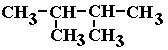
2,3-dimethylbutane C6H14
For more see The molecular structure, classification and naming of alkanes
|
||||||||||||||||||||||||||||||||||||||||||||||||
 ,
,
 ,
,

| Chemical Shift (δ, ppm) | Carbon Type | Environment | Number of Equivalent Carbons |
|---|---|---|---|
| ~28–30, 33.9 ppm | CH | Two central methine carbons | 2 |
| ~11–15, 19.5 ppm | CH3 | Four terminal methyl groups | 4 |
https://sdbs.db.aist.go.jp/ diagram 13C δ ppm spectral database of organic compounds
Common Misconceptions in Exams
- Expecting six signals for six carbons: Symmetry reduces the number of observed signals.
- Confusing CH3 and CH signals: CH3 carbons are more shielded (lower ppm); CH carbons appear slightly downfield (higher ppm).
- Assuming more signals means more atoms: Signal count reflects unique environments, not atom count.
- Overlooking quaternary carbons: While not present here, quaternary (C with no H) carbons often give weaker signals.
Exam Revision Tips
For AQA, Edexcel, OCR, WJEC, CCEA, CIE, IB, and US AP Chemistry:
- Count environments, not atoms: Use symmetry to predict the number of signals.
- Use symmetry to predict signal count: Fewer signals can indicate high symmetry.
- Memorize typical alkane shifts:
- CH3: ~10–15 ppm
- CH2: ~20–40 ppm
- CH: ~25–50 ppm
- Practice drawing and labeling environments: Helps visualize equivalence or non-equivalence.
- Compare isomers: ¹³C NMR is powerful for distinguishing between hexane, 2-methylpentane, and 2,3-dimethylbutane.
- Link to ¹H NMR and mass spectrometry: Use all spectra together for full structural elucidation.
Tips for spotting equivalent methyl group carbons in 13C NMR e.g. 4 methyl groups on C2 of 2,2-dimethypentane
- Check for identical attachments: If two or more methyl groups are bonded to the same carbon and that carbon is not chiral, they are usually equivalent.
- Look for symmetry: Even partial symmetry (like in 2,2-dimethylpentane) can lead to equivalence.
- Use integration clues: If two methyl groups give a single peak with integration of 6H, that’s a strong hint they’re equivalent.
- Compare with isomers: Try contrasting with 2,2-dimethylbutttane with 3-methylpentane, where methyl carbon environments differ more clearly.
- Counting methyls as separate signals: Leads to overestimating the number of peaks in ¹³C NMR spectra.
- Assuming all methyls are equivalent: Not true in asymmetric or chiral environments.
- Ignoring branching effects: Branching can create or remove equivalence depending on the substitution pattern.
|
Comparing the infrared, mass, 1H NMR and 13C NMR
spectra of the five structural alkane isomers of C6H14 NOTE: The images are linked to their original detailed spectral analysis pages AND can be doubled in size with touch screens to increase the definition to the original hexane, 2-methylpentane, 3-methylpentane, 2,2-dimethylbutane and 2,3-dimethylbutane image sizes. These five molecules are structural isomers of saturated alkanes of molecular formula C6H14 and exemplify the infrared, mass, 1H NMR and 13C NMR spectra of lower aliphatic alkanes (non-cyclic alkanes). |
|
| Infrared spectra below. | |
 |
 |
 |
INFRARED SPECTRA: Apart from the significant differences in the fingerprint region at wavenumbers 1500 to 400 cm-1, there are no other great striking differences, but each could be identified from its infrared spectrum. All the absorption bands are typical of molecules containing saturated alkyl structure and there are no characteristic infrared absorptions due to a specific functional group. |
 |
 |
| Infrared spectra above, mass spectra below. | |
 |
 |
 |
MASS SPECTRA: Base ion peaks plus m/z comments. Hexane: m/z 57, 42 and 56 prominent 2-methylpentane: m/z 43, 42 and 71 prominent 3-methylpentane: m/z 57, 41 and 56 prominent 2,2-dimethylbutane: m/z 43, 41, 57 and 71 prominent 2,3-dimethylbutane: m/z 43, 41, 42 and 71 prominent |
 |
 |
| Mass spectra above, 1H NMR spectra below. | |
 |
 |
 |
1H NMR SPECTRA: They can all be distinguished by their different integrated proton ratios - need very high resolution. Hexane: 3 1H δ shifts, H ratio 3:2:2 (6:4:4 in formula) 2-methylpentane: 5 1H δ shifts, H ratio 6:3:2:2:1 3-methylpentane: 4 1H δ shifts, H ratio 6:4:3:1 2,2-dimethylbutane: 3 1H δ shifts, H ratio 9:3:2 2,3-dimethylbutane: 2 1H δ shifts, H ratio 6:1 (12:2 in formula) |
 |
 |
| 1H NMR spectra above, 13C NMR spectra below. | |
 |
 |
 |
13C NMR SPECTRA: From the number of shifts, you can't distinguish (iii) and (iv) but you can distinguish them from (i), (ii) and (v). (i) Hexane: 3 13C δ shifts (ii) 2-methylpentane: 5 13C δ shifts (iii) 3-methylpentane: 4 13C δ shifts (iv) 2,2-dimethylbutane: 4 13C δ shifts (v) 2,3-dimethylbutane: 2 13C δ shifts |
 |
 |
| 13C NMR spectra above. | |
Key words & phrases: Interpreting the C-13 NMR spectra of 2,3-dimethylbutane, C-13 nmr spectrum of 2,3-dimethylbutane, understanding the carbon-13 nmr spectrum of 2,3-dimethylbutane, explaining the line pattern in the high resolution C-13 nmr spectra of 2,3-dimethylbutane, revising the C-13 nmr spectrum of 2,3-dimethylbutane, ppm chemical shifts of the C-13 nmr spectrum of 2,3-dimethylbutane, how to construct the diagram of the C-13 nmr spectrum of 2,3-dimethylbutane, how to analyse the chemical shifts in the carbon-13 NMR spectrum of 2,3-dimethylbutane deducing the chemical environment of all the carbon atoms in 2,3-dimethylbutane examining the c13 nmr spectrum of 2,3-dimethylbutane analysing the 13-c nmr spectrum of 2,3-dimethylbutane how do you sketch and interpret the C-13 NMR spectrum of 2,3-dimethylbutane interpreting interpretation of the C-13 NMR spectrum of 2,3-dimethylbutane Molecular structure diagram of the carbon-13 NMR diagram for the 13C NMR spectrum of 2,3-dimethylbutane. Deducing the number of different chemical environments of the carbon atoms in the 2,3-dimethylbutane molecule from the 13C chemical shifts in the carbon-13 NMR spectrum of 2,3-dimethylbutane. Revision notes on the carbon-13 NMR spectrum of 2,3-dimethylbutane. Matching and deducing the structure of the 2,3-dimethylbutane molecule from its 13C NMR spectrum. Carbon-13 NMR spectroscopy of aliphatic alkanes, 13C NMR spectra of 2,3-dimethylbutane, a structural isomer of molecular formula C6H14 How do you interpret the chemical shifts of the C-13 NMR spectrum of 2,3-dimethylbutane How to interpret the C-13 NMR spectrum of 2,3-dimethylbutane Explanatory diagram of the 13C C-13 carbon-13 NMR spectrum of the number of different carbon atom environments in the 2,3-dimethylbutane molecule from its carbon-13 NMR spectrum to help work out the molecular structure of the 2,3-dimethylbutane molecule? The uses and distinctive features of the carbon-13 NMR spectrum of the 2,3-dimethylbutane molecule explained. What do the number and values of the chemical shifts from the c-13 carbon-13 NMR spectrum tell us about the 2,3-dimethylbutane molecule? explaining the decoupled carbon-13 NMR spectrum of 2,3-dimethylbutane with a detailed interpretation diagram of all the C-13 chemical shifts and intensities
Links associated with 2,3-dimethylbutane
The chemistry of ALKANES revision notes INDEX
The infrared spectrum of 2,3-dimethylbutane
All Advanced Organic Chemistry Notes
Email doc b: chem55555@hotmail.com
Website content © Dr Phil Brown 2000+. All copyrights reserved on revision notes, images, quizzes, worksheets etc. Copying of Doc Brown's pre-university advanced level chemistry website material is NOT permitted. Exam revision summaries & references to science course specifications are unofficial. These organic chemistry revision notes on spectroscopy are suitable for use of pre-university students studying AQA advanced level chemistry, Edexcel advanced level chemistry, OCR advanced level chemistry, IB advanced level chemistry, WJEC (Eduqas) advanced level chemistry, CIE advanced level chemistry, US grade 11-12 AP honors chemistry courses and they will also prove useful to 1st year undergraduate students of chemistry.
