|
Interpreting the mass
spectrum of 2-chloro-2-methylpropane
[Author
©
Dr
Phil Brown PhD:
Doc Brown's advanced level organic chemistry exam revision notes
suitable for students of UK A level chemistry courses & US K12 grade
11, grade 12 and AP honors chemistry courses: Molecular
spectrometry - analysing the mass spectrum of 2-chloro-2-methylpropane
[updated
Mar 12th 2026 *]
*
email doc
brown *
[privacy,
cookies & disclaimer policies] * Re-edit
mass spectrum of (CH3)3CCl
(tert-butyl chloride)
Links associated
with 2-chloro-2-methylpropane
The
chemistry of organic halogen compounds
This is a BIG
chemistry website, please take time to explore it
Mass spectrometry
- introduction and spectra index
See also
Comparing infrared, mass, 1H NMR & 13C NMR
spectra of the 4 structural isomers of C4H9Cl
Introductory note on the mass spectrum of 2-chloro-2-methylpropane
Students and teachers please note
my explanation of the mass spectrum of 2-chloro-2-methylpropane is designed for
advanced, but pre-university, chemistry courses.
If M represents the
2-chloro-2-methylpropane molecule, the initial ionisation to give the molecular ion is:
M(g) +
high KE e- ==> [M•]+(g) + 2e-
and for fragmentation equations assume [M]+ is the start of the
processes and all species are in a gaseous state.
I've not usually shown an unpaired electron on e.g. an ion or a non-ionised
alkyl radical R e.g.
[M•]+ ==> [X]+ + R•,
but you should be aware this is a more accurate depiction of some
processes.
I've used simplified equations to show how some of
the ions that might be formed in the fragmentation pattern for the
mass spectrum of 2-chloro-2-methylpropane and only the formation of singly charged
positive are considered for the mass spectrum of
2-chloro-2-methylpropane.
I've included a stick diagram and table of m/z ions for the mass spectrum of
2-chloro-2-methylpropane
and doing the mass spectrum analysis under standard conditions,
databases can be compiled based on complex fingerprint patterns, often involving
the relative intensities of many fragment ions, and used to identify compounds including
2-chloro-2-methylpropane.
In selected cases, where two
different fragment ions have the same integer m/z value,
I've pointed out that modern mass spectrometers can measure
relative ion mass to four decimal places. So, using
accurate isotopic masses, I've calculated the accurate ion
masses, BUT strictly speaking, 0.0005 should be deducted
for singly charged ions to account for the loss of the
electron in their formation. I have NOT done this,
but the mass spectrometer software does!

 , ,
 , ,
 , ,
 ,
2-chloro-2-methylpropane ,
2-chloro-2-methylpropane
For more see
Molecular structure, classification and
naming of
halogenoalkanes (haloalkanes)
Interpreting the fragmentation pattern of the mass spectrum of
2-chloro-2-methylpropane
[M]+ is the molecular ion peak (M) with an m/z of
92 corresponding to [C4H9Cl]+, the original 2-chloro-2-methylpropane molecule minus an electron,
[(CH3)3C35Cl]+.
Since this ion is so unstable, there is even less chance of observing
the m/z 94 M+2 ion [(CH3)3C37Cl]+
(see note below on isotopes).
Not here, but at a lower electron beam energy, you
might see a tiny peak at m/z 94 (M+2) corresponding to another
molecular ion containing the heavier isotope of chlorine,
[(CH3)3C37Cl]+.
Since chlorine has two common isotopes of 35Cl
and 37Cl in the approximate ratio of 3 : 1, you should observe double peaks
in the intensity ratio 3 : 1, two mass units apart for molecular
fragments containing a chlorine atom from the fragmentation of
1-chlorobutane.
An example of this are quoted in the table below for m/z
values of 79 and 77, you can see they are
roughly in the ratio 3 : 1 in the mass spectrum diagram above.
You 'might' see another very tiny M+1 peak at m/z 93, corresponds to an ionised
2-chloro-2-methylpropane
molecule with one 13C atom in it i.e. an ionised
2-chloro-2-methylpropane molecule of
formula [13C12C3H935Cl]+
Carbon-13 only accounts for ~1% of all carbon atoms
(12C ~99%), but the more carbon atoms in the molecule,
the greater the probability of observing this 13C M+1
peak.
2-chloro-2-methylpropane has 4 carbon atoms, so on
average, ~1 in 25 molecules will contain a 13C atom.
The most abundant ion of the molecule under mass
spectrometry investigation (2-chloro-2-methylpropane) is usually given an arbitrary abundance value of
100, called the base ion peak, and all other abundances
('intensities') are measured against it.
The base peak ion for
the mass spectrum of 2-chloro-2-methylpropane is the m/z 57 ion
[C4H9]+
Identifying the species giving the most prominent peaks
(apart from M) in the fragmentation pattern of 2-chloro-2-methylpropane.
Unless otherwise indicated, assume the carbon atoms in
2-chloro-2-methylpropane are the 12C isotope.
Some of the possible positive ions, [molecular fragment]+,
formed in the mass spectrometry of 2-chloro-2-methylpropane.
|
m/z value of
[fragment]+ |
79 |
77 |
57
[C4H9]+ |
56 |
55 |
|
[molecular fragment]+ |
[(CH3)2C37Cl]+ |
[(CH3)2C35Cl]+ |
[(CH3)3C]+ |
[C4H8]+ |
[C4H7]+ |
|
m/z value of
[fragment]+ |
42 |
41 |
39 |
29 |
28 |
27 |
15 |
|
[molecular fragment]+ |
[C3H6]+ |
[C3H5]+ |
[C3H3]+ |
[C2H5]+ |
[C2H4]+ |
[C2H3]+ |
[CH3]+ |
Analysing and explaining the principal ions in the
fragmentation pattern of the mass spectrum of 2-chloro-2-methylpropane
PLEASE NOTE
I have found it difficult to find 'authentic' equations to explain mass
spectra fragmentation patterns and it is complex chemistry! I've identified
the formulae of the ionised fragments on the mass spectrum diagram, but the
equations are from the internet or my conjecture as to how the ions might be
formed - please take care in using the information, especially for
assignments at university or pre-university level.
Atomic masses: H = 1; C = 12; Cl = 35 or 37 (3:1)
Bond enthalpies kJ/mol: C-C = 348; C-Cl = 338;
C-H = 412
Possible equations to explain some of the most abundant ion peaks
in the mass spectrum of
2-chloro-2-methylpropane
Note the molecular ion peaks (M and M+2) are very small indicating
the parent molecular ion of 2-chloro-2-methylpropane fragments very easily.
Formation of m/z 77 and 79 ions:
[(CH3)3C35Cl]+ ===> [(CH3)2C35Cl]+
or [(CH3)2C37Cl]+
+ CH3
Scission of the C-C bond to lose a methyl group,
mass loss 92 - 15 = 77, 94 - 15 = 79.
Low probability due to strength of C-C bond,
scission of the weaker C-Cl bond much more likely.
Where R is alkyl, the double RCl m/z ion
peaks of roughly 3 : 1 abundance ratio are characteristic of
organo-chlorine compounds i.e. caused by the 3 : 1 isotope ratio of
35Cl : 37Cl.
Formation of m/z 57 ion:
[(CH3)3CCl]+ ===> [(CH3)3C]+
+ Cl
Formed by the scission of the C-Cl bond, the weakest
bond in the 2-chloro-2-methylpropane molecule, loss of chlorine
radical.
The m/z 57 ion is the base peak ion, the most
abundant and 'stable' ion fragment.
The m/z 57 ion is a tertiary carbocation, the most
stable type of alkyl based ion, the positive charge is stabilised by
the +I (inductive) effect of the three methyl groups.
Another reason why the ionised fragments, not
containing chlorine, are more likely to be formed, is the more
electronegative chlorine tends to make the chlorine containing
fragment retain the electrons.
Note the m/z peak of 58 could
also correspond with the
ion [13C12C3H9]+.
Formation of m/z 56 ion
[(CH3)3CCl]+ ===> [C4H8]+
+ HCl
Elimination of HCl
from the parent molecular ion.
Formation of m/z 41 ion:
[?]+ ===> [C3H5]+
+ ?
Formation of m/z 39 ion:
[C3H5]+ ===> [C3H3]+
+ H2
Formation of m/z 29 ion:
[?]+ ===> [C2H5]+
+ ?
Formation of m/z 27 ion:
[C2H5]+ ===> [C2H3]+
+ H2
Formation of m/z 15 ion:
[(CH3)3CCl]+ ===> [CH3]+
+ (CH3)2CCl
C-C bond scission of the parent molecular ion
(or other fragment) to free a positively charged methyl group
Summary of the
mass
spectrum of 2-chloro-2-methylpropane and extra comments
The mass spectrum of
2-chloro-2-methylpropane (tert-butyl chloride) with exam
precision and structural insight.
Key Fragment Ions
in
mass
spectrum of 2-chloro-2-methylpropane
|
m/z |
Ion Formula |
Origin / Fragmentation Pathway |
Notes |
| 92 |
C4H9Cl⁺ |
Molecular ion (M⁺) |
Often weak
due to fragmentation tendency |
| 77 & 79 |
C3H6Cl⁺ |
Loss of methyl group from
parent molecular ion |
C-C bond
fission less likely than C-Cl fission to give m/z 57 ion |
| 57 |
C4H9⁺ |
Loss of Cl• radical (M⁺ – 35) |
Base
ion
peak (most intense) |
| 41 |
C3H5⁺ |
Further fragmentation of C3H7 or C4H9⁺ |
Common alkyl
fragment |
| 39 |
C3H3⁺ |
Common in alkane spectra, from later fragmentation stage |
Seen in many
branched alkanes |
| 35 & 37 |
Cl⁺ isotopes |
Chlorine isotopic peaks (³⁵Cl and ³⁷Cl) |
3:1 ratio
confirms presence of chlorine |
Common Misconceptions
about the
mass
spectrum of 2-chloro-2-methylpropane
(see also below)
- Confusing base peak with molecular
ion: Students often assume the
tallest peak is the molecular ion. Clarify that the base peak (m/z 57) is a
fragment, not M⁺.
- Ignoring isotope patterns:
Overlooking the 3:1 ratio of Cl⁺ peaks can lead to missed identification of
halogen presence.
- Expecting oxygen-containing
fragments: Some learners
mistakenly look for m/z 45 or 60, typical of alcohols or esters—irrelevant
here.
Exam Tips for
questions involving
the
mass
spectrum of 2-chloro-2-methylpropane
(see also above)
- Use isotope clues:
The presence of m/z 35 and 37 in a 3:1 ratio is a strong indicator of
chlorine—use this to eliminate non-halogen options.
- Compare with t-butanol:
t-butanol shows a molecular ion at m/z 74 and lacks Cl isotope peaks—great
for contrast questions.
- Watch for base peak logic:
The base peak at m/z 57 corresponds to the stable tert-butyl cation, a
common fragment in branched alkanes.
- Check fragmentation logic:
Emphasize that loss of Cl• (not Cl⁻) leads to m/z 57—this helps in
mechanism-based questions.
Practice
questions based on the mass spectrum of 2-chlor
Two technically robust multiple-choice
questions on the mass spectrum of 2-chloro-2-methylpropane (C4H9Cl),
designed for advanced pre-university chemistry students across AQA, Edexcel,
OCR, WJEC, CCEA, CIE, IB, and US AP/Honors curricula.
Each question includes a model answer and
distractor analysis to support deeper understanding and exam readiness.
ANSWERS
Question 1:
Molecular Ion Peak Identification in the mass spectrum of
2-chloro-2-methylpropane
Which of the following m/z values
corresponds to the molecular ion peak (M⁺) of 2-chloro-2-methylpropane in its
mass spectrum, assuming the presence of the most abundant chlorine isotope?
- 92
- 90
- 91
- 94
Question 2:
Fragmentation Pattern Recognition
in the mass spectrum of 2-chloro-2-methylpropane
In the mass spectrum of
2-chloro-2-methylpropane, a prominent fragment ion appears at m/z 57. Which
fragment is most likely responsible for this peak?
- CH3CH2CH2⁺
- (CH3)3C⁺
- CH3CHCl⁺
- CH3CH2Cl⁺
Question 3:
Isotopic Pattern Interpretation
on
the mass spectrum of 2-chloro-2-methylpropane
The molecular ion region of the
mass spectrum of 2-chloro-2-methylpropane shows two peaks at m/z 92 and
94 in a 3:1 ratio.
What does this pattern indicate
about the structure of the molecule?
- The molecule contains one chlorine
atom, which exists as two isotopes in a 3:1 ratio.
- The molecule contains two chlorine
atoms, each contributing to the isotopic pattern.
- The molecule contains one bromine
atom, which has two isotopes in a 3:1 ratio.
- The molecule contains both chlorine
and bromine atoms, producing a complex isotopic pattern.
Question 4:
Fragmentation Pathway and Stability
of the mass spectrum of 2-chloro-2-methylpropane
Which of the following best
explains why the base peak in the mass spectrum of
2-chloro-2-methylpropane appears at m/z 57?
- It corresponds to the loss of a methyl
radical from the molecular ion.
- It is the most stable carbocation
formed after cleavage of the C–Cl bond.
- It results from the rearrangement of
the molecular ion to form a neutral alkene.
- It is the molecular ion peak, as the
molecule is resistant to fragmentation.
|
Comparing the infrared, mass, 1H NMR and 13C NMR
spectra of the 4 halogenoalkane isomers of C4H9Cl
NOTE: The images are linked to their
original detailed spectral analysis pages AND can be doubled in
size with touch screens to
increase the definition to the original 1-chlorobutane,
2-chlorobutane, 1-chloro-2-methylpropane and 2-chloro-2-methylpropane
image sizes. These four molecules
are structural isomers of molecular formula C4H9Cl
and
exemplify the infrared, mass, 1H NMR and 13C NMR spectra of lower
aliphatic halogenoalkanes (haloalkanes, alkyl halides,
chloroalkanes, alkyl chlorides). |
 |
 |
 |
 |
|
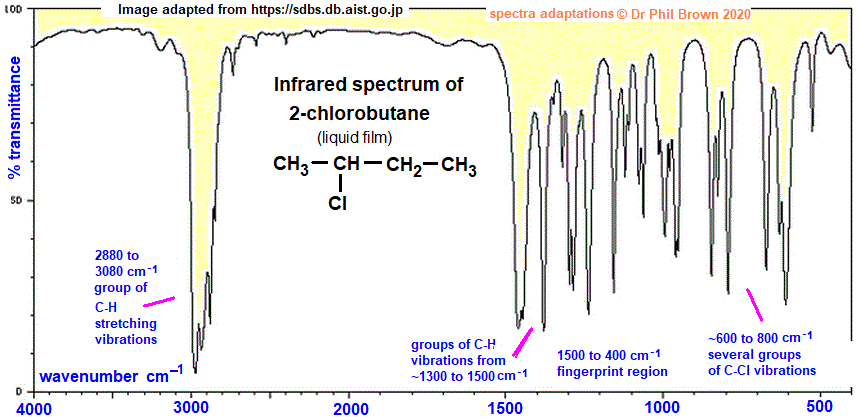
INFRARED SPECTRA
(above):
Apart from the significant differences in the fingerprint region at
wavenumbers 1500 to 400 cm-1, there are no other
great striking differences, but each could be identified from
its infrared spectrum. The infrared spectrum of
2-chloro-2-methylpropane is noticeably simpler in the
fingerprint region, perhaps due to
the greater symmetry of the molecule. |
 |
 |
 |
|
|
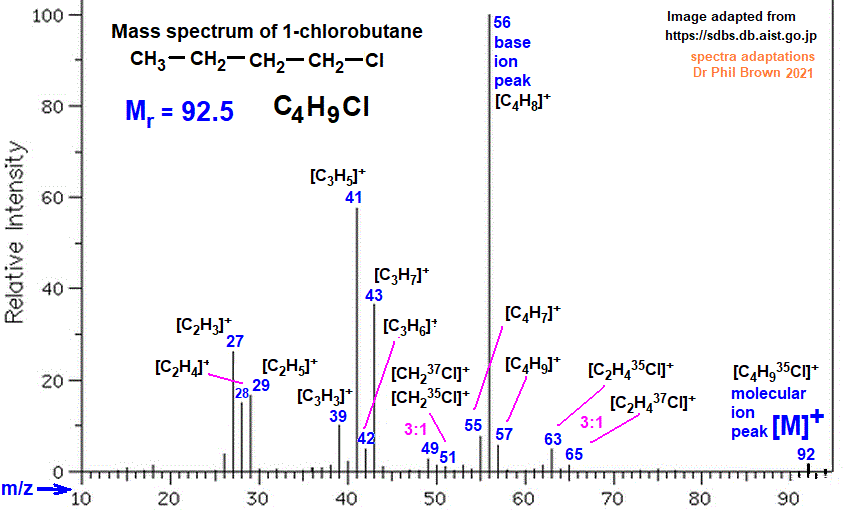
MASS SPECTRA (above):
Theoretically, all four can give the parent molecular ions of
m/z 92 and 94, but they are all relatively tiny peaks.
2-chlorobutane and 2-chloro-2-methylpropane give a base ion peak
of m/z 57. The base ion peak for 1-chlorobutane is m/z 56 and
that of 1-chloro-2-methylpropane is m/z 43. Each gives different
patterns of pairs of m/z values two mass units apart, in the
peak height ratio of 3:1, if the positive fragment contains a
chlorine atom (35Cl or 37Cl) e.g look for
m/z pairs 49/51, 63/65 and 77/79 in their mass spectra. |
 |
 |
 |
 |
|
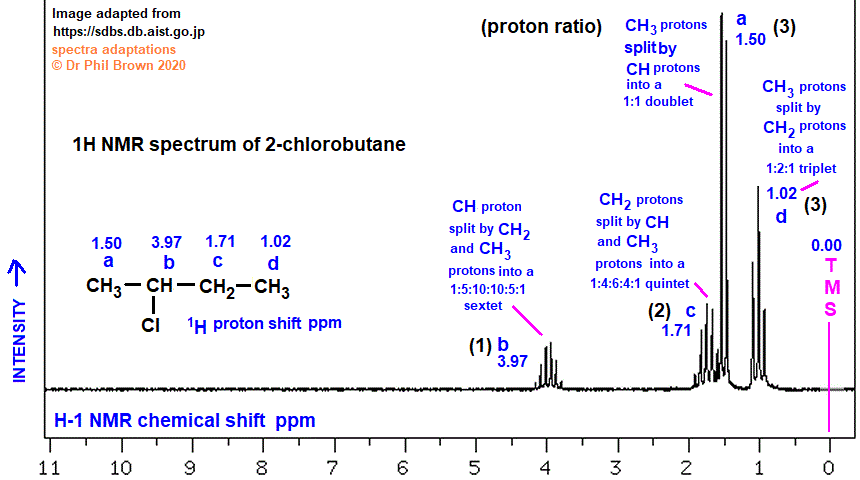
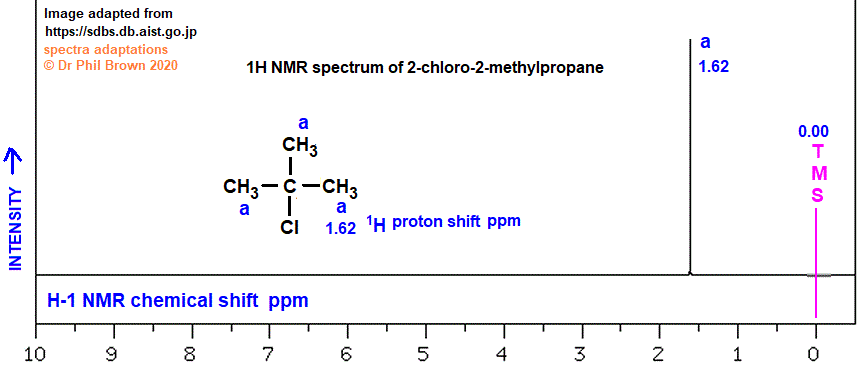
1H NMR SPECTRA
(above): The 1H NMR spectra of all four molecules give different
integrated proton ratios i.e.1-chlorobutane
four peaks of ratio 3:2:2:2; 2-chlorobutane four peaks of
ratio 3:3:2:1,
1-chloro-2-methylpropane three peaks of ratio 6:2:1 and
2-chloro-2-methylpropane gives just one peak '1' (effectively no ratio
involved), so all four molecular structures can be distinguished from each other by their
1H NMR spectra proton ratios, numbers of peaks and (n+1)
rule splitting patterns. |
 |
 |
 |
 |
|
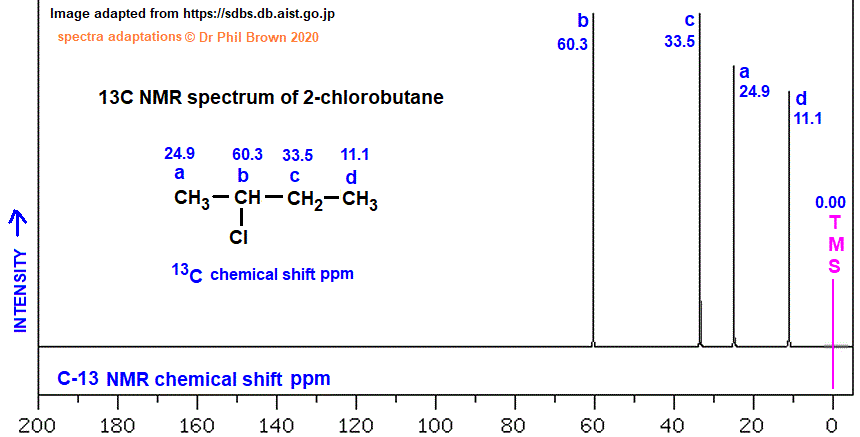
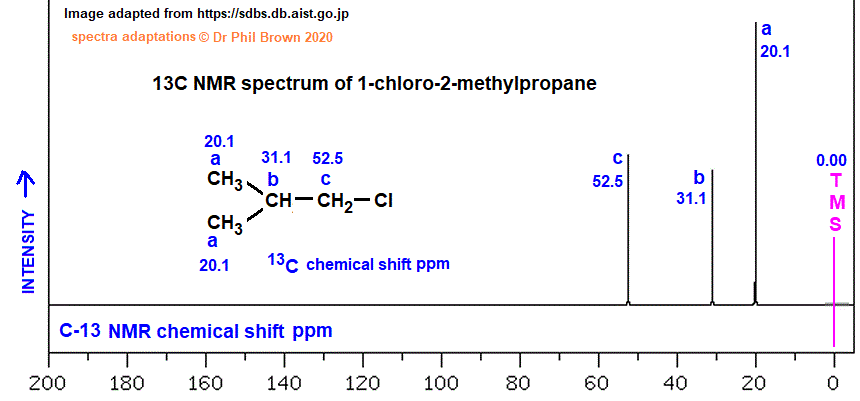
13C NMR SPECTRA
(above): The
13C NMR spectra of the four molecules show various numbers of
carbon-13 chemical environments i.e 1-chlorobutane and
2-chlorobutane show four 13C NMR resonances,
1-chloro-2-methylpropane three 13C NMR resonances and
2-chloro-2-methylpropane only two 13C resonances (3 and 2
chemical environments respectively. Therefore
1-chloro-2-methylpropane and 2-chloro-2-methylpropane can be
distinguished from the other three by their number of resonances
in their 13C NMR spectra, but 1-chlorobutane and 2-chlorobutane
cannot be distinguished from each other from their number of 13C
NMR resonance lines - other data would be required. |
Key words & phrases: C4H9Cl (CH3)3CCl image diagram on how to interpret and explain the mass spectrum of
2-chloro-2-methylpropane m/z m/e base peaks, image and diagram of the mass spectrum of
2-chloro-2-methylpropane, details of the mass spectroscopy of
2-chloro-2-methylpropane, low and high resolution mass
spectrum of 2-chloro-2-methylpropane, prominent m/z peaks in the mass spectrum of
2-chloro-2-methylpropane, comparative
mass spectra of 2-chloro-2-methylpropane, the molecular ion peak in the mass spectrum of
2-chloro-2-methylpropane,
analysing and understanding the fragmentation pattern of the mass spectrum
of 2-chloro-2-methylpropane, characteristic pattern of peaks in the mass spectrum of
2-chloro-2-methylpropane, relative
abundance of mass ion peaks in the mass spectrum of 2-chloro-2-methylpropane, revising the mass
spectrum of 2-chloro-2-methylpropane, revision of mass spectroscopy of
2-chloro-2-methylpropane, most abundant ions in the
mass spectrum of 2-chloro-2-methylpropane, how to construct the mass spectrum diagram for abundance
of fragmentation ions in the mass spectrum of 2-chloro-2-methylpropane, how to analyse the mass
spectrum of 2-chloro-2-methylpropane, how to describe explain the formation of fragmented ions in the
mass spectra of 2-chloro-2-methylpropane equations for explaining the formation of the positive ions
in the fragmentation of the ionised molecule of 2-chloro-2-methylpropane
recognising the base ion peak of 2-chloro-2-methylpropane
interpreting interpretation the mass spectrum of 2-chloro-2-methylpropane
tert-butyl chloride
Stick diagram of the relative abundance
of ionised fragments in the fingerprint pattern of the mass spectrum of
2-chloro-2-methylpropane. Table of the m/e m/z values and formula of the ionised fragments in the
mass spectrum of 2-chloro-2-methylpropane. The m/e m/z value of the molecular ion peak in the
mass spectrum of 2-chloro-2-methylpropane. The m/e m/z value of the base ion peak in the
mass spectrum of 2-chloro-2-methylpropane. Possible examples of equations showing the formation
of the ionised fragments in 2-chloro-2-methylpropane. Revision notes on the mass spectrum of
2-chloro-2-methylpropane.
Matching and deducing the structure of the 2-chloro-2-methylpropane molecule from its mass
spectrum. Mass spectroscopy of
aliphatic halogenoalkanes
haloalkanes alkyl halides alkyl chlorides chloroalkanes,
mass spectra of 2-chloro-2-methylpropane, an isomer of molecular formula
C4H9Cl How do you interpret the mass spectrum of
2-chloro-2-methylpropane How to interpret
the mass spectrum of 2-chloro-2-methylpropane Explanatory diagram of the mass spectrum of the
2-chloro-2-methylpropane molecule in
terms of its molecular structure.
Listing data of the prominent main peaks in the mass spectrum of
2-chloro-2-methylpropane. How to explain the mass spectrum of
2-chloro-2-methylpropane. The m/z value of the
molecular ion peak in the mass spectrum of 2-chloro-2-methylpropane. Identifying
2-chloro-2-methylpropane from
its mass spectrum pattern. The m/z m/e peak analysis of the mass
spectrum of the 2-chloro-2-methylpropane molecule. The uses of the mass spectrum of the
2-chloro-2-methylpropane molecule. The distinctive features of the mass spectrum of
the 2-chloro-2-methylpropane molecule explained. explaining the fragmentation pattern of the mass spectrum of
2-chloro-2-methylpropane equations showing the
formation of the ionised fragments in the mass spectrum of
2-chloro-2-methylpropane
what does the mass spectrum tell you about the structure and
properties of the 2-chloro-2-methylpropane molecule? Data table of
ionised fragments in the mass spectrum of 2-chloro-2-methylpropane and equations
for their formation in the fragmentation of 2-chloro-2-methylpropane molecules
ANSWERS to the mass spectrum
questions
Question 1:
Molecular Ion Peak Identification in the mass spectrum of
2-chloro-2-methylpropane
Which of the following m/z values
corresponds to the molecular ion peak (M⁺) of 2-chloro-2-methylpropane in its
mass spectrum, assuming the presence of the most abundant chlorine isotope?
- 92
- 90
- 91
- 94
Correct Answer:
A
Explanation:
- Molecular formula: C4H9Cl
- Atomic masses:
- C = 12 × 4 = 48
- H = 1 × 9 = 9
- Cl = ³⁵Cl = 35
→ Total = 48 + 9 + 35 = 92
This corresponds to the M⁺ peak
with ³⁵Cl.
A second peak at m/z 94 (from ³⁷Cl) also
appears, typically in a 3:1 ratio due to chlorine isotope abundance.
Distractor Analysis:
| Option |
Why It’s Incorrect |
| B (90) |
Too low; omits part of the molecular
mass. |
| C (91) |
Not a valid isotope combination. |
| D (94) |
Represents the M⁺ peak with ³⁷Cl, not
the most abundant isotope. |
Question 2:
Fragmentation Pattern Recognition
in the mass spectrum of 2-chloro-2-methylpropane
In the mass spectrum of
2-chloro-2-methylpropane, a prominent fragment ion appears at m/z 57. Which
fragment is most likely responsible for this peak?
- CH3CH2CH2⁺
- (CH3)3C⁺
- CH3CHCl⁺
- CH3CH2Cl⁺
Correct Answer:
B
Explanation:
- The molecule fragments by losing the
chlorine atom (Cl•), forming the tert-butyl cation:
(CH₃)₃C⁺
- Mass:
- C = 12 × 4 = 48
- H = 1 × 9 = 9
→ Total = 57
This is a highly stable carbocation due to
tertiary carbon center and resonance stabilization.
Distractor Analysis:
| Option |
Why It’s Incorrect |
| A |
CH3CH2CH2⁺
= 43; too low and not formed from this structure. |
| C |
CH3CHCl⁺
= 64; not a major fragment from this molecule. |
| D |
CH3CH2Cl⁺
= 78; too high and not consistent with the structure. |
Question 3:
Isotopic Pattern Interpretation
on
the mass spectrum of 2-chloro-2-methylpropane
The molecular ion region of the
mass spectrum of 2-chloro-2-methylpropane shows two peaks at m/z 92 and
94 in a 3:1 ratio.
What does this pattern indicate
about the structure of the molecule?
- The molecule contains one chlorine
atom, which exists as two isotopes in a 3:1 ratio.
- The molecule contains two chlorine
atoms, each contributing to the isotopic pattern.
- The molecule contains one bromine
atom, which has two isotopes in a 3:1 ratio.
- The molecule contains both chlorine
and bromine atoms, producing a complex isotopic pattern.
Correct Answer:
A
Explanation:
- Chlorine
has two naturally occurring isotopes:
- A molecule with one chlorine
atom will show a molecular ion (M⁺) peak and
an M+2 peak in a 3:1 ratio.
- 2-chloro-2-methylpropane contains
only one Cl atom, so the observed pattern at
m/z 92 (³⁵Cl) and m/z 94 (³⁷Cl) confirms this.
Distractor Analysis:
| Option |
Why It’s Incorrect |
| B |
Two Cl atoms would give a 9:6:1
triplet pattern (binomial distribution), not 3:1. |
| C |
Bromine has a 1:1 isotope ratio
(⁷⁹Br and ⁸¹Br), not 3:1. |
| D |
The spectrum lacks the 1:2:1 or
1:1:1:1 patterns expected from multiple halogens. |
Question 4:
Fragmentation Pathway and Stability
of the mass spectrum of 2-chloro-2-methylpropane
Which of the following best
explains why the base peak in the mass spectrum of
2-chloro-2-methylpropane appears at m/z 57?
- It corresponds to the loss of a methyl
radical from the molecular ion.
- It is the most stable carbocation
formed after cleavage of the C–Cl bond.
- It results from the rearrangement of
the molecular ion to form a neutral alkene.
- It is the molecular ion peak, as the
molecule is resistant to fragmentation.
Correct Answer:
B
Explanation:
- The base peak is the
most intense peak, representing the most stable and abundant fragment.
- In 2-chloro-2-methylpropane,
cleavage of the C–Cl bond forms a tertiary carbocation:
(CH3)3C⁺
- This ion has m/z 57
and is highly stable due to hyperconjugation and inductive
effects from the three methyl groups.
Distractor Analysis:
| Option |
Why It’s
Incorrect |
| A |
Loss of a methyl radical would
give m/z 77, not 57. |
| C |
Rearrangement to a neutral alkene
would not produce a positively charged ion at m/z 57. |
| D |
The molecular ion is at m/z 92/94;
m/z 57 is a fragment, not the parent ion. |
Links associated
with
2-chloro-2-methylpropane
The chemistry of HALOGENOALKANES (haloalkanes)
revision notes INDEX
The infrared
spectrum of 2-chloro-2-methylpropane (tert-butyl
chloride)
The H-1 NMR
spectrum of 2-chloro-2-methylpropane (tert-butyl
chloride)
The C-13
NMR spectrum of 2-chloro-2-methylpropane (tert-butyl
chloride)
Mass spectrometry
- introduction and spectra index
ALL SPECTROSCOPY INDEXES
All Advanced Organic
Chemistry Notes
Use My Google search site box
Email doc b:
chem55555@hotmail.com
Website content © Dr Phil Brown
2000+. All copyrights reserved on revision notes, images, quizzes, worksheets
etc. Copying of Doc Brown's pre-university advanced level chemistry website
material is NOT permitted. Exam revision summaries & references to chemistry
course specifications are unofficial. These organic chemistry revision notes on
the spectroscopy of 2-chloro-2-methylpropane - its mass spectrum are
suitable for use of pre-university students studying AQA advanced level
chemistry, Edexcel advanced level chemistry, OCR advanced level chemistry, IB
advanced level chemistry, WJEC (Eduqas) advanced level chemistry, CIE Cambridge advanced level chemistry, US grade 11-12 AP honors
chemistry courses and they will also prove useful to
1st year undergraduate students of chemistry. |
