|
Interpreting the
1H NMR spectrum of 2-chloro-2-methylpropane
[Author
©
Dr
Phil Brown PhD:
Doc Brown's advanced level organic chemistry exam revision notes
suitable for students of UK A level chemistry courses & US K12 grade
11, grade 12 and AP honors chemistry courses: Molecular
spectroscopy - analysing the 1H NMR spectrum of 2-chloro-2-methylpropane
[updated
Mar 12th 2026 *]
*
email doc
brown *
[privacy,
cookies & disclaimer policies] * Re-edit
1H NMR spectrum of (CH3)3CCl
(tert-butyl chloride)
Links associated
with 2-chloro-2-methylpropane
The
chemistry of organic halogen compounds
This is a BIG
chemistry website, please take time to explore it
H-1 proton NMR spectroscopy -
spectra index
See also
Comparing infrared, mass, 1H NMR & 13C NMR
spectra of the 4 structural isomers of C4H9Cl
Introductory note on the 1H NMR spectra of 2-chloro-2-methylpropane
Students and teachers please note my explanation of the
proton NMR spectrum of 2-chloro-2-methylpropane is designed for advanced, but
pre-university, chemistry courses.
The chemical shift
δ splitting pattern effects for
2-chloro-2-methylpropane are
confined to a proton spin-spin
coupling effects analysed using the n+1 rule for adjacent
non-equivalent proton fields (n is the number of neighbouring
protons in a non-equivalent different chemical environment for the
2-chloro-2-methylpropane molecule).
It is assumed that the integrated intensities of the
1H
NMR δ
chemical shifts give the ratio of the protons in the different
non-equivalent chemical environments of the
2-chloro-2-methylpropane molecule.
The most common solvent used for investigating the 1H NMR
spectrum of compounds like 2-chloro-2-methylpropane, is CDCl3 and other
deuterated solvents to avoid confusion with a 1H NMR
signal, 2D (2H) has a different NMR chemical
shift.
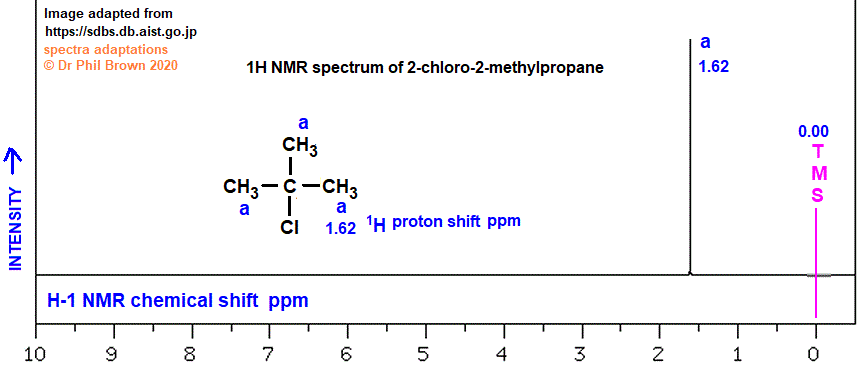
TMS is the acronym for tetramethylsilane, formula Si(CH3)4,
whose protons are arbitrarily given a chemical shift of 0.0 ppm.
This is the 'standard' in 1H NMR spectroscopy and all
other proton resonances, called chemical shifts, are measured
with respect to the TMS, and depend on the
individual (electronic) chemical environment of the hydrogen atoms
in an organic molecule - 2-chloro-2-methylpropane here.
The chemical shifts quoted in ppm on the diagram of
the H-1 NMR spectrum of 2-chloro-2-methylpropane represent the peaks of the intensity of
the chemical shifts of (which are often groups of split lines at
high resolution) AND the relative integrated areas under the peaks
gives you the ratio of protons in the different chemical
environments of the 2-chloro-2-methylpropane molecule.
 , ,
 , ,
 , ,
 ,
2-chloro-2-methylpropane ,
2-chloro-2-methylpropane
For more see
Molecular structure, classification and
naming of
halogenoalkanes (haloalkanes)
Interpreting the
H-1 NMR spectrum of
2-chloro-2-methylpropane
In terms of spin-spin coupling from the possible proton magnetic orientations,
for 2-chloro-2-methylpropane I
have only considered the interactions of
non-equivalent protons on adjacent carbon atoms,
BUT there aren't such protons in 2-chloro-2-methylpropane.
The hydrogen atoms (protons) of
2-chloro-2-methylpropane occupy only 1 chemical environment in 2-chloro-2-methylpropane.
In this symmetrical molecules all the nine protons are
chemically equivalent to each other, so no proton field
splitting takes place.
(CH3)3CCl
(a) 1H
Chemical shift 1.62 ppm for all the CH3 protons
Evidence for the presence of a just one
type of alkyl (methyl) group
in the molecule of 2-chloro-2-methylpropane because all
9 protons are equivalent to each other.
Summary of the
1H NMR
spectrum of 2-chloro-2-methylpropane and extra comments
The ¹H NMR spectrum of
2-chloro-2-methylpropane (tert-butyl chloride) is a model
of simplicity due to its high symmetry and lack of hydrogen
diversity. Here's a structured breakdown:
Proton
Environments in
the 1H NMR
spectrum of 2-chloro-2-methylpropane
| Chemical Shift (δ,
ppm) |
Proton Type |
Origin /
Environment
(CH3)3CCl |
Integration Ratio |
Splitting Pattern |
| ~1.6, 1.62 ppm |
CH3 protons |
Nine equivalent protons in
three methyl groups bonded to the central carbon atom |
9, no ratio involved |
Singlet |
Note: Exact shifts may vary slightly
depending on solvent and instrument, but the pattern remains consistent.
Why is
the 1H NMR
spectrum of 2-chloro-2-methylpropane
so simple?
- The central carbon (C⁺) is bonded
to three methyl groups and one chlorine atom.
- All nine methyl protons are
chemically and magnetically equivalent, producing
one singlet.
- No other hydrogen atoms are
present—no CH, OH, or aromatic protons.
Common
Misconceptions
about the 1H NMR
spectrum of 2-chloro-2-methylpropane
(see also below)
- Expecting multiple peaks:
Students may assume multiple signals due to the number of atoms,
forgetting symmetry.
- Looking for splitting:
With no neighboring non-equivalent protons, there's no
splitting—just a singlet.
- Confusing integration with
number of signals:
Nine protons give one signal, not nine signals.
Exam Tips
for questions involving
the 1H NMR
spectrum of 2-chloro-2-methylpropane
(see also above)
- Spot the singlet:
A sharp singlet with integration of 9 at ~1.6 ppm is a hallmark of
tert-butyl groups.
- Compare with t-butanol:
t-butanol also shows a singlet for CH₃ (9H), but adds a broad OH
signal (~1–5 ppm).
- Use symmetry logic:
Highly symmetrical molecules often yield fewer signals than
expected.
- Watch for distractors:
Questions may include spectra with multiple methyl signals—use
integration and chemical shift to rule out less symmetrical isomers.
|
Comparing the infrared, mass, 1H NMR and 13C NMR
spectra of the 4 halogenoalkane isomers of C4H9Cl
NOTE: The images are linked to their
original detailed spectral analysis pages AND can be doubled in
size with touch screens to
increase the definition to the original 1-chlorobutane,
2-chlorobutane, 1-chloro-2-methylpropane and 2-chloro-2-methylpropane
image sizes. These four molecules
are structural isomers of molecular formula C4H9Cl
and
exemplify the infrared, mass, 1H NMR and 13C NMR spectra of lower
aliphatic halogenoalkanes (haloalkanes, alkyl halides,
chloroalkanes, alkyl chlorides). |
 |
 |
 |
 |
|
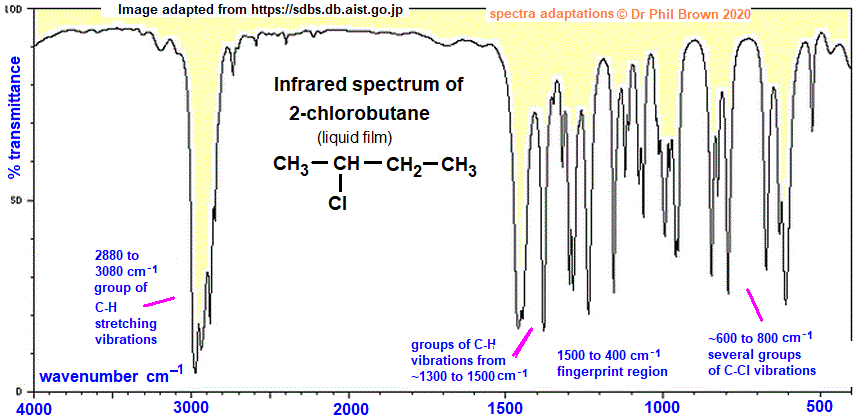
INFRARED SPECTRA
(above):
Apart from the significant differences in the fingerprint region at
wavenumbers 1500 to 400 cm-1, there are no other
great striking differences, but each could be identified from
its infrared spectrum. The infrared spectrum of
2-chloro-2-methylpropane is noticeably simpler in the
fingerprint region, perhaps due to
the greater symmetry of the molecule. |
 |
 |
 |
 |
|
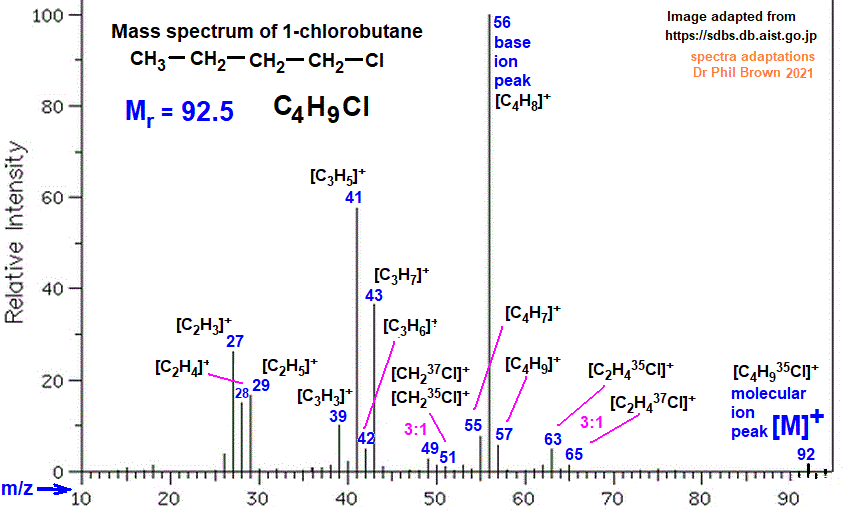
MASS SPECTRA (above):
Theoretically, all four can give the parent molecular ions of
m/z 92 and 94, but they are all relatively tiny peaks.
2-chlorobutane and 2-chloro-2-methylpropane give a base ion peak
of m/z 57. The base ion peak for 1-chlorobutane is m/z 56 and
that of 1-chloro-2-methylpropane is m/z 43. Each gives different
patterns of pairs of m/z values two mass units apart, in the
peak height ratio of 3:1, if the positive fragment contains a
chlorine atom (35Cl or 37Cl) e.g look for
m/z pairs 49/51, 63/65 and 77/79 in their mass spectra. |
 |
 |
 |
|
|
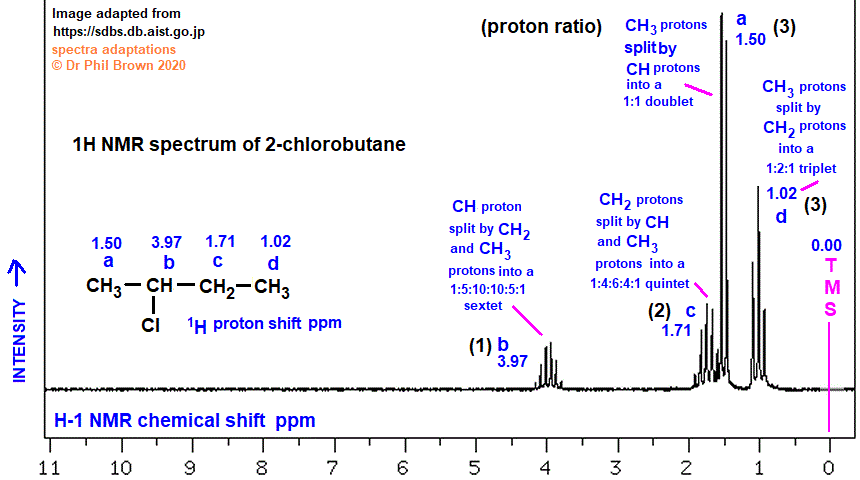
1H NMR SPECTRA
(above): The 1H NMR spectra of all four molecules give different
integrated proton ratios i.e.1-chlorobutane
four peaks of ratio 3:2:2:2; 2-chlorobutane four peaks of
ratio 3:3:2:1,
1-chloro-2-methylpropane three peaks of ratio 6:2:1 and
2-chloro-2-methylpropane gives just one peak '1' (effectively no ratio
involved), so all four molecular structures can be distinguished from each other by their
1H NMR spectra proton ratios, numbers of peaks and (n+1)
rule splitting patterns. |
 |
 |
 |
 |
|
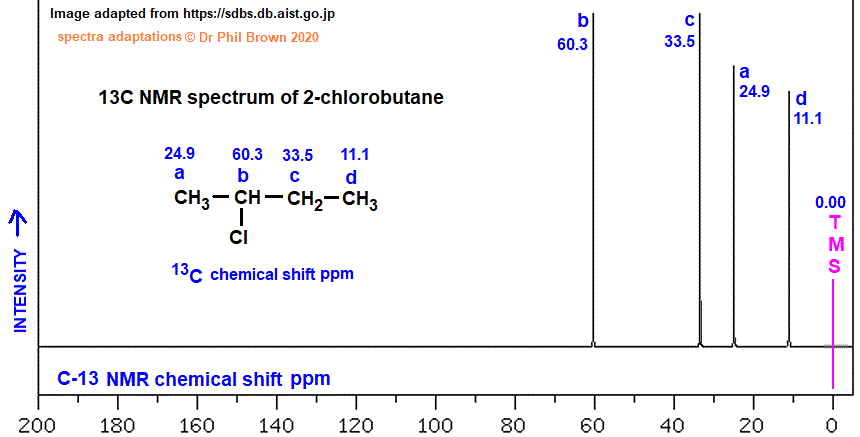
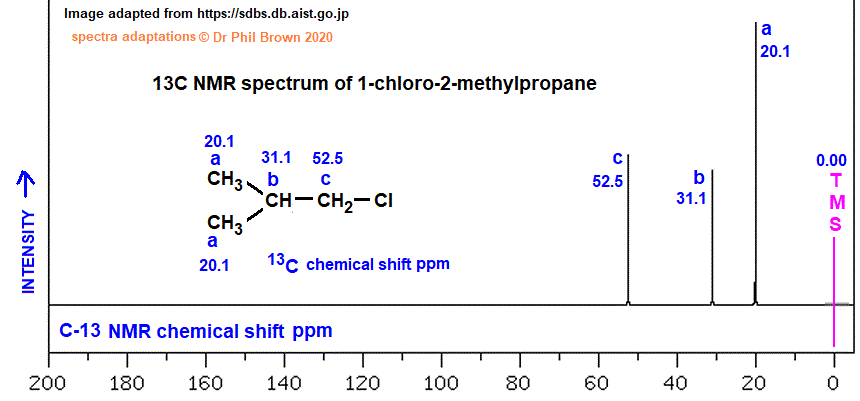
13C NMR SPECTRA
(above): The
13C NMR spectra of the four molecules show various numbers of
carbon-13 chemical environments i.e 1-chlorobutane and
2-chlorobutane show four 13C NMR resonances,
1-chloro-2-methylpropane three 13C NMR resonances and
2-chloro-2-methylpropane only two 13C resonances (3 and 2
chemical environments respectively. Therefore
1-chloro-2-methylpropane and 2-chloro-2-methylpropane can be
distinguished from the other three by their number of resonances
in their 13C NMR spectra, but 1-chlorobutane and 2-chlorobutane
cannot be distinguished from each other from their number of 13C
NMR resonance lines - other data would be required. |
The splitting pattern from proton
spin-spin coupling effects is analysed using the n+1 rule for
adjacent non-equivalent proton fields (n is the number of
neighbouring protons in a non-equivalent different chemical
environment).
|
Number of directly adjacent protons 1H
causing splitting |
Splitting pattern produced from the
n+1 rule on spin-spin coupling and the theoretical ratio of line intensities |
|
0
means no splitting |
|
|
|
|
|
|
1 |
|
|
|
|
|
|
|
1
creates a doublet |
|
|
|
|
|
1 |
|
1 |
|
|
|
|
|
|
2
creates a triplet |
|
|
|
|
1 |
|
2 |
|
1 |
|
|
|
|
|
3
creates a quartet |
|
|
|
1 |
|
3 |
|
3 |
|
1 |
|
|
|
|
4
creates a quintet |
|
|
1 |
|
4 |
|
6 |
|
4 |
|
1 |
|
|
|
5
creates a sextet |
|
1 |
|
5 |
|
10 |
|
10 |
|
5 |
|
1 |
|
|
6
creates a septet |
1 |
|
6 |
|
15 |
|
20 |
|
15 |
|
6 |
|
1 |
Key words & phrases:
C4H9Cl
(CH3)3CCl Interpreting the proton H-1 NMR spectra of
2-chloro-2-methylpropane, low resolution & high resolution proton
nmr spectra of 2-chloro-2-methylpropane, H-1 nmr spectrum of
2-chloro-2-methylpropane, understanding the
hydrogen-1 nmr spectrum of 2-chloro-2-methylpropane, explaining the line splitting patterns from
spin-spin coupling in the
high resolution H-1 nmr spectra of 2-chloro-2-methylpropane, revising the H-1 nmr spectrum of
2-chloro-2-methylpropane,
proton nmr of 2-chloro-2-methylpropane, ppm chemical shifts of the H-1 nmr spectrum of
2-chloro-2-methylpropane,
explaining and analyzing spin line splitting in the H-1 nmr spectrum, how
to construct the diagram of the H-1 nmr spectrum of 2-chloro-2-methylpropane, how to work out the
number of chemically different protons in the structure of the
2-chloro-2-methylpropane organic
molecule, how to analyse the chemical shifts in the hydrogen-1 H-1 proton NMR
spectrum of 2-chloro-2-methylpropane using the n+1 rule to explain the spin - spin coupling splitting in the proton nmr spectrum of 2-chloro-2-methylpropane deducing the nature of the protons
from the chemical shifts ppm in the H-1 nmr spectrum of 2-chloro-2-methylpropane
examining the 1H nmr spectrum of 2-chloro-2-methylpropane analysing the 1-H nmr spectrum of
2-chloro-2-methylpropane how do you sketch and interpret the H-1 NMR spectrum of
2-chloro-2-methylpropane
interpreting interpretation of the 1H proton spin-spin coupling causing line
splitting in the NMR spectrum of 2-chloro-2-methylpropane
assignment of chemical shifts in the
proton 1H NMR spectrum of 2-chloro-2-methylpropane formula explaining spin-spin coupling for line splitting
of
tert-butyl chloride Molecular structure diagram of the
proton NMR diagram for the 1H NMR spectrum of 2-chloro-2-methylpropane. The proton ratio in the
1H NMR spectrum of 2-chloro-2-methylpropane. Deducing the number of different chemical
environments of the protons in the 2-chloro-2-methylpropane molecule from the 1H chemical shifts
in the hydrogen-1 NMR spectrum of 2-chloro-2-methylpropane. Analysing the high resolution 1H NMR
spectrum of 2-chloro-2-methylpropane. Analysing the low resolution 1H NMR spectrum of
2-chloro-2-methylpropane. You
may need to know the relative molecular mass of 2-chloro-2-methylpropane to deduce the molecular
formula from the proton ratio of the 1H NMR spectrum of
2-chloro-2-methylpropane. Revision notes
on the proton NMR spectrum of 2-chloro-2-methylpropane. Matching and deducing the structure of
the 2-chloro-2-methylpropane molecule from its hydrogen-1 NMR spectrum.
Proton NMR spectroscopy of aliphatic
halogenoalkanes haloalkanes alkyl halides alkyl chlorides chloroalkanes,
1H NMR spectra of 2-chloro-2-methylpropane, an isomer of molecular formula
C4H9Cl
How do you interpret the H-1 NMR spectrum of
2-chloro-2-methylpropane How to interpret
the H-1 NMR spectrum of 2-chloro-2-methylpropane Explanatory diagram of the chemical
shifts of the 1H H-1 proton NMR spectrum of the
2-chloro-2-methylpropane
molecule in terms of its molecular structure. Listing data of all the chemical shift peaks in ppm in the
proton NMR spectrum of 2-chloro-2-methylpropane. How to explain the H-1 NMR spectrum of
2-chloro-2-methylpropane. The chemical shifts and integrated values of the proton ratios in the 1-H NMR
spectrum of the 2-chloro-2-methylpropane molecule. How to work out the molecular
structure of the 2-chloro-2-methylpropane molecule from its proton NMR spectrum. The uses
and distinctive features of the proton NMR spectrum of the
2-chloro-2-methylpropane
molecule explained. What does the H-1 proton NMR spectrum chemical
shifts tell us about the
structure and properties of the 2-chloro-2-methylpropane
molecule? explaining the spin-spin proton coupling effects in the 1H
NMR spectrum of 2-chloro-2-methylpropane. diagram explaining the proton splitting pattern produced from the
n+1 rule and the theoretical ratio of chemical shift and
values of intensities for the proton NMR spectrum lines of
2-chloro-2-methylpropane
Links associated
with
2-chloro-2-methylpropane
The chemistry of HALOGENOALKANES (haloalkanes)
revision notes INDEX
The infrared
spectrum of 2-chloro-2-methylpropane (tert-butyl
chloride)
The mass
spectrum of 2-chloro-2-methylpropane (tert-butyl
chloride)
The C-13
NMR spectrum of 2-chloro-2-methylpropane (tert-butyl
chloride)
H-1 proton NMR spectroscopy index
(Please
read 8 points at the top of the 1H NMR index page)
ALL SPECTROSCOPY INDEXES
All Advanced Organic
Chemistry Notes
Use My Google search site box
Email doc b:
chem55555@hotmail.com
Website content
© Dr Phil Brown 2000+. All copyrights reserved on revision
notes, images, quizzes, worksheets etc. Copying of Doc Brown's
pre-university advanced level chemistry website material is NOT
permitted. Exam revision summaries & references to chemistry
course specifications are unofficial. These organic chemistry
revision notes on the spectroscopy of
2-chloro-2-methylpropane - its 1H NMR spectrum are suitable
for use of pre-university students studying AQA advanced level
chemistry, Edexcel advanced level chemistry, OCR advanced level
chemistry, IB advanced level chemistry, WJEC (Eduqas) advanced
level chemistry, CIE Cambridge advanced level chemistry, US grade 11-12 AP honors
chemistry courses and they will also prove useful to
1st year undergraduate students of chemistry. |
