isomers of C4H10O

Advanced level organic chemistry PART 14.7: Structural isomers of molecular formula C4H10O

HOME PAGE * SEARCH * GCSE Level Chemistry age ~14-16 * Advanced Level Chemistry age ~16-19

Doc Brown's Advanced Chemistry: Part 14.7 Isomerism in organic chemistry

The 7 constitutional structural chain, positional and functional group isomers of molecular formula C4H10O

Sub-index for this page

Introduction to the structure and isomerism of the isomers of C4H10O

Details of the constitutional isomers and stereoisomers of molecular formula C4H10O

A comparison of the spectra of some of these isomers which can help identify them

Key revision points for the isomers of C4H10O

Practise multiple choice exam questions based on the isomers of C4H10O

Learning objectives - questions to be answered concerning the isomers of C4H10O

Associated organic chemistry page links

Index of sets of isomers for a given molecular formula

Answers to the practise multiple choice exam questions based on the isomers of C4H10O


[Author ©  Dr WP Brown PhD: Doc Brown's advanced level organic chemistry exam revision notes suitable for students of UK advanced level chemistry courses, IB chemistry & US K12 grade 11, grade 12 and AP honors chemistry courses: Molecular spectroscopy and analysing the isomers of C4H10O [updated RE-EDIT]

 email doc brown - comments - query? * [privacy policy, cookies and disclaimer]

 Associated organic chemistry page links

 Index of sets of isomers for a given molecular formula

 This is a big chemistry website, please allow time to explore it


The 7 aliphatic non-cyclic alcohol and ether structural isomers of molecular formula C4H10O

7 constitutional isomers of C4H10O names skeletal structural formula types of isomerism how to analysise C4H10O for functional group R/S optical isomers positional substituent isomers uses applications Doc Brown's advanced level organic chemistry revision notes

Introduction to isomerism for molecular formula C4H10O  (see also summary diagram)

Percent mass composition of C4H10O based on the relative atomic masses

C= 12.01  H = 1.01  O = 16.00  and  Mr(C4H10O) = 74.14

Element composition of C4H10O by mass: 64.80% carbon  * 13.62% hydrogen  *  21.58% oxygen

Empirical formula = molecular formula = C4H10O

Structural isomerism  - isomers based on different connectivity's of the constituent atoms, so cannot be spatially identical (but can be defined as having the same shape).

This includes (a) carbon chain variation (usually need a minimum of 4 atoms), (b) change in position of a substituent or functional group and (c) functional group isomerism where the atoms have a different connectivity configuration, usually with significant differences in chemical and physical properties.

All three are applicable for isomers of C4H10O

(a) carbon chain variation and variation of C-O-C chains in ethers rather than C-C-C

(b) variation of position of hydroxy/alcohol (OH) and methoxy (OCH3) groups in the carbon chain.

(c) functional group isomerism - alcohol C-O-H group and ether C-O-C linkage

Stereoisomerism - isomers based on the same connectivity of the atoms (same constitutional formula), but in some way, they are 2D or 3D spatially different non-superimposable images (e.g. E/Z 'geometrical' isomers or mirror image R/S 'optical' isomers)

E/Z stereoisomerism was called 'geometrical isomerism' e.g. cis and trans isomers of alkenes or disubstituted cyclic alkanes where there are 3D spatial variations that are not mirror images and not super imposable.

E/Z geometrical isomerism is not possible with isomers of C4H10O

R/S stereoisomerism was called 'optical isomerism', the pairs of isomers are called enantiomers which are 3D non-superimposable mirror image forms of the molecule. The molecule must have a chiral centre (a stereocentre), that is an asymmetric carbon atom with four different atoms/groups attached to it.

There is one constitutional C4H10O isomer that can exhibit R/S optical isomerism (1 alcohol, butan-2-ol).

NOTE

C4H10O isomers are a good example of functional group isomerism: alcohol C-O-H linkage isomers versus ether C-O-C linkage isomers.

There are 7 constitutional-structural isomers of C4H10O, but 8 distinct unique isomers of C4H10O including the pair of R/S isomers (enantiomers, 'optical isomers').


Details of the 7 constitutional isomers and stereoisomers of molecular formula C4H10O

There are four isomeric alcohols and three isomeric ethers of molecular formula C4H10O

The four isomeric aliphatic alcohols

(1) butan-1-ol, 1-butanol, isomers of C4H10O alcohols ethers  structural formula , alcohols and ether structure and naming (c) doc b , is a linear primary alcohol

Number of low resolution NMR chemical shift δ signal peaks: 5 1H and 4 13C (email if disagree?)

1H NMR proton ratio of integrated peak areas: 3 : 2 : 2 : 2 : 1  (for equivalent protons)

Some key wavenumbers from the infrared spectra of the isomers of C4H10O


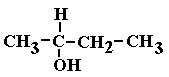
(2) butan-2-ol, 2-butanol, isomers of C4H10O alcohols ethers  structural formula , alcohols and ether structure and naming (c) doc b is a linear secondary alcohol

This has a chiral (asymmetric) carbon atom (2nd C2), so can also exhibit R/S stereoisomerism because a pair of two non-imposable mirror images can exist fro butan-2-ol

R/S stereoisomers of butan-2-ol enantiomers, optical isomers of molecular formula C4H10O (R)-butan-2-ol (S)-butan-2-ol (R)-2-butanol (S)-2-butanol

The R/S stereoisomers of butan-2-ol (pair of enantiomers, non-superimposable mirror images structures, optical isomers)

From the CIP assignment priority rule for R/S isomers: 8O  >  6C6C  >  6C1H  >  1H

Number of low resolution NMR chemical shift δ signal peaks: 5 1H and 4 13C (email if disagree?)

1H NMR proton ratio of integrated peak areas: 3 : 1 : 1 : 2 : 3  (for equivalent protons)

Some key wavenumbers from the infrared spectra of the isomers of C4H10O


(3) 2-methylpropan-1-ol, 2-methyl-2-butanol, isomers of C4H10O alcohols ethers  structural formula , alcohols and ether structure and naming (c) doc b , is a branched primary alcohol

Number of low resolution NMR chemical shift δ signal peaks: 4 1H and 3 13C (email if disagree?)

1H NMR proton ratio of integrated peak areas: 6 (3+3) : 1 : 2 : 1  (for equivalent protons)

Some key wavenumbers from the infrared spectra of the isomers of C4H10O


(4) 2-methylpropan-2-ol, 2-methyl-2-propanol, isomers of C4H10O alcohols ethers  structural formula , alcohols and ether structure and naming (c) doc b , is a tertiary alcohol

Number of low resolution NMR chemical shift δ signal peaks: 2 1H and 2 13C (email if disagree?)

1H NMR proton ratio of integrated peak areas: 9 (3x3) : 1  (for equivalent protons)

Some key wavenumbers from the infrared spectra of the isomers of C4H10O


There are three isomeric aliphatic ethers

(5) ethoxyethane,  isomers of C4H10O alcohols ethers  structural formula , alcohols and ether structure and naming (c) doc b (ether, diethyl ether)

Number of low resolution NMR chemical shift δ signal peaks: 2 1H and 2 13C (email if disagree?)

1H NMR proton ratio of integrated peak areas: 6 (3+3) : 4 (2+2)  (for equivalent protons)

Some key wavenumbers from the infrared spectra of the isomers of C4H10O


(6) 1-methoxypropane isomers of C4H10O alcohols ethers  structural formulaalcohols and ether structure and naming (c) doc b  (ether, methyl propyl ether)

Number of low resolution NMR chemical shift δ signal peaks: 4 1H and 4 13C (email if disagree?)

1H NMR proton ratio of integrated peak areas: 3 : 2 : 2 : 3  (for equivalent protons)

Some key wavenumbers from the infrared spectra of the isomers of C4H10O


(7) 2-methoxypropane isomers of C4H10O alcohols ethers  structural formula , alcohols and ether structure and naming (c) doc b  (ether, isopropyl methyl ether)

Number of low resolution NMR chemical shift δ signal peaks: 3 1H and 3 13C (email if disagree?)

1H NMR proton ratio of integrated peak areas: 6 : 1 : 3  (for equivalent protons)

Some key wavenumbers from the infrared spectra of the isomers of C4H10O


A comparison of the spectra of some of these isomers which can help identify them

Infrared spectra of 4 isomeric alcohols of molecular formula C4H10O

The infrared spectrum of butan-1-ol (1-butanol)

The infrared spectrum of butan-2-ol (2-butanol)

The infrared spectrum of 2-methylpropan-1-ol

The infrared spectrum of 2-methylpropan-2-ol

Mass spectra of 4 isomeric alcohols of molecular formula C4H10O

The mass spectrum of butan-1-ol (1-butanol,)

The mass spectrum of butan-2-ol (2-butanol)

The mass spectrum of 2-methylpropan-1-ol

The mass spectrum of 2-methylpropan-2-ol

1H NMR spectra of 4 isomeric alcohols of molecular formula C4H10O

The H-1 NMR spectrum of butan-1-ol (1-butanol)

The H-1 NMR spectrum of butan-2-ol (2-butanol)

The H-1 NMR spectrum of 2-methylpropan-1-ol

The H-1 NMR spectrum of 2-methylpropan-2-ol

C13 NMR spectra of 4 isomeric alcohols of molecular formula C4H10O

The C-13 NMR spectrum of butan-1-ol (1-butanol)

The C-13 NMR spectrum of butan-2-ol (2-butanol)

The C-13 NMR spectrum of 2-methylpropan-1-ol

The C-13 NMR spectrum of 2-methylpropan-2-ol

Infrared spectra of 3 isomeric ethers, molecular formula C4H10O (see 4 isomeric alcohols too)

Infrared spectrum of ethoxyethane (diethyl ether)

The infrared spectrum of 1-methoxypropane (methyl propyl ether)

The infrared spectrum of 2-methoxypropane (methyl isopropyl ether)

Mass spectra of 3 isomeric ethers, molecular formula C4H10O (see 4 isomeric alcohols too)

The mass spectrum of ethoxyethane (diethyl ether)

The mass spectrum of 1-methoxypropane (methyl propyl ether)

The mass spectrum of 2-methoxypropane (methyl isopropyl ether)

1H NMR spectra of 3 isomeric ethers of molecular formula C4H10O (see 4 isomeric alcohols too)

The H-1 NMR spectrum of Ethoxyethane (diethyl ether)

The H-1 NMR spectrum of 1-methoxypropane (methyl propyl ether)

The H-1 NMR spectrum of 2-methoxypropane (methyl isopropyl ether)

C13 NMR spectra of 3 isomeric ethers of molecular formula C4H10O (see 4 isomeric alcohols too)

The C-13 NMR spectrum of ethoxyethane

The C-13 NMR spectrum of 1-methoxypropane (methyl propyl ether)

The C-13 NMR spectrum of 2-methoxypropane (methyl isopropyl ether)


KEY REVISION POINTS for the isomers of C4H10O

Some key wavenumbers from the infrared spectra of the isomers of C4H10O

The table shows key IR absorptions for O–H, C–H, and C–O bonds.

The broad O–H stretch and fingerprint region are crucial for identification and exam analysis.


Key IR Absorption Features of C4H10O

C4H10O includes both primary alcohols (e.g. 1-butanol) and secondary alcohols (e.g. 2-butanol or isobutanol). Their IR spectra share common features:

Bond Type Wavenumber (cm⁻¹) Appearance Assignment
O–H stretch (alcohol) 3200–3600 Broad, strong Hydrogen-bonded alcohol group
C–H stretch (alkane) 2850–2960 Sharp, medium Methyl and methylene groups
C–O stretch (alcohol) 1000–1260 Strong, sharp Alcohol C–O single bond
O–H bend (alcohol) 1400–1440 Weak to medium Bending vibration of hydroxyl group
CH2 bend (alkane) 1450–1470 Medium Methylene scissoring
CH3 bend (alkane) 1370–1390 Medium Methyl symmetric bending

Common misconceptions in IR spectroscopy exams for questions involving the isomers of C4H10O

  • Confusing O–H stretch with N–H or carboxylic acid: Alcohol O–H is broad but not as wide or intense as carboxylic acids.
  • Overlooking C–O stretch: Students often miss this key fingerprint region peak (1000–1260 cm⁻¹), crucial for confirming alcohols.
  • Assuming all broad peaks are O–H: Water contamination or overlapping peaks can mislead interpretation.
  • Ignoring fingerprint region: While complex, it holds vital clues for functional group confirmation.

Exam Revision Tips for IR Spectroscopy for questions involving the isomers of C4H10O

For A Level

  • Memorise key wavenumber ranges: Especially O–H, C=O, C–H, and C–O.
  • Practice spectrum matching: Identify functional groups from given spectra.
  • Use comparative analysis: Spot differences between alcohols, ketones, and acids.
  • Link to structure: Relate IR peaks to molecular formula and bonding.
  • Understand peak shape and intensity: Not just position—broad versus sharp, strong versus weak.
  • Apply to unknowns: Use IR to deduce or confirm molecular identity.
  • Integrate with other techniques: Combine IR with NMR or MS for full structural analysis.
  • Explain reasoning: Justify peak assignments in written responses.

Advanced Insight for teachers and students

  • Primary versus secondary alcohols: Slight shifts in O–H and C–O stretches due to hydrogen bonding differences.
  • Isomer differentiation: IR alone may not distinguish isomers—combine with boiling point or NMR.
  • Spectral overlays: Create comparative overlays for classroom use showing 1-butanol versus 2-butanol.

Summary and extra information about the isomers of C4H10O

There are seven constitutional isomers of C4H10O: four alcohols and three ethers.


Constitutional Isomers of C4H10O

Alcohols Ethers
1-butanol, butan-1-ol 1-methoxypropane
2-butanol, butan-2-ol 2-methoxypropane
2-methyl-1-propanol, 2-methylpropan-1-ol ethoxyethane (diethyl ether)
2-methyl-2-propanol, 2-methylpropan-2-ol  
  • Alcohols have an –OH group bonded to a saturated carbon.
  • Ethers have an oxygen atom bonded to two alkyl groups (R–O–R′).

Types of Isomerism in C4H10O molecules

For C4H10O

  • Chain isomerism: Straight-chain versus branched-chain.
  • No functional group or positional isomerism, as both are alkanes.

For C4H10O:

  • Functional group isomerism: Alcohols versus ethers.
  • Chain isomerism: Straight versus branched carbon skeleton.
  • Positional isomerism: Location of –OH or –O– group on the chain.

Physical Property Differences the isomers of C4H10O

Property Alcohols Ethers
Boiling point Higher (due to hydrogen bonding) Lower (no hydrogen bonding)
Solubility in water Good (especially lower primary alcohols) Moderate to low
Volatility Lower - H-bonding increasing intermolecular forces Higher
  • Branched isomers generally have lower boiling points than straight-chain counterparts due to reduced surface area.

Chemical Reactivity and Reactions of the isomers of C4H10O

  • Alcohols:
    • Undergo oxidation (primary → aldehyde → carboxylic acid; secondary → ketone).
    • Dehydration to form alkenes.
    • Esterification with carboxylic acids.
  • Ethers:
    • Relatively inert.
    • Cleaved by strong acids (e.g., HI, HBr).

Reactivity order (alcohols):

Primary > Secondary > Tertiary for oxidation;

Tertiary > Secondary > Primary for acid-catalyzed dehydration.


Uses and Applications of the isomers of C4H10O

  • 1-butanol: Solvent, precursor in perfumes and plastics.
  • 2-butanol: Industrial solvent.
  • 2-methyl-2-propanol (tert-butanol): Fuel additive, lab reagent.
  • Diethyl ether: Historical anaesthetic, solvent in Grignard reactions.

Common Student Misconceptions about the isomers of C4H10O

  • Confusing constitutional isomers with stereoisomers.
  • Assuming all alcohols behave the same chemically.
  • Forgetting that ethers lack hydrogen bonding, affecting boiling points.
  • Misidentifying oxidation products of alcohols.

Exam Revision Tips for questions involving the isomers of C4H10O

  • Draw all isomers systematically: start with straight chains, then branch.
  • Practice naming using IUPAC rules—watch for position numbers.
  • Compare boiling points and solubility based on structure and bonding.
  • Use oxidation flowcharts for alcohol reactions.
  • Link structure to reactivity: tertiary alcohols resist oxidation but dehydrate easily.
  • Use past papers to identify common question styles (e.g., “Explain why…” or “Draw and name…”).
  • For AP/IB: Emphasize mechanisms and reaction conditions.

Practise multiple choice exam questions based on the isomers of C4H10O

You may have to sketch out some molecular structures to work out the answer.

If you think there is an error email me asap chem55555@hotmail.com

A Co-Pilot AI experiment: Here’s a focused set of 12 exam-style multiple-choice questions on the  constitutional isomers (alcohols and ethers), with detailed feedback, distractor explanations, and common misconceptions.

The relevant IUPAC isomers are:

  • Alcohols: butan-1-ol, butan-2-ol, 2-methylpropan-1-ol, 2-methylpropan-2-ol
  • Ethers: 1-methoxypropane, 2-methoxypropane, ethoxyethane

    You may have to sketch out some molecular structures to work out the answer.

    If you think there is an error email me asap chem55555@hotmail.com


Q1. Number of alcohol and ether isomers

How many distinct alcohol and ether constitutional isomers with molecular formula C(4)H({10})O are there in total?

A. 5
B. 7
C. 8
D. 9


Q2. Primary versus secondary versus tertiary alcohols

Which of the following is a tertiary alcohol?

A. butan-1-ol
B. butan-2-ol
C. 2-methylpropan-1-ol
D. 2-methylpropan-2-ol


Q3. IR spectroscopy: identifying an alcohol

Which isomer would show a broad O–H stretching absorption around 3200–3600 cm(^{-1}) in its IR spectrum?

A. butan-1-ol
B. 1-methoxypropane
C. ethoxyethane
D. 2-methoxypropane


Q4. 1H NMR: number of distinct proton environments

Which isomer is expected to show the greatest number of distinct proton environments in its (^1)H NMR spectrum?

A. 2-methylpropan-2-ol
B. ethoxyethane
C. butan-2-ol
D. 2-methoxypropane


Q5. Oxidation behaviour of alcohol isomers

Which alcohol cannot be oxidised (under normal conditions with acidified dichromate) to a carbonyl compound?

A. butan-1-ol
B. 2-methylpropan-2-ol
C. butan-2-ol
D. 2-methylpropan-1-ol


Q6. 13C NMR: number of carbon environments

Which isomer would show only two distinct carbon environments in its 13C NMR spectrum?

A. butan-1-ol
B. butan-2-ol
C. 1-methoxypropane
D. 2-methylpropan-2-ol


Q7. Distinguishing an ether from an alcohol by simple tests

Which statement correctly describes a simple way to distinguish ethoxyethane from butan-1-ol in the lab?

A. Ethoxyethane will react with acidified potassium dichromate(VI), turning the solution green.
B. Butan-1-ol will not burn in air, whereas ethoxyethane will burn readily.
C. Butan-1-ol will react with sodium metal to produce hydrogen gas, whereas ethoxyethane will not.
D. Ethoxyethane will give a positive test with Tollens’ reagent, whereas butan-1-ol will not.


Q8. 1H NMR: presence of an OH proton

Which isomer’s 1H NMR spectrum would typically show a broad, exchangeable signal (often around 1–5 ppm) that disappears on adding D2O to the specimen, indicating an OH proton?

A. 2-methylpropan-1-ol
B. ethoxyethane
C. 1-methoxypropane
D. 2-methoxypropane


Q9. Boiling point comparison

Which compound is expected to have the highest boiling point?

A. 1-methoxypropane
B. ethoxyethane
C. 2-methoxypropane
D. butan-1-ol


Q10. Dehydration to an alkene

Which alcohol is most likely to give 2-methylpropene as the major product on dehydration with hot concentrated sulfuric acid?

A. butan-1-ol
B. 2-methylpropan-2-ol
C. 2-methylpropan-1-ol
D. butan-2-ol


Q11. Distinguishing butan-1-ol and butan-2-ol by oxidation

Which statement correctly describes a way to distinguish butan-1-ol from butan-2-ol using acidified potassium dichromate(VI)?

A. Neither will change the colour of acidified dichromate(VI).
B. Both will change the colour of acidified dichromate(VI), but only butan-1-ol forms a ketone.
C. Both will change the colour of acidified dichromate(VI), but butan-1-ol can be further oxidised to a carboxylic acid.
D. Only butan-2-ol will change the colour of acidified dichromate(VI).


Q12. 1H NMR splitting pattern clue

A compound with formula C4H10O shows a 1H NMR spectrum containing only one sharp singlet (ignoring the OH proton). Which isomer is most consistent with this data?

A. 2-methylpropan-2-ol
B. butan-1-ol
C. ethoxyethane
D. 1-methoxypropane


You may have to sketch out some molecular structures to work out the answer.

If you think there is an error email me asap chem55555@hotmail.com


Learning objectives - questions to be answered concerning the isomers of C4H10O

How many constitutional isomers are there of formula C4H10O?

How do you draw the skeletal structure of isomers of C4H10O?

How do you draw the structural formula of isomers of C4H10O?

Can you recognise the different functional groups in the isomers of C4H10O?

How do you name the isomers of C4H10O?

How do you work out the structure of the isomers of molecular formula C4H10O?

How do you draw the structural formula and skeletal formula of the isomers of molecular formula C4H10O?

How do you name the isomers of molecular formula C4H10O?

How many aliphatic structural isomers are there of molecular formula C4H10O?

How many aliphatic carbon chain isomers are there of molecular formula C4H10O?

How many positional isomers are there of molecular formula C4H10O?

How many E/Z (geometrical) isomers are there of molecular formula C4H10O?

How many R/S (optical) isomers (enantiomers) of molecular formula C4H10O?

Are there any functional group isomers with a molecular formula C4H10O?

Does C4H10O have any stereoisomers?

Be able to work out the number of different 1H proton NMR chemical shift signals for C4H10O isomers

Be able to work out the number of different 13C NMR chemical shift signals for C4H10O isomers

This page will answer these questions for molecular formulae C4H10O


Associated organic chemistry  links

 Advanced Level pre-university organic chemistry notes

 IR, mass and H-1 & C-13 NMR spectra of organic compounds

Index of sets of isomers for a given molecular formula

The molecular structure and naming of aliphatic ALCOHOLS including isomeric ethers

INDEX of ALL revision notes on the chemistry of ALCOHOLS (and mention of ethers)

For isomerism in organic chemistry, see also the notes

Isomerism: introduction, structural isomerism - chain, positional, functional group, tautomerism

Stereoisomerism: introduction, definition, priority rules, E/Z isomerism (cis/trans isomerism)

Stereoisomerism - R/S isomerism (optical isomerism) - definition - examples explained

 This is a big chemistry website, please allow time to explore it

Index of advanced (pre-university) organic chemistry revision notes

 The chemistry of alkanes and the petrochemical industry

 The chemistry of alkenes

 The chemistry of organic halogen compounds

 The chemistry of alcohols

 The chemistry of aldehydes and ketones

 The chemistry of carboxylic acids and derivatives

 The chemistry of organo-nitrogen compounds

 The chemistry of aromatic compounds


A summary chart of isomerism

index for all isomerism pages

ANSWERS to the practise multiple choice exam questions

You may have to sketch out some molecular structures to work out the answer.

If you think there is an error email me asap chem55555@hotmail.com


Q1. Number of alcohol and ether isomers

How many distinct alcohol and ether constitutional isomers with molecular formula C(4)H({10})O are there in total?

A. 5
B. 7
C. 8
D. 9

Correct answer: B

Explanation:

  • There are 4 alcohols: butan-1-ol, butan-2-ol, 2-methylpropan-1-ol, 2-methylpropan-2-ol.
  • There are 3 ethers: 1-methoxypropane, 2-methoxypropane, ethoxyethane.
    Total = (4 + 3 = 7).

Why the distractors are wrong:

  • A (5): Underestimates—ignores branching and ether isomers.
  • C (8) and D (9): Overcount—often from double-counting positional isomers or inventing impossible structures.

Tip / misconception:
Students often forget that ethers can also be constitutional isomers of alcohols with the same formula. Always consider both functional groups when given only a molecular formula.


Q2. Primary versus secondary versus tertiary alcohols

Which of the following is a tertiary alcohol?

A. butan-1-ol
B. butan-2-ol
C. 2-methylpropan-1-ol
D. 2-methylpropan-2-ol

Correct answer: D

Explanation:

  • In 2-methylpropan-2-ol, the carbon bearing the OH group is attached to three other carbons → tertiary.

Why the distractors are wrong:

  • A (butan-1-ol): OH on a carbon attached to only one other carbon → primary.
  • B (butan-2-ol): OH on a carbon attached to two other carbons → secondary.
  • C (2-methylpropan-1-ol): OH on a carbon attached to one other carbon → primary.

Tip / misconception:
Don’t classify primary/secondary/tertiary by “how substituted the OH looks”; it’s about how many carbon atoms are directly bonded to the carbon bearing the OH, not to the oxygen.


Q3. IR spectroscopy: identifying an alcohol

Which isomer would show a broad O–H stretching absorption around 3200–3600 cm(^{-1}) in its IR spectrum?

A. butan-1-ol
B. 1-methoxypropane
C. ethoxyethane
D. 2-methoxypropane

Correct answer: A

Explanation:

  • Alcohols show a broad O–H stretch in the 3200–3600 cm-1 region.
  • butan-1-ol is an alcohol, so it shows this broad band.

Why the distractors are wrong:

  • B, C, D: All are ethers; ethers lack an O–H bond and therefore do not show the broad O–H stretch, only C–O stretches around 1000–1200 cm-1.

Tip / misconception:
Students sometimes think “any oxygen-containing compound” shows an O–H peak. Only compounds with an actual O–H bond (alcohols, carboxylic acids, etc.) show that broad O–H stretch.


Q4. 1H NMR: number of distinct proton environments

Which isomer is expected to show the greatest number of distinct proton environments in its (^1)H NMR spectrum?

A. 2-methylpropan-2-ol
B. ethoxyethane
C. butan-2-ol
D. 2-methoxypropane

Correct answer: C

Explanation (qualitative):

  • butan-2-ol is relatively unsymmetrical: it has an OH-bearing CH, two different CH3 groups (on each side), and a CH2 group, plus the OH proton → several distinct environments.
  • The others have more symmetry or equivalent groups, reducing the number of distinct signals.

Why the distractors are wrong (qualitative reasoning):

  • A (2-methylpropan-2-ol): Highly symmetrical; three equivalent CH3 groups plus OH → fewer signals.
  • B (ethoxyethane): Symmetrical ether (diethyl ether); both ethyl groups are equivalent.
  • D (2-methoxypropane): Has equivalent methyl groups attached to the same carbon, reducing the number of distinct environments.

Tip / misconception:
Students often count “types of groups” CH3, CH2, CH) instead of unique environments. Always consider symmetry—equivalent groups give one signal.


Q5. Oxidation behaviour of alcohol isomers

Which alcohol cannot be oxidised (under normal conditions with acidified dichromate) to a carbonyl compound?

A. butan-1-ol
B. 2-methylpropan-2-ol
C. butan-2-ol
D. 2-methylpropan-1-ol

Correct answer: B

Explanation:

  • Tertiary alcohols (like 2-methylpropan-2-ol) lack a hydrogen on the carbon bearing the OH group, so they are resistant to oxidation to carbonyl compounds under typical conditions.

Why the distractors are wrong:

  • A (butan-1-ol): Primary alcohol → oxidised to aldehyde and then carboxylic acid.
  • C (butan-2-ol): Secondary alcohol → oxidised to a ketone.
  • D (2-methylpropan-1-ol): Primary alcohol → oxidised to aldehyde and then carboxylic acid.

Tip / misconception:
A common error is to assume “all alcohols oxidise”. Check for a hydrogen on the carbon bearing the OH—no such hydrogen means no simple oxidation to a carbonyl.


Q6. 13C NMR: number of carbon environments

Which isomer would show only two distinct carbon environments in its 13C NMR spectrum?

A. butan-1-ol
B. butan-2-ol
C. 1-methoxypropane
D. 2-methylpropan-2-ol

Correct answer: D

Explanation:

  • 2-methylpropan-2-ol has:
    • One quaternary carbon (attached to OH and three CH(_3) groups).
    • Three equivalent CH(_3) groups (all identical).
      So only two distinct carbon environments.

Why the distractors are wrong (qualitative):

  • A, B, C: Each has more than two distinct carbon environments because of less symmetry and different positions relative to the functional group.

Tip / misconception:
Students often forget that multiple identical groups (like three equivalent CH3 groups) give one signal, not three. Symmetry drastically reduces the number of 13C signals.


Q7. Distinguishing an ether from an alcohol by simple tests

Which statement correctly describes a simple way to distinguish ethoxyethane from butan-1-ol in the lab?

A. Ethoxyethane will react with acidified potassium dichromate(VI), turning the solution green.
B. Butan-1-ol will not burn in air, whereas ethoxyethane will burn readily.
C. Butan-1-ol will react with sodium metal to produce hydrogen gas, whereas ethoxyethane will not.
D. Ethoxyethane will give a positive test with Tollens’ reagent, whereas butan-1-ol will not.

Correct answer: C

Explanation:

  • Alcohols (like butan-1-ol) react with sodium metal to form a salt and hydrogen gas.
  • Ethers (like ethoxyethane) do not react with sodium metal under these conditions.

Why the distractors are wrong:

  • A: Ethoxyethane (an ether) is not oxidised by acidified dichromate; butan-1-ol (a primary alcohol) is.
  • B: Both are flammable and will burn in air.
  • D: Tollens’ reagent tests for aldehydes, not for alcohols or ethers.

Tip / misconception:
Students sometimes think “any oxygen-containing compound” reacts with sodium or oxidising agents. Reaction patterns depend on functional group, not just the presence of oxygen.


Q8. 1H NMR: presence of an OH proton

Which isomer’s 1H NMR spectrum would typically show a broad, exchangeable signal (often around 1–5 ppm) that disappears on adding D2O to the specimen, indicating an OH proton?

A. 2-methylpropan-1-ol
B. ethoxyethane
C. 1-methoxypropane
D. 2-methoxypropane

Correct answer: A

Explanation:

  • 2-methylpropan-1-ol is an alcohol and contains an OH proton, which appears as a broad signal and disappears on D(_2)O exchange.

Why the distractors are wrong:

  • B, C, D: All ethers; they have no OH proton, so no such broad, exchangeable signal.

Tip / misconception:
Students sometimes misinterpret broad signals as “impurities”. In alcohols, a broad, exchangeable peak is a key diagnostic feature for the OH proton.


Q9. Boiling point comparison

Which compound is expected to have the highest boiling point?

A. 1-methoxypropane
B. ethoxyethane
C. 2-methoxypropane
D. butan-1-ol

Correct answer: D

Explanation:

  • butan-1-ol can form strong hydrogen bonds between molecules due to the OH group, leading to a significantly higher boiling point than the ethers, which can only form dipole–dipole and London dispersion forces.

Why the distractors are wrong:

  • A, B, C (ethers): No O–H bond → no hydrogen bonding between molecules → lower boiling points compared with an alcohol of similar molar mass.

Tip / misconception:
Students often overemphasise “molecular mass” and forget intermolecular forces. Hydrogen bonding usually dominates boiling point trends among molecules of similar size.


Q10. Dehydration to an alkene

Which alcohol is most likely to give 2-methylpropene as the major product on dehydration with hot concentrated sulfuric acid?

A. butan-1-ol
B. 2-methylpropan-2-ol
C. 2-methylpropan-1-ol
D. butan-2-ol

Correct answer: B

Explanation:

  • 2-methylpropan-2-ol (a tertiary alcohol) dehydrates to give the more substituted alkene 2-methylpropene.
  • Tertiary alcohols dehydrate readily and often follow Zaitsev’s rule (more substituted alkene favoured).

Why the distractors are wrong:

  • A (butan-1-ol): Dehydration gives mainly but-1-ene and but-2-ene, not 2-methylpropene.
  • C (2-methylpropan-1-ol): Dehydration would give mainly 2-methylprop-1-ene (less substituted) or rearranged products under harsher conditions, but not straightforwardly 2-methylpropene as the major product at this level.
  • D (butan-2-ol): Dehydration gives mainly but-2-ene.

Tip / misconception:
Students sometimes ignore carbocation stability and Zaitsev’s rule. More substituted alkenes are usually more stable and therefore favoured in dehydration of alcohols.


Q11. Distinguishing butan-1-ol and butan-2-ol by oxidation

Which statement correctly describes a way to distinguish butan-1-ol from butan-2-ol using acidified potassium dichromate(VI)?

A. Neither will change the colour of acidified dichromate(VI).
B. Both will change the colour of acidified dichromate(VI), but only butan-1-ol forms a ketone.
C. Both will change the colour of acidified dichromate(VI), but butan-1-ol can be further oxidised to a carboxylic acid.
D. Only butan-2-ol will change the colour of acidified dichromate(VI).

Correct answer: C

Explanation:

  • Both primary (butan-1-ol) and secondary (butan-2-ol) alcohols are oxidised by acidified dichromate(VI), turning the solution from orange to green.
  • butan-1-ol can be oxidised first to butanal and then to butanoic acid.
  • butan-2-ol is oxidised to butan-2-one (a ketone), which is not further oxidised under these conditions.

Why the distractors are wrong:

  • A: Incorrect—both are oxidised.
  • B: Butan-1-ol forms an aldehyde (and then an acid), not a ketone.
  • D: Both, not just butan-2-ol, cause the colour change.

Tip / misconception:
Students often think “primary → aldehyde only” and forget further oxidation to carboxylic acid, or they confuse which type gives ketones (secondary).


Q12. 1H NMR splitting pattern clue

A compound with formula C4H10O shows a 1H NMR spectrum containing only one sharp singlet (ignoring the OH proton). Which isomer is most consistent with this data?

A. 2-methylpropan-2-ol
B. butan-1-ol
C. ethoxyethane
D. 1-methoxypropane

Correct answer: A

Explanation:

  • 2-methylpropan-2-ol has three equivalent CH(_3) groups attached to the same carbon, and they are not adjacent to any other non-equivalent protons (apart from the OH, which often appears separately and may be broad).
  • All nine protons of the three CH3 groups are equivalent and see no neighbouring non-equivalent protons → one sharp singlet.

Why the distractors are wrong (qualitative):

  • B (butan-1-ol): Has multiple environments and splitting patterns.
  • C (ethoxyethane): Has at least two signals with splitting.
  • D (1-methoxypropane): Has different CH3 groups (on O and on carbon chain) → multiple signals.

Tip / misconception:
Students often forget that equivalent groups give a single signal and that lack of neighbouring non-equivalent protons gives a singlet. Highly symmetrical structures often give very simple NMR spectra.


You may have to sketch out some molecular structures to work out the answer.

If you think there is an error email me asap chem55555@hotmail.com


Website content © Dr Phil Brown 2000+. All copyrights reserved on revision notes, images, quizzes, worksheets etc. Copying of Doc Brown's pre-university advanced level chemistry website material is NOT permitted. Exam revision summaries & references to science course specifications are unofficial. These organic chemistry revision notes on the isomers of C4H10O with names, structures, types of isomerism and a few spectroscopy details are suitable for use of pre-university students studying AQA advanced level chemistry, Edexcel advanced level chemistry, OCR advanced level chemistry, IB advanced level chemistry, WJEC (Eduqas) advanced level chemistry, CIE advanced level chemistry, CCEA advanced level chemistry, US grade 11-12 AP honors chemistry courses and they will also prove useful to 1st year undergraduate students of chemistry.

Keywords or phrases: how many isomers are there of molecular formula C4H10O? how do you name the isomers of molecular formula C4H10O? what is the molecular structure of the isomers of C4H10O, what type of isomerism is exhibited by molecules of formula C4H10O, how do you work out the isomers of molecular formula C4H10O, what are the structural isomers of C4H10O, the carbon chain isomers of C4H10O in the homologous series of alkanes, comparing the spectra of isomers of molecular formula C4H10O how many structural isomers of C4H10O can you draw? how many structural isomers does C4H10O have? what are the possible isomers of C4H10O? revision notes on isomerism of C4H10O molecules, isomerism in aliphatic alcohols, isomerism in aliphatic ethers, alcohol isomers of C4H10O, ether isomers of C4H10O the molecular structure of the isomers of C4H10O ethers alcohols molecules isomeric with molecular formula C4H10O, structural isomers of molecular formula C4H10O, optical isomers R/S enantiomers isomeric with molecular formula C4H10O, positional isomers isomeric with molecular formula C4H10O, which types of isomerism are exhibited by molecules isomeric with molecular formula C4H10O alkyl positional isomers of C4H10O branched carbon chain ethers alcohols isomers of C4H10O R/S optical isomers enantiomers of C4H10O, isomers of C4H10 of molecular mass 74

TOP OF PAGE