|
Interpreting the
1H NMR spectrum of 2,2-dimethylpentane
[Author
©
Dr WP Brown PhD:
Doc Brown's advanced level organic chemistry exam revision notes
suitable for students of UK A level chemistry courses & US K12 grade
11, grade 12 and AP honors chemistry courses: Molecular
spectroscopy - analysing the
1H NMR spectrum of
2,2-dimethylpentane
[updated
October 29th 2025]
email doc
brown
Re-edit
CH3CH2CH2C(CH3)3
Links associated with 2,2-dimethylpentane
This is a BIG
website, PLEASE take time to explore it
H-1 proton NMR spectroscopy -
spectra index
See also
comparing the
1H NMR and 13C NMR spectra of the nine alkane structural isomers of C7H16
Introductory note on the 1H NMR spectra of 2,2-dimethylpentane
Students and teachers please note my explanation of the
proton NMR spectrum of 2,2-dimethylpentane is designed for advanced, but
pre-university, chemistry courses.
The chemical shift
δ splitting pattern effects for
2,2-dimethylpentane are
confined to a proton spin-spin
coupling effects analysed using the n+1 rule for adjacent
non-equivalent proton fields (n is the number of neighbouring
protons in a non-equivalent different chemical environment for the
2,2-dimethylpentane molecule).
It is assumed that the integrated intensities of the
1H
NMR δ
chemical shifts give the ratio of the protons in the different
non-equivalent chemical environments of the 2,2-dimethylpentane molecule.
The most common solvent used for investigating the 1H NMR
spectrum of compounds like 2,2-dimethylpentane, is CDCl3 and other
deuterated solvents to avoid confusion with a 1H NMR
signal, 2D (2H) has a different NMR chemical
shift.

TMS is the acronym for tetramethylsilane, formula Si(CH3)4,
whose protons are arbitrarily given a chemical shift of 0.0 ppm.
This is the 'standard' in 1H NMR spectroscopy and all
other proton shifts, called chemical shifts, depend on the
individual (electronic) chemical environment of the hydrogen atoms
in an organic molecule - 2,2-dimethylpentane here.
The chemical shifts quoted in ppm on the diagram of
the H-1 NMR spectrum of 2,2-dimethylpentane represent the peaks of the intensity of
the chemical shifts of (which are often groups of split lines at
high resolution) AND the relative integrated areas under the peaks
gives you the ratio of protons in the different chemical
environments of the 2,2-dimethylpentane molecule.
2,2-dimethylpentane C7H16

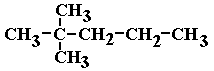

The molecular structure and
naming of alkanes
Interpreting the
H-1 NMR spectrum of
2,2-dimethylpentane
For relatively simple molecules, the low
resolution H-1 NMR spectrum of 2,2-dimethylpentane is a good,
but limited starting point.
Theoretically, the 16 hydrogen atoms (protons) of
2,2-dimethylpentane occupy
4
different chemical environments so that the low resolution NMR
spectra should show 4 principal peaks of different H-1 NMR chemical shifts (diagram above for
2,2-dimethylpentane).
BUT, as you can see, you get only 2 principal
peaks in the integrated proton ratio observed of 3:1 for the CH3:CH2
proton ratio.
(CH3)3CCH2CH2CH3
Note the 'real'
integrated proton ratio 9:2:2:3 of the 4 colours of the protons
in the 4 chemically different environments
Chemical shifts
(a) to (d) on the H-1 NMR
spectrum diagram for 2,2-dimethylpentane.
Although there are 16 hydrogen atoms in the molecule,
there are only 4 possible different chemical
environments (four 1H chemical shifts) for the hydrogen atoms in 2,2-dimethylpentane molecule.
The high resolution 1H NMR
spectrum of 2,2-dimethylpentane
The ppm quoted on the diagram represent the peak
of resonance intensity for a particular proton group in the
molecule of 2,2-dimethylpentane - since the peak' is at the apex of a band of
H-1 NMR resonances due to spin - spin coupling field splitting effects - see high resolution
notes on 2,2-dimethylpentane below.
So, using the chemical shifts and applying the
n+1 rule to
2,2-dimethylpentane
and make some predictions using some colour coding! (In problem
solving you work the other way round!)
(a) 1H
Chemical shift 0.86 ppm for the -C(CH3)3 protons: (CH3)3CCH2CH2CH3
Resonance (a) would not be readily
split, since no protons on the adjacent carbon atom on
the right - this theoretically gives a singlet.
All nine
protons on these three methyl group of
2,2-dimethylpentane are equivalent to
each other and their proton fields cannot split each
i.e. they occupy identical chemical environments and
absorb at the same chemical shift.
(b) and (c) 1H
Chemical shift 1.18 ppm for the -CH2- protons: (CH3)3CCH2CH2CH3
These are almost identical, but
theoretically different - you would need very high
resolution spectra to sort them out.
(b) is split into a 1:2:1 triplet by the
neighbouring (c) CH2 protons (n+1 = 3).
Evidence of a CH2 group
in the molecule.
(c) is split into a sextet by the
neighbouring CH2 and CH3 protons
(n+1 =6).
Evidence of a CH2-C-CH3
grouping in the molecule.
(d) 1H
Chemical shift 0.88 ppm for the 'lone' CH3 group: (CH3)3CCH2CH2CH3
(d) is split into a 1:2:1 triplet by the
neighbouring (c) CH2 protons (n+1 = 3).
Evidence of a 2nd CH2
group in the molecule.
Very similar to 1H resonance (a) and
you would need very high resolution spectra to resolve (a)
and (d).
Key
points about the 1H NMR spectrum of 2,2-dimethypentane
The
¹H NMR spectrum of 2,2-dimethylpentane shows three (theoretically 4
at high resolution) distinct proton environments with chemical
shifts between ~0.85–1.25 ppm, all appearing as singlets or
multiplets due to overlapping alkyl signals. The integrated proton
ratio is 9:4 (or 2 : 2) : 3, reflecting methyl and methylene groups
in a branched alkane.
Key ¹H NMR
Features of 2,2-Dimethylpentane
2,2-Dimethylpentane (C7H16) is a saturated,
highly branched alkane.
| Label |
shift δ (ppm) |
Proton Type |
Environment |
Integration |
| A |
~1.18 ppm x 2,
|
2 x CH2 |
2 x methylene (–CH2–CH2–) |
2H + 2H |
| B |
~0.88
ppm |
CH3 |
Terminal methyl (–CH3) |
3H |
| C |
~0.86
ppm |
3 x CH3 |
Trimethyl on C2 (–C(CH3)3–) |
6H |
Sources:
ChemicalBook NMR data
https://sdbs.db.aist.go.jp/
diagram 1H
δ ppm
spectral database of organic compounds
Common
Misconceptions in ¹H NMR Interpretation
- Expecting complex splitting: In branched
alkanes like 2,2-dimethylpentane, many protons are magnetically
equivalent, leading to singlets or overlapping multiplets.
- Misidentifying environments: Students may
overlook that the two methyl groups on C2 are equivalent and give a
single signal.
- Ignoring integration: Some learners focus only
on chemical shift and splitting, but integration is crucial for
deducing structure.
- Assuming downfield shifts: Alkanes typically
appear upfield (0.8–1.5 ppm); shifts above 2 ppm suggest
electronegative atoms or unsaturation.
Exam
Revision Tips (AQA, Edexcel, OCR, WJEC, CCEA, CIE, IB, AP)
- Use integration ratios: For C7H16,
expect 16 protons total. Integration helps confirm group sizes (e.g.
6H methyl versus 4H methylene).
- Recognize symmetry: The molecule’s branching
creates equivalent methyl groups—this simplifies the spectrum.
- Practice with low-resolution spectra: Many
exams use simplified spectra—focus on number of signals, chemical
shift, and integration.
- Link structure to spectrum: Draw the molecule
and label proton environments to predict signal count and ratios.
- Be cautious with splitting: In highly symmetric
alkanes, splitting may be minimal or obscured by overlap.
Tips for
spotting equivalent methyl group protons in 1H NMR
e.g. 4 methyl groups in 2,2-dimethylpentane
- Check for identical
attachments: If two
or more methyl groups are bonded to the same carbon and that carbon is not
chiral, they are usually equivalent.
- Look for symmetry:
Even partial symmetry (2,2-dimethylpentane) can lead to
equivalence.
- Use integration clues:
If two methyl groups give a single peak with integration of 6H (3
gives 9H), that's a strong hint they are equivalent.
- Compare with isomers:
Try contrasting with
2,2-dimethylpentane
with 3-methylhexane, where methyl
proton environments differ more clearly.
- Counting methyls as
separate signals:
Leads to overestimating the number of peaks in ¹H NMR spectra.
- Assuming all methyls are
equivalent: Not true
in asymmetric or chiral environments.
- Ignoring branching effects:
Branching can create or remove equivalence depending on the
substitution pattern.
The splitting pattern from proton
spin-spin coupling effects is analysed using the n+1 rule for
adjacent non-equivalent proton fields (n is the number of
neighbouring protons in a non-equivalent different chemical
environment).
|
Number of directly adjacent protons 1H
causing splitting |
Splitting pattern produced from the
n+1 rule on spin-spin coupling and the theoretical ratio of line intensities |
|
0
means no splitting |
|
|
|
|
|
|
1 |
|
|
|
|
|
|
|
1
creates a doublet |
|
|
|
|
|
1 |
|
1 |
|
|
|
|
|
|
2
creates a triplet |
|
|
|
|
1 |
|
2 |
|
1 |
|
|
|
|
|
3
creates a quartet |
|
|
|
1 |
|
3 |
|
3 |
|
1 |
|
|
|
|
4
creates a quintet |
|
|
1 |
|
4 |
|
6 |
|
4 |
|
1 |
|
|
|
5
creates a sextet |
|
1 |
|
5 |
|
10 |
|
10 |
|
5 |
|
1 |
|
|
6
creates a septet |
1 |
|
6 |
|
15 |
|
20 |
|
15 |
|
6 |
|
1 |
|
Comparing the
1H NMR and 13C NMR spectra of the nine alkane structural isomers of C7H16
You can distinguish all 9 isomers from a data combination of their number of
1H NMR
chemical shifts,
and their resulting integrated 1H proton ratios, plus, their number of
13C
chemical shifts. |
|
Name of the alkane structural isomer of molecular
formula C7H16 |
Abbreviated structural formulae
of the nine isomers of molecular formula C7H16 (interpretation complications with 3-methylhexane and
2,3-dimethylpentane because they exhibit R/S isomerism due to a
chiral carbon) |
Skeletal formula of the
nine
alkane isomers of
molecular formula C7H16 |
Number of 1H NMR chemical shifts (δ) and
proton ratio (links
to spectrum) |
Number of 13C chemical shifts (δ)
(links
to spectrum) |
|
heptane |
 |
 |
4 δ: proton ratio: 3:2:2:1 (6:4:4:2 in the molecule) |
4 δ shifts |
|
2-methylhexane |
 |
 |
6 δ: proton ratio :
6:3:2:2:2:1 |
6 δ shifts |
|
3-methylhexane |
 |
 |
7 δ: proton ratio:
3:3:3:2:2:2:1 (simplification) ! |
7
δ shifts |
|
3-ethylpentane |
 |
 |
3 δ: proton ratio:
9:6:1 |
3 δ
shifts |
|
2,2-dimethylpentane |
|
|
4 δ: proton ratio:
9:3:2:2 |
5 δ shifts |
|
2,3-dimethylpentane |
 |
 |
6 δ: proton ratio:
6:3:3:2:1:1 (simplification) ! |
6 δ
shifts (simplification) !!! |
|
2,4-dimethylpentane |
 |
 |
3 δ: proton ratio:
12:2:2 |
3 δ
shifts |
|
3,3-dimethylpentane |
 |
 |
3 δ: proton ratio:
3:3:2 (6:4:4 in the molecule) |
4 δ
shifts |
|
2,2,3-trimethylbutane |
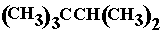 |
 |
3 δ: proton ratio:
9:6:1 |
4 δ shifts |
Key words & phrases: C7H16
Interpreting the proton H-1 NMR spectra of 2,2-dimethylpentane, low resolution & high resolution proton
nmr spectra of 2,2-dimethylpentane, H-1 nmr spectrum of 2,2-dimethylpentane, understanding the
hydrogen-1 nmr spectrum of 2,2-dimethylpentane, explaining the line splitting patterns in the
high resolution H-1 nmr spectra of 2,2-dimethylpentane, revising the H-1 nmr spectrum of
2,2-dimethylpentane,
proton nmr of 2,2-dimethylpentane, ppm chemical shifts of the H-1 nmr spectrum of
2,2-dimethylpentane,
explaining and analyzing spin spin line splitting in the H-1 nmr spectrum, how
to construct the diagram of the H-1 nmr spectrum of 2,2-dimethylpentane, how to work out the
number of chemically different protons in the structure of the
2,2-dimethylpentane organic
molecule, how to analyse the chemical shifts in the hydrogen-1 H-1 proton NMR
spectrum of 2,2-dimethylpentane using the n+1 rule to explain the spin - spin coupling
spin
splitting in the proton nmr spectrum of 2,2-dimethylpentane deducing the nature of the protons
from the chemical shifts ppm in the H-1 nmr spectrum of 2,2-dimethylpentane
examining the 1H nmr spectrum of 2,2-dimethylpentane analysing the 1-H nmr spectrum of
2,2-dimethylpentane how do you sketch and interpret the H-1 NMR spectrum of
2,2-dimethylpentane
interpreting interpretation of the 1H proton NMR spectrum of 2,2-dimethylpentane
(CH3)3CCH2CH2CH3 Molecular structure diagram of the
proton NMR diagram for the 1H NMR spectrum of 2,2-dimethylpentane. The proton ratio in the
1H NMR spectrum of 2,2-dimethylpentane. Deducing the number of different chemical
environments of the protons in the 2,2-dimethylpentane molecule from the 1H chemical shifts
in the hydrogen-1 NMR spectrum of 2,2-dimethylpentane. Analysing the high resolution 1H NMR
spectrum of 2,2-dimethylpentane. Analysing the low resolution 1H NMR spectrum of
2,2-dimethylpentane. You
may need to know the relative molecular mass of 2,2-dimethylpentane to deduce the molecular
formula from the proton ratio of the 1H NMR spectrum of 2,2-dimethylpentane. Revision notes
on the proton NMR spectrum of 2,2-dimethylpentane. Matching and deducing the structure of
the 2,2-dimethylpentane molecule from its hydrogen-1 NMR spectrum.
Proton NMR spectroscopy of aliphatic alkanes,
1H NMR spectra of 2,2-dimethylpentane, a structural isomer of molecular formula
C7H16
How do you interpret the H-1 NMR spectrum of
2,2-dimethylpentane How to interpret
the H-1 NMR spectrum of 2,2-dimethylpentane Explanatory diagram of the chemical
shifts of the 1H H-1 proton NMR spectrum of the 2,2-dimethylpentane
molecule in terms of its molecular structure. Listing data of all the chemical shift peaks in ppm in the
proton NMR spectrum of 2,2-dimethylpentane. How to explain the H-1 NMR spectrum of
2,2-dimethylpentane. The chemical shifts and integrated values of the proton ratios in the 1-H NMR
spectrum of the 2,2-dimethylpentane molecule. How to work out the molecular
structure of the 2,2-dimethylpentane molecule from its proton NMR spectrum. The uses
and distinctive features of the proton NMR spectrum of the
2,2-dimethylpentane
molecule explained. What does the H-1 proton NMR spectrum chemical
shifts tell us about the
structure and properties of the 2,2-dimethylpentane
molecule? explaining the spin-spin proton coupling effects in the 1H
NMR spectrum of 2,2-dimethylpentane.
interpretation
diagram explaining the proton splitting
pattern produced from the n+1 rule and the theoretical ratio of chemical shift
and values of intensities for the proton NMR spectrum lines of
2,2-dimethylpentane
Links associated
with
2,2-dimethylpentane
The infrared spectrum of
2,2-dimethylpentane
The mass spectrum of
2,2-dimethylpentane
The C-13 NMR spectrum of
2,2-dimethylpentane
The chemistry of ALKANES
revision notes INDEX
H-1 proton NMR spectroscopy index
(Please
read 8 points at the top of the 1H NMR index page)
ALL SPECTROSCOPY INDEXES
All Advanced Organic
Chemistry Notes
Use My Google search site box
Email doc b:
chem55555@hotmail.com
TOP OF PAGE
|
Infrared spectra of the isomers of C7H16
The infrared
spectrum of heptane
The
infrared spectrum of 2-methylhexane
The
infrared spectrum of 3-methylhexane
The
infrared spectrum of 3-ethylpentane
The infrared spectrum of
2,2-dimethylpentane
The infrared spectrum of
2,3-dimethylpentane
The infrared spectrum of
2,4-dimethylpentane
The infrared spectrum of
3,3-dimethylpentane
The infrared spectrum
of 2,2,3-trimethylbutane
|
Mass spectra of the isomers of C7H16
The mass
spectrum of heptane
The mass
spectrum of 2-methylhexane
The mass
spectrum of 3-methylhexane
The
mass spectrum of 3-ethylpentane
The mass spectrum of
2,2-dimethylpentane
The mass spectrum of
2,3-dimethylpentane
The mass spectrum of
2,4-dimethylpentane
The mass spectrum of
3,3-dimethylpentane
The mass
spectrum of 2,2,3-trimethylbutane
|
|
H-1 proton NMR spectra of ALKANES
1H NMR spectra of the isomers of C7H16
The H-1 NMR
spectrum of heptane
The
H-1 NMR spectrum of 2-methylhexane
The
H-1 NMR spectrum of 3-methylhexane
The
H-1 NMR spectrum of 3-ethylpentane
The H-1 NMR spectrum of
2,2-dimethylpentane
The H-1 NMR spectrum of
2,3-dimethylpentane
The H-1 NMR spectrum of
2,4-dimethylpentane
The H-1 NMR spectrum of
3,3-dimethylpentane
The H-1
NMR spectrum of 2,2,3-trimethylbutane
|
C-13 carbon-13 NMR spectra
of ALKANES
13C NMR spectra of the isomers of C7H16
The C-13 NMR
spectrum of heptane
The
C-13 NMR spectrum of 2-methylhexane
The
C-13 NMR spectrum of 3-methylhexane
The
C-13 NMR spectrum of 3-ethylpentane
The C-13 NMR spectrum of
2,2-dimethylpentane
The C-13 NMR spectrum of
2,3-dimethylpentane
The C-13 NMR spectrum of
2,4-dimethylpentane
The C-13 NMR spectrum of
3,3-dimethylpentane
The
C-13 NMR spectrum of 2,2,3-trimethylbutane
|
Website content © Dr
Phil Brown 2000+. All copyrights reserved on revision notes, images,
quizzes, worksheets etc. Copying of Doc Brown's pre-university
advanced level chemistry website material is NOT
permitted. Exam revision summaries & references to science course specifications
are unofficial. These organic chemistry revision notes on
spectroscopy are
suitable for use of pre-university students studying AQA advanced level
chemistry, Edexcel advanced level chemistry, OCR advanced level
chemistry, IB advanced level chemistry, WJEC (Eduqas) advanced level
chemistry, CIE advanced level chemistry, US grade 11-12 AP honors
chemistry courses and they will also prove useful to
1st year undergraduate students of chemistry.
|
